

Why Can't Packaging Design Be Judged Only by Whether It Looks Good?
Packaging design cannot be judged only by whether it looks good, because visual trends shape what the market expects from a brand, and they also change how designers and printers communicate
Market signals are the visual language that consumers, distribution channels, and industry peers are currently accepting. Design teams use them to decide which direction a brand should move toward
The industry video I watched puts graphic design trends and the commercial value of printed materials on the same line, and that framing is spot-on. Packaging is first seen on a store shelf, in an e-commerce thumbnail, or in a pitch deck. If the visual is out of step with the market's language, even refined finishing may leave it as nothing more than 'beautifully made,' without turning it into a reason to buy
I don't treat trends as a reason to chase every fashionable effect. Trends are a calibration tool before the design is signed off. The printer has to translate them into visible color choices, paper stock, and post-press finishing choices (processes added after printing to create surface or shaping effects). This echoes the relationship between design trends and finished products discussed in The Importance of Graphic Design Trends to the Commercial Value of Printed Materials: Why Packaging Design Cannot Ignore Market Signals

How Do Market Signals Enter Prepress Communication?
For market signals to enter prepress communication (file and process checks before printing begins), they first need to be turned from adjectives into conditions a printer can verify. That keeps design and mass production from pulling in opposite directions
When a client says, 'I want it to feel premium and tactile,' the printer cannot just reply, 'Sure.' It needs to ask whether that feeling should come from the paper stock, ink color, surface effect, or structure. The design team also needs to know what each choice changes. Don't rush to finalize
For packaging projects, I usually use the three-checkpoint system at MINDS (MS, a mid-to-high-end fully customized commercial printer)
・① Market alignment: Clarify who the package needs to speak to and which visual expectations the brand should move toward
・② Process alignment: Bring color, paper stock, surface effects, and structural constraints into the discussion
・③ Document alignment: Confirm the copy, visuals, and finishing notes so prepress can take over without guessing
These three checkpoints move the project from 'looking right' to 'coming out right.' If a brand client needs the production team involved in the decision, talk to MINDS first about printing conditions and proofing trade-offs, then decide whether special finishing belongs in the quote
Why Does Creative Flow Affect the Printed Result?
Creative flow affects the printed result because packaging design requires sustained attention to market direction, visual hierarchy, copy details, and production constraints. Once that focus breaks, the file can easily end up with decisions that contradict one another
Creative flow is a state in which a designer stays focused on the problem and the visual decisions for an extended period. It keeps the concept, details, and overall tone consistent. The industry video treats sustained focus as a condition for high-quality design output, and I agree
The production floor is most worried about repeated changes of direction at the last minute. An avant-garde style is not the problem. The key visual, type size, negative space, and localized effects may each look good on their own, yet the box face has no single voice when they sit together. A screen is not a physical sample
The practical approach is simple: during the design brief (a summary of project requirements), the brand should spell out the market expectation and its non-negotiable brand elements, giving the designer uninterrupted creative time. The printer should bring proofing (making a sample first to confirm the result), paper stock, and finishing issues into one focused review. Both sides can then revise against a concrete visual
What Should Small and Midsize Printers and Brand Clients Do?
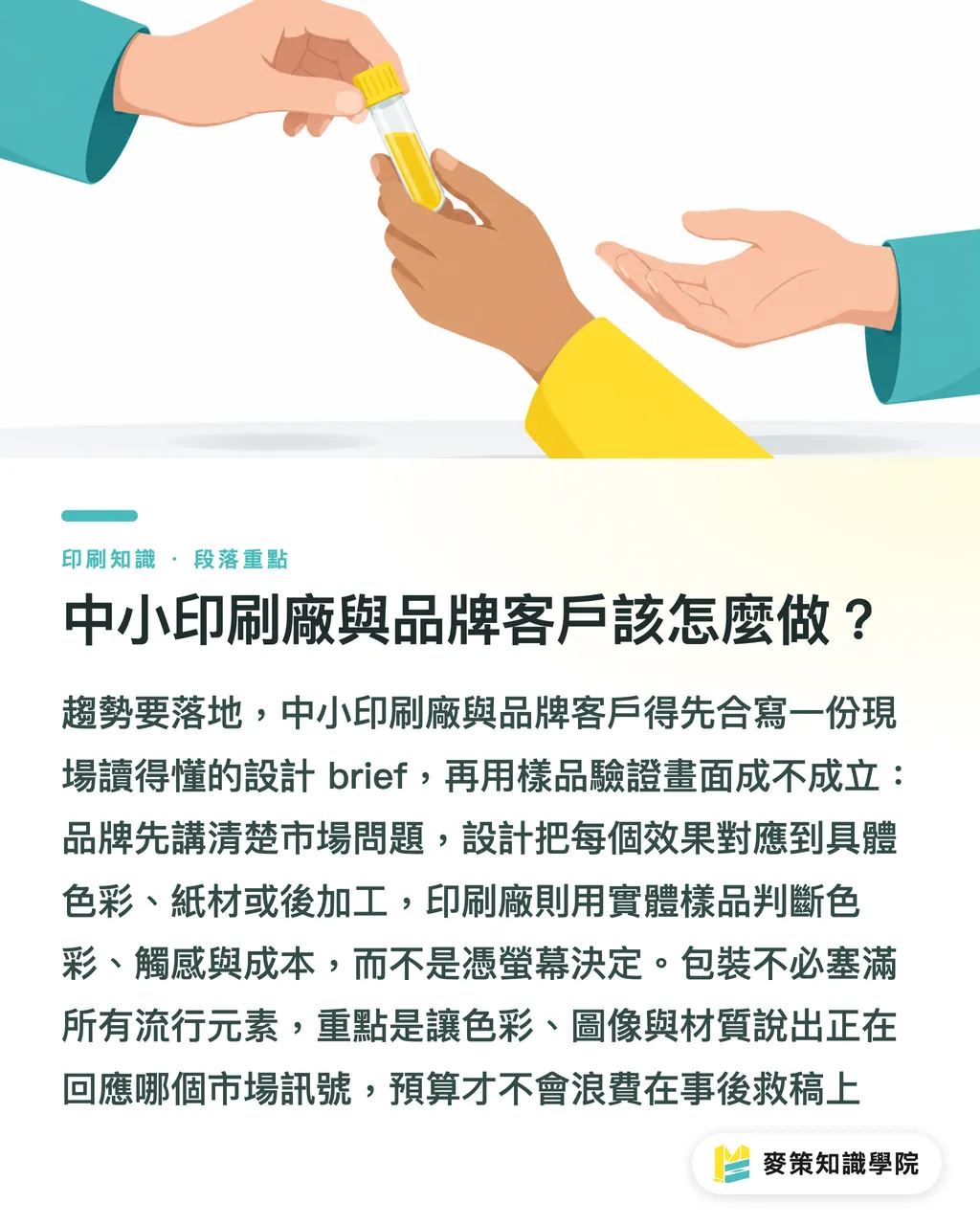
Small and midsize printers and brand clients can turn trends into commercial value by first completing a design brief the production team can actually understand, then using a physical sample to confirm that the visual really holds up
・The brand first brings the market question: Where will the package be seen, and what should customers notice first?
・The designer then delivers a production-ready solution: connect each major effect to a color, paper stock, or finishing choice, and mark what cannot be compromised
・The printer returns to the finished piece: use a sample to check color, feel, structure, and cost, rather than making the decision from the screen
These three steps pull trends off the inspiration board and back into the product itself. If the team is still sorting out its brand direction, it can ask the Mai Strategy Knowledge Academy consulting team to clarify the design language and printing conditions first. Once the requirements are clear, move on to proofing and compare quotes
My view is practical: packaging does not need to cram in every fashionable element, but it does need to say which market signal its colors, imagery, and materials are responding to. Then the budget is spent where people can see it, rather than on fixing the artwork after the fact
Key Takeaways
・Make the market signal clear before sign-off so the trend has a chance to become a print specification
・A package's commercial value comes from the visual being understood and from the finished piece delivering on its promise
・MINDS (MS)'s three checkpoints before sending a job to press bring the market, process, and documents into the same prepress conversation
・Creative flow needs to be built into the workflow because high-quality files depend on continuous judgment
Further Thoughts
Printers can put market signals into the questions they ask before accepting a job, so sales, design, and prepress all work from the same brief. When the design team uses AI (artificial intelligence) to generate visual directions, it should first write the audience, brand voice, and mass-production constraints down as conditions, then have a person confirm the copy, colors, materials, and structure. If SaaS (software delivered online through a subscription) is going to be useful in a print project, it should retain version history, proofing results, and the reasons for revisions so the team can trace the decision trail. For the next step, take an existing packaging project, list the market signals it needs to answer, write the corresponding print conditions beside them, and schedule a joint sample review. That gets closer to commercial value than saving another batch of trendy images
Further Reading
FAQ
- Does keeping up with packaging trends guarantee better sales?
- Not necessarily. Trends can help a brand align with market expectations, but the commercial value still depends on color, materials, finishing, and a file ready for mass production to deliver on the visual promise
- Should a printer wait until the design is finalized before getting involved?
- Not recommended. The earlier a printer knows the packaging's market direction and material goals, the sooner it can flag process constraints during prepress, reducing rework when an effect turns out to be impossible after sign-off
- How can someone without a design background tell whether a packaging trend is usable?
- Start by asking whether it fits what the brand needs to say. Then ask the printer to break the colors, paper stock, and finishing down into conditions that can be proofed. A physical sample is more reliable than a screen alone
- Can packaging visuals generated by AI go straight to press?
- You cannot assume so. AI-generated artwork still needs checks for copy, resolution, color, and structure. In the end, the designer and printer must confirm that it can be produced at scale
Related articles


The Print × AI weekly
The print and AI know-how designers, brands and enterprises can use before they commit — one email, every week
MINDS Free Tools
Spine width and imposition calculators — skip the manual math, free in your browser.
MINDS Group
Need actual printing or gifting services?
From premium printing to online ordering and festive gifts — the MINDS Group sister brands take it from here.