
Overview
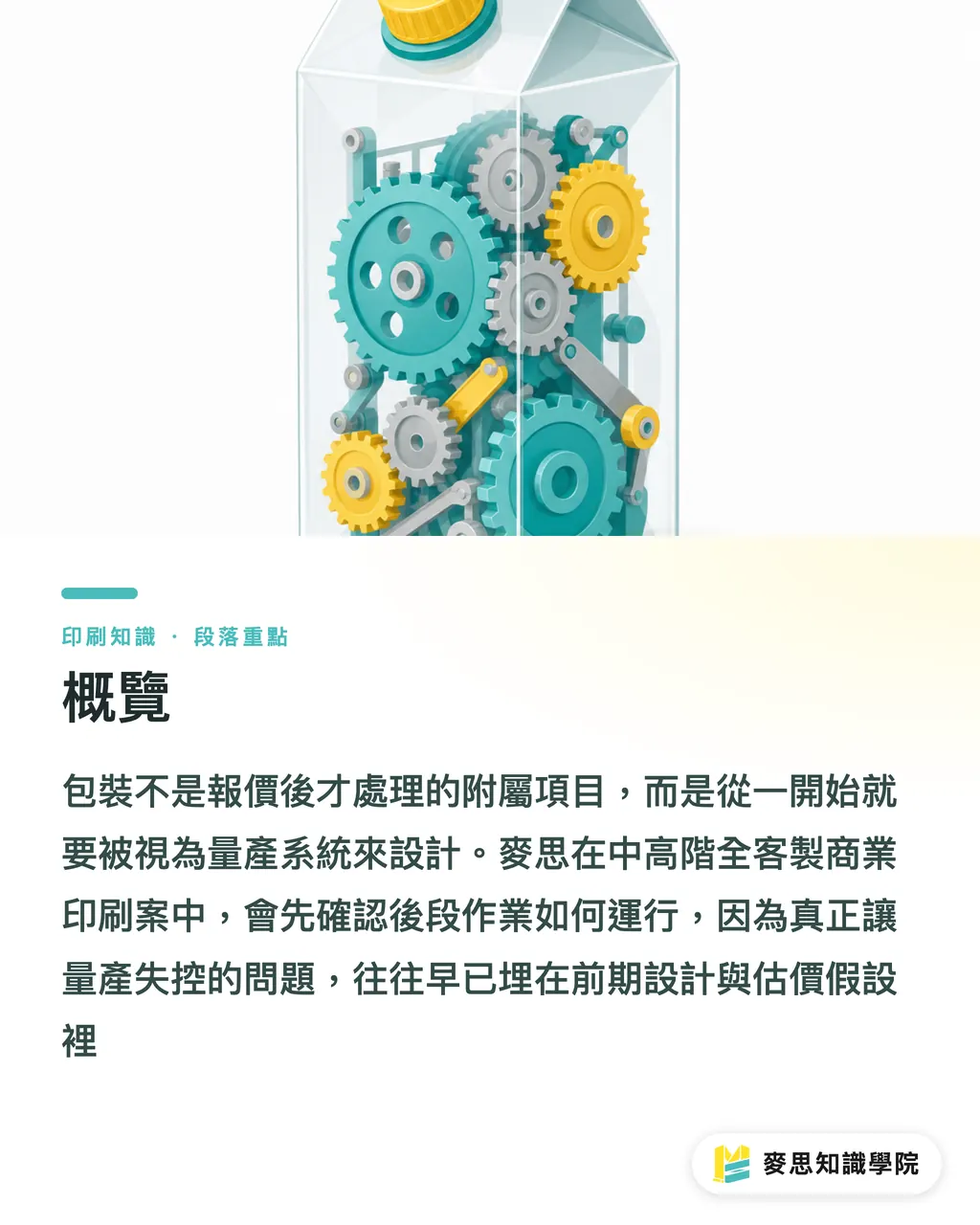
Packaging should be treated as a production system before a quote is made. For mid- to high-end fully custom commercial printing jobs, MINDS (MS) first asks how downstream operations will run, because the problems that blow up at the end of mass production often have their roots in early design and estimating assumptions
Why Can’t Packaging Wait Until Post-Press?
In PackPod Episode 4: Packaging as a System, Packaging as a System is discussed in the context of automation. The reminder is practical: packaging design determines whether downstream equipment can run smoothly, and whether manual fixes become part of everyday work
A standard definition of Packaging as a System: treating packaging as one continuous engineering process from design to logistics, so every decision can be mapped to equipment, labor, and schedule risk
If a print shop leaves packaging discussions until post-press, one thing gets missed in the quote: the box has to pass through a chain of downstream actions on a real production line. This PackPod episode puts that issue in a spot automation talks often overlook. I agree with that framing, because the more automated the downstream process gets, the less vague the front end can afford to be
Which 6 Downstream Actions Should a Packaging System Check?
I break downstream work into 6 actions. These 6 are more useful than simply saying something can be automated, because each one can change the dieline, substrate, coating, and schedule
・Forming: the box structure has to open and hold shape consistently. Crease lines, glue flaps, and opening direction need to match the equipment rhythm
・Filling: the direction the product enters the box, the clearance, and the insert need to be settled early. The tolerance for hand placement and machine pushing is completely different
・Labeling: the labeling surface must be flat and have room for positioning. Surface treatment cannot cause labels to lift after temperature changes or friction
・Scanning: QR code, barcode, or NFC placement must avoid crease lines, reflective surfaces, and areas likely to be blocked by fingers
・Stacking: a single nice-looking box is not enough. It will take pressure after carton packing, and pallet orientation can also change the deformation risk
・Logistics: outer carton size, units per carton, and retail display method can all work backward into the inner box dimensions and material choices
Here is a rough, very real industry edge: a box that looks perfectly smooth on the sample table may start causing trouble after one or two hundred units, because paper moisture uptake, glue-line rebound, or a slight labeling offset all get amplified by equipment
How Should Automation Be Counted Before Quoting?
The quote needs one more field: downstream conditions
MINDS (MS) uses three packaging system checkpoints that can be put directly into the estimating process. They are especially useful for new product launches, event packaging, and jobs that need scan-based tracking
・① Ask about the use scenario before quoting: first confirm whether the packaging is mainly for e-commerce, retail stores, exhibitions, or warehousing. Different pressure sources lead to different material and structure choices
・② Check downstream conditions before final artwork: forming method, filling method, label position, scanning distance, and units per outer carton should be written into the work order
・③ Hand off mass production after proofing: sample approval should check color, but it should also record crease rebound, stacking pressure, and points where manual fixes may be needed
If the client already knows downstream work will use semi-automatic labeling, it is far easier for MINDS to step in before quoting than to patch things after final artwork. In mid- to high-end fully custom commercial printing, unclear process order is one of the biggest risks. One extra coating, one added window, or one foil-stamped area can all change labeling and scanning results
Which Habits Can Small and Midsize Print Shops in Taiwan Change First?
The clearest change I have felt on the client side over the past month or two is that packaging issues are moving upstream. Brand clients now bring up material compliance, sustainability claims, recyclable design, food hygiene, and automation equipment before the post-press meeting
・Add 1 field to the estimate: downstream operations. At minimum, write down who is responsible for filling, labeling, scanning, and stacking
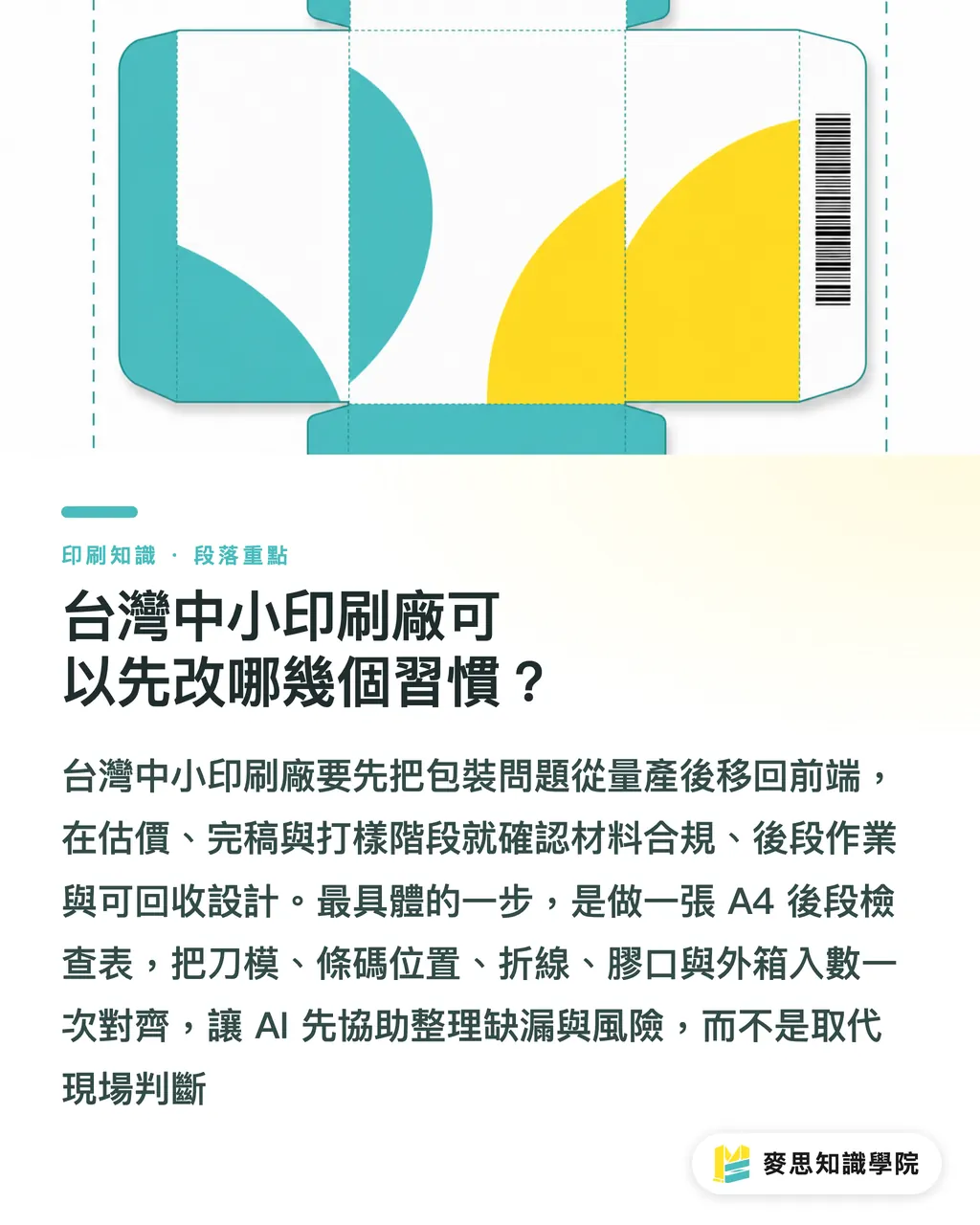
・Add 1 A4 sheet to the final artwork check: confirm the dieline, barcode position, crease lines, glue flap, and units per outer carton on the same page
・Leave 30 minutes in the proofing meeting: get the designer, buyer, print shop, and downstream operator in the same room. Do not wait until mass production and chase answers by phone
・Add 3 records to the SaaS or work order system: version, downstream conditions, and abnormality cause. That is how the next revision knows where the problem came from
AI adoption should start here too: first let AI help organize specification questionnaires, compare missing work order fields, and flag risk fields. Do not hand structural judgment to the tool from day one. Print-floor experience has to enter the system before the system becomes useful to the floor
If a brand client is preparing packaging for a new product, the consulting team at Mai Strategy Knowledge Academy can first help organize this 1-page A4 downstream checklist, then clarify the conditions that can be handed to MINDS for estimating
Key Takeaways
・Packaging failures often start before the quote. The later the fix, the more likely it turns into manual work and schedule pressure
・A dieline has to answer the 6 downstream actions. If it cannot, mass production will make the front end retake the exam
・Automation starts with clear conditions. Equipment purchases come later
・Small and midsize print shops need to write downstream conditions into the work order, not leave them only in the heads of salespeople or pressroom veterans
Further Thinking
On the print manufacturing side, start by changing estimate and work order fields. On the design side, put scanning position, opening direction, and channel context into the final artwork check. AI adoption can begin with specification organization and risk reminders. SaaS should connect quoting, final artwork, proofing, post-processing, and logistics into traceable records. When MINDS handles mid- to high-end fully custom jobs, I want clients to state the new product launch rhythm, channel display method, and downstream packaging method earlier, because these 3 things often decide schedule risk before the pretty rendering does
Further Reading
FAQ
- What is Packaging as a System?
- Packaging as a System means treating packaging as one continuous engineering process from design to logistics. Before quoting, downstream equipment, labor, scanning, stacking, and schedule risks all need to be checked
- Why should small and midsize print shops ask about downstream operations before quoting?
- Asking about downstream operations before quoting helps identify forming, filling, labeling, and logistics conditions early, instead of relying on manual fixes after mass production starts. Packaging automation also has a better chance of running steadily
- What should designers pay extra attention to when handing off final packaging artwork?
- Designers need to review the dieline, crease lines, glue flaps, scanning position, and surface treatment together, because these details affect whether equipment can form, label, and read codes consistently
- What can AI or SaaS do in packaging system design?
- AI and SaaS are best used first for specification organization, missing work order reminders, and version tracking. Structural judgment still has to come back to the product, material, and downstream equipment conditions
Related articles

The Print × AI weekly
The print and AI know-how designers, brands and enterprises can use before they commit — one email, every week
MINDS Free Tools
AI background removal, brand stamping, and a LINE sticker maker — free design tools, right in your browser, no upload.
MINDS Group
Need actual printing or gifting services?
From premium printing to online ordering and festive gifts — the MINDS Group sister brands take it from here.