
Why is the industry in urgent need of "light and stiff" paper?
Why the industry is searching for "light and stiff" paper
Based on my long-term observation of production lines and clients, the biggest headache for everyone in the last two years has been raw materials
Especially wood pulp. Production capacity in North America began to shrink last year, and by 2025, containerboard production alone had dropped by more than 5%, transmitting supply pressure right through to the customer's costs
Brand clients haven't been idle, either. Under ESG pressure, they are in turn demanding reduced material in packaging, the use of lighter paper, and ideally, sustainability certifications
This puts printing plants in a dilemma:
・Traditionally, for exquisite printing, you need high-weight paper with a smooth surface for stable ink performance
・But to achieve bulk and a solid feel, you usually have to sacrifice smoothness, causing printing resolution to drop
In the past, to make lightweight paper smooth, you had to apply pressure during the calendering process, which resulted in crushed fibers and the sacrifice of precious volume and stiffness
This is why Voith's new technology is worthy of close attention from everyone in the industry, it is attempting to solve this fundamental contradiction
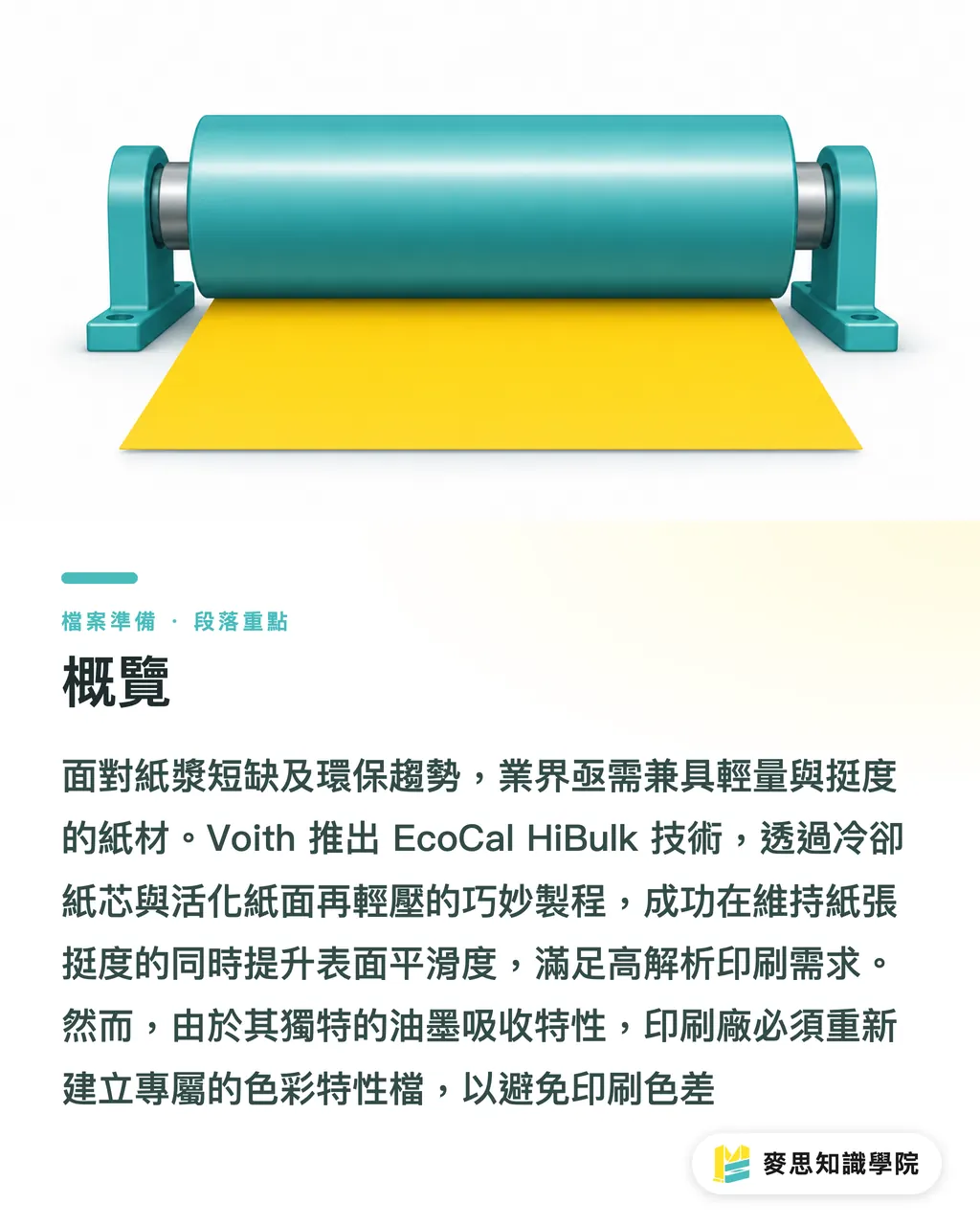
How does Voith EcoCal HiBulk achieve the best of both worlds?
How does Voith EcoCal HiBulk achieve the best of both worlds?
Rather than calling it a brand-new invention, I prefer to view it as a "smart process integration."
Voith has combined three of its mature technologies to change the rules of calendering. The core concept is "not flattening with brute force, but using finesse to make the surface behave."
The process works like this:
・Step 1: MCB Cooler (paper core cooling): Use cold air to cool the core of the entire paper sheet first, making the fiber structure stronger and less prone to deformation
・Step 2: OnQ ModuleCal (paper surface activation): Just before entering the rollers, use steam to precisely heat and moisten the "surface" of the paper, making the surface fibers soft and easier to shape
・Step 3: Light pressure setting: Finally, passing through high-temperature rollers, because only the surface is soft, lower pressure is required to flatten the surface, while the strong core remains completely unaffected, preserving stiffness and thickness
According to mass production tests by Voith at a leading European paper mill, this method indeed improves surface smoothness significantly while maintaining or even increasing stiffness and volume, reaching the level required for high-resolution printing
What challenges will printing plants face when using this new paper, and why does color management need to be reset?
What challenges will printing plants face immediately, and why does color management need to be reset?
When sales bring in quotes for this new type of "high-bulk, lightweight paper," procurement or factory managers must absolutely not just look at the data and treat it like regular coated or uncoated paper
I can almost guarantee that if you apply the existing ICC Profiles from your database directly, the colors printed will be significantly different from what is on the screen
The reason is simple:
・Uncontrolled Dot Gain: After ink is printed on paper, it spreads due to fiber absorption. This degree of "dot gain" is directly related to the physical characteristics of the paper surface; EcoCal HiBulk changes this crucial variable
・Changes in Color Saturation: Different surface structures result in different luster after ink dries, and different ways light is reflected, directly affecting the color saturation perceived by the naked eye
If prepress hasn't established a dedicated ICC Profile for this new paper material and simulated its color behavior during the proofing stage, discovering color deviations only after it hits the press is a catastrophe
At best, it brings client complaints; at worst, it requires reprinting the entire batch. The lost costs and reputation are far higher than the little bit of money saved on testing
How should small and medium-sized printing plants and designers respond to the challenges of new paper materials?
How should small and medium-sized printing plants and designers respond?
When faced with new materials, my advice is always: "Test first, then commit."
For printing plants:
・Build awareness: Educate procurement and sales. When they see keywords like "lightweight," "high-bulk," or "sustainable," they need to ask one more question about the paper's manufacturing process and characteristics
・Invest in processes: Don't skimp on testing costs. Treat the establishment of ICC Profiles for new paper materials as a Standard Operating Procedure (SOP). This is the best investment for improving quality and building professional barriers to entry
・Proactive communication: Talk openly with your paper suppliers and brand clients. Let them know that to ensure color accuracy, you need time and resources to do prepress testing
For designers and brand procurement:
・Communicate early: When you are intrigued by a certain sustainable paper material, discuss it with the printing plant immediately. They may understand the "temperament" of that paper better than you do
・Manage expectations: Explain to your boss or client that using new materials is good, but it may require longer proofing times and a slightly larger budget to ensure the final product is perfect
・Request samples: Be sure to request digital proofs or actual printed proofs "on the target paper." Use your own eyes and hands to confirm the texture and color
This whole process is actually the core spirit of the "one-stop integrated service" that MINDS Printing has always done. We don't just look at the design files; we consider backend material science, color management, and processing workflows entirely, eliminating all foreseeable risks right at the beginning of the project
Key Takeaways
・Voith's new technology allows lightweight paper to have a detailed printing surface without sacrificing stiffness
・Sustainability and cost are the main drivers; this type of high-bulk, lightweight paper will only become more common in the future
・Applying old ICC Profiles directly will lead to severe color deviation; it is essential to re-proof and calibrate colors for the new paper material
・Designers and printing plants need closer communication to test new materials early in the project
Further Reflections
This is not just a technology announcement from a single equipment vendor; it is an important industry bellwether: Material science is seeking solutions for the long-standing contradiction between "sustainability" and "quality."
For printing plants, future competitiveness will no longer just be about who has newer machines or lower prices, but about who has a deeper understanding of materials and better mastery of processes. The key is whether you can convert upstream material innovation into stable, high-quality products in the hands of customers
For designers and brands, this represents a whole new space for creation, allowing the use of more environmentally friendly materials to produce equally exquisite, or even better-textured designs. However, this also relies on your close cooperation with a printing partner that understands material science and is willing to put sufficient effort into prepress. Otherwise, even the best creative ideas may fail at the last mile
Further Reading
FAQ
- What is calendering?
- It is one of the key processes in papermaking, using rollers to press the paper surface to be smoother for subsequent printing, but traditional processes often sacrifice the paper's thickness and stiffness
- Why is color management for lightweight paper particularly difficult?
- Because the fiber structure and surface roughness of lightweight paper directly affect how ink is absorbed and how light is reflected, leading to "dot gain" and color saturation differences compared to standard paper. EcoCal HiBulk changes the physical properties of the paper surface, so old ICC Profiles will be completely ineffective
- I am a designer, what should I pay attention to when using this new paper material?
- Communicate actively with the printing plant at the beginning of the design process, and be sure to request actual proofs made using this new paper material. Before signing off on proofs, do not rely solely on screens or universal color swatches to imagine the final color, as that is extremely dangerous
References
- EcoCal HiBulk - a new calendering solution from Voith · thepackagingportal.com
Related articles

The Print × AI weekly
The print and AI know-how designers, brands and enterprises can use before they commit — one email, every week
Tool Library
RGB↔CMYK conversion, ΔE color difference and brand color print analysis — free color management tools, computed right in your browser.
MINDS Group
Need actual printing or gifting services?
From premium printing to online ordering and festive gifts — the MINDS Group sister brands take it from here.