
Why do my designs look different when printed on recycled paper?
In recent meetings with clients, discussions around ESG and sustainable packaging have heated up significantly. Many brands want to switch to recycled paper to convey their environmental commitment. While this is certainly a positive move, I often receive desperate calls from designers who find that the printed colors look vastly different from what they see on screen, resulting in a lackluster final product
This isn't actually a problem with the paper itself, but rather a lack of understanding of its characteristics. Recycled paper and virgin fiber paper are fundamentally different materials. You must tailor your design specifically for it to truly bring out its charm
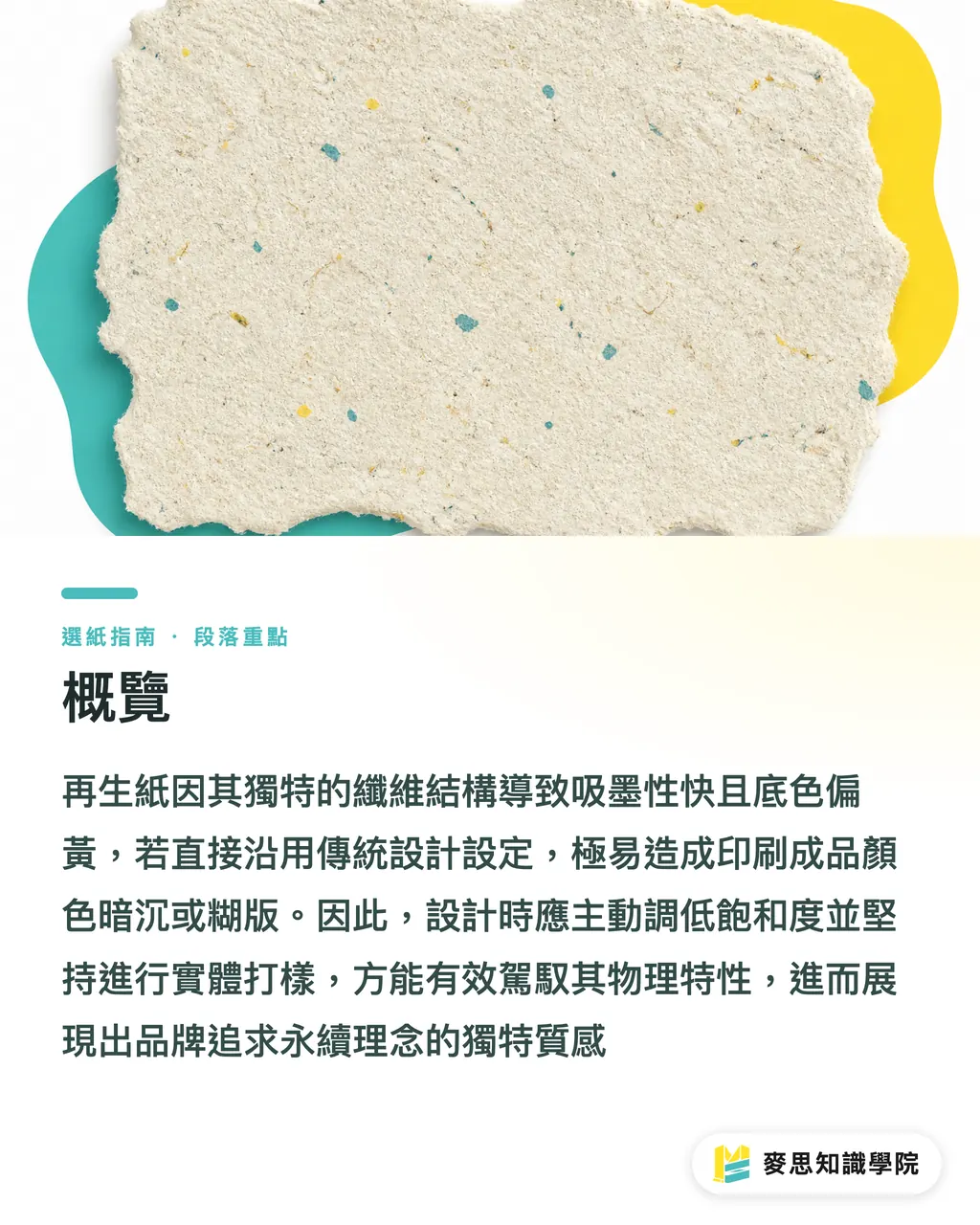
How does the physical nature of recycled paper differ from standard paper?
What exactly is the difference between recycled paper and regular paper?
Simply put, recycled paper contains a certain percentage of recycled fibers. These may come from paper trimmings left over from factory cutting (pre-consumer recycled), or from old newspapers and cardboard collected from the public (post-consumer recycled)
This gives it several key physical differences from virgin paper made from entirely new wood pulp:
・Rougher surface: After being recycled and reprocessed, the fibers are shorter and more brittle, resulting in larger pores on the paper's surface and a less smooth feel
・Yellowish-gray base color: Unlike the brilliant white of virgin paper, the base color of recycled paper has a natural yellowish-gray tint, an inevitable result of mixed fibers
・Faster ink absorption: Due to the high surface porosity, ink is absorbed very quickly once it hits the paper. This is the single most critical factor affecting color performance
Think of it like comparing whole wheat flour to refined white flour: you can't use the same recipe and expect the exact same texture of bread. You have to adapt to the characteristics of the material
How can I adjust my designs to make colors on recycled paper more cooperative?
How to master color performance on recycled paper
Since recycled paper has a yellowish base and absorbs ink quickly, applying a design file intended for standard coated paper will almost certainly make colors appear dark or muddy, especially for large areas of deep colors, which can easily become mottled or blurry due to uneven ink absorption
To make colors behave on recycled paper, you need to make adjustments during the design phase:
・Actively reduce saturation: In your design software, proactively lower the saturation of your fills, especially for warm tones, to leave some 'room' for the paper's yellowish base to 'neutralize' the color
・Avoid large solid dark areas: If your design features large areas of dark backgrounds, they will easily appear dirty or muddy on recycled paper. I recommend using more negative space, lighter colors, or using lines and patterns to achieve the look instead, the quality will be much better
・Always do a physical proof: This is the most critical step. The RGB on your screen and the CMYK on recycled paper are completely different things. You must ask your printing house for a physical proof and fine-tune the colors while looking at the actual paper and ink until you are satisfied
If a brand is truly focused on color performance but still wants to balance it with sustainability, I usually recommend 'Coated Recycled Paper.' These papers usually contain 30% to 50% recycled fiber but are treated with a coating on the surface, making their color reproduction closer to traditional coated paper. It's a great compromise
Which products are best suited for using recycled paper to convey brand philosophy?
Which products benefit most from recycled paper
Recycled paper is not a universal fix. It is best suited for items where the brand wants to communicate themes of 'sustainability, nature, and rustic character.' In these contexts, its yellowish base and rustic feel actually become advantages
Here are the applications I find to be highly suitable:
・Business cards and envelopes: Convey the brand's care for the environment and allow people to feel the 'warmth' from the very first impression
・Event flyers and catalogs: Suitable for art exhibitions, organic produce, or corporate image brochures that prioritize social responsibility
・Shopping bags and packaging: When a consumer carries your recycled paper bag, the bag itself becomes a mobile sustainability advertisement
Conversely, if your product is a high-chroma, delicate photography book or jewelry catalog that requires extreme precision in capturing photo details and luster, I will honestly still recommend choosing high-quality virgin coated paper. The results will be more stable and desirable
Selecting paper is never about 'which is best,' but 'which is most suitable.' When used in the right place, recycled paper is a powerful tool to enhance brand image; when used in the wrong place, it can become a disaster
Key Takeaways
・Recycled paper is not a low-grade product; it is a material with different characteristics. You must consider its ink absorption and yellowish base before designing
・To control color, you must actively lower saturation at the design stage, avoid large dark solid areas, and insist on producing a physical proof
・Coated recycled paper is a smart choice for balancing environmental friendliness with color performance, with a recycled fiber content of about 30-50%
・The purpose of selecting recycled paper is to convey a sustainable brand tone, not to pursue ultimate color reproduction
・For high-end photography books or items requiring extreme color detail, it is still recommended to prioritize virgin coated paper
Further Reflections
For designers, this means the workflow cannot just stay in front of a screen. You must communicate with the printing house earlier, touch paper samples in person, check proofs with your own eyes, and think about the characteristics of the paper as part of the design process itself, this is what true professionalism is
For brand owners and purchasers, choosing sustainable materials is only the first step. More importantly, it is about 'using it correctly.' A thoughtful design that perfectly integrates the characteristics of recycled paper is far more moving to an audience than just printing an eco-label in a corner. This also echoes the spirit behind certifications like FSC: sustainability is not just a label, but a complete execution philosophy
At MINDS, we are not just a printing service; we hope to be your consultants, assisting you in finding the most suitable balance between budget, design aesthetics, and sustainable value, ensuring every print run becomes an effective piece of brand communication
FAQ
- Colors come out dull when printed on recycled paper, what should I do?
- Advise the designer to proactively lower color saturation in the file, avoid large dark solid areas, and be sure to ask the printing house to provide a physical proof for color correction on the actual paper. Do not rely solely on the screen
- Is recycled paper suitable for all printed materials?
- Not entirely. Recycled paper is well-suited for business cards, flyers, or packaging that emphasizes sustainability and natural texture. However, if your product is a delicate photo book or art reproduction that requires high color reproduction, traditional high-quality coated paper remains a safer, more reliable choice
- Coated recycled paper doesn't sound very environmentally friendly?
- It is a solution that strikes a balance between environmental friendliness and color performance. It typically uses 30% to 50% recycled fiber with an added coating to improve print quality. Compared to 100% virgin fiber paper, it remains a more environmentally friendly choice
Related articles




The Print × AI weekly
The print and AI know-how designers, brands and enterprises can use before they commit — one email, every week
MINDS Free Tools
AI background removal, a LINE sticker maker, spine & imposition calculators — all free, right in your browser, no upload.
MINDS Group
Need actual printing or gifting services?
From premium printing to online ordering and festive gifts — the MINDS Group sister brands take it from here.