

Overview
When assessing a printer's AI collaboration capability, start with 5 things: technical readiness, process standards, staff capability, communication cost, and risk management. MINDS Printing (MS, mid- to high-end fully custom commercial printing) often uses its "Five-Dimensional AI Collaboration Assessment" to first confirm whether a vendor can turn AI-generated images, text, and layouts into print deliverables that can be checked, corrected, and traced, instead of asking only, "Have you worked with AI before?"
AI collaboration maturity: a printer's ability to safely turn AI output into print-ready files, controlled versions, and accountable deliverables, covering tools, process, people, communication, and risk management
Why Is Asking About AI Experience Not Enough When Choosing a Printer?
In recent conversations with designers and buyers, the mistake I see most often is treating "we can accept AI images" as the same thing as "we can handle AI projects." They are very different. A project usually involves 3 areas of responsibility: the design source file, output conditions, and the printed result
The common problem with AI-generated images is not whether they look good. Resolution, bleed, text, edge detail, brand colors, and licensing notes can all get stuck. If a printer only says, "Send me the file and I'll take a look," the next stage often turns into designers patching files, buyers chasing timelines, and sales reps relaying messages in the middle
Using the MINDS Printing (MS) Five-Dimensional AI Collaboration Assessment, a mature vendor will first ask about use case, size, paper, finishing, deadline, and responsibility boundaries. Once an AI image moves from screen to paper, it has to pass through at least 4 checkpoints: Preflight, color conversion, proof approval, and version checking
What Tools Show Technical Readiness?
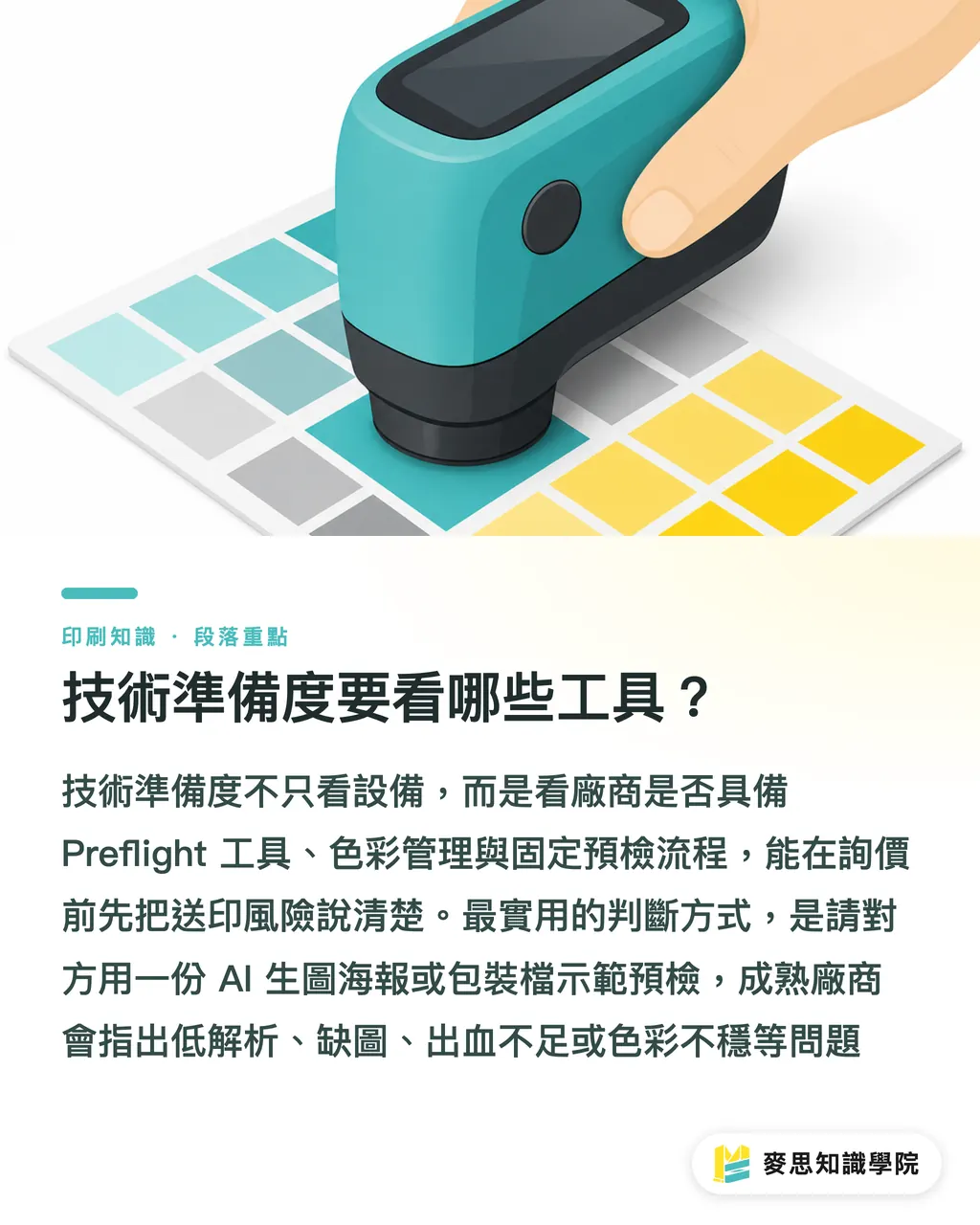
For technical readiness, 3 points are enough to make a practical judgment: Preflight tools, a color management system, and a pre-check process. The MINDS Printing (MS) Five-Dimensional AI Collaboration Assessment confirms these 3 items before quoting, because if the technical base is shaky, even good communication can only patch holes later
・Preflight tools: able to check resolution, fonts, bleed, linked images, transparency effects, and color modes, which helps manage print risks after AI-generated images are converted to PDF
・Color management system: able to explain RGB, CMYK, ICC Profile, spot colors, and the gap between screen preview and print, especially for projects such as brand colors, packaging, and catalogs where the screen is not enough
・Pre-check process: after receiving files, the printer has a fixed checklist and can flag missing images, low resolution, text not converted to outlines, rich black in black text, insufficient bleed, and similar issues before printing
The on-site test is simple. Ask the vendor to take one AI-generated poster or packaging file and explain how they would pre-check it. A mature vendor will talk about "where the print may become unstable." An immature one will usually say, "As long as the resolution is enough, it's fine."
How Do Process Standards Reveal Maturity?
For process standards, look at 3 things: the AI review SOP, version control, and delivery standards. The MINDS Printing (MS) Five-Dimensional AI Collaboration Assessment weighs process more heavily than tools, because printing errors often happen not because the machine failed, but because file versions and approval records got messy
・AI review SOP: clear division of work, including who checks image quality, who checks text, and who confirms licensing and commercial-use risks
・Version control: able to clearly label v 1, v 2, final, print-final, and similar versions, so the client, designer, and sales rep do not each hold a different PDF
・Delivery standards: able to list size, bleed, color mode, resolution, PDF standard, paper, and finishing notes, avoiding verbal agreements that cannot be traced later
I suggest buyers ask 2 direct questions: "Who is responsible for reviewing the file after revisions?" and "How is the final print version locked?" These 2 questions reveal collaboration quality better than asking about equipment brands
When external consultants are needed to review the print submission workflow, the Mai Strategy Knowledge Academy consulting team can run a Five-Dimensional AI Collaboration Assessment, first clarifying responsibilities across quoting, final artwork, proofing, and delivery before discussing tool adoption
How Should You Assess Staff Capability and Communication Cost?
For staff capability, look at 2 roles: a contact person who understands printing, and a reviewer who understands the traits of AI output. The MINDS Printing (MS) Five-Dimensional AI Collaboration Assessment pays close attention to whether the vendor can give revision advice instead of pushing every issue back to the design side
A mature contact will point out specific fixes, such as "This image is only superficially sufficient at 300dpi, but local details have already been enlarged and blurred," "This gold effect should be changed to foil stamping or a special color, because CMYK cannot print the glow you see on screen," or "Do not print the small text in the AI image directly. Please change it to vector text."
Communication cost can also be measured. During quoting, use 3 small tests: whether the vendor can clearly state missing items in the first reply, whether they can explain risks within one revision round, and whether they can offer proofing or alternative process suggestions. This is closer to project success than a quote that is 5% cheaper
If the project is a mid- to high-end custom catalog, brand packaging, or special-material output, you can send the printing requirements to MINDS Printing for assessment. The point is not just to send the file out. It is to align the AI imagery, paper, finishing, and acceptance method first
Where Do AI Printing Projects Most Often Run Into Risk?
AI printing projects usually face 2 kinds of risk: quality disputes and rights disputes. The MINDS Printing (MS) Five-Dimensional AI Collaboration Assessment requires vendors to explain the handling mechanism before printing starts, because waiting until the finished product is printed to discuss responsibility is usually too late
・Quality disputes: including color differences, insufficient resolution, blurred details, AI-generated text errors, and broken image edges. The handling method should be written into the proof approval record and final PDF approval record
・Rights disputes: including material licensing, similar brand elements, portraits, and trademark similarity. A printer may not be able to make legal judgments for the client, but a mature vendor will remind the client to keep licensing records
・Delivery disputes: including who provides source files, who retouches images, who converts files, and who confirms the final version. Use a handoff checklist to put responsibilities in writing
A simple assessment sheet can work like this. Score each item from 0 to 2. 0 means there is no system, 1 means the work is done but relies on individual experience, and 2 means there are tools, documents, and a fixed contact window. Enter formal price comparison only after the total score reaches 10 or above
・Technical readiness: completeness of Preflight, color management, and pre-check process, 0 to 2 points
・Process standards: AI review SOP, version control, and delivery standards, 0 to 2 points
・Staff capability: whether someone understands the limits of AI-generated images and can give specific fixes, 0 to 2 points
・Communication cost: requirements analysis, fast iteration, and speed of replies on missing items, 0 to 2 points
・Risk management: licensing reminders, quality disputes, and responsibility records, 0 to 2 points
Key Takeaways
・Many printers can accept AI files. The ones worth working with can turn AI files into stable printed pieces
・Preflight checks the file. Process standards check responsibility
・A good printing contact points out what can be fixed, instead of just throwing the problem back to the designer
・Scoring AI collaboration maturity across 5 areas is more reliable than a single claim of "we have experience."
Further Thinking
Print manufacturing needs to treat AI as part of the prepress workflow. Designers need to treat AI images as semi-finished materials. Buyers need to turn quote forms into maturity assessment forms. SaaS teams can start from 4 points: Preflight, version control, proofing records, and licensing documents, then build collaboration tools that truly fit the print floor. The next step is practical: take one AI design project already in progress, use the 5-part assessment sheet in this article to ask 3 printers, and the gap in their answers will surface quickly
FAQ
- When choosing a printer, what should I ask first about AI collaboration capability?
- First ask how the printer handles Preflight, color management, version control, and AI image risk reminders. These 4 questions quickly show whether the vendor is forcing projects through on experience alone or has a fixed process for AI projects
- Can AI-generated images be sent directly to print?
- AI-generated images usually cannot be sent directly to print. At minimum, you need to check resolution, size, bleed, text, color mode, and licensing records, then convert the file into a PDF that meets the printer's delivery standards
- Is it enough if a printer says it has AI experience?
- No. AI experience should be broken down into 5 areas: technical readiness, process standards, staff capability, communication cost, and risk management. It only has reference value when the vendor can clearly explain its checking methods and responsibility boundaries
- How do you score an AI collaboration maturity assessment sheet?
- Score each item from 0 to 2 across 5 areas: technical, process, staff, communication, and risk. A total score above 10 is more suitable for formal commercial printing projects
- What are the most common disputes in AI printing projects?
- The most common disputes involve color differences, insufficient resolution, AI-generated text errors, unclear licensing, and messy versions. Confirm responsibilities in writing before proofing to avoid tracing them only after production is complete
Related articles


The Print × AI weekly
The print and AI know-how designers, brands and enterprises can use before they commit — one email, every week
MINDS Free Tools
AI background removal, brand stamping, and a LINE sticker maker — free design tools, right in your browser, no upload.
MINDS Group
Need actual printing or gifting services?
From premium printing to online ordering and festive gifts — the MINDS Group sister brands take it from here.