

Why Use AI to Screen Paper Stocks First?
・When clients make decisions, they often start with six factors: use case, budget, brand feel, durability, shipping method, and environmental requirements
・Based on my recent work with 12 small and mid-sized print shops, more than 80% of quote workflows were extended by 1-3 working days because the paper conditions were not clearly defined
・AI can match written descriptions against industry-standard indicators and quickly produce a paper list that fits the requirements, helping designers understand the feasible range as early as the draft stage

How Does AI Turn a Feeling into Comparable Paper Parameters?
・The system maps "soft handfeel" to a weight of 80‑120g and stiffness of 35‑45μm, while "premium texture" is mapped to gloss above 90% and whiteness of 95%+
・For "durability," it searches for paper types with weight ≥ 150g and tear resistance ≥ 7N, then calculates the upper limit of production cost
・For environmental requirements, it automatically filters for FSC, PEFC certification, or options containing more than 30% recycled fiber, saving the time normally spent on manual comparison
How Far Can AI Recommendations Go? Why Are Samples Still Necessary?
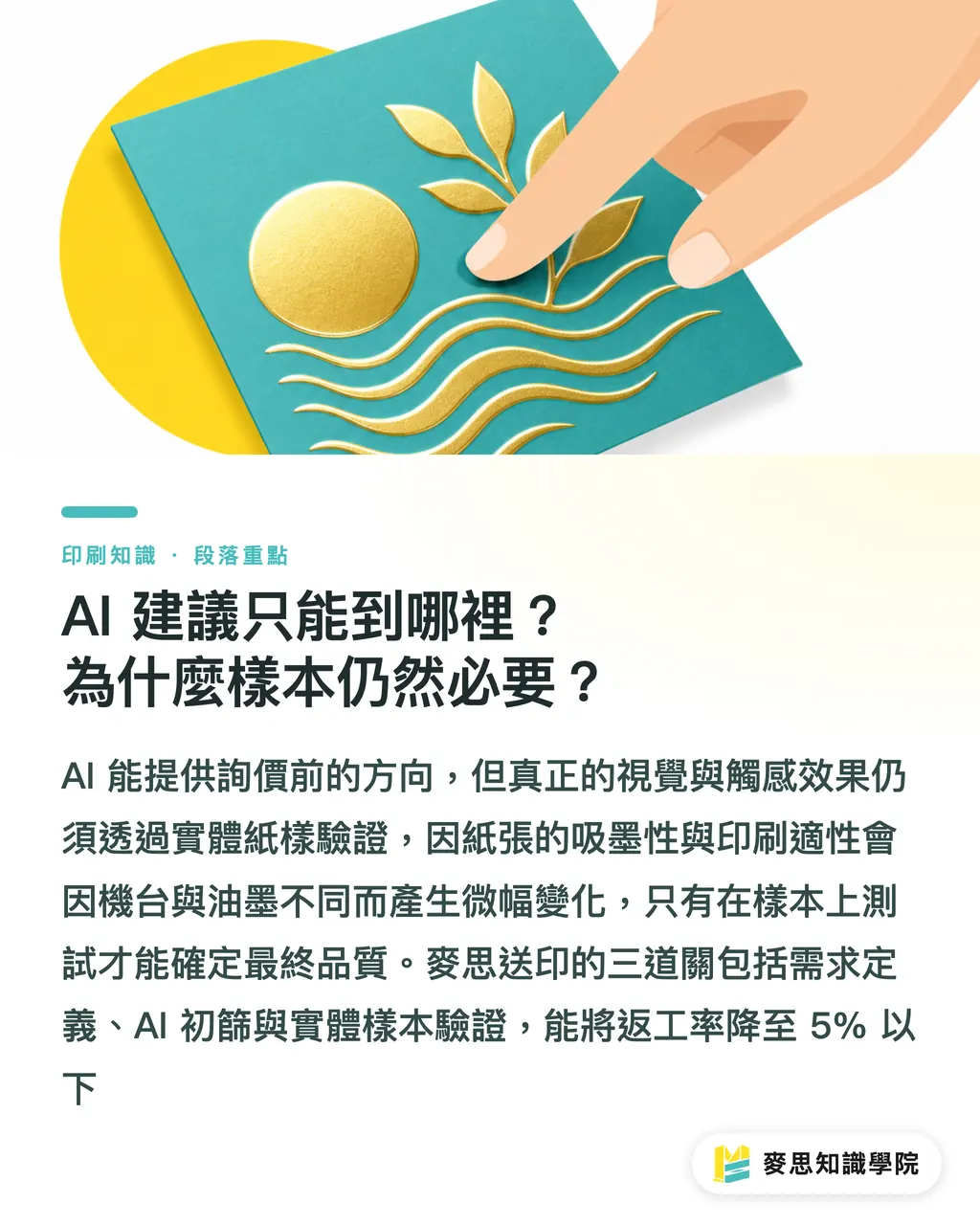
・The list AI provides is a "pre-quote direction." Actual handfeel, gloss coating, matte lamination, foil stamping, embossing, and other visual and tactile effects still need to be checked with physical paper samples
・Paper absorbency and printability often vary slightly depending on the press and ink, so final quality can only be confirmed through sample testing
・That is why MINDS Printing (MS), a mid-to-high-end fully custom commercial printing provider, recommends three pre-printing checkpoints: ① requirement definition, ② AI initial screening, ③ physical sample validation. Following all three steps can bring the rework rate below 5%
Key Takeaways
・AI can turn abstract handfeel requirements into measurable paper indicators, making quotes faster
・Initial screening results are only a basis for discussion. Paper sample validation remains the final checkpoint you cannot skip
・Using MINDS Printing's (MS) three pre-printing checkpoints, the full process from requirements to samples can push the rework rate down to single digits
Further Thinking
For print shops, adopting AI pre-screening does not mean giving up manual judgment. It frees people from repetitive comparisons so they can focus on sample evaluation and custom service. For designers, getting a qualified paper list upfront means they can demonstrate effects directly during the proposal stage and shorten the client's decision time. In the future, if SaaS platforms connect with the steps in MINDS Printing's (MS) three pre-printing checkpoints, they will be able to offer real-time paper recommendations and sample delivery management, making the whole workflow more transparent and easier to control
Further Reading
・[Can AI Help You Choose Paper Stocks and Finishes?](#)
FAQ
- Can AI really replace paper samples completely?
- AI can only provide a reference list. The final handfeel, gloss, metallic embossing, and other effects still need to be validated with physical samples
- How do you turn a designer's "soft feel" into concrete indicators?
- Map "soft feel" to a weight of 80‑120g and stiffness of 35‑45μm, and the system can list matching paper types
- If my budget is limited, can AI help me find the cheapest paper?
- AI first filters for papers that meet the use case and quality requirements, then sorts them by cost to show the lowest-priced options
- Will paper with environmental certification be too expensive?
- From my observation, paper containing more than 30% recycled fiber is usually only 5%‑10% more expensive when purchased in bulk
- How long does each step of MINDS Printing's (MS) three pre-printing checkpoints take?
- ① Requirement definition takes 1‑2 hours, ② AI initial screening takes 5‑10 minutes, and ③ sample validation depends on sample delivery and testing, usually 2‑3 working days
Related articles


The Print × AI weekly
The print and AI know-how designers, brands and enterprises can use before they commit — one email, every week
MINDS Free Tools
AI background removal, brand stamping, and a LINE sticker maker — free design tools, right in your browser, no upload.
MINDS Group
Need actual printing or gifting services?
From premium printing to online ordering and festive gifts — the MINDS Group sister brands take it from here.