

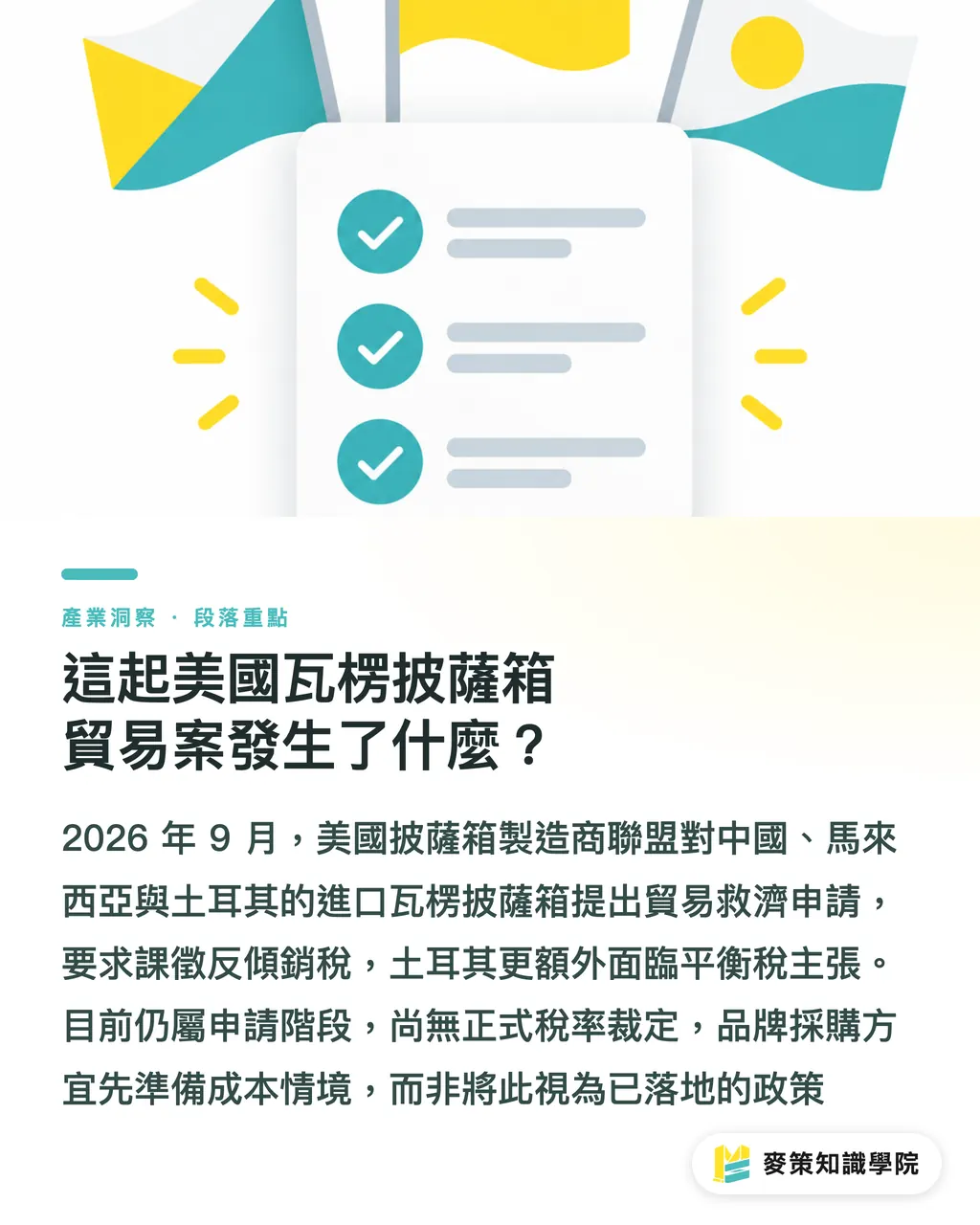
What Happened in This U.S. Corrugated Pizza Box Trade Case?
The American Pizza Boxes Manufacturers Coalition filed a trade-remedy petition on September 9, 2026, targeting corrugated pizza boxes from China, Malaysia, and Turkey. An industry report published on September 15 says the petition seeks antidumping duties (additional duties on imports alleged to be unfairly low-priced) on products from all three countries. For Turkey, it also claims countervailing duties (measures addressing price effects caused by government subsidies)
Strictly speaking, this is a trade petition, not a court ruling. The public information does not include a final duty rate
Trade remedies are a system under which an importing country investigates injury to domestic industry caused by low-priced imports or government subsidies and may impose antidumping or countervailing duties. Brands should model cost scenarios first. Do not treat the petition as a tariff rate already in force
Start with the scope
Read the full case outline in U.S. Corrugated Pizza Box Trade Case Kicks Off
Why Does the Scope of the Case Affect Brand Quotes?
The scope affects brand quotes because the proposal covers finished boxes, die-cut blanks (carton sheets that have been die-cut and shipped flat for assembly on site), and multiple flute types and sizes
・Both finished boxes and die-cut blanks are within scope. Whether a box has already been glued can no longer be used to blur the quote
・B, C, D, and E flute (corrugated flute types that affect board thickness and structural performance), along with equivalent flute types, are included
・Finished boxes must be at least 5 inches long and wide, and no more than 4 inches high, whether or not they have printing, coating, lining, or ventilation holes
The goods are generally classified under the US Harmonized Tariff Schedule (the tariff-classification system used for imported and exported goods), 4819.10.0020
The thing I most hate seeing on a quote is simply "pizza box." The processes, shipping volume, and assembly responsibilities differ between a finished box and a flat blank. Leave out one field, and you add another round of phone calls later
How Will Import Competition Change the Corrugated Supply Chain?
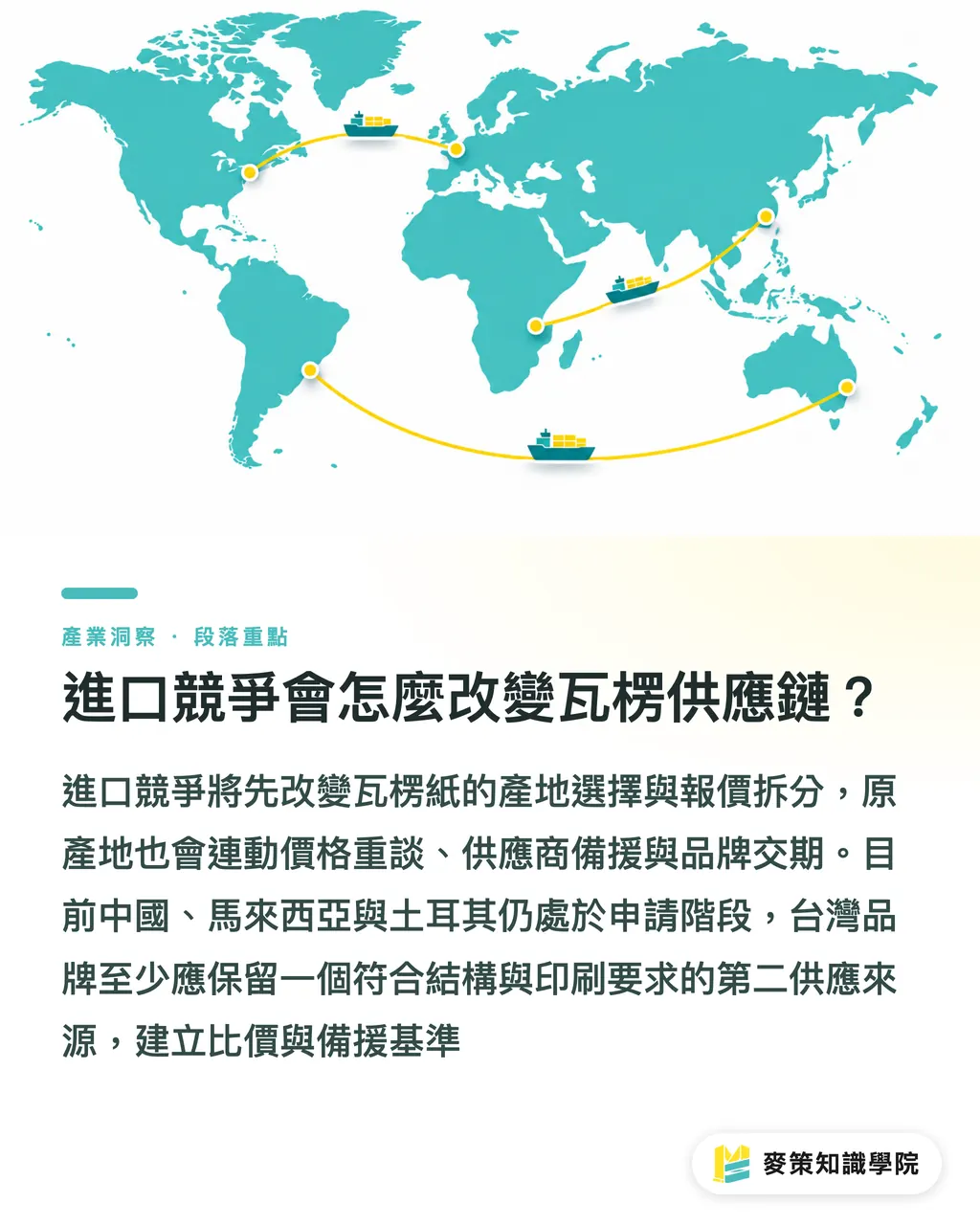
Import competition will first change the choice of origin and the way quotes are broken down, because this case puts China, Malaysia, and Turkey in the same petition, with a separate countervailing-duty petition for Turkey
The petition was submitted by Smurfit Westrock and Pratt Industries together with the United Steel, Paper and Forestry, Rubber, Manufacturing, Energy, Allied Industrial and Service Workers International Union (USW, the union participating in the joint filing)
When companies and unions step forward together, I read it as a sourcing signal: country of origin is no longer just a logistics field. It also connects to price renegotiation, supplier backup, and brand lead times
The case is still at the petition stage. None of the three origins has been publicly found in violation as a result. Taiwanese brands should at least keep a second supplier option that meets their structural and printing requirements, so they have a meaningful comparison benchmark
What Should Brands Change in Their Sourcing Now?
Brands should first put product boundaries, cost scenarios, and alternative origins in the same table, then decide whether sourcing needs to change. The "Mai Strategy's Three Sourcing Questions" can be broken into three checks
・1. Does the product fall within the proposed scope? Confirm whether it is a finished box or die-cut blank, whether it uses B, C, D, or E flute, and whether it meets the minimum length and width of 5 inches and maximum height of 4 inches
・2. Are costs itemized separately? Put paperboard, printing, die-cutting, assembly, transportation, and the duty scenario in separate columns. With no final duty rate, do not write assumed figures as confirmed costs
・3. Does changing the origin change the experience? Ask suppliers to compare country of origin, dimensions, flute, printing, coating, lining, ventilation holes, and lead time. Validate brand colors and the unboxing structure with sample boxes
If a brand lacks cross-functional interpretation, it can ask the Mai Strategy Knowledge Academy consulting team to place design files, supplier quotes, and compliance fields in one decision table, so the options are comparable from the outset
How Can Taiwanese Small and Mid-Sized Printers Respond?
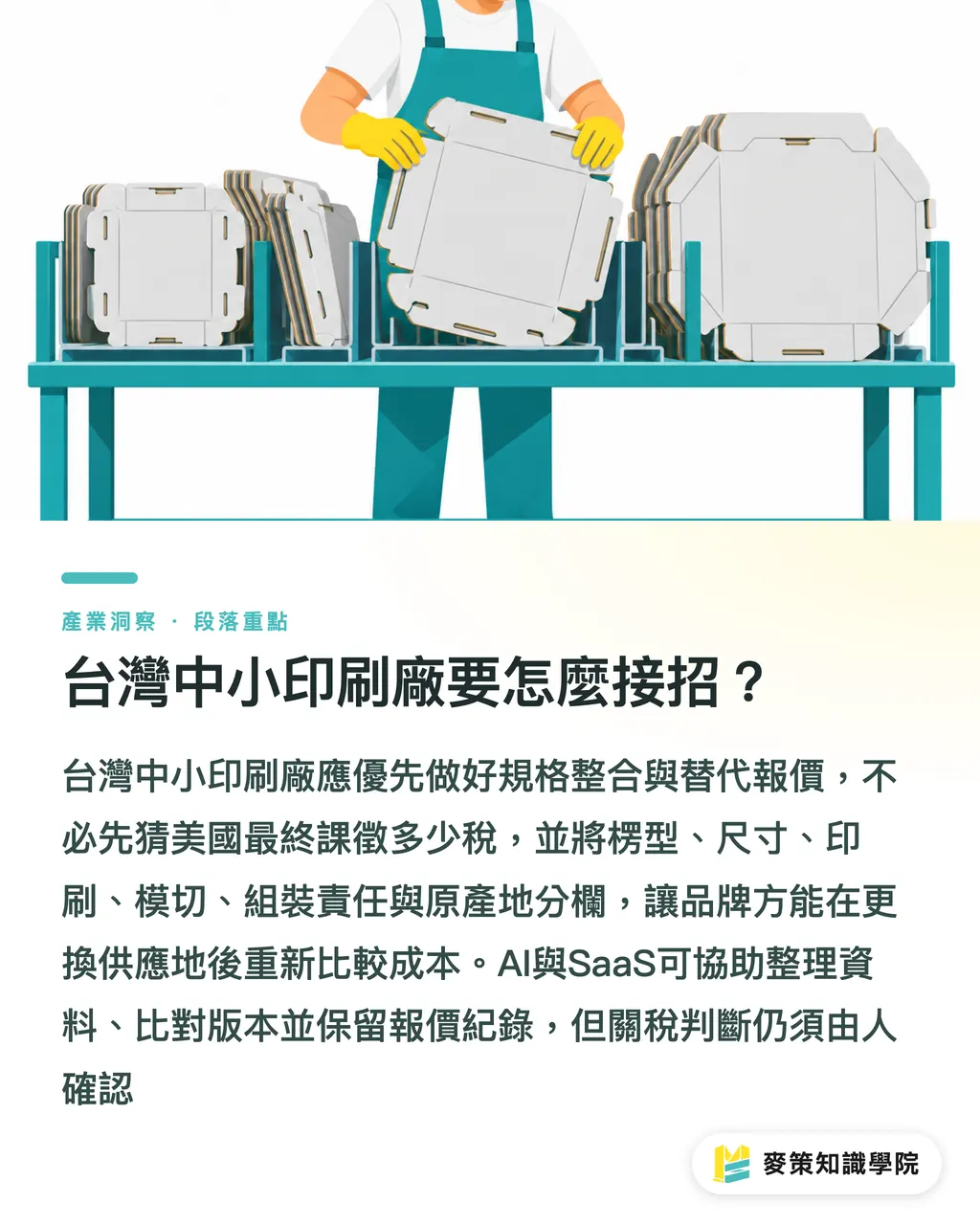
For Taiwanese small and mid-sized printers, the first response should be to integrate specifications and prepare alternative quotes, not guess how much the U.S. will ultimately charge
Do not quote just one unit price
This case covers B, C, D, and E flute, finished boxes, and die-cut blanks. If a printer writes only "corrugated box," the brand cannot see which conditions remain unchanged after the origin changes
・On the manufacturing side, break out flute type, dimensions, printing, die-cutting, assembly responsibility, and country of origin into separate fields so the quote can be recalculated
・On the design side, retain the artwork and die-line versions, and check bleed, ventilation holes, and surface treatments when the supply location changes
・Use AI and SaaS (software services provided by subscription) for data organization, version comparisons, and quote records. Tariff decisions still need human confirmation
The system should retain the origin, specifications, and version attached to every quote. As the case develops, brands will have a consistent specification and cost record to compare
Key Takeaways
・The U.S. case is currently a trade-remedy petition. Do not treat the petition as a final tariff rate
・Both finished boxes and die-cut blanks are in the proposed scope, so quotes need to separate them
・China, Malaysia, and Turkey are all named in the petition. Turkey also faces a countervailing-duty claim
・Brands should first build comparable versions of origin, specifications, and landed cost before discussing a supplier switch
・The value of small and mid-sized printers lies in specification integration and alternative arrangements. AI and SaaS should leave a version trail
Further Thoughts
I see this case as a stress test for the data fields used in packaging procurement. The manufacturing side should put flute, finished box, die-cut blank, country of origin, and lead time into one specification sheet. The design side should retain versions of the artwork, die-line, and surface treatment. AI should organize the differences, while SaaS should retain quotes and versions. Tariff decisions still need human confirmation. At the brand team's next meeting, start with one existing pizza-box product and compare sourcing scenarios across the three origins. That will expose gaps faster than abstract talk about supply-chain resilience
Further Reading
FAQ
- Have duties already been confirmed in the U.S. corrugated pizza box trade case?
- What can be confirmed so far is the petition filed on September 9, 2026. There is no final duty rate yet. Brands should treat antidumping and countervailing duties as scenario variables, not as costs already in force
- Which products may fall within the scope of the case?
- Both finished corrugated pizza boxes and die-cut blanks shipped flat for assembly are in the proposed scope. B, C, D, and E flute and equivalent flute types are also covered. Finished boxes must be at least 5 inches long and wide and no more than 4 inches high. Printing or ventilation holes do not automatically exclude the product
- Which part of the sourcing process should brands change first?
- First, put finished box or blank, flute, dimensions, origin, transportation, and duty scenario in separate columns. Then ask suppliers to quote against the same specification. That is the only way to see whether switching the source country is workable
- How should Taiwanese small and mid-sized printers respond?
- Turn flute, die-line, printing, surface treatment, assembly responsibility, and origin into comparable specification options, and retain version records from AI and SaaS. Customers need verifiable alternatives, not a guess at a tariff rate that has not yet been announced
Related articles


The Print × AI weekly
The print and AI know-how designers, brands and enterprises can use before they commit — one email, every week
MINDS Free Tools
Spine width and imposition calculators — skip the manual math, free in your browser.
MINDS Group
Need actual printing or gifting services?
From premium printing to online ordering and festive gifts — the MINDS Group sister brands take it from here.