
Why Does Canada-U.S. Trade Friction Reach Plastic Packaging?
Because plastic packaging costs build up layer by layer across cross-border supply chains. Once any segment, raw materials, tooling, film, or converting, gets caught in a policy shift, pricing and lead times can change
Plastic Packaging Caught in the Tariff Crossfire: Shocks and Lessons from the North American Supply Chain notes that plastic packaging in Canada, Iran, and elsewhere has been hit by tariffs and trade friction, with pressure landing first on local converters. This case has made Canada-U.S. plastic packaging trade a useful reference point for Taiwan brands trying to understand material risk
The question I've heard most from clients over the past couple of months has shifted from 'should we switch away from plastic?' to 'where is this batch of material coming from?' The source doesn't give Taiwan brands a cost percentage they can directly apply, so procurement shouldn't try to map North American events onto their own price increases. Get the supply path clear first, then you'll know where the risk actually stops
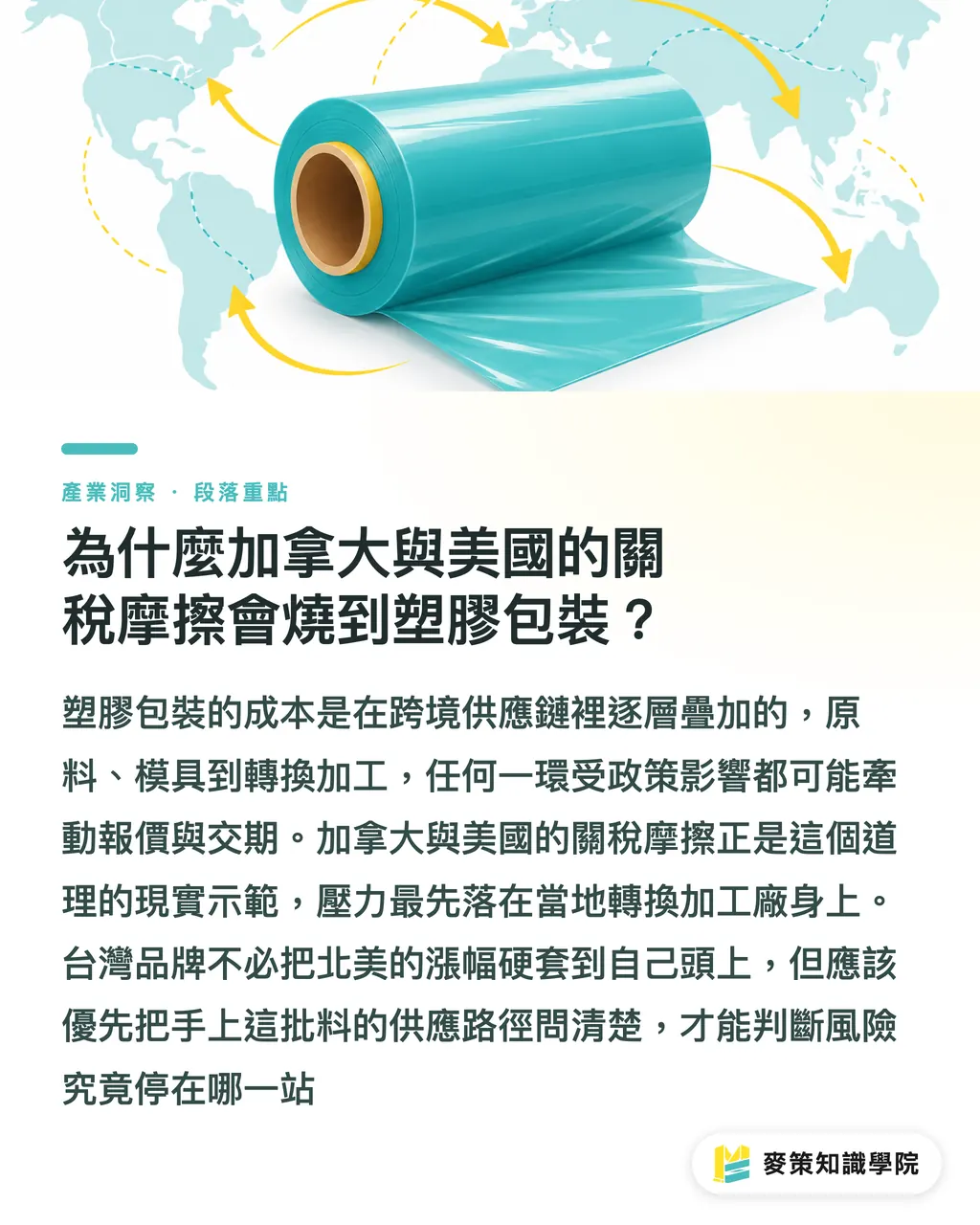
How Do Tariffs Travel Through the Supply Chain to Brand Costs?
Tariffs travel along cross-border paths for raw materials, tooling, semi-finished goods, and finished products. Suppliers may absorb the cost, pass it on, or ask brands to switch to unvalidated materials. All three approaches affect lead times and quality
A converter is the operation that turns film, resin, paper, or aluminum foil into packaging like pouches, wraps, and labels. It sits between the raw material supplier and the brand. That position is sensitive because material pricing, tooling origin, and order scheduling all land on the same factory at once
Tariffs and trade friction tend to show up in three places
・Raw materials: When the import path for resin or film shifts, suppliers won't just swap in an alternative before it's been validated
・Converting: When tooling or equipment parts cross borders, lead times may stretch first, with price increases coming later
・Brand side: Changing materials affects heat-sealing, barrier properties, ink adhesion, and recycling labels. The savings on material cost can turn into the cost of re-sampling
Why Can't Brands Just Tell Their Printer to Switch Suppliers?
Because packaging isn't a commodity part. Switching suppliers often means switching materials, tooling, processes, and validation conditions all at once. The consequences land on product appearance, tactile experience, and launch timing
Swap one roll of film for a single SKU (Stock Keeping Unit), and heat-seal temperature, pouch shape, clarity, ink adhesion, and barrier performance can all change. EPR (Extended Producer Responsibility) means brands carry extended responsibility for how packaging is recycled and disposed of after use. If an alternative material changes the material classification, recycling labels and market communications need revisiting too
I put three sheets into the same project file
・Spec sheet: film material, printing, sealing, barrier, appearance, and acceptance criteria
・Source sheet: raw material origin, tooling location, converting location, and final shipping point
・Decision sheet: acceptable cost, latest switching date, who approves alternatives, and line-stop handling
Comparing only by per-kilogram price usually misses re-sampling costs, inventory write-offs, and channel delays. The real headache isn't whether the sample looks right on the table; it's when sealing, registration, and shelf appearance all go wrong at the same time in production
How Should Small and Mid-Sized Print Shops Respond?
Small and mid-sized print shops need to map the cross-border path for their packaging materials, run small-batch tests to confirm alternatives, and write the switching conditions into quotes and purchase agreements. Those three steps beat last-minute calls to suppliers asking whether stock is available
I use Mai Strategy's Three Print Gates to handle brand packaging risk, so procurement, design, printing, and QA are all working from the same document
・1. Source Gate: Break down the five nodes, raw materials, tooling, converting, printing, and shipping, and ask suppliers which segments cross borders and which are exposed to tariffs
・2. Validation Gate: Run a small-batch test of the alternative material against the same die, checking heat-sealing, ink adhesion, pouch shape, barrier, and appearance. Unit price is not a substitute for testing
・3. Switch Gate: Put quote validity, lead time changes, who approves the alternative, and switching notice requirements into the purchase conditions. Keep one validated backup path ready
Check the source first
Don't just look at unit price
If your team is missing the inventory sheet, material-change test sheet, or decision process, Mai Strategy Knowledge Academy's consulting team can help you put specs, costs, and compliance conditions on a single working sheet
How Should Brands Communicate Packaging Changes?
Brands should be clear about what changed, what stayed the same, and how it was validated. Avoid turning tariffs into a one-line excuse for a price increase that consumers can't evaluate
Consumers don't need to know every tariff code, but they care whether sealing, appearance, volume, feel, and recycling instructions have changed. Brands can communicate with three checkable statements
・The supply path was adjusted due to Canada-U.S. trade friction, requiring a new confirmation of the packaging version
・Product function and safety conditions have been validated against the existing spec. No alternative material is claimed publicly before testing is complete
・Material information and recycling labels have been updated together. Markets subject to EPR requirements are checked against local regulations
Design teams need to get involved early, because packaging changes run all the way through the brand experience. Once you switch materials, clarity, haze, print color, or pouch shape can shift, and hero visuals, product photography, and shelf recognition may all need to be redone
Key Takeaways
・For plastic packaging tariff risk, start by checking raw material origin, tooling location, and converting location
・Switching suppliers doesn't make the risk disappear. Alternative materials need to pass heat-sealing, printing, and recycling label validation
・Brand procurement should track switching dates, lead times, and re-sampling costs more closely than per-kilogram unit price
・Tariff communications should come with the packaging facts. Don't put out sustainability claims for materials that haven't been validated yet
Further Considerations
On the print manufacturing side, build a source and alternative material record for every packaging SKU. On the design side, put material specs, recycling labels, and print effects into the same sampling run. When bringing in AI or SaaS, start by organizing raw material origin, tooling location, converting location, quote validity, and test results, then let the system identify which SKUs might be affected. That approach is more reliable than starting with price forecasting. Brands can put this data in front of procurement, design, printing, and QA together, so supply chain changes don't stay stuck in one person's inbox
Further Reading
FAQ
- Will North American plastic packaging tariffs cause the same price increase for packaging in Taiwan?
- No direct proportional pass-through. The actual impact depends on raw material origin, converting location, tariff codes, contracts, and how suppliers split the cost. The source doesn't provide a fixed percentage that Taiwan can apply
- What should brands validate first before switching plastic film?
- Start with the same SKU and check heat-sealing, ink adhesion, pouch shape, barrier, appearance, and recycling labels. Make the call to scale up only after those pass
- What should small print shops do if they don't have a backup supplier?
- Start by documenting the raw material, tooling, converting, and shipping path. Then find alternatives that can be tested in small batches. The backup path needs to be validated before you need it, not after you run out
- How should brands explain a packaging change to consumers?
- Be clear about why the supply path changed, how product function was validated, and whether materials and recycling labels were updated. Don't frame an untested alternative as a sustainability upgrade
- How can AI or SaaS help with packaging supply chains?
- First organize SKU, raw material origin, tooling location, converting location, quote validity, and test results into traceable data. Then use the system to identify affected packaging and switching deadlines
Related articles



The Print × AI weekly
The print and AI know-how designers, brands and enterprises can use before they commit — one email, every week
MINDS Free Tools
AI background removal, a LINE sticker maker, spine & imposition calculators — all free, right in your browser, no upload.
MINDS Group
Need actual printing or gifting services?
From premium printing to online ordering and festive gifts — the MINDS Group sister brands take it from here.