

Why shouldn't you blame the machine first when wide-format colors differ?
Wide-format printing uses large-format equipment to produce large images. When a customer complains about color, first check whether both sides are comparing the output under the same conditions. Then decide whether the equipment is producing a color shift. An article on wide-format printing published by Idealliance, a print industry organization, on November 16, 2023, lists five common challenges: customer expectations, file preparation, viewing conditions, equipment maintenance, and gaps in staff knowledge. The machine is only one of them. Calling it a fault right away could mean missing all the other clues
The same sample of a red sign can look different by a window and under the warm lights inside a shop. Agree on the lighting first, so both sides know exactly what they're comparing
Hold on
The article excerpt doesn't provide measurement tolerances or a complete operating standard, so a particular measurement threshold shouldn't be presented as an answer specified by the source.Idealliance: Color and Prepress Challenges in Wide-Format Printing

What should you agree on before acceptance?
Before accepting wide-format output, agree on at least three things: the reference sample, the lighting conditions, and the evaluation method. It's best to record all three on the same job ticket or approval form. A reference sample is a sample both sides approve and use to compare against the final output. Viewing conditions cover the light source, surroundings, and viewing method, so the customer and print shop can compare colors in the same setting instead of mistaking a lighting difference for a print color shift
Don't sign off under different lighting
If a customer says, "Make it look like the brand color," but doesn't point to an approved sample, the designer, buyer, and print shop may each use the color they have in mind as the standard. Write down these three points first:
・Reference sample: Record the version, date, and approver to avoid comparing different versions
・Lighting conditions: Specify conditions both sides can reproduce, and avoid mixed light sources when reviewing the sample
・Evaluation method: Identify the color patch or area that matters most. If measurements are required, state in advance who will take them and which method will be used to evaluate the result
How can you tell whether the issue is the file, the lighting, or the equipment?
Check the file version and viewing environment first, then arrange an equipment check. Change only one condition at a time while troubleshooting. Idealliance lists file preparation, viewing conditions, and equipment maintenance as wide-format color challenges, but doesn't say which one must come first
I'd review the same file and reference sample under the agreed lighting. First, confirm that the production file and proof use the same version, then compare them under the agreed light. If the colors look different as the environment changes, address the viewing conditions first. If the output still differs from the approved sample under the same conditions, ask the print shop to check its equipment and maintenance records
If different shifts have different understandings of the file or operating requirements, include the handoff in the investigation. Checking each part in turn can prevent a rushed machine adjustment or reprint, only to discover later that the two sides weren't even using the same file version
Can a color target be used as the acceptance standard?
A color target is useful for checking equipment performance and spotting color risks early. It can't replace a customer-approved acceptance sample. A color target is a test chart containing multiple color patches. Print shops use it to measure output equipment and spot color risks early. The caption in the Idealliance article notes that Atchley Graphics uses color targets to measure printer performance and anticipate color challenges
This example makes the distinction clear: the print shop uses a test chart to check the equipment, while the customer uses a reference sample approved by both sides to confirm that the finished output meets the agreement. Each answers a different question. Without either one, complaints can circle back to "Is the machine accurate?"
The source doesn't list a measurement standard, tolerance, or complete procedure. If a contract refers to measurement specifications, both sides still need to name the standard and explain how the result will be evaluated
How can a small or midsize print shop make its complaint process clear?
The easiest process for a small or midsize print shop to follow is to put the acceptance agreement on the job ticket, so the same record carries through order intake, proofing, and customer complaints. Two of the five challenges Idealliance lists, customer expectations and gaps in staff knowledge, involve handoffs. I'd avoid writing only "color must be accurate," because nobody on the shop floor can tell which patch, version, or lighting conditions to compare
Use this order:
・At order intake: Record the reference sample version and ask the customer to point out the color areas that matter most
・At proofing: Record the lighting conditions and approver. Carry the approval through to final production
・When a complaint comes in: Start with the approved sample and lighting, then check the file version, equipment maintenance, and operating records
You can start with a few simple fields. There's no need to wait until all the measurement equipment is in place. To turn acceptance questions into wording that works for both purchasing and production, talk with the Mai Strategy Knowledge Academy consulting team
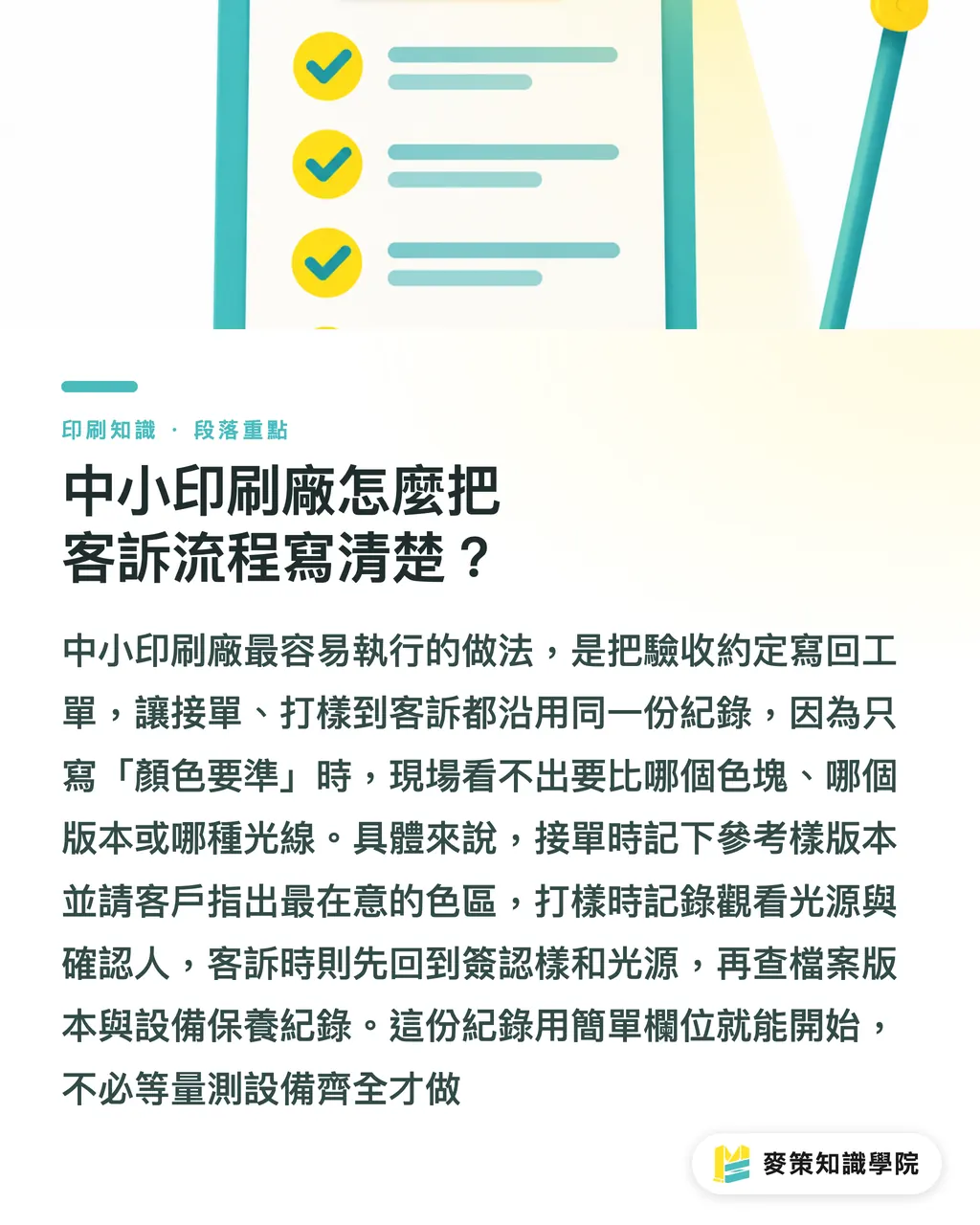
Key takeaways
・Agree on the reference sample, lighting conditions, and evaluation method before acceptance, so complaints have a shared basis
・Check the file version and viewing environment first, then decide whether the equipment needs inspection
・Use color targets to check equipment performance. They don't replace a customer-approved acceptance sample
・Record the agreement on the job ticket, so order intake, proofing, and shipping all use the same conditions
Further thoughts
Print production teams and designers can add the reference sample, lighting conditions, approver, and file version to the job ticket. When introducing artificial intelligence (AI) color suggestions or SaaS (Software as a Service, software services accessed over the internet), keep these fields for future reference as well. A system can store the records. The customer and print shop still need to check the output against the conditions agreed in advance
Further reading
FAQ
- Are color differences in wide-format output always caused by the machine?
- Not always. File preparation, viewing light, equipment maintenance, and gaps in staff knowledge can all affect wide-format color. Align on the reference sample and viewing conditions first, then decide whether the equipment needs inspection
- What should we agree on before accepting wide-format printing?
- Confirm a reference sample approved by both sides, the lighting conditions both sides will use, and how color differences will be evaluated. If measurements are required, specify the measurement method and who is responsible in advance
- What should we do if the customer and print shop see different colors under different lights?
- Compare the same reference sample under the lighting conditions both sides agreed on. This helps avoid mistaking a lighting-related difference in appearance for a color shift in the output
- Can a color target be used as the customer's acceptance standard?
- A color target can be used to measure equipment performance and spot color risks early. Customer acceptance should still be based on a reference sample approved by both sides and the evaluation method agreed in advance
Related articles



The Print × AI weekly
The print and AI know-how designers, brands and enterprises can use before they commit — one email, every week
Tool Library
RGB↔CMYK conversion, ΔE color difference and brand color print analysis — free color management tools, computed right in your browser.
MINDS Group
Need actual printing or gifting services?
From premium printing to online ordering and festive gifts — the MINDS Group sister brands take it from here.