

Why did Thailand push its new food-contact paper standard back a year?
The delay was approved by Thailand's cabinet on a proposal from the Ministry of Industry. The food-contact paper industrial product standard first published in 2024 won't be mandatory until June 22, 2027 instead of the original June 22, 2026. The affected product categories are clear: paper goods in direct contact with food, including snack bags, paper bags, paper plates, and food-grade liner sheets. The official reasoning is straightforward, they were worried small operators wouldn't be able to switch packaging materials fast enough and would run out of stock, and that a sudden spike in packaging costs would push food prices up. In the middle of an economic adjustment period, the government didn't want to pile more pressure on consumers
From what I've seen working with Southeast Asian export clients, that judgment makes sense. Most mid- and small-scale food manufacturers and local retailers genuinely didn't have enough reaction time, and forcing the issue would have hit shelves directly. So is the delay good news for Taiwanese packaging exporters? On the surface, yes. In practice, it just pushes the pressure back, it doesn't disappear. The new standard is still coming. You just get a one-year window to lock in materials, run samples, and renegotiate with clients
What does this new standard actually regulate, and what should Taiwan-based printers zero in on first?
Thailand's new standard is, at its core, an industrial product standard for paper goods in direct contact with food. It's not a voluntary ESG pledge from brands. It's national mandatory regulation. Until I've seen the full text, I'd tell any export-focused printer to focus on three areas:
・ Material sourcing and formulation declarations: Once the new standard kicks in, the composition of paper products, additives, and the proportion of recycled pulp all need to be traceable and declared. That's a pressure point for factories that have long relied on recycled or blended pulp
・ Testing and report format: Food-contact paper has specific thresholds for migration, microbiological counts, optical brighteners, and other items. You need to check up front whether Thailand's required testing methods and report formats line up with what Taiwan currently does
・ Labeling and language requirements: Thai-language labeling, required warnings, manufacturer and importer info. Under the new standard, label real estate gets squeezed, which cascades into print file structure
If any of these three isn't sorted by June 2027, the goods won't enter Thailand. Start here and the workflow won't turn into a mess
Why the delay isn't a relaxation, and three things export printers should do now
The biggest trap for paper packaging printers shipping into Thailand this year is falling into the "we still have time" mindset. I'd say do these three things right now, in this order:
・ Raw material audit and stockpiling: Ask your paper suppliers for the food-grade certification documents on their current production lines (FSC chain of custody, FDA food contact, ISO 22000 is the baseline). Go through each one and check whether it maps to Thailand's new material requirements. For anything that doesn't match, start lining up alternative sources, you need at least two
・ Pre-emptive testing: Before June 2027, run your main product lines through voluntary testing, migration, optical brighteners, microbiological counts. Keep the reports as backup, so you're not stuck waiting when Thai local labs get jammed up in Q3 2027
・ Client comms package: Your brand clients exporting into the region (especially food brands that already have ESG commitments) will need a compliance briefing on Thailand's new standard. I'd suggest packaging printers proactively issue a "Thailand Food-Contact Paper Compliance Progress Memo" laying out where you stand. Don't wait for clients to ask
Get those three done and you're not the shop scrambling in 2027—you're the partner clients actively think of when the next tender comes up
For designers and prepress: what parts of the layout does this new standard touch?
This is the part designers and prepress people most easily miss, because the new standard sounds like a "manufacturing-side problem." But once Thai-language labels, manufacturer/importer info, and required warnings need to be re-laid out, the files have to be rebuilt. Three common pitfalls I'd flag for the prepress side:
・ Reserve space for Thai labels and warnings: When you preflight Thai text, get the official Thai copy from the client. Don't pad word counts with machine translation. Thai characters have different height and width from Chinese, reserve at least 1.5x the space you'd give Chinese copy
・ Recheck bleeds and safety zones: Items like liner sheets and paper plates that touch food directly often get treated as "interior components" and don't get strict bleed and safety zone treatment. Once the new standard kicks in, the food-contact surface is part of the compliance scope. Go back to the brand's master visual guidelines and redo them
・ File version control: The same food brand might run a Taiwan version, a Vietnam version, and a Thailand version at the same time. Use clear version numbering (e.g., TW-VN-TH-v3) so your sales team doesn't ship old files into Thailand
None of these are hard. Miss any one of them, though, and you're getting rejected by Thai customs or the client's QA after June 2027
Over the next 12 months, how should printers and brand clients walk this path together?
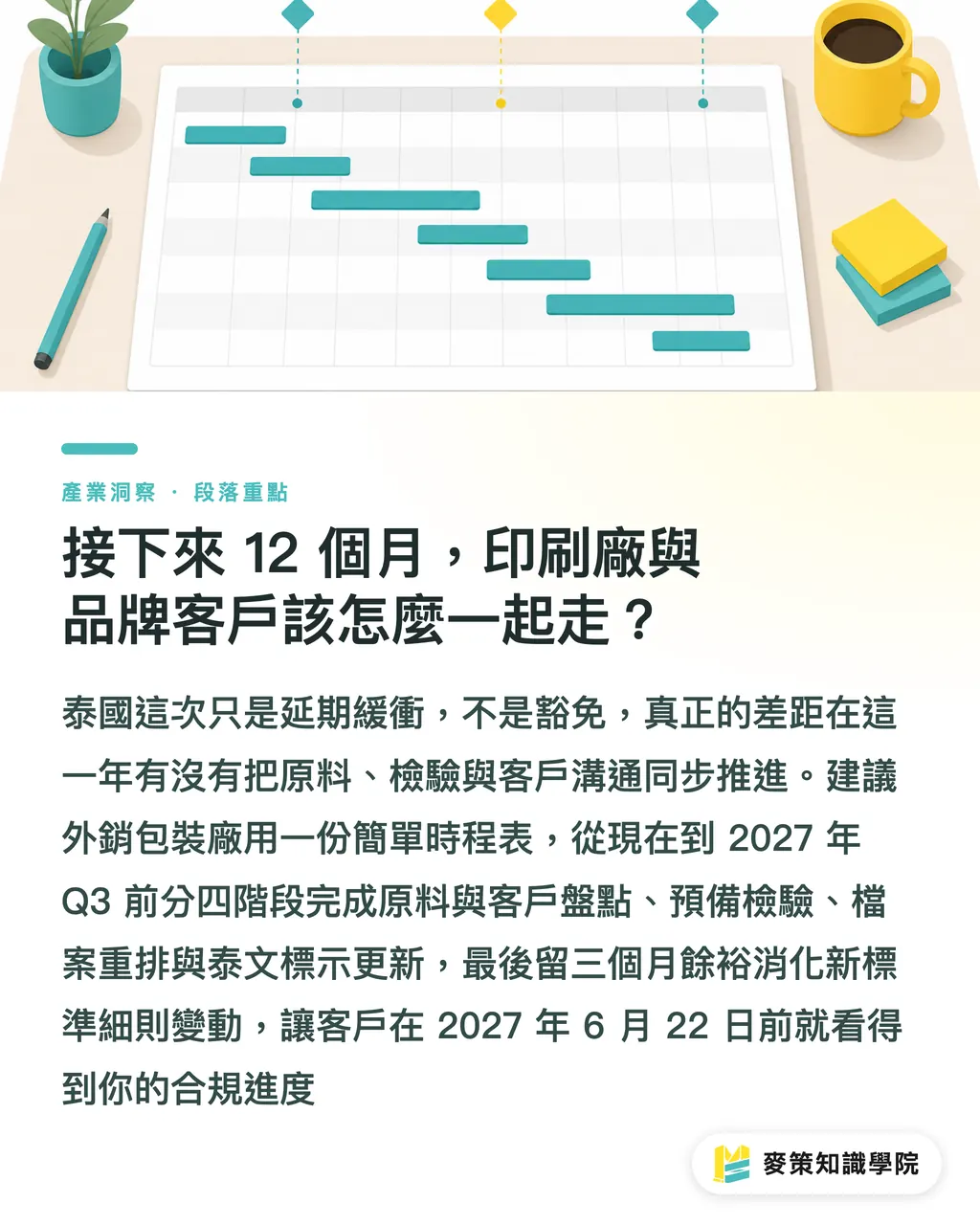
Thailand's delay here is a buffer period, not an exemption. What actually separates the pack is whether you can run all three tracks, materials, testing, client comms, in parallel over the next twelve months. I'd suggest export-focused packaging printers push this with a simple timeline:
・ Months 1-3 (now through Q4 2026): Finish the raw material audit and client roster audit. Build a master list of every product you ship into Thailand
・ Months 4-6 (Q1 2027): Submit main product lines for testing. Get preliminary test reports in hand
・ Months 7-9 (Q2 2027): Finish file relayouts, update Thai labels, and align with clients on ESG and compliance messaging
・ Months 10-12 (before Q3 2027): Finish cutting dies and stockpiling for all main product lines. Keep a 3-month buffer for any tweaks to the new standard's fine print
The timeline isn't complicated, but it lets your clients see your compliance progress before June 22, 2027—which beats any sales pitch
If you've got projects that need realigning food paper packaging for Thailand under the new standard, handling file rebuilds and tying them into material testing, you can send the brief over to MINDS Printing for an assessment. Especially for mid- to high-end fully custom food boxes and liner sheets, they can handle material documentation through to prepress version control in one pipeline. To level up your team's overall judgment on Southeast Asian regulations, talk to the Mai Strategy Knowledge Academy consulting team and plan internal training and SOPs together
Key Takeaways
・ Thailand's new food-contact paper standard is pushed to June 22, 2027—but it's a buffer period, not a relaxation
・ Affected items include snack bags, paper bags, paper plates, food-grade liner sheets, and other paper products in direct contact with food
・ What export printers should focus on most this year: raw material audit, voluntary testing, and proactively giving clients a compliance progress update
・ Prepress needs to lock down Thai label space, bleed and safety zones, and multi-country file version control all at once
・ Split the period from Q4 2026 to Q2 2027 into four phases, with a three-month buffer before June 2027
Further Thinking
What Thailand's delay really tests is whether export printers will turn "someone else's regulation" into "our own SOP." I've watched too many peers go through EU PPWR, California SB 54, and Indonesia's halal packaging timelines without a reusable compliance checklist, and every new rule means starting from scratch
For the print manufacturing side, the smartest investment this year is a "material certification database" and "multi-country file version management." For design and prepress, it's about pre-building layout templates for Thai, Vietnamese, and English labels so that when Thailand, Indonesia, or Malaysia rolls out the next standard, you can drop in and apply it. For printers who want to go further, these 12 months are training grounds for building a "regulatory response SOP." Do it right, and the next PPWR or SB 54 won't be a from-scratch job
Further Reading
FAQ
- When does Thailand's new food-contact paper standard actually take effect now?
- It's pushed back a year from the original June 22, 2026. Mandatory enforcement is now June 22, 2027, covering snack bags, paper bags, paper plates, food-grade liner sheets, and other paper products in direct contact with food
- Is the delay good news for Taiwanese packaging printers exporting into Thailand?
- On the surface, you've won a year of adjustment time. But the standard itself hasn't loosened, raw material formulation, test reports, and label layout all need to be in place before June 2027. The pressure is still there
- What's the easiest pitfall for designers in this new standard?
- Squeezing Thai labels, warnings, and manufacturer/importer info into the existing Chinese-version layout without accounting for the different character height and width of Thai, which eats into the bleed and safety zones and forces a full file rebuild
- What's the first thing a print shop should tackle in these 12 months?
- Start with the raw material audit and pre-emptive testing. Pull FSC and food-contact certifications from your paper suppliers, and run your main product lines through voluntary testing. Those two done, you've got ground to stand on when talking compliance progress with brand clients
- Does Thailand's standard have anything to do with EU PPWR?
- They're independent. Thailand's is a national industrial product standard; PPWR is the EU's packaging and packaging waste regulation. Both require traceability and material declarations, though, so I'd prep them in parallel
Related articles

The Print × AI weekly
The print and AI know-how designers, brands and enterprises can use before they commit — one email, every week
MINDS Free Tools
AI background removal, a LINE sticker maker, spine & imposition calculators — all free, right in your browser, no upload.
MINDS Group
Need actual printing or gifting services?
From premium printing to online ordering and festive gifts — the MINDS Group sister brands take it from here.