
Why Did Kellogg Remove BHT Ahead of Schedule?
WK Kellogg moved early because brand management of chemical additives has now reached the packaging materials level
Packaging Dive's report on WK Kellogg removing BHT ahead of schedule, published August 7, 2026, notes that WK Kellogg will fully remove artificial colors and BHT from its cereals and packaging by end of 2026, nearly 12 months ahead of plan
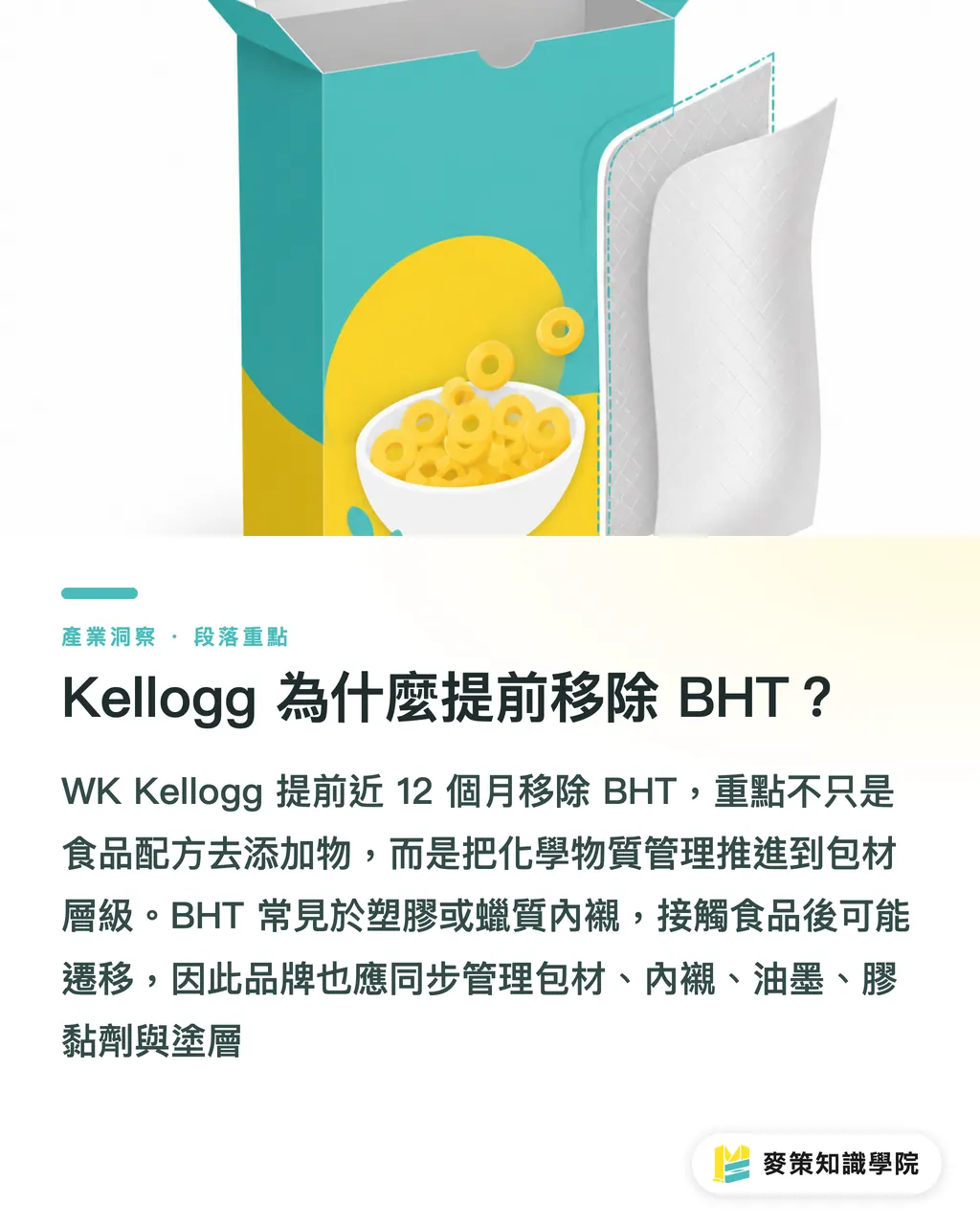
BHT (Butylated hydroxytoluene) is a synthetic antioxidant used to slow fat oxidation. It commonly appears in plastic or wax liners in food packaging, and can migrate into food on contact
My take: brands shouldn't read this as just another American cereal story. Food Contact Materials (FCM) are the packaging, liners, inks, adhesives, and coatings that touch food directly or indirectly. The whole point of managing them is what they might carry into the food after contact
How Does BHT Migration Actually Happen?
BHT migration typically starts with plastic or wax liners, and through contact, stacking, heat, and time, carries substances from the packaging into the food
The U.S. FDA (Food and Drug Administration) currently still allows specific limits: no more than 0.02% of the fat or oil content in food, or migrating from packaging into food no more than 0.005%. The FDA launched a re-evaluation in May 2026 and extended the public comment period through August 31, 2026
On the print floor, the most common thing brands miss is the assumption that 'we're not printing directly on the food-contact surface.' Migration doesn't respect layout boundaries
・Liner contact: plastic or wax liners sit near food; fatty foods are especially sensitive to migration
・Stack contact: during reeling, stacking, and boxing, print surfaces can touch food-contact surfaces
・Gas-phase migration: inside sealed packaging, volatile substances can travel through the air space
・Heat and storage: heat sealing, retort processing, and long-term storage all amplify the consequences of the wrong material choice
It's that simple
A nice proof only tells you the colors are right. It says nothing about chemical safety
What Documents Should Brands Get in Order Now?
Start with four documents, because food packaging revisions most often fall apart when responsibility isn't clearly divided
I recommend brands use the Mai Strategy three print-submission checkpoints for these cases: ① materials gate, ② process gate, ③ declaration gate. This works before a food packaging revision, and it's also something print buyers can take straight to their suppliers
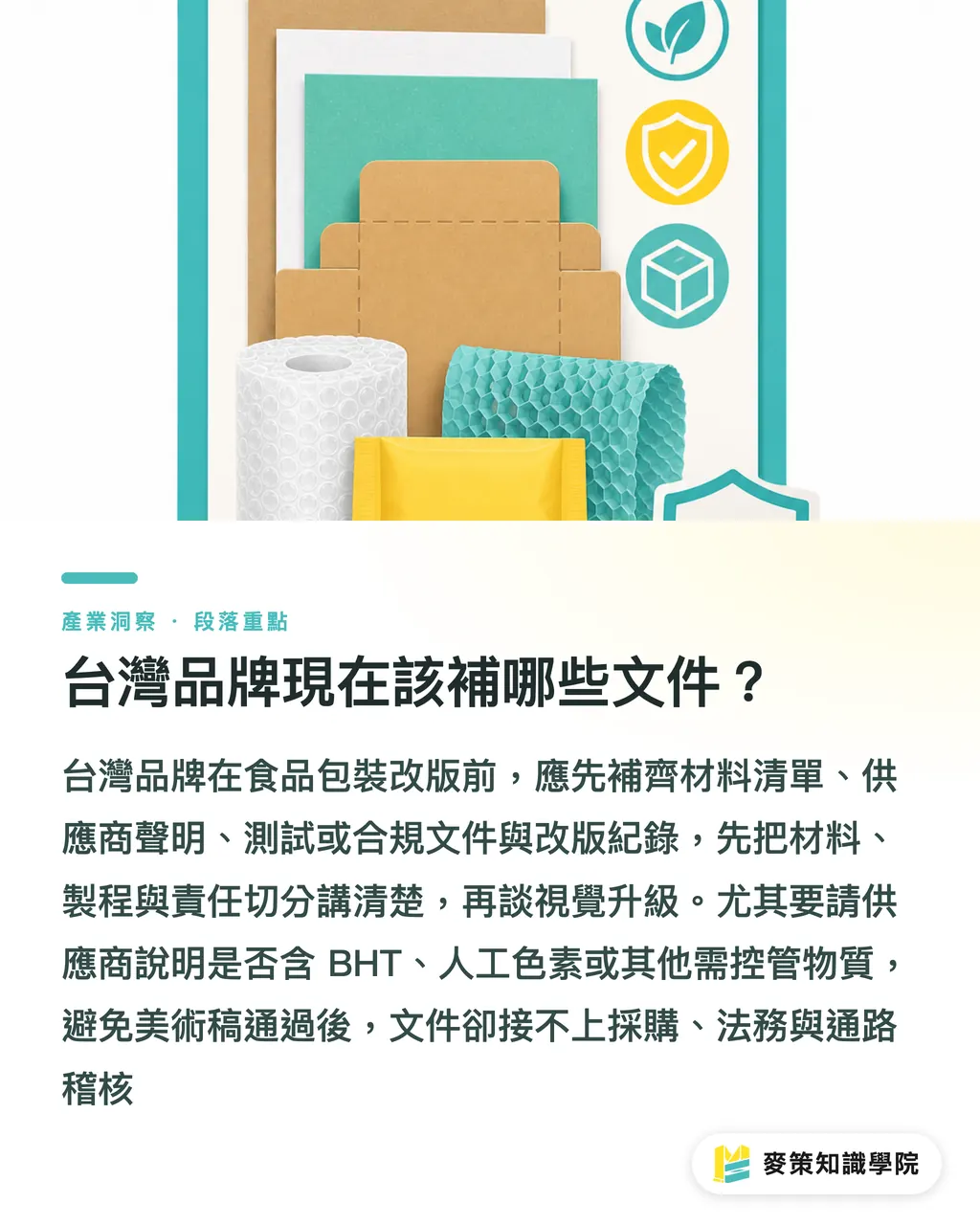
・Material list: document paper stock, plastic film, liners, inks, coatings, adhesives, and heat-seal materials
・Supplier declaration: ask suppliers to confirm whether BHT, artificial colors, or other controlled substances are present
・Test or compliance documents: keep documentation for low-migration inks, food contact materials, and migration risk
・Revision records: log the dates of any changes to packaging materials, inks, liners, and copy claims
If you're preparing a food packaging revision, I'd have a team like MINDS, familiar with mid-to-high-end custom print, review the material combination before talking visual upgrades. The worst way to spend money on food packaging is to pass the artwork and then find the documentation doesn't hold up to procurement, legal, or retail audits
Does Reformulating Affect Brand Communication?
Yes, because Kellogg is handling BHT, artificial colors, supply, and consumer familiarity all at once. You can't just swap in a clean label line
WK Kellogg is also removing artificial colors. The affected products, including Froot Loops, Apple Jacks, and a handful of limited-time items, account for about 15% of the portfolio. The company says it will switch to six colors sourced from fruits, vegetable juices, and plant-based ingredients, such as turmeric for yellow and annatto for orange, after testing hundreds of alternatives
One thing for brands to keep in mind: consumers buy the familiar taste, color, and reassurance they know. They're not buying a material name off a procurement sheet
・Formula change: first confirm whether the flavor, aroma, texture, and appearance can hold the consumer's familiar experience
・Pack copy: avoid writing 'no added' claims with medical-sounding implications; every claim needs documentation to back it
・Retail rollout: when old and new packaging overlap, customer service, sales, and retail need to be working from the same script
・Color control in design: natural color palettes can be harder to keep bright; packaging photography and print proofs need another pass
How Should Printers and Designers Respond?
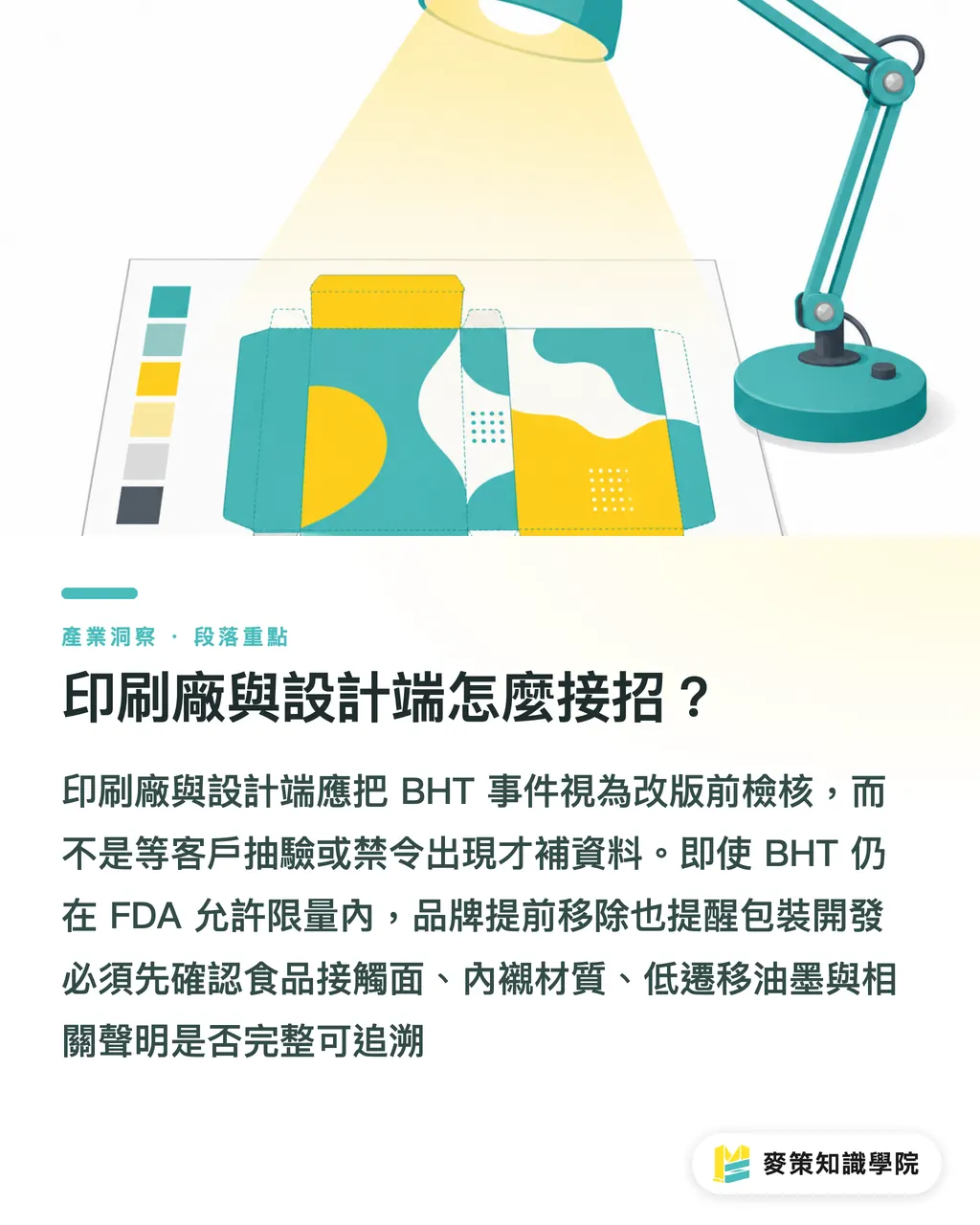
Printers and designers should treat the BHT story as a pre-revision checklist item. Don't wait for a client audit to start pulling documents together
There's one very practical lesson from the WK Kellogg case: BHT is still within FDA-allowed limits, yet the brand chose to remove it nearly 12 months early. Market pressure, regulatory re-evaluation, and consumer perception can walk into a packaging meeting before a formal ban ever does
・Design side: before finalizing artwork, clarify the food-contact surface, liner material, heat-seal method, and any claim copy
・Printers: low-migration inks need to be managed together with liners, adhesives, drying conditions, and storage method
・Procurement: don't compare on unit price alone; bring supplier declarations, test documents, and alternative material availability into the evaluation
・Brand side: when running old and new packaging in parallel, prepare retail briefings and customer service FAQs before the switch so consumers don't assume something's gone wrong with the product
That's all it takes
Key Takeaways
・BHT risk runs across the entire food contact chain, not just whether anything was printed on the food-contact surface
・For a food packaging revision, check the material list first, then change the copy
・The FDA's 0.005% migration limit is a reminder that claims can't rest on verbal commitments from procurement
・Low-migration inks only work when assessed alongside liners, adhesives, and storage conditions
・Consumers want the familiar taste and a reassuring message; brands need to sequence the transition before anything ships
Broader Thinking
Printers need to push food packaging from 'printed beautifully' to 'fully documented.' Design teams need to build material constraints into pre-final artwork checks. AI tools can handle spec sheet comparison, missing declaration alerts, and revision log organization. SaaS teams are well positioned to turn material lists, supplier declarations, test documents, and version control into traceable workflows. If your brand doesn't have that process yet, the Mai Strategy Knowledge Academy consulting team can help you build a food packaging compliance checklist before handing it off to print and procurement
Further Reading
FAQ
- Is BHT a food ingredient or a packaging ingredient?
- BHT can be used in food, but it's also commonly added to packaging materials like plastic or wax liners to prevent fat oxidation. The Kellogg case is a reminder that BHT in packaging can also migrate into food
- Has the FDA banned BHT?
- Not yet. The FDA still allows BHT up to 0.02% of the fat or oil content in food, or no more than 0.005% migrating from packaging into food. A re-evaluation was launched in May 2026
- Do brands need to reprint all their food packaging immediately?
- Not necessarily. Start by building a Food Contact Material list, confirm what's in your liners, inks, and adhesives, and get your supplier declarations in order. Then decide whether a revision or material swap is needed
- Can low-migration inks fully eliminate migration risk in food packaging?
- Low-migration inks only address the ink side of the problem. Food packaging still requires checking liners, coatings, adhesives, drying conditions, and storage method together
- What's the first question to ask a printer when revising food packaging?
- Ask where the food-contact surface is, which liners and inks are being used, and whether they can provide supplier declarations and migration risk documentation. That comes before asking about unit price
Related articles



The Print × AI weekly
The print and AI know-how designers, brands and enterprises can use before they commit — one email, every week
MINDS Free Tools
Spine width and imposition calculators — skip the manual math, free in your browser.
MINDS Group
Need actual printing or gifting services?
From premium printing to online ordering and festive gifts — the MINDS Group sister brands take it from here.