
Why do quotes from overseas platforms like Packhelp blindside startups?
The problem isn't the platform, it's the structure. Platforms like Packhelp have clean interfaces and a solid design workflow, but the moment you check out, three line items stack up, custom size fees, print plate fees, and international ocean freight, and the per-unit cost on small orders just doesn't pencil out
Looking at a recent thread on Reddit's r/ecommerce, plenty of sellers say something along the lines of "uploaded my design, picked my specs, and the quote came back more than double what I expected." That's textbook. The pricing logic on these overseas platforms is built for volume, that's how plate fees get amortized and shipping becomes a smaller share of the total. A startup's first batch is usually somewhere between a few dozen and a hundred or two pieces, which is nowhere near the sweet spot of that model
Compare that with a local digital printing shop: plate costs are basically zero (no CTP plates, no die-cutting tooling), they'll take orders under 100 pieces, and you can run different design versions in the same batch, useful for testing the unboxing reaction on a couple of visual directions. That kind of flexibility isn't something the overseas platform architecture can offer
Before sourcing small-batch packaging, nail down these 3 questions
Comparing quotes isn't just about unit price, it's about total landed cost per batch and how easy it is to swap designs. Based on years of working with procurement folks at small and mid-sized e-commerce brands, getting these three questions answered before the RFQ goes out saves most of the back-and-forth on spec changes later:
・Minimum order quantity and version-mixing rules: most digital printers will let you run different design versions within one order, but confirm whether each version needs to hit MOQ on its own, or whether the combined total counts. Combined-count rules are way friendlier to startups
・How sampling fees and plate fees are billed: some shops fold the sample fee into the first production order, others bill it separately, that directly affects the true unit cost of batch one. Ask before the quote, not when the invoice lands
・Scope of post-press finishing in-house: things like gloss lamination, matte lamination, spot UV, foil stamping aren't available at every digital shop. Confirm what's in-house so you're not splitting finishing between two vendors
When comparing prices, add up design output, plate fees, finishing, and packaging shipping, that's the real procurement cost. Comparing print unit prices alone gets you misled by lowball base rates
How does modular packaging keep test-market risk at a minimum?
Modular means: separate what stays fixed from what changes easily, and source them independently. Don't print everything onto the box
The low-risk, three-step test-market path that MINDS (MS, mid-to-high-end fully custom commercial printing) suggests goes like this:
1. Start with a plain spec box: pick a standard, restockable, plain-color corrugated box with no branding printed on it. High-volume unit price, fast replenishment, treat the box itself as infrastructure
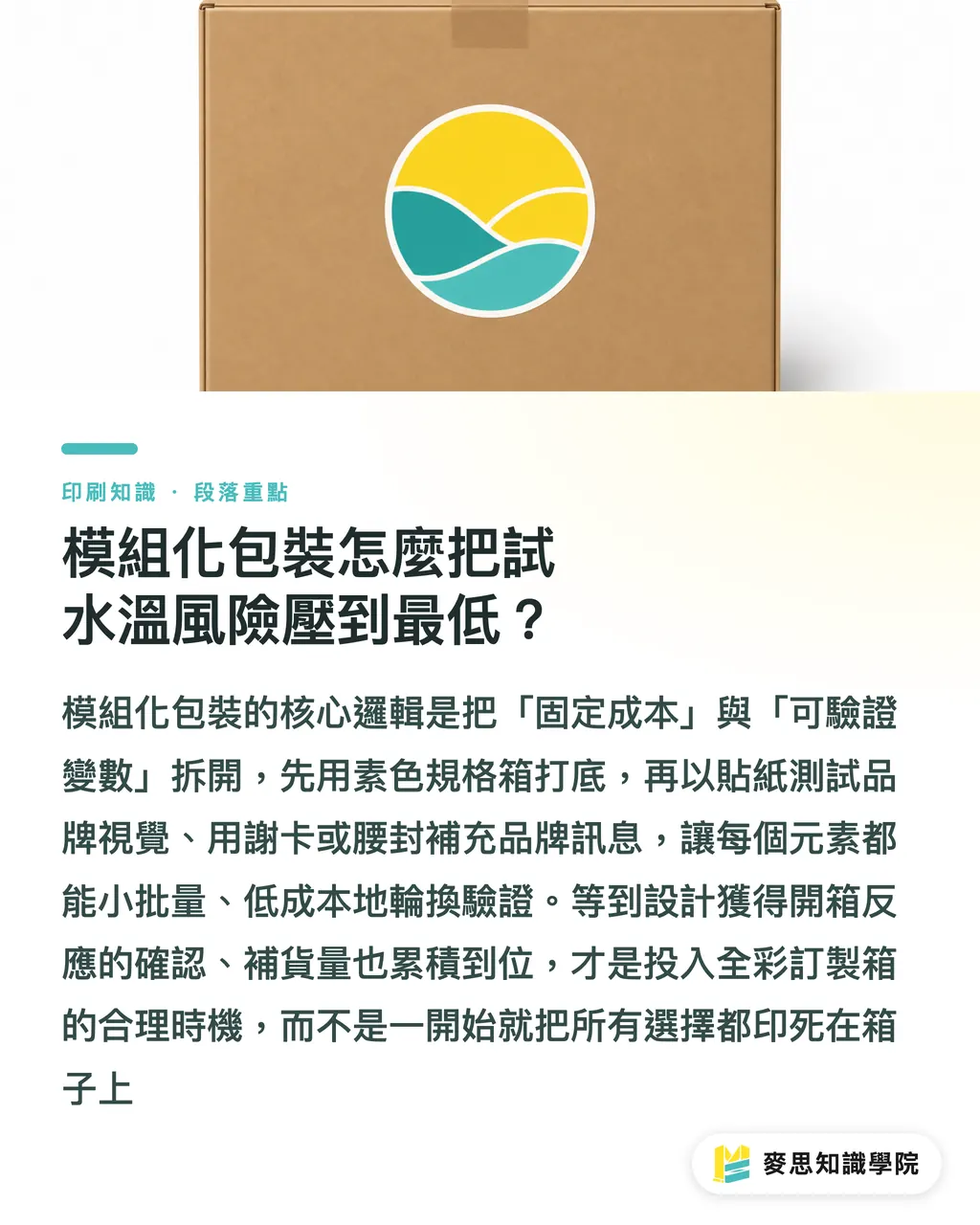
2. Validate the visuals with branded stickers: turn your logo and brand visuals into stickers. You can print several design versions at once, distribute them across different order batches, and watch which one gets a better unboxing reaction. Keep cost down to a few bucks per sticker
3. Use belly bands or thank-you cards to fill in brand info: as supplementary carriers for brand messaging, printed in small digital batches with a new theme each season, no need to touch the box inventory
This setup means you don't have to commit to a custom box before you've confirmed which version works. Once you're on your second or third restock and the design is validated and the volume is there, that's the right time to place the full-color custom box order
Mai Printing offers online ordering for small-batch thank-you cards, stickers, and belly bands, it fits this phased sourcing logic well, so you don't have to go back to the vendor and renegotiate every time
How to QA a small-batch packaging run and avoid first-batch disasters
QA criteria need to be locked down with the vendor before you place the order, negotiating after the goods arrive puts you in a weak position. A few specific things to confirm:
・Color variance range: digital print runs have batch-to-batch color variation. Ask whether the shop works to a color management standard (ISO 12647-2, the international offset printing color standard, if a digital shop references it, that's a sign of real color control), or ask them to provide a proof as the color reference
・Material spec verification: when the goods arrive, check the material weight and thickness, especially the adhesive type on stickers. Waterproof adhesive versus standard adhesive are used in very different scenarios. Finding out it's wrong after you've shipped product is an expensive fix
・Cut accuracy: belly bands and stickers have bleed and cut lines. Spot-check that cuts land within the range specified in the design file. 1–2mm tolerance is reasonable; anything beyond that and you should ask for a reprint
Strong recommendation: with the first small batch, set aside some pieces and pack them yourself by hand, stick the stickers on yourself. Feel the material, feel the adhesion, that's something you can't pick up from looking at a proof on a screen in the office
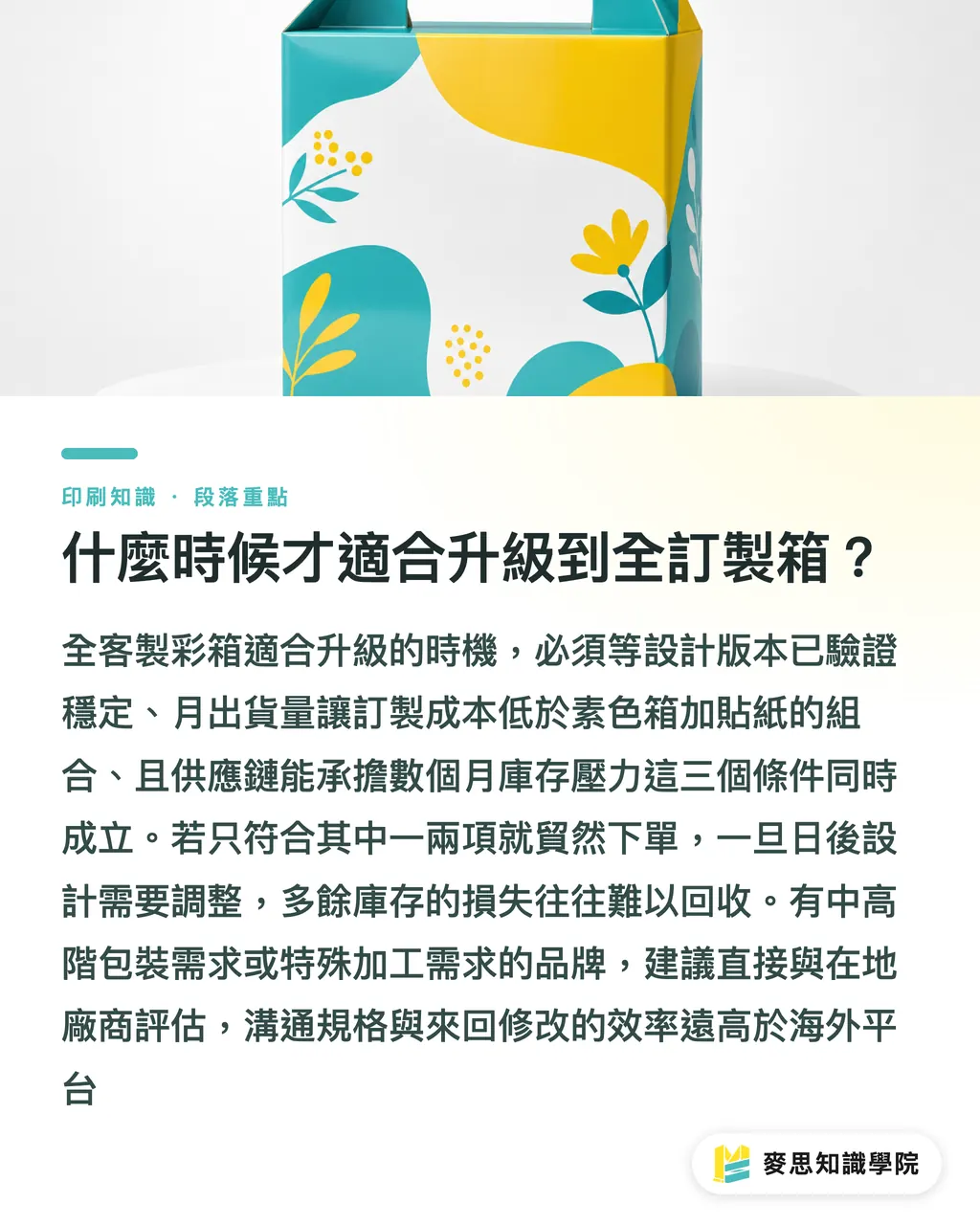
When is the right time to upgrade to a fully custom box?
A fully custom printed box isn't the finish line, but it isn't the starting point either. In my judgment, the upgrade timing needs all three of these to be true at once:
・The fixed design version has been validated, and the market doesn't need frequent design changes
・Monthly shipment volume is steady enough that the per-unit cost of a custom box is lower than the combined cost of plain boxes plus stickers
・The supply chain is stable enough to absorb 3–6 months of custom packaging inventory
Rushing into a custom box order when only one or two of those conditions are met means that when the design inevitably needs to change, all that cost gets stuck in deadstock
Brands that need a mid-to-high-end fully custom packaging solution, or have specific material and finishing combinations in mind, can get an evaluation from MINDS. A local shop communicates spec details way faster than an overseas platform, the admin cost of going back and forth is night and day
Key takeaways
・The high cost on overseas packaging platforms is structural: plate fees, customization fees, and shipping stack up. Small orders are inherently a bad fit
・The lowest-risk test path is three pieces: plain box as the base, stickers to validate visuals, belly bands to fill in info. Only after validation do you integrate into a custom box
・When requesting quotes, ask about "mixed-version feasibility" and "total landed cost." Comparing print unit prices alone gets you misled by base quotes
・QA criteria need to be nailed down before the order, especially color variance range, material specs, and cut accuracy
・Timing for upgrading to a fully custom box: validated design version, shipment volume past the threshold, inventory capacity in place. All three need to hold at the same time before you move
Further thoughts
From a sourcing strategy angle, the biggest decision mistake e-commerce startups make with packaging isn't picking the wrong vendor, it's compressing "design validation" and "scaled procurement" into a single step. Phased sourcing isn't complicated, but making it actually work means the buyer writes the swap-version conditions, minimum reorder quantities, and color-matching standards into the RFQ or purchase contract up front. Otherwise every batch becomes a renegotiation, and the flexibility advantage of small batches just gets ground down by admin overhead
For local printers, this customer segment has a specific trait: the buyer usually packs and ships the orders personally, so their feel for materials and print is more direct than a typical corporate procurement person. If the first delivery gets them to pack a piece by hand and know it's right, the scaled orders that follow usually don't go anywhere else
Further reading
FAQ
- What's the smallest batch digital printing can start from?
- Local digital printers typically take orders starting at 50–100 pieces, with some shops going lower. The key thing to confirm is whether they allow mixed versions (different designs within one order). If mixed versions are allowed, the flexibility is actually there
- What's the main difference between overseas packaging platforms and local digital printers?
- Overseas platforms like Packhelp have rich design templates and a visual workflow, but once you add international shipping and plate fees, the per-unit cost on small batches runs high. Local digital printers have lower plate fees, shorter proofing cycles, and faster communication, but their design support is thinner, you need to bring print-ready files yourself
- What specs should I confirm before sourcing stickers and belly bands?
- When requesting a quote, confirm the material (PVC waterproof vs. coated paper), adhesive type, weight, cut size, and whether custom shapes or rounded corners are supported. These directly affect the use case. Sorting it out before ordering is way easier than discovering the spec is wrong after delivery
- How do I control budget risk on my first custom packaging purchase?
- Ship with plain generic boxes paired with branded stickers first. Only after validating that the unboxing visual works should you evaluate the custom box timing. Don't let your first batch of custom packaging exceed 2–3 months of forecasted sales, so if the design needs tweaking you aren't locked into inventory
- What should a buyer understand about the difference between digital and offset printing?
- Digital printing needs no plates, supports mixed versions, and handles small quantities, it's the right fit during design validation. Offset printing carries higher plate fees but the per-unit cost drops with volume and color consistency is more stable, that's the fit for scaled production after the design is confirmed. The two complement each other; one doesn't replace the other
Related articles
The Print × AI weekly
The print and AI know-how designers, brands and enterprises can use before they commit — one email, every week
MINDS Free Tools
Spine width and imposition calculators — skip the manual math, free in your browser.
MINDS Group
Need actual printing or gifting services?
From premium printing to online ordering and festive gifts — the MINDS Group sister brands take it from here.