

Why has demand for short-run packaging clearly heated up in recent years?
Bottom line up front: it's not that digital printing tech suddenly got better, it's that brand-side risk tolerance shifted
From the clients I've been talking to lately, the frequency of "let's do a small batch first, confirm sell-through, then scale up" requests is way higher than it was three or four years ago. Two forces are pushing at the same time: cost pressure and SKU explosion. The US has kept stacking tariffs on paper, lumber, and aluminum, and imported consumables in Taiwan get pulled along. In an environment where raw material costs aren't easing, brands instinctively want to lower first-batch inventory risk. On the other side, e-commerce has ballooned SKU counts. The same product line running five flavors and three language versions on packaging at the same time isn't just a big-brand problem anymore, mid-sized brands are running into it too
Structural shifts in the North American printing industry back this up. The 2026 Printing Impressions 300 ranking shows a clear shake-up this year: Transcontinental dropped from #3 to #7, mainly because it sold its packaging business to ProAmpac for $2.1 billion, so a lot of traditional packaging capacity keeps consolidating into a few large players. Meanwhile, Cimpress, built around customization, held steady at #2 with $3.4 billion in total sales. Both moves point to the same thing: the packaging market is splitting into two ends, with traditional high-volume capacity consolidating while demand for custom flexibility keeps growing

When should short-run digital packaging be the first pick?
If any of these conditions apply, short-run digital packaging usually wins on total cost over traditional offset:
・New product first batch: volume is low, market feedback isn't in yet, and offset's plate costs plus minimum order quantities tend to turn that first batch into dead inventory, with the design changing before it even sells through
・Multi-SKU parallel runs: the same packaging needs to come out in 5+ flavor, language, or regional versions at once. Digital doesn't need a separate set of plates per version, so the savings go beyond plate fees, into vendor communication and version management time
・Seasonal or promo-limited packaging: designs that expire after a campaign window; pressing a large run is basically manufacturing waste on purpose. Short-run keeps stock matched to actual sell-through
・E-commerce shipping custom boxes: small batches, fast turnarounds, frequent design updates, these are the three baseline requirements of e-commerce packaging, and traditional offset loses to digital on every one
When does offset actually come out ahead? When specs are locked, it's a single version, volume is high (roughly past a few tens of thousands per drop), and you need finishing like foil stamping, embossing, or special spot colors. That's when offset's per-unit cost edge shows up
Beyond unit price, what else should you compare when sourcing?
A lot of procurement windows lose money staring only at "per-piece cost" without folding in hidden costs. From what I've seen, the real gaps between short-run digital and traditional offset on the procurement side cluster in four spots:
・Plate fees and minimum order thresholds: digital plate fees are near-zero or zero, minimums can start in the hundreds; offset plate fees run from a few thousand to tens of thousands of NTD depending on size and color count, so small volumes spread across them end up costing more overall
・Lead time: short-run digital usually ships in 5–10 business days; offset involves plate making and press scheduling, and rush surcharges get steep fast
・Revision cost: copy or design changes on digital go straight from the revised file to output, no new plates; any change on offset triggers plate fees, and the later the change, the bigger the hit
・Inventory risk: bulk stock that doesn't sell turns into waste; short-run orders in batches keep inventory close to zero
When asking for quotes, try asking the vendor one question: "What's the minimum order quantity for this spec, and how much does unit price drop past that?" That question exposes the vendor's cost structure fast, and tells you which road is actually cheaper
If you have custom packaging needs but aren't sure which way to go, the consulting team at MINDS Printing can give an initial read based on your specs and volume

Which spec questions should you ask vendors during quoting?
The usual pitfall with short-run packaging quoting isn't miscalculating the price, it's not nailing down the spec. Here are the most commonly missed confirmations from the procurement side:
1. Substrate and basis weight: folding cartons, flexible packaging, stickers, and labels each suit different print methods, and substrate thickness directly affects forming results and shipping durability, so ask together
2. Finishing options: coating type (water-based, UV, matte film), foil stamping, embossing. Digital printing shops don't always cover everything, but these processes hugely affect brand image. Missing them is the main reason for surprise add-on charges later
3. Color matching standards: if the brand specifies a Pantone spot color or has strict color consistency requirements, confirm the vendor's color management capability up front
4. Maximum print area: large-format packaging designs may exceed the digital machine's printable area, check first
5. Rush order and reorder policy: can a reorder ship within one to two weeks after the first batch, and what's the lead time. E-commerce brands especially need this nailed down
How do you make sure finished output doesn't drift from the proof during acceptance?
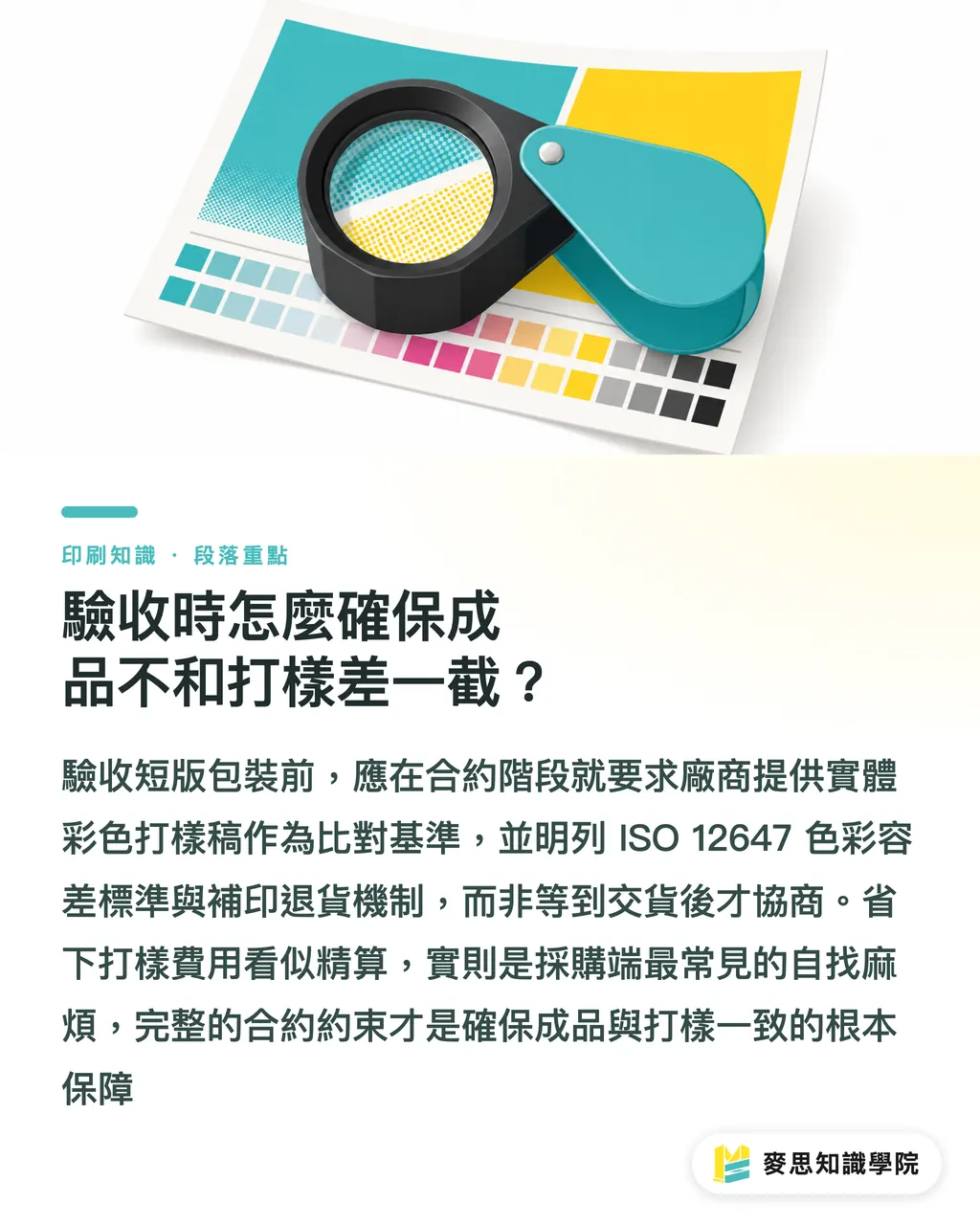
Acceptance on short-run packaging needs a clear baseline locked in before the contract, because digital's batch-to-batch color control works differently from offset's
A few clauses worth writing into the contract:
・Require the vendor to provide a physical color proof (not a digital file) as the formal acceptance benchmark. Hand feel, color, and finishing effects all need to be locked in at the proof stage
・Specify a color tolerance standard: if the brand has color management requirements, the contract can cite ISO 12647 (the international print color standard with tolerances widely adopted across the industry) as the benchmark
・Set reprint or return clauses: short-run volumes are small, so if defect rates run high, there needs to be a clear remediation mechanism, not something worked out after delivery
Proof fees usually can be credited against the subsequent production order. Skipping the proof to save that small fee is the most common self-inflicted wound on the procurement side
For standardized packaging needs, you can also look at online ordering platforms like MINDS Print. Transparent specs, real-time pricing, good fit for rush small-batch label and sticker needs
Key takeaways
・The core edge of short-run digital packaging is low minimums, fast lead times, and no plate fees on revisions. It fits new product trials, multi-SKU runs, and seasonal demand. Fixed specs with high volume is offset's home turf
・When comparing quotes, fold plate fees, revision costs, and inventory risk into the math; don't stare only at per-piece price
・Before requesting quotes, lock down three things, volume, number of versions, and lead time tolerance, and you've basically decided which road to take
・Finishing (coating, foil, emboss) is the most easily missed line in quoting, and should be confirmed at the quoting stage for whether the vendor can handle it
・Acceptance benchmarks need to be locked before signing the contract. A physical color proof plus a color tolerance standard is the most direct way to protect the buyer
Extended thoughts
A lot of Taiwan enterprise procurement windows, when sourcing packaging, fall into the habit of mixing "comparing quotes" and "choosing the production type" into one step. The result is using offset quotes to squeeze digital vendors, or expecting offset quality at digital prices, both ends end up with gaps. The more practical move is to finish the production-type decision first, then compare among vendors of the same type. I'd suggest procurement teams build a simple internal sourcing checklist: annual volume, number of versions, how often the design changes. Once those three questions are answered, you know which kind of vendor to look for, and quote turnaround gets much faster after that. This isn't about saving the vendor effort, it's about saving your own procurement cycle
Further reading
FAQ
- From what volume does offset start to beat digital on cost for the same spec?
- There's no fixed number, because spec variation is too wide. As a rough rule: if a single version needs past a few tens of thousands and the design isn't changing soon, offset's per-unit cost starts clearly beating digital. At low volumes with many versions, digital is almost always cheaper
- Is the color from digital printing very different from traditional offset?
- For typical commercial colors on everyday paper stocks, the gap has gotten small, and modern high-end digital presses keep widening gamut coverage. But if a brand specifies a strict Pantone spot color or needs special fluorescent and metallic colors, digital still has limitations in those ranges. Spell out your color requirements when asking for quotes so the vendor can confirm
- What's the most commonly missed spec when requesting quotes?
- Finishing gets overlooked the most. Coating, foil stamping, embossing, digital shops don't always cover all of them, but brands often don't pin this down at the quoting stage and only discover the add-on fees or need to switch vendors at delivery. Another common blind spot is substrate basis weight and thickness, which directly affects how rigid the finished package feels
- Is short-run digital packaging a good fit for e-commerce custom shipping boxes?
- Very much so. E-commerce packaging runs in small batches at high frequency with fast design iteration, and offset's plate fees plus minimums don't play nice with e-commerce brands. Short-run digital can start in the hundreds and ship quickly, matching the rhythm of e-commerce warehouse stock
- How should acceptance clauses be written to protect the buyer?
- Three points worth putting in: use the vendor's physical color proof as the acceptance baseline, apply color tolerance per ISO 12647, and require reprint or refund if defects exceed an agreed ratio. All three tend to get skipped on small short-run jobs, and that's exactly where disputes blow up
Related articles





The Print × AI weekly
The print and AI know-how designers, brands and enterprises can use before they commit — one email, every week
MINDS Free Tools
Spine width and imposition calculators — skip the manual math, free in your browser.
MINDS Group
Need actual printing or gifting services?
From premium printing to online ordering and festive gifts — the MINDS Group sister brands take it from here.