

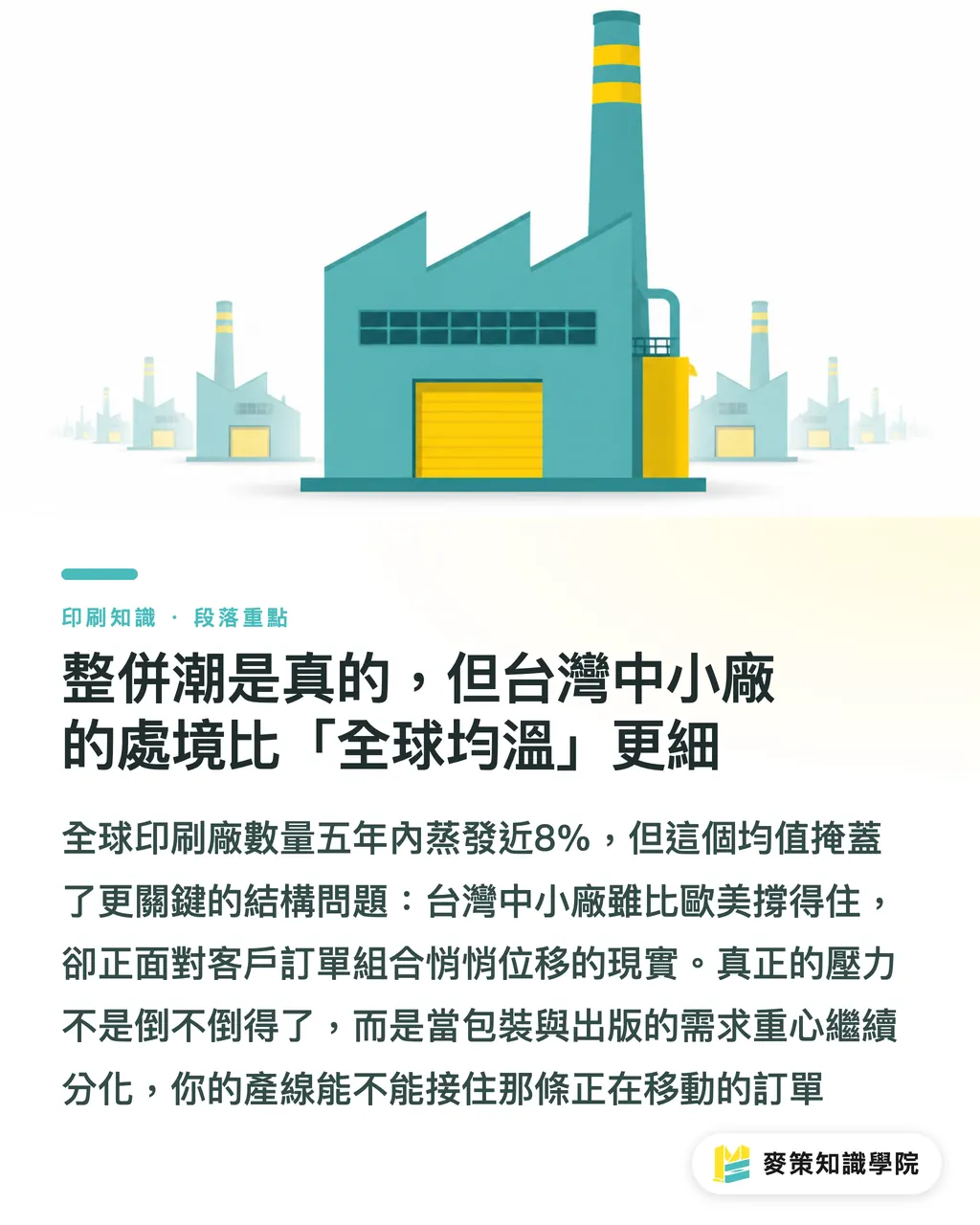
The Consolidation Wave Is Real, but Taiwan's Small Shops Face a More Nuanced Reality Than the Global Average
Smithers' report 'The Future of Print Enterprise Demographics to 2031' delivered cold numbers this year: the number of printing companies worldwide dropped to 353,707 in 2024, down 7.9% from 384,102 in 2019. Over the same period, industry headcount fell from 3.9 million to 3.4 million, a 12.7% drop. Publishing and graphic printing took the hardest hit, while packaging and labels held up relatively well
Putting this data in the context of Taiwan paints a clearer picture:
・ Asia's share of global print enterprises has risen to 41.9%. Taiwan sits right in this mix, and the overall decline here is slower than in Europe and the US. That is a fact
・ North America saw the biggest drop in headcount, while Latin America and Eastern Europe had the sharpest percentage drops in company counts. Taiwan's drop is comparatively mild, but 'comparatively mild' never means safe
・ Every single one of the five major trends highlighted in the report (weak end-market demand, Asia's rising share, automation reshaping labor, hiring difficulties, and cautious AI adoption) will land directly on your shop floor
My take: reciting numbers is pointless. The structure behind them is where the real pressure on small shops comes from. The pressure is not 'will we go under next year?' It is 'your clients' order structures are shifting, and can your production line actually handle it?'
Path 1: Move Toward High-Value Digital Printing and Custom Packaging
The essence of this path is defending price per unit area, using short-run variety and customization to counter the cost advantages of large-scale plants. The Smithers report puts it plainly: publishing and graphic print demand is falling, but packaging and labels keep growing, and the digital print market has topped 300 billion USD. Put those two signals together, and the direction is clear
Execution requires three things:
・ A digital printing press (UV inkjet or aqueous inkjet, depending on your primary substrates). This is a capital expenditure ranging from millions to tens of millions of NTD
・ At least one person skilled in Color Management who can consistently handle ICC Profile matching and device calibration
・ A quoting and scheduling workflow built for short runs, multiple versions, and rapid revisions. This is harder to build than buying equipment
The upside: high gross margins and strong client retention (once you handle custom packaging, designers rarely switch vendors). The downside: heavy upfront investment, the need for talent who speaks the designer's language, and a grueling client acquisition period during the first three years. If you already have post-press finishing capabilities (die-cutting, foil stamping, spot UV), the barrier to entry here is much lower
Path 2: Pivot to Certified OEM Processing for Sustainable Substrates
The EU PPWR (Packaging and Packaging Waste Regulation) took effect on August 12, putting teeth on the 'sustainability pressure' trend in the Smithers report. For Taiwan's small and mid-sized shops, the opportunity lies in 'certified contract manufacturing,' not in trying to launch your own eco-friendly branded products
Here is why: product lines complying with FSC (Forest Stewardship Council), PEFC (Programme for the Endorsement of Forest Certification), or EU recycled content ratios demand verifiable compliance documents at every single link in the supply chain. Most brand clients cannot maintain a fully compliant in-house production line. They will outsource to satellite shops that have the certifications and can produce at scale
The barrier on this path is not machinery, but three soft skills:
・ Document management: full traceability for every batch of raw substrate, recycled material ratio, and chemical usage
・ Certification maintenance: annual audit costs and staffing for FSC CoC (Chain of Custody) or ISO 14001 (Environmental Management Systems) must be factored in
・ Client targeting: aim at brands and trading companies, not directly at design studios
The upside: relatively stable orders (once compliance is cleared, clients rarely switch suppliers) and above-average gross margins. The downside: long certification application cycles, audit risks, and the need to redraw your compliance boundaries whenever European or US regulations change. If you have already worked with export clients or trading companies, this path is closer than you think
Path 3: Plug into Large Distribution Networks as a Satellite Supplier
This path is easiest to overlook because 'being someone else's satellite' sounds like a downgrade. But based on what I see on the ground with small shops, this is actually the lowest-risk option with the most reliable cash flow, especially for shops with older equipment that cannot afford an immediate leap into digital presses
The logic goes like this: major distributors like Antalis, Ingram Content Group, and Fedrigoni (or regional paper and substrate distributors) hold long-term contracts with multinational clients. They need regional satellite shops to handle:
・ Fast turnaround within the local region
・ Specialized post-press finishing
・ Local compliance required during client audits
A satellite shop does not compete with giants for business. It handles the parts where big players do not want to build their own lines. The costs of entry here:
・ Passing distributor supplier audits (usually requiring ISO 9001, verified capacity proof, and stable financial statements)
・ Willingness to accept lower unit margins in exchange for predictable order volumes
・ Integrating with the distributor's ERP (Enterprise Resource Planning) or order platform, which is often underestimated
The upside: predictable orders, steady cash flow, and no immediate need to replace machinery. The downside: limited bargaining power, an obvious profit ceiling, and heavy dependence on a single channel. If your shop already handles regional commercial jobs and struggles with uneven press capacity, this is a pragmatic option to fill capacity first
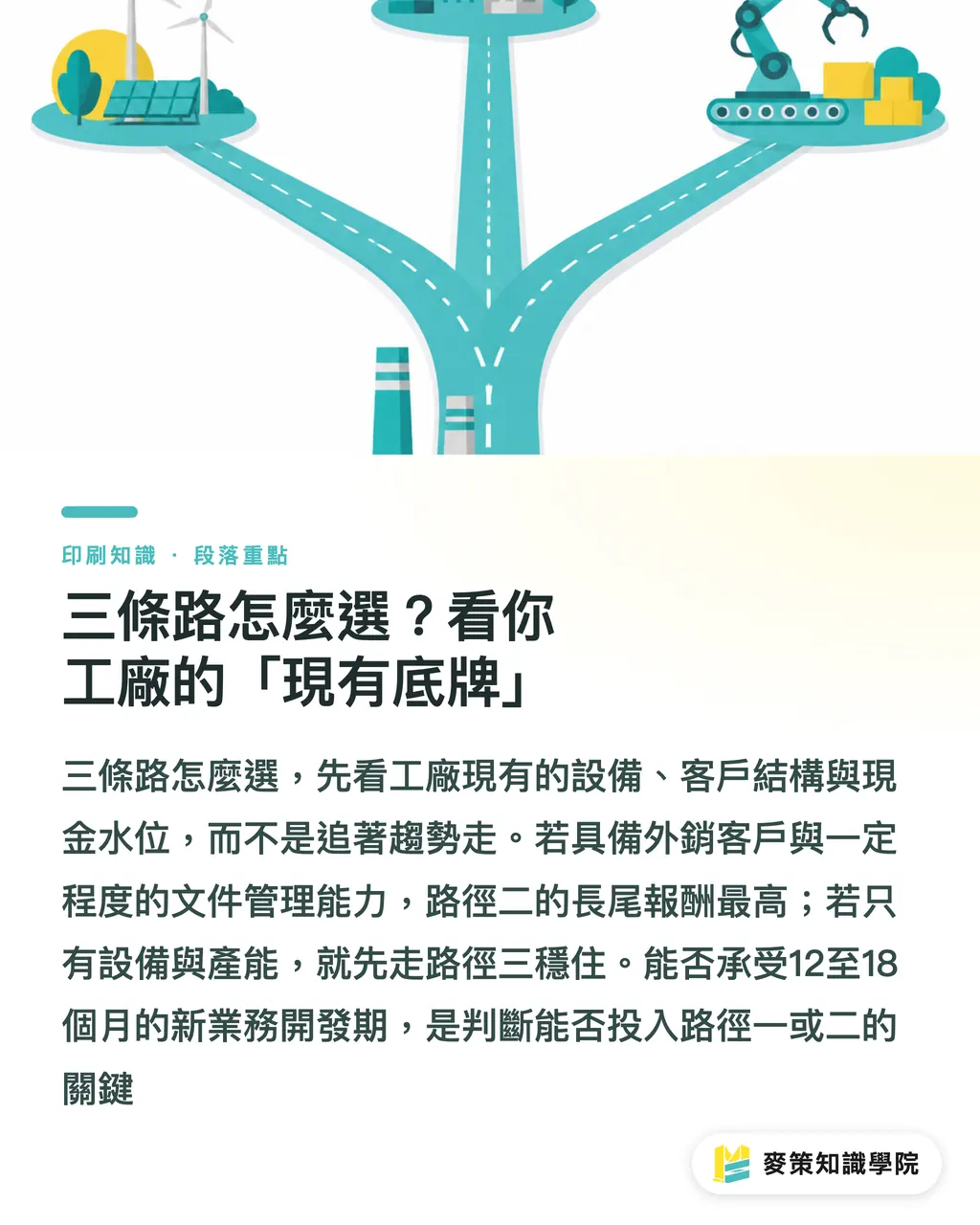
How to Choose Between the Three Paths? Look at Your Shop's Current Cards
When helping clients make strategic decisions, I never start with macro trends. I look at three hard realities first:
・ Equipment status: Is your primary machine traditional offset, or do you already have digital presses? The former leans toward Path 3, the latter toward Path 1
・ Client structure: Do you mostly serve export and brand accounts, or design agencies and local shops? The former points to Path 2, the latter to Path 3 or 1
・ Cash reserves: Can you withstand a 12 to 18-month new business development cycle? If yes, take Path 1 or 2. If not, anchor yourself with Path 3 first
There is no single 'right answer.' But here is a blunt assessment I give clients: if your shop has both export accounts and decent document management capabilities, Path 2 offers the highest long-tail payoff. If you only have machinery and raw capacity, take Path 3 honestly. There is no shame in that
Key Takeaways
・ Global printing enterprises shrank by 7.9% over five years, but Asia's share climbed to 41.9%. Taiwan is not out of opportunities, the opportunities have just changed shape
・ The three viable paths for small shops are digital custom packaging, certified sustainable OEM processing, and acting as a satellite supplier for large distributors. Your choice depends on equipment, client base, and cash
・ Sustainability compliance (EU PPWR, FSC, PEFC) is not an expense, it is a ticket to play. No certificate, no orders
・ Becoming a satellite shop is not a demotion. It is the lowest-risk starting point for transformation with the most dependable cash flow
・ The digital print market has surpassed 300 billion USD, but that dividend only goes to those ready with solid color management and rapid quoting workflows
Further Considerations
The shared signal across these three paths is clear: competition in print has shifted from 'how big are my machines' to 'what kind of ecosystem can I plug into.' For players like MINDS, which runs dual-track services covering mid-to-high-end bespoke commercial print (MINDS) and budget self-serve online print (Mai Print), this means client demand will keep polarizing. One end heads toward complex customization, while the other moves toward stripped-down self-service. The takeaway for Taiwan's small shops: you do not need to capture every segment yourself. Finding your specific place in the ecosystem is far more practical than blindly rushing to buy new equipment. Your immediate next step: review your top 10 clients over the past 12 months. Are their orders growing or shrinking? Are their specs getting more complex or simpler? That signal will tell you straight up which path to take
Further Reading
FAQ
- Can small and mid-sized print shops in Taiwan still do traditional offset printing?
- Yes, but offset should be positioned as reliable satellite capacity for steady orders rather than your main growth engine. Growth must come from digital printing or sustainability compliance
- Is FSC certification worth applying for? How much does it cost?
- It is worth it, but depends on your client makeup. If export brand clients make up less than 30% of your business, build a solid client pipeline first before pursuing certification. Otherwise, auditing and documentation costs will eat up your margins
- How much does a digital printing press cost?
- Entry-level UV inkjet machines run between several million and over ten million NTD, depending on print width and speed. That does not include dedicated color management staff or backend workflow overhaul, which typically adds another 30% to 50% to the total investment
- If we become a satellite supplier for large distributors, will we get locked in?
- Pricing power will be limited, but order predictability is high and you do not necessarily have to buy new machines. For small shops struggling with cash flow, this is a pragmatic stepping stone to stability, not a dead end
- What is the actual impact of the EU PPWR on Taiwanese print shops?
- Since taking effect on August 12, packaging exported to the EU faces strict scrutiny on recycled material ratios, traceability, and material reduction. Without compliance documentation, you cannot enter buyer supply chains. This is about qualifying to take orders, not an empty environmental slogan
Related articles



The Print × AI weekly
The print and AI know-how designers, brands and enterprises can use before they commit — one email, every week
MINDS Free Tools
AI background removal, a LINE sticker maker, spine & imposition calculators — all free, right in your browser, no upload.
MINDS Group
Need actual printing or gifting services?
From premium printing to online ordering and festive gifts — the MINDS Group sister brands take it from here.