

Where exactly is the print industry talent gap stuck?
PINE Academy, under the US New England printing industry association PINE, recently put out a warning through its CEO Alyssa Summers: commercial printing is being squeezed by three pressures at once, including the accelerated retirement of senior technicians, younger generations who barely know the printing industry exists, and a vocational training system that can't keep up with the speed of digital transformation. The talent gap isn't coming, it's already here. PINE New England is the trade association serving printers and suppliers across the New England region in North America, and PINE Academy is its education and training arm
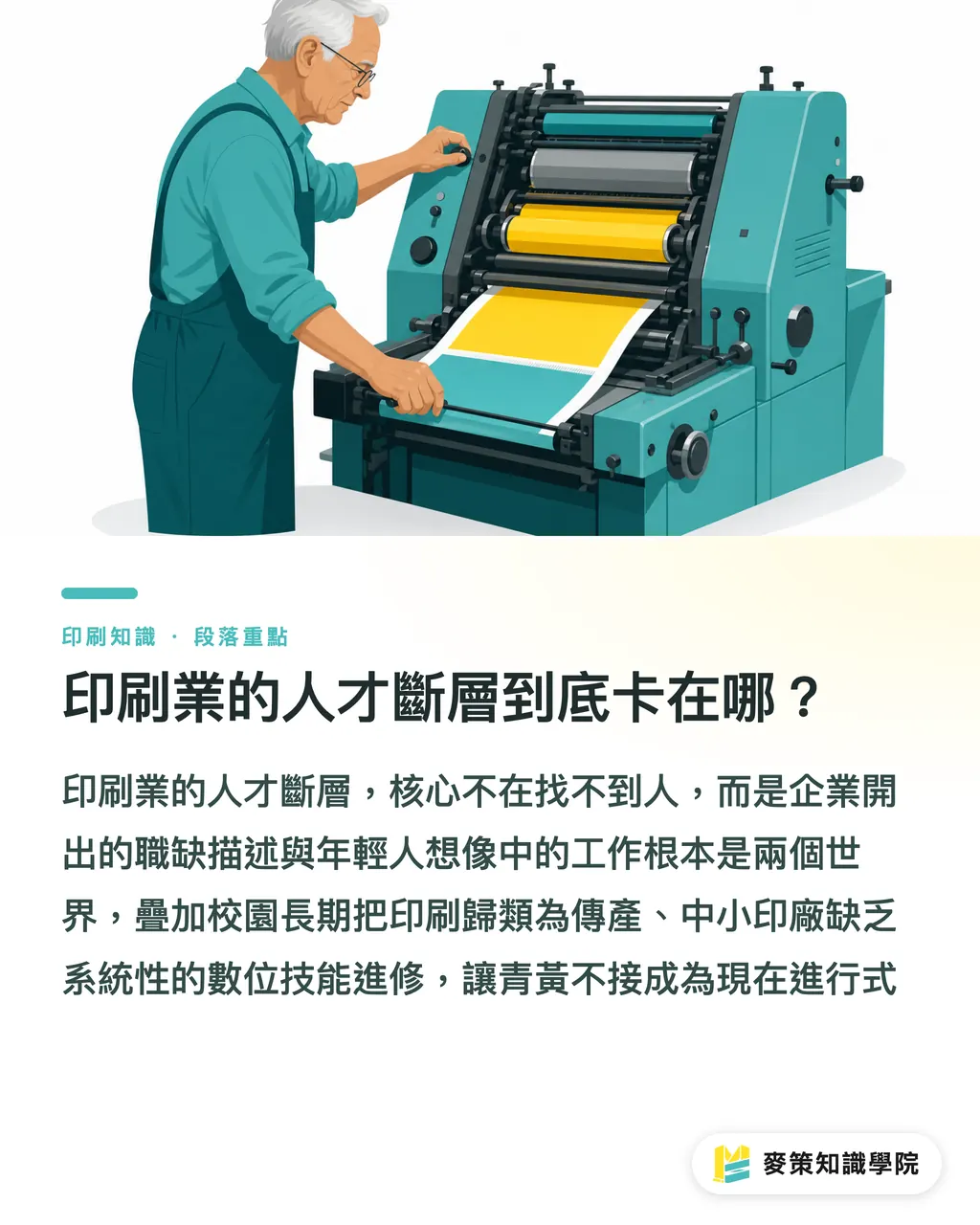
The situation in Taiwan is essentially the same, it just gets talked about less. After years on production floors and at client sites, the thing that hits me hardest is this: over the past month walking through several mid-size print shops, the veteran press operators standing at the machines are on average well past fifty, operators under thirty make up less than a third of the floor, and even fewer are willing to learn digital prepress and color management. The core problem isn't the simple "can't find people." It's that "the job we post and the job young people picture in their heads are two completely different worlds"
That gap shows up in three specific places:
・Job descriptions are stuck ten years ago, still saying "printing press operator," with no mention that what operators actually run today are digital control interfaces and automated workflows
・On campus, printing has long been filed under "traditional industry," so design, IT, and media students never consider a print shop as a career option
・On-the-job training resources are concentrated at a handful of large printers; the bosses at mid-size shops are too busy chasing orders to set up any systematic digital skills training for their staff
All three squeeze together, and the gap surfaces on its own
Why can't this wait?
The PINE CEO's original piece flags a key point: talent shortages eat directly into line efficiency, quote turnaround, and customer satisfaction. When a veteran operator retires, the machine tuning parameters, ink formulas, and troubleshooting logic stored in his head simply evaporate if no digital system picks them up. This isn't something you fix by buying new equipment. The know-how lives in a veteran's hands and judgment, and a shiny new machine without anyone who can tune it is still useless
Taiwan's mid-size print shops feel this even more sharply. The reasons:
・Quoting power drops: without people who know digital prepress and automated scheduling, estimate times stretch and margins get squeezed
・Delivery risk climbs: critical know-how sits with a handful of people, so sick days or resignations mean a line stop
・The order ceiling gets lower: clients want small batches, multiple versions, customization, and traditional lines can't swallow that, so if no one can run the digital workflow, you just watch the orders walk away
Put plainly, the talent gap isn't an HR problem, it's an operations problem. The longer you sit on it, the fewer orders you can take
Three recruitment paths Taiwan's mid-size print shops can start today
These three paths don't cost much and can move right now. They're approaches I've actually seen work in practice
① Redesign the job title: swap "printing" for "digital production line"
Rewrite the recruiting copy from "printing press operator" to "digital production line operator" or "print digitalization technician," and spell out the actual work: operating digital printing equipment, handling color management and quality inspection, supporting automated scheduling and data processing. This isn't sugarcoating, it's just reflecting reality. Print shops stopped being a pure-craft industry a while ago
The recruiting channels need to change too. Don't just post on 104. The places design students, information management students, and media design students actually browse are Dcard's job board, CakeResume, and Yourator. Get the posting where they actually show up, and pair it with a short "day in the life" video or Instagram story, that does more than three pages of JD
② Run on-the-job training on a "digital skills add-on" track
For existing staff, plan a three to six month digital skills program with three main pillars:
・Digital prepress: PDF proofing, color management basics (ICC profiles, the standard files that describe color conversion between devices), prepress file specifications
・Digital machine operation: software interfaces on newer digital presses, automated scheduling, cloud monitoring
・Customer data handling: variable data printing (a technique where each piece has different content, like serial numbers or names), CRM basics
Training resources can come from several directions: vendor education (usually bundled with equipment purchases), IDB in-service training courses, and mid-to-large print shops that have already run a digital workflow, like MINDS Printing, which actually make solid observation and exchange partners
③ Plug into campuses and communities, grow your own talent pool
Don't wait for schools to come to you. Make the first move:
・Talk to local design and IT departments about industry-academia partnerships or internships, and offer "digital printing production line" content, not "traditional line" content
・Sponsor or join student design shows and printing-related community events, get your brand and the actual work seen
・Build an internal "mentor system" where senior staff take on newcomers, and systematically document the feel and judgment logic instead of leaving it all in someone's head
This path is slow, but in three years you'll see results, and in ten it'll be what separates you from the rest of the trade

Two traps mid-size print shop owners fall into most often
Trap one: handing recruitment off to a job bank and assuming it's handled. The problem was never how many resumes come in, it's whether the posting actually reaches the right people. Until you rewrite the job description, throwing money at more channels is wasted budget
Trap two: training only on machine operation, not digital literacy. The bottleneck today usually isn't "nobody can run the machine," it's "the machine's running but the prepress file is off, the color won't match, the client data won't feed in." Machine operation is just the tip of the iceberg, and underneath sits the whole chain of digital workflow capability
Fix these two first, and the rest of the playbook actually has somewhere to land

Key takeaways
・The print industry talent gap is fundamentally a generational perception gap and a skills transition speed problem, not just a headcount shortage
・Digital and automation skills are now the entry ticket for recruiting the next generation at print shops, not a bonus
・Rewrite the job posting, add value to training, connect with campus. All three legs need to move at once for this to hold up
・On-the-job training beats hiring outsiders on cost, because existing staff already know the line, and stacking digital skills on top shows results fastest
・Veteran operators' feel and judgment need to be documented systematically. Don't let the know-how evaporate along with their retirement
Further thinking
For Taiwan's mid-size print shop owners, the single most useful step right now is this: one evening, pull out the "printing press operator" posting you currently have running, rewrite it from a "digital production line operator" angle, list the actual digital tools and workflows the role touches, and put it on the job platforms your target age group actually browses. Then at the same time, audit your current staff's digital skills gaps and lay out a three to six month training plan. Both of these can kick off within a week, no one has to give you permission. For the design and procurement side, understanding how a print shop's talent pool is structured helps you set more realistic delivery timelines and file specs, and that's the invisible foundation of smooth collaboration
Further reading
FAQ
- Is the print industry talent gap really that serious?
- Yes. Accelerated senior technician retirements, younger generations who barely know the industry, and a training system that's fallen out of step are three pressures hitting at the same time. The reality on the floor at Taiwan's mid-size print shops lines up with the warning from the US trade association
- Without a big-brand halo, how can a mid-size print shop actually win over young people?
- Rewrite the job description, switch recruiting channels, and add value through on-the-job training. What younger workers want now is a clear skills growth path and digital work content, not a company name
- Which digital skill should on-the-job training start with?
- Start with three: prepress PDF proofing, color management basics, and variable data printing. These are the pieces existing staff can pick up fastest and that most directly affect your ability to win orders
- Do print shops really need to compete for IT or design graduates?
- Yes. Operating digital presses, automated scheduling, and customer data handling are essentially extensions of IT and design capability, and a traditional-industry background is no longer the only path in
- How do you keep the know-how a veteran takes with them when they retire?
- Set up a mentor system and systematically document machine tuning parameters, ink formulas, and troubleshooting logic. Pair that with digital monitoring and data collection tools, and turn craft feel into transferable knowledge
Related articles




The Print × AI weekly
The print and AI know-how designers, brands and enterprises can use before they commit — one email, every week
MINDS Free Tools
AI background removal, brand stamping, and a LINE sticker maker — free design tools, right in your browser, no upload.
MINDS Group
Need actual printing or gifting services?
From premium printing to online ordering and festive gifts — the MINDS Group sister brands take it from here.