
What is each company bringing to the table?
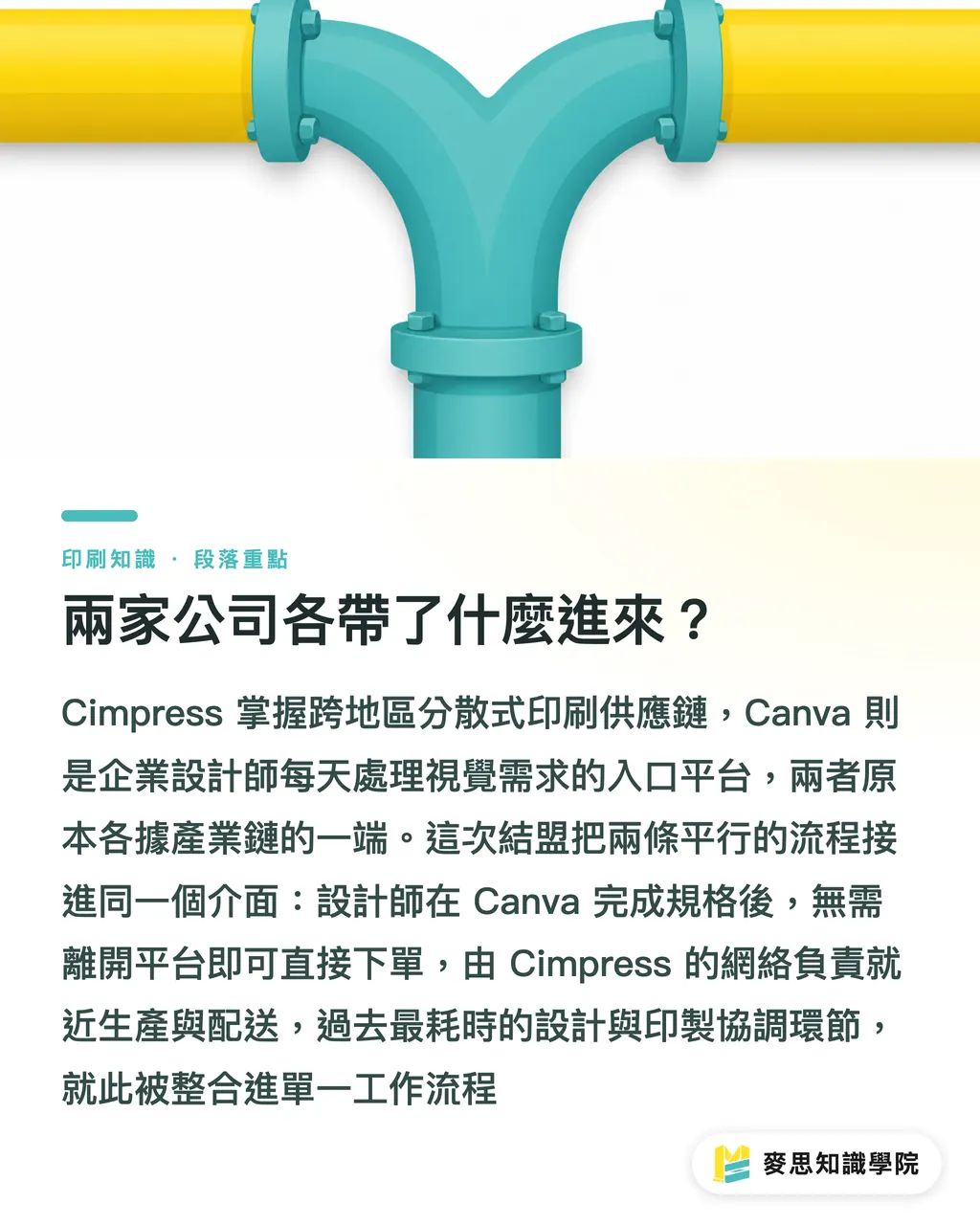
Cimpress brings a distributed print supply chain spread across multiple regions, Canva brings the design interface that in-house designers already use every day. This alliance is essentially splicing two industry chains that have always run parallel into a single workflow
Cimpress is a heavyweight in the global custom-print market, and most people have heard of Vistaprint, one of its brands. Its core capability isn't a single mega-plant but a distributed print supply network, with production nodes in multiple regions that can print and ship close to the order's destination. That's especially useful for corporate clients who need synchronized delivery across countries or cities, and it means small, varied orders don't have to be batched together just to be economical
Canva is the entry point on the design side. It lets marketers who don't know Illustrator crank out visual assets, and the enterprise version is already a daily tool for many mid-sized and large brands. Users are used to producing everything from business cards to social posts on it
Splicing the two together means: once a designer picks the specs in Canva, they can place the order without leaving the platform, and Cimpress's network handles the actual production and delivery. That middle stretch between design and finished product, the coordination step that has always eaten the most time, is now folded into the same interface
Where does the traditional buying process actually get stuck?
The problem almost always trips on two things: bleed and color mode
Bleed is the extra 3mm margin a print file needs beyond the finished size, so the trim doesn't leave a white sliver on the edge. Canva's design interface is built for screen display by default and doesn't auto-add bleed. Send that file to a traditional printer and the first round of rejection is, nine times out of ten, exactly this
Color mode is the other trap. Screens use RGB (red-green-blue additive color); printing presses use CMYK (cyan-magenta-yellow-black subtractive). These two color spaces don't cover the same range, so the bright colors you see in RGB usually come out darker and duller after conversion to CMYK. That gap is completely invisible in the Canva interface
The traditional workflow also costs time. The designer exports the file, procurement requests quotes, the shop reviews the file and confirms, it bounces back for revisions, the artwork is re-confirmed, and the fastest version of that loop still takes two or three days. When you're racing a deadline right before an event, that wait is the real bottleneck
In theory, the Canva × Cimpress integration is supposed to absorb all of this into the platform's backend, with spec conversion and file confirmation handled automatically, so procurement doesn't have to play middleman anymore
Three real changes on the buyer side
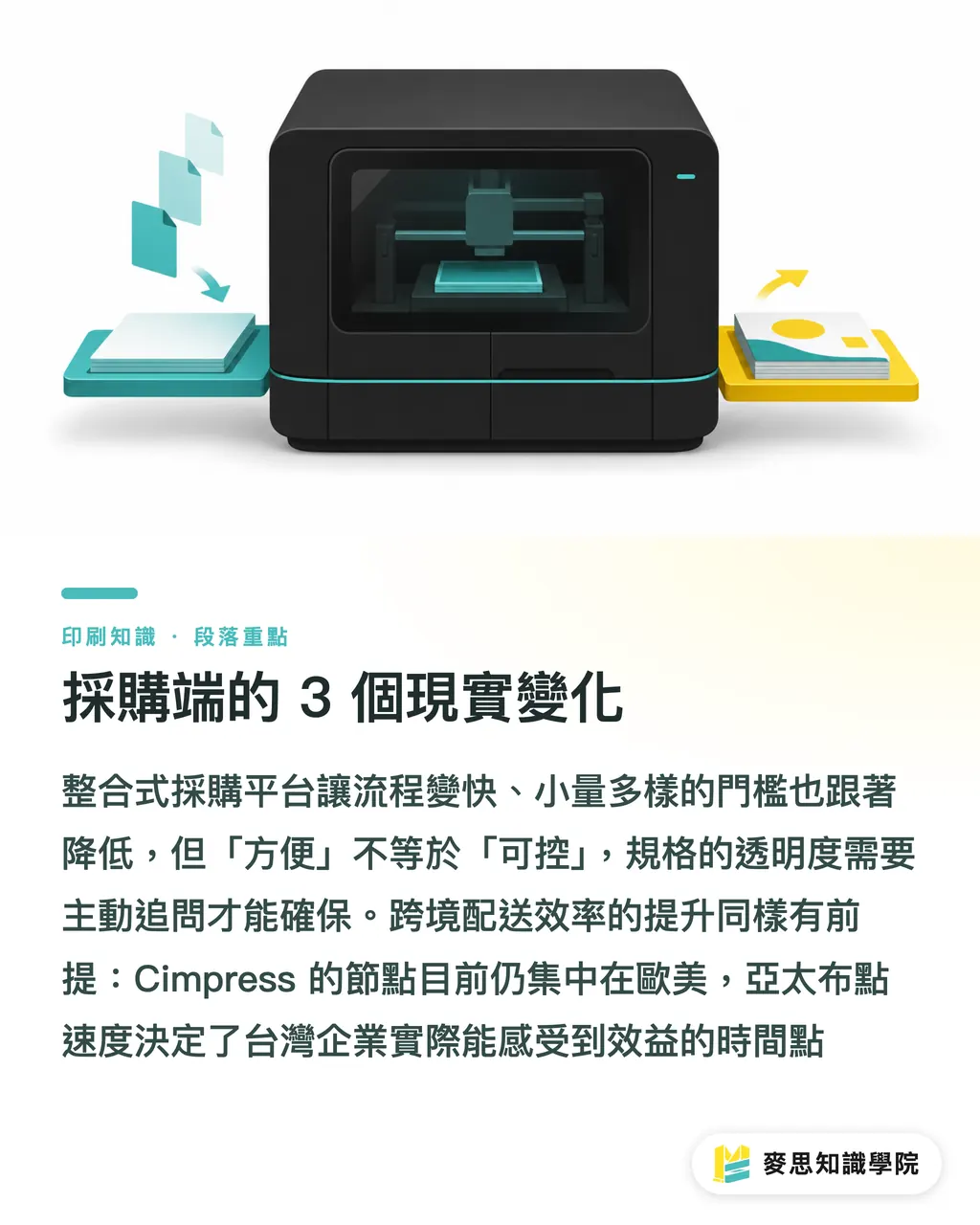
What the integrated workflow brings isn't just "more convenient", a few angles are worth pulling apart
First, the process is shorter, and visibility drops along with it. With a local vendor you knew exactly what paper weight was being used, whether it was matte or gloss lamination, what the trim tolerance was. When you order through a platform integration, the granularity of those specs may not be as fine as you'd like. "Convenient" and "controllable" are two different things, and the integrated workflow boosts the first one, while the second one only holds if you actively ask
・Second, the bar for small, varied orders drops. One of the traits of a distributed supply chain is
・that it doesn't need every production node running high volume to be economical. That means small quantities and version-heavy items no longer have to be lumped together to make sense, so a few dozen custom business cards and a few hundred event flyers can be handled as separate jobs without forcing them to share the same delivery window
Third, cross-border delivery can get faster, but only if the nodes are close enough. Cimpress's distributed nodes are currently concentrated in Europe and North America, and APAC coverage is still being built out. For Taiwanese companies that need synchronized print delivery across multiple points in Southeast Asia, the direction matters long-term, but the near-term benefit depends on how fast those APAC nodes come online
What kinds of jobs fit this route, and which ones don't?
Standard, repeatable jobs fit. Mid-to-high-end print with strict color requirements or special finishing doesn't. Don't rush to switch processes, figure out the line first, that's the practical move
・Standard materials (business cards, stickers, generic event flyers, folded leaflets): high spec repeatability, loose color requirements, small volumes. These are the best candidates for dipping a toe in. Run a test batch first to see the actual color shift and lead time, then decide whether to move them to the platform long-term
・Mid-to-high-end commercial print (brand books, key event collateral, anything with foil stamping or die-cutting): for these, keep going to a shop that can walk through every production step with you. MINDS Printing sits exactly here, prepress engineers catch the problems before artwork confirmation, not after the client opens the box
・Scattered reprints and rush jobs (small quantity, one-off items, no patience for the regular order cycle): Mai Strategy Printing runs an online ordering model that handles this kind of need fast, no need to negotiate with a vendor just for a few hundred pieces
Three situations where you need to be extra careful: first-time gifts to important clients, main visual output for major events, brand materials with strict Pantone requirements. No matter how convenient the platform is, these aren't the occasions to test a new workflow. Lock in the quality first, then decide the process, that order doesn't flip
What should Taiwanese SMEs do now?
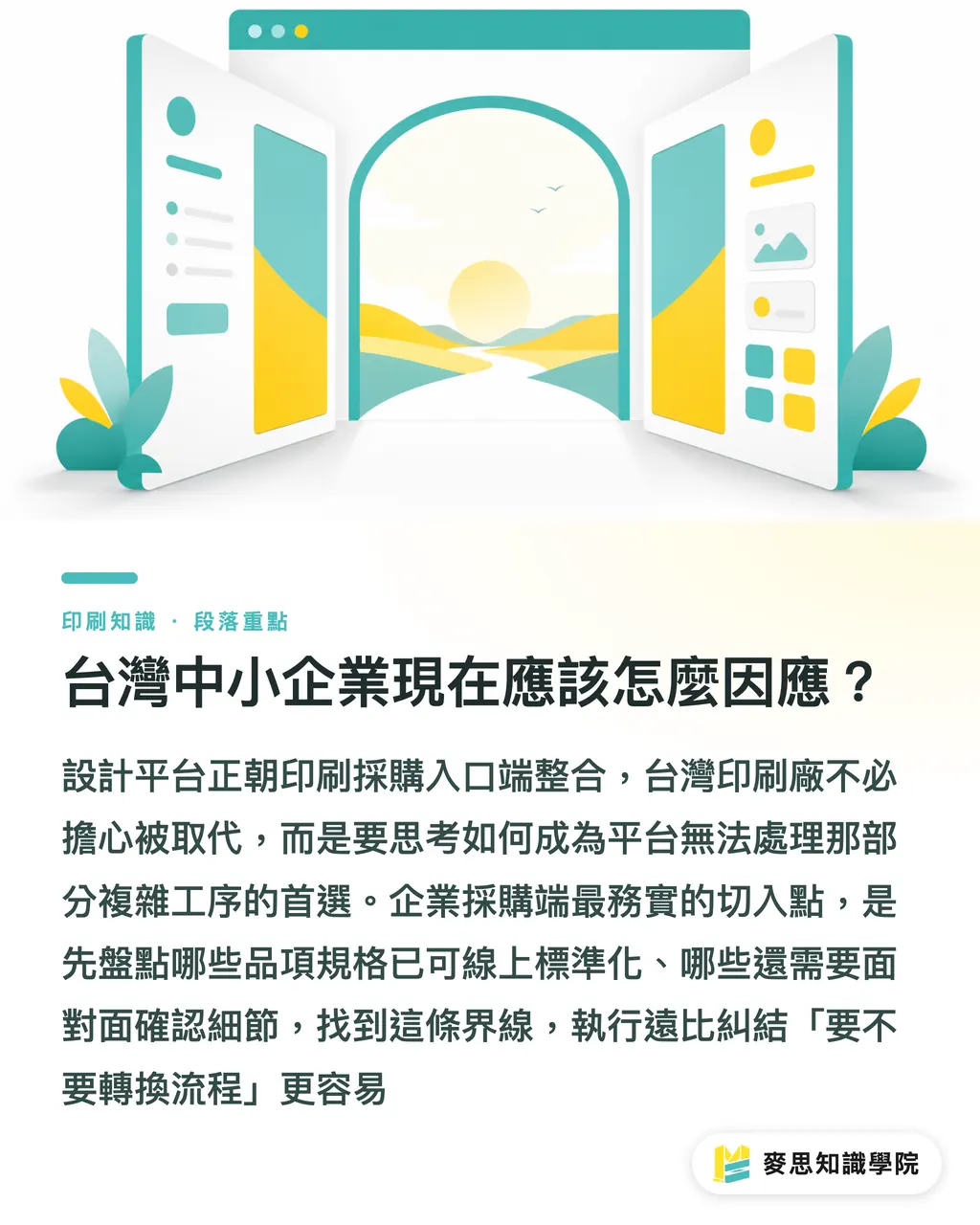
Zooming out, what this alliance confirms is: design platforms are moving toward the entire print buying pipeline's entry point, not just making visuals, but making it so your design becomes a physical thing sitting on a desk
For Taiwanese print shops, the real question isn't "will we get replaced?" but whether they can become the first-choice answer for the pieces the platform can't handle. For jobs with strict process requirements, solid artwork-confirmation communication actually becomes a stronger differentiator
For corporate buyers, start by mapping out your demand structure: which items are already standardized enough to go online, and which still need face-to-face confirmation on production details. Finding that line is easier to actually do than answering the big "should we switch processes?" question
Key takeaways
・The Canva × Cimpress alliance compresses the design-to-print coordination step, so corporate buyers no longer have to play middleman between designer and printer
・A distributed supply chain is a real advantage for small, varied orders, but Cimpress's APAC node coverage is still limited, so Taiwanese companies should discount the near-term payoff
・Integrated platforms make buying more convenient, but spec visibility drops at the same time, so actively confirming specs matters more than before
・Standard materials are the best fit for testing the waters; for items with strict brand colors or special finishing, don't use them as test cases for a new workflow
・Lock in the quality first, then decide the process, that order doesn't flip
Worth thinking about further
The most interesting thing here isn't Canva or Cimpress themselves, it's the direction this confirms: the design interface is becoming the entry point for print buying. Whoever can make "quality control" clear inside that entry point, that's where the real competition sits next
Concrete things Taiwanese SMEs can do right now:
1. Map your own print buying list, separate items that are "standard, can go online" from those that "need process-level communication", and draw that line
2. For standard items, set up a small platform test order, focusing on how your brand's primary color actually lands in CMYK and whether the lead time fits the need
3. For important print jobs, ask the vendor for a spec confirmation checklist, so prepress issues surface before artwork confirmation, not after delivery
Further reading
FAQ
- Can Canva actually print for me now?
- Through the Canva × Cimpress partnership, you can place a print order directly inside Canva after finishing the design, with Cimpress's distributed supply chain handling production and delivery. But actual availability and lead times for users in Taiwan still depend on how fast Cimpress's APAC coverage expands, so it's worth checking in the short term
- What is Cimpress and how does it relate to Vistaprint?
- Cimpress is one of the largest custom-printing groups in the world, and Vistaprint is its most widely known consumer brand. The group's core capability is a distributed print supply chain that lets orders at different locations be produced and shipped nearby, which fits the needs of corporate buyers working across countries or cities
- If I print through Canva, will the colors be accurate?
- This is the most common trap. Canva defaults to RGB color space, and there's already a gap between what you see on screen and what CMYK actually outputs. On top of that, different nodes in a distributed supply chain run different equipment, so for jobs with strict brand color requirements, color consistency needs to be confirmed explicitly, you can't rely on screen preview alone
- What kinds of print jobs are best suited for platform ordering?
- Items with high repeatability, standard specs, and loose color requirements fit best, such as business cards, stickers, and generic event flyers. For jobs with special finishing (foil stamping, die-cutting) or strict color requirements, go with a printer that can walk through every production step with you
- Should Taiwanese companies switch their print buying to a platform now?
- No need to switch everything at once. Try the water with low-risk standard items first, order a batch of business cards or stickers to test the actual color shift and lead time, and once it checks out, gradually move the jobs that fit onto the platform. Keep important print jobs on the original workflow with full artwork confirmation
Related articles


The Print × AI weekly
The print and AI know-how designers, brands and enterprises can use before they commit — one email, every week
MINDS Free Tools
Imposition calculator and preflight file check — free prepress tools, right in your browser.
MINDS Group
Need actual printing or gifting services?
From premium printing to online ordering and festive gifts — the MINDS Group sister brands take it from here.