
Two Different Color Logics: 'Combining' Four Inks, or Pre-Mixing One Dedicated Bucket
To understand the difference between spot color and four-color printing, you first need to grasp that these are two entirely different approaches to creating color
Four-color printing (CMYK) works through 'halftone simulation.' The press uses only four base inks, Cyan, Magenta, Yellow, and Key/Black, and layers them as tiny dots at varying densities and proportions, letting the human eye 'blend' millions of colors at a reading distance. The full-color photos, gradients, and skin tones you see are all the visual result of these four-color dot patterns interlacing. At its core, CMYK uses a limited set of inks to simulate an unlimited range of color
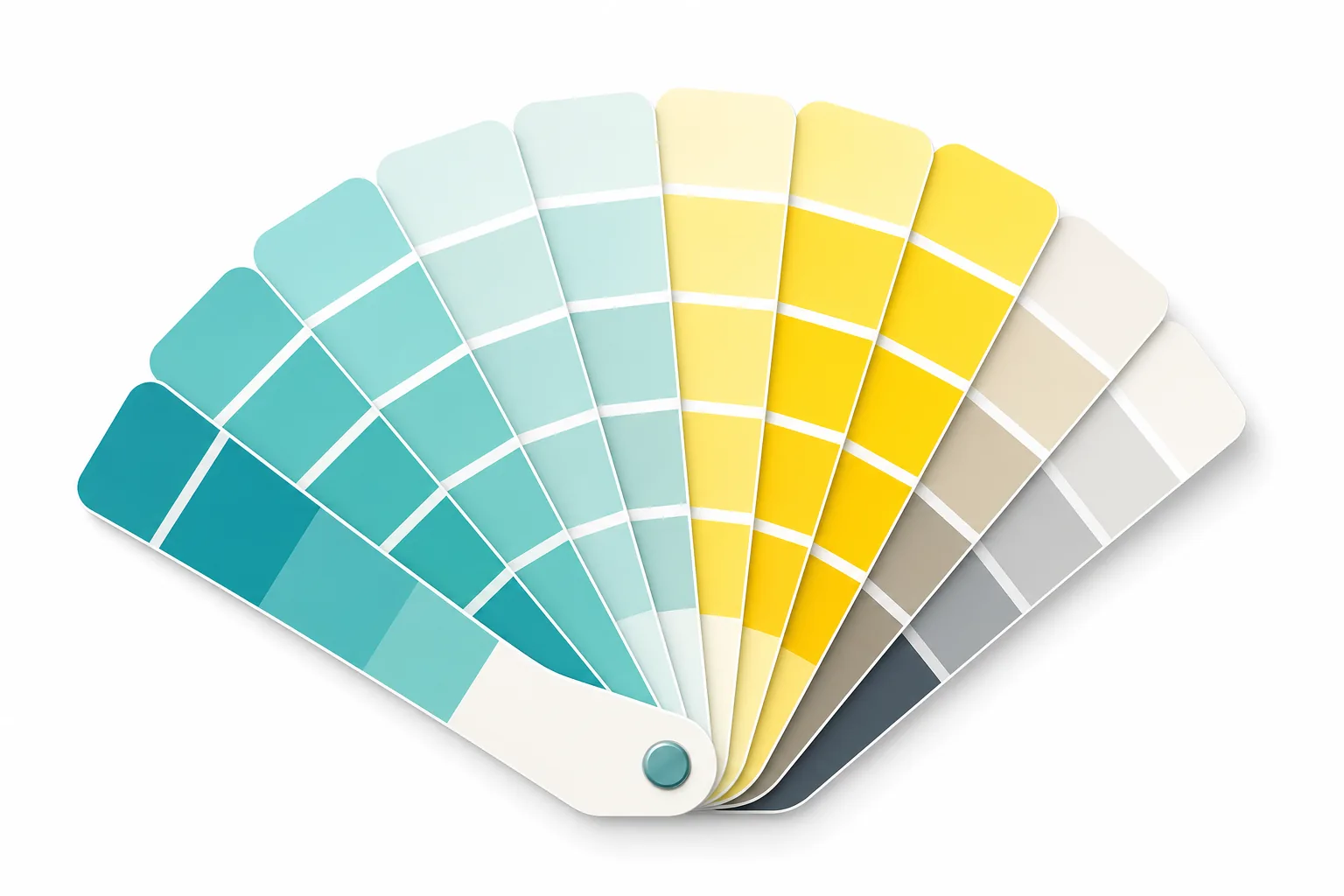
Spot color is 'pre-mixed dedicated ink.' Rather than relying on overprinting, it works like a paint shop mixing a custom shade: the ink for a specific color is formulated in advance, loaded into its own printing unit, and the entire color block is printed directly from that single bucket. Pantone (PANTONE Matching System, PMS) is the world's most widely used spot color swatch system, every color number corresponds to a precise formula. When a designer specifies 'PANTONE 186 C,' any print shop can mix an almost perfectly consistent red
The core difference in one line: CMYK colors are assembled; spot colors are specified. The former is flexible and suited for complex imagery; the latter is precise and suited for color blocks that must remain consistent across multiple runs

Three Things Spot Color Does That Nothing Else Can
Spot color exists because it achieves things CMYK simply cannot
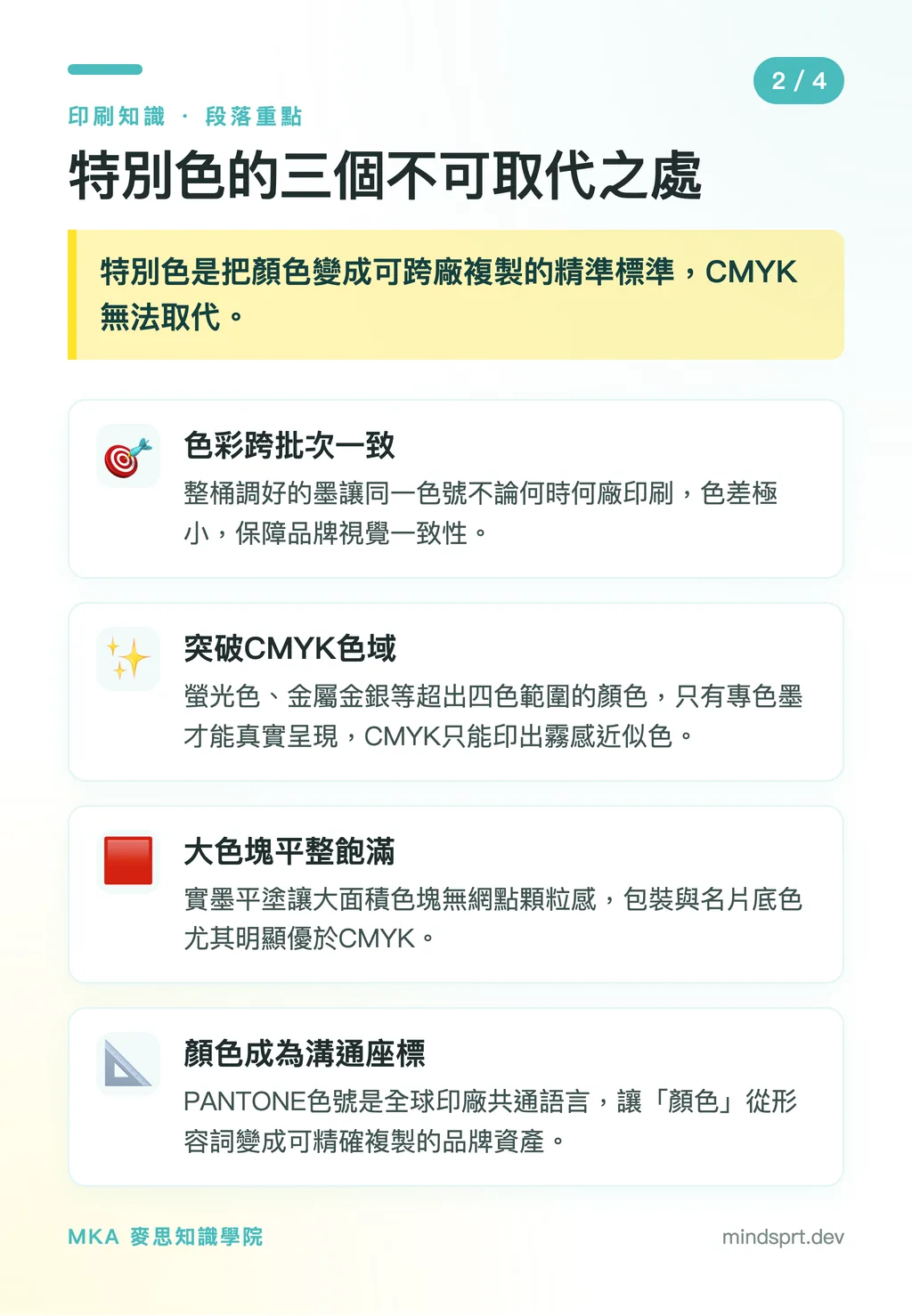
・Color accuracy and cross-batch consistency. A brand's worst nightmare is 'orange this run, pink the next.' CMYK builds color from halftone dots, making it susceptible to registration tolerance, paper absorbency, and press conditions, color drift is common. Spot color is a pre-mixed bucket of ink: the same Pantone number printed today, printed next year, or printed at a different shop will show minimal variation. For logos and corporate standard colors, true visual assets, consistency is professionalism
・Colors that fall outside the CMYK gamut. Fluorescent colors, metallic gold and silver, and certain high-chroma blues and greens all lie beyond the range that CMYK can simulate. If you want a metallic gold, you need spot metallic ink; if you want a fluorescent orange that truly pops, you need a spot color. Forcing CMYK to simulate these produces a dull, muted approximation
・Cleaner, flatter large color blocks. Printing a large solid area in CMYK can cause the halftone dot pattern to read as grainy or uneven. Spot color lays down a solid, opaque layer of ink, producing a rich, smooth block, especially noticeable on packaging and business card backgrounds
The key insight: spot color turns 'a color' into a communicable, reproducible standard. 'PANTONE 186 C' is not a description, it is a set of coordinates recognized by print shops worldwide. That is its core value in brand management
The True Cost: Every Additional Spot Color Means One More Plate
Spot color precision is not free. Its cost logic is the exact opposite of four-color printing, understanding this is what enables smart decisions
Four-color printing uses a fixed four plates, no matter what you print. Whether your design is one photo or a hundred, CMYK is handled by C, M, Y, and K, four plates, full stop, with no additional color charges. That's why full-color, image-heavy print jobs are most economical in four-color: posters, catalogs, photo books, almost always CMYK
Spot color is one plate per color. Every additional Pantone color requires one more plate, one more printing unit, and one more round of inking and washup. So cost is not driven by how many copies you print, it's driven by how many spot colors you use
This creates an important cost threshold:
・Few colors, large print run → spot color is more economical. For example, printing tens of thousands of envelopes and letterheads in just 'corporate blue + black,' two spot color plates cost less in platemaking and ink than opening four CMYK plates just for that one shade of blue, and the color will be more accurate
・Many colors, full-color design → four-color is more economical. Once your design includes photography, gradients, or a wide range of colors, adding spot colors one by one becomes far more expensive than CMYK, that's when four-color is the right answer
・Full color plus precise brand color → use 'CMYK + spot color' hybrid printing (commonly called five- or six-color printing). The catalog body uses four-color for imagery, while the critical logo red gets its own spot color plate to guarantee accuracy. This is standard practice for premium brand print materials, at the cost of one additional plate

Back to the Real Question: Should I Specify a Spot Color for My Logo Red?
This is the dilemma brand clients wrestle with most often. Here's an actionable decision framework
Start by asking: 'Where does this red appear, and how often?'
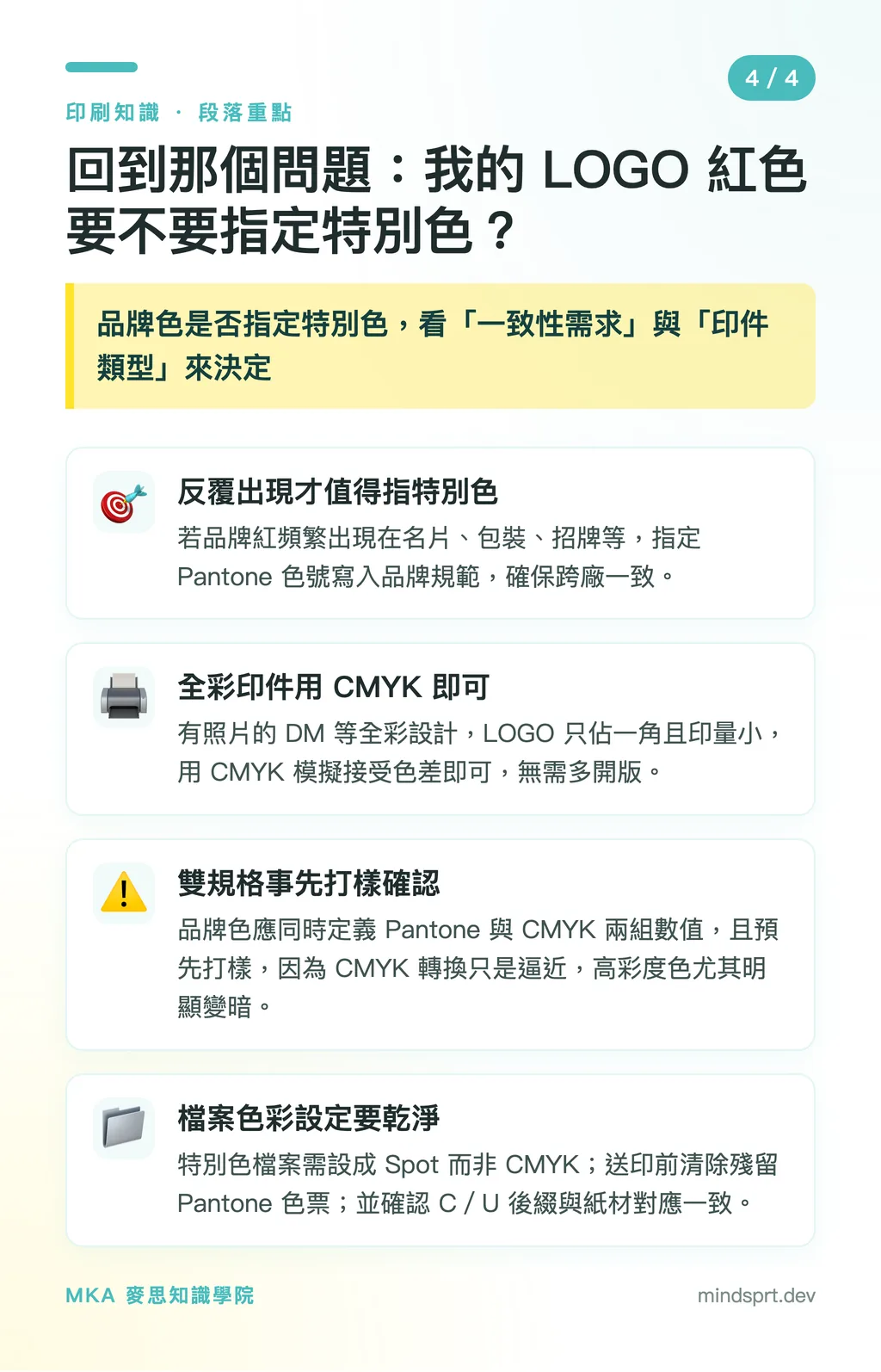
・If your red is a core brand asset that will appear repeatedly on business cards, envelopes, packaging, signage, and merchandise, and you care deeply about it being the same red every time, it's worth specifying a Pantone spot color and writing it into your Brand Guideline. From that point on, regardless of which printer or which paper stock, you quote that color number, and consistency is guaranteed
・If the print job is already a full-color design (say, a DM with photography), the logo is just a small element within it, and the print run is modest with a limited budget, CMYK simulation is usually fine. Accept a small degree of color variation and avoid opening an extra plate for one small block
One thing you must acknowledge: CMYK simulation of Pantone always produces some color difference. Many design applications will 'convert' a Pantone color to CMYK values, but this is an approximation, not a faithful reproduction. High-chroma, fluorescent, and metallic colors in particular tend to look noticeably darker and muddier after conversion. The professional approach: define your brand color in two sets of specs simultaneously, one Pantone number (used for spot color or critical print jobs) and a corresponding CMYK value set (used for four-color jobs) — and confirm the CMYK version is acceptable to you through proofing
A few file preparation reminders (this is where mistakes happen most often in practice):
・If you intend to print spot color, the colors in your file must actually be set as Pantone spot colors, not CMYK. If you send CMYK values, the printer receives a four-color build, and all precision is lost
・Conversely, any unintended spot colors must be removed. It's easy to accidentally leave unused Pantone colors in a file during the design process. If you don't catch them before sending to print, they may be treated as additional colors and charged as extra plates, or cause color separation errors. Always check the Swatches panel before submitting: confirm that spot colors are truly spot, and process colors are truly process
・When specifying a color number, include the suffix: the same Pantone number on coated paper (suffix C) and uncoated paper (suffix U) will look different when printed. 'PANTONE 186 C' and 'PANTONE 186 U' are two different things, align on the paper stock before finalizing the spec
The bottom line: the more a brand color needs to be consistent across repeated uses, the more it deserves a spot color designation. The more a design is a one-time, full-color piece, the better suited it is for four-color. These are not opposites, they are tools assigned by purpose
Key Takeaways
・Four-color printing assembles color from four inks; spot color prints a pre-mixed, dedicated ink directly. The former is flexible; the latter is precise
・The cost logic is reversed: four-color always uses four plates; spot color adds one plate per additional color. Fewer colors, larger runs favor spot color; full-color, multi-color designs favor four-color
・Fluorescent, metallic, and high-chroma colors fall outside the CMYK gamut, only spot color can reproduce them accurately
・Brand colors that recur and require consistency should be specified as Pantone; one-time full-color pieces can use CMYK simulation, but you must accept some color difference
・Best practice for brand colors: define both a Pantone number and a corresponding CMYK value, then confirm the CMYK version through proofing before committing
Further Thinking
For brand and design teams, the 'spot color vs. four-color' question is really an asset management question, not just a printing question. Standardizing your core brand colors with Pantone numbers and writing them into your Brand Guideline is essentially buying insurance for your company's visual consistency, no matter who executes it or how many times it's printed, it won't drift. The practical next step is concrete: audit your brand colors, establish both a Pantone number and a proofing-confirmed CMYK value for each key color, and build the habit of checking the swatches panel and aligning on paper suffix before every print submission. If a job requires both full-color imagery and precise brand color, don't force a choice — 'CMYK + spot color' hybrid printing is the professional answer. From an integrated workflow perspective, when design, file preparation, paper selection, and printing method are all considered within the same process, you can calculate cost and color consistency from the start, avoiding color surprises or unexpected plate charges after the job is already at press. That is the real value of bringing print knowledge into the design phase
FAQ
- What is the difference between spot color and four-color printing?
- Spot color prints a pre-mixed, dedicated ink directly onto the substrate; four-color printing uses halftone dots of CMYK inks layered together to simulate color. Spot color is precise and consistent; four-color is flexible and suited for complex imagery
- Should my logo be printed in spot color or four-color?
- If your logo appears repeatedly across brand materials such as business cards and packaging and requires consistent color, specify a Pantone spot color. If it only appears as part of a one-time full-color design, CMYK simulation is sufficient
- When does using spot color actually cost less?
- When the number of colors is small and the print run is large. Four-color always requires four plates; spot color adds one plate per color. For few-color, high-volume jobs, spot color wins on cost. Full-color, multi-color designs should use four-color to stay economical
- Why can fluorescent and metallic colors only be achieved with spot color?
- Metallic gold, silver, and high-chroma fluorescent colors fall outside the CMYK gamut. Forcing CMYK to simulate them produces a dull, undersaturated approximation. Only spot color ink can deliver the true effect
- If I convert a Pantone number to CMYK, can I skip spot color entirely?
- Software conversion is an approximation, not a faithful reproduction. High-chroma and metallic colors in particular tend to appear darker and muddier after conversion to CMYK. The professional approach is to define both a Pantone number and a proofing-confirmed CMYK value simultaneously, and use each in the appropriate context
References
- PANTONE Matching System (PMS spot color system) · Pantone LLCThe standard swatch numbering system for spot colors — a common language for specifying colors across printers
- ISO 12647-2 — dot and color control standard for offset printing · International Organization for Standardization (ISO)Defines target chromaticity, dot gain, and gray balance for CMYK printing — the international reference printers use for color matching
Related articles



The Print × AI weekly
The print and AI know-how designers, brands and enterprises can use before they commit — one email, every week
MINDS Free Tools
Spine width and imposition calculators — skip the manual math, free in your browser.
MINDS Group
Need actual printing or gifting services?
From premium printing to online ordering and festive gifts — the MINDS Group sister brands take it from here.