

How Many Layers of Finishing Does a Luxury Box Actually Go Through?
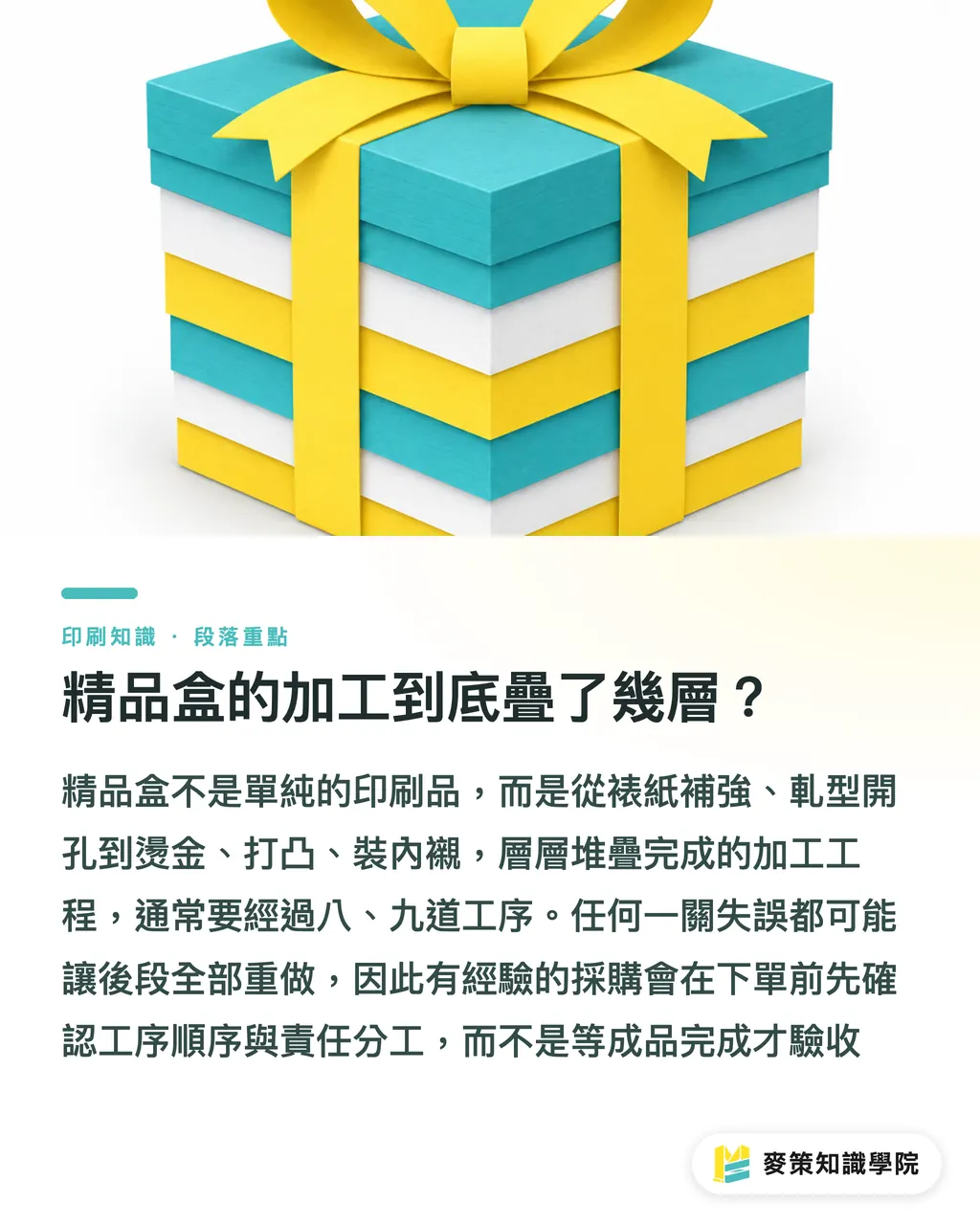
A luxury box that looks simple usually passes through eight or nine processes from paper to finished product: after the paper is selected, it is mounted to a backing for reinforcement, die-cut and window-punched, folded into shape, film-laminated for protection, given spot gloss for highlights, foil-stamped for accents, embossed for a three-dimensional effect, and finally fitted with an insert
Each process builds on the one before it. If any one stage is not kept under control, everything after it will be thrown off. I often tell clients that a luxury box is not a printed product, but a "layered engineering project." The later a problem appears, the more expensive it is to remake, because all the paper and labor invested earlier have already gone to waste
If inspection happens only when the finished product comes out, it is already too late. Experienced buyers ask the printer about the sequence of those eight or nine processes and who is responsible for each one before placing the order. That way, when the shipment arrives, they know exactly where to look for the problem
What Happens When the Film Does Not Adhere Well Enough and Peels Off with a Tug?
Film adhesion is checked with a cross-hatch test, in which 100 small squares are cut into the surface, tape is applied and pulled off, and the amount that comes away is assessed. It is the most basic checkpoint, and one of the easiest to overlook
I have seen plenty of jobs where the matte or gloss film looked smooth and beautiful, only for a customer to pull off a label and take a small patch of film with it, exposing the paper fibers underneath. The entire batch was effectively scrap. A cross-hatch test does not require expensive equipment. A utility knife and a strip of tape are enough, so buyers can ask the printer to demonstrate it on the spot during receiving inspection
If the printer dodges the request and refuses to run the test, they probably already know what is going on: the film bond on this batch is already a problem
Is a 0.5mm Shift in the Foil-Stamping Position a Defect?
A positional tolerance of ±0.5mm for foil stamping is a standard the industry generally accepts. Once it goes beyond that range, the misalignment between the artwork and its position becomes visible to the naked eye
Foil stamping is the finishing step on a luxury box most prone to being off by "just a hair," because the foil die has to register precisely with the printed artwork. A slight machine vibration or poorly controlled thermal expansion and contraction in the paper can shift the position. During inspection, use a ruler or magnifying glass to measure a few corners and the center instead of relying on the impression that it "looks fine."
My own rule of thumb is to accept a tolerance within 0.5mm. Beyond that, discuss re-stamping or a price concession with the printer. Do not let "it is only a little crooked" slide. The whole point of a luxury box is that refined finish
If the Embossing Height Is Uneven, How Much Difference Can You Feel?
Judge embossing uniformity by running your fingers over the entire design and checking whether the raised effect feels consistent. If one side of the same design is raised higher and the other flatter, the embossing pressure was not adjusted evenly
Embossing relies on male and female dies pressing against each other. Uneven pressure distribution often shows up in larger layouts or complex designs. During inspection, I recommend that buyers close their eyes and run their fingers over it. That is more reliable than looking. Your eyes can be fooled by light and shadow, but your fingertips pick up the actual difference in height
Like foil stamping, this checkpoint is easy to wave through based on the subjective impression that "the overall effect is pretty good." But customers usually touch a luxury box too. If the raised areas feel uneven, the brand takes a hit
What Does an Uneven Die-Cut Edge Say About the Cutting Die?
Poorly finished die-cut edges usually mean the die has become dull or the pressure setting is wrong. The edge may show burrs, loose paper fibers, or spots that were not cut all the way through
Die-cutting presses the paper into a flat box template using a custom cutting die. With use, the blade dulls. If the printer does not maintain or replace it regularly, the cut edges easily become rough. During inspection, open out the box's edges, especially around corners and windows, and lightly run your fingers over them to check for anything sharp
Rough edges may seem minor, but luxury boxes often need to be folded and locked by hand. Uneven cuts can directly affect how smoothly they assemble and may even scratch the contents

Why Does the Box Feel Floppy When the Fold Lines Lack Stiffness?
Insufficient stiffness along the fold lines is usually caused by paper stock that is too light or by poor mounting, leaving the folds soft and unable to support the structure
A luxury box gets its rigidity from two things: the basis weight of the paper itself and whether the mounting process bonds the two layers firmly. If the glue is applied unevenly during mounting, gaps can form along the fold lines, and the box can deform once something is placed inside. During inspection, stand the box upright and press lightly on both sides to check its spring-back. Quick recovery and crisp, firm lines indicate a solid structure
I covered this in "How Should the Finishing Sequence for a Luxury Box Be Arranged?" If the paper-mounting step is put in the wrong place before or after printing, stiffness problems become more obvious. So while you inspect the folds, you are also checking whether the earlier processes were actually done properly
Why Does the Product Catch When the Insert Is Out of Alignment?
The accuracy of the insert's positioning is easy to judge: see whether the product sits snugly in the box, with no gaps and nothing catching
Inserts are usually cut separately and then fixed inside the box. If the insert's dimensions do not match the box's actual dimensions after forming, the product may sit crooked, or the insert may be hit when the lid is closed. This issue often only appears when you actually test-fit the product, so do not inspect an empty box alone. Put in a sample or substitute item and test it for real
I have seen projects where the insert was off by a few millimeters. The box itself looked completely fine, until the customer put a perfume bottle inside and found that it got stuck and could not be removed. The entire batch had to be scrapped and remade
How Much Overall Box Tolerance Is Acceptable Before Inspection Becomes a Problem?
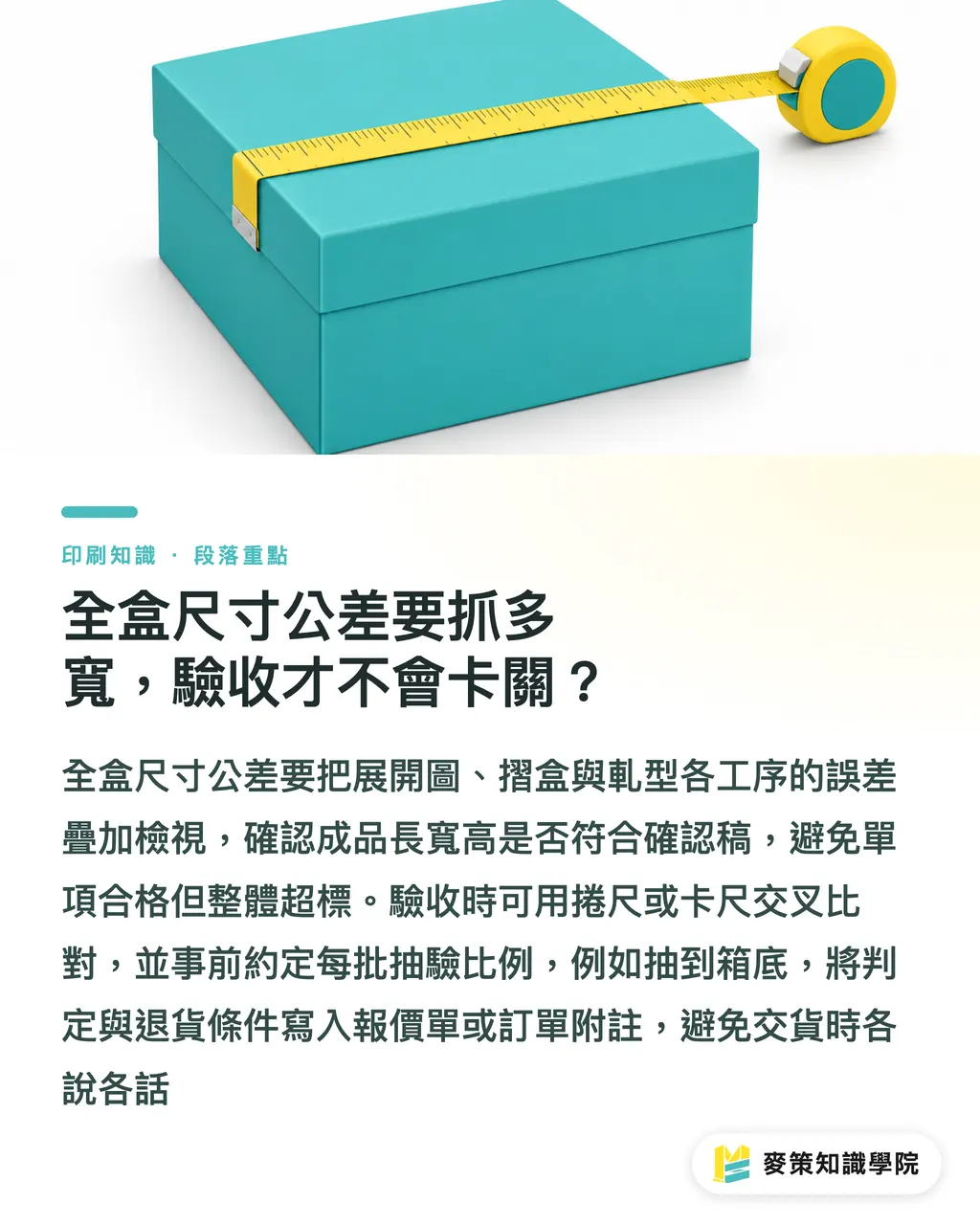
The overall box dimensions are the final line of defense. This is where you add up the errors from the flat layout, folding, and die-cutting to see whether the finished length, width, and height match the approved proof
The error in any single process may be within tolerance, but the combined error can still exceed the limit. When checking the overall dimensions, compare the numbers on the approved proof against the actual finished box with a tape measure or caliper. For the sampling rate, you can use the three-step method described in "How to Conduct Sampling Inspection for Printed Materials": check the paperwork, sample the physical goods, and keep a record. The same logic applies to luxury boxes
For the standard operating procedure for receiving inspection, I recommend that buyers and printers agree in advance on the sampling rate, such as inspecting a set percentage of cartons from each batch and making sure to sample cartons from the bottom of the stack rather than only checking the top layer, the criteria for nonconforming goods, including which defects are acceptable and which mean an immediate return, and whether the return terms should include a remake deadline. Put these conditions in the quotation or the order notes. If something goes wrong, you then have a basis for discussion instead of two sides simply telling different stories
Key Takeaways
・A luxury box should be inspected against concrete specifications, not the subjective impression that it "looks fine."
・A ±0.5mm foil-stamping tolerance and a cross-hatch test for film adhesion are both on-site inspection methods that require no special equipment
・Always test-fit the actual product in the insert. An empty-box inspection will not reveal catching or fit problems
・Overall box dimensions are the final check for accumulated error. Agree on the sampling rate and return terms in advance and put them in the order
Further Thoughts
The logic behind inspecting a luxury box can actually be pushed back to the stage where you confirm the quotation and the finishing sequence. I have always advised clients that, rather than waiting for the finished product to go wrong and then arguing about it, they should clarify the finishing sequence, tolerance standards, and inspection method with the printer before placing the order, then write them into the notes of the luxury-finishing quotation. For brand teams introducing a SaaS system to manage supplier quality, these 7 checkpoints are also well suited to an internal inspection checklist. Run through it for every delivery, and over time you build a standard that can be used to compare different printers, cutting the time spent figuring things out from scratch at every inspection. If you are interested in turning this SOP into a system, or want to discuss specifications with a printing partner familiar with the full luxury-finishing workflow, talk to the Mai Strategy Knowledge Academy consulting team about the details of your project
Further Reading
・How to Conduct Sampling Inspection for Printed Materials
・What to Look for in a Luxury-Finishing Quotation
FAQ
- Do I Really Need to Test Every Checkpoint When Inspecting a Luxury Box?
- When budget and time are limited, prioritize film adhesion, foil-stamping tolerance, and overall box dimensions. These are the issues customers or consumers are most likely to spot directly. The other points can be sampled
- Does a Foil-Stamping Tolerance over 0.5mm Automatically Mean the Shipment Must Be Returned?
- Not necessarily. First discuss with the printer whether to re-stamp or offer a price concession. Returns are generally reserved for batches where the tolerance is exceeded throughout, or where defects are concentrated in visually prominent areas
- If the Insert Is Misaligned during Inspection, Who Is Responsible?
- First determine whether the insert was cut to the wrong dimensions or the box shifted out of size during forming. The responsibility differs, which is also why inspection records matter: they make it easier to sort out what happened afterward
- What Sampling Rate Is Enough?
- There is no single standard percentage, but sampling should cover different cartons, including cartons from the bottom of the stack rather than only the top layer. That is how you catch later-stage crooked cuts or finishing misalignment
Related articles



The Print × AI weekly
The print and AI know-how designers, brands and enterprises can use before they commit — one email, every week
MINDS Free Tools
Spine width and imposition calculators — skip the manual math, free in your browser.
MINDS Group
Need actual printing or gifting services?
From premium printing to online ordering and festive gifts — the MINDS Group sister brands take it from here.