
Why Client Demands for 'Soy Ink' Can Easily Lead into Greenwashing Traps
Due to its higher vegetable oil content, soy ink reduces VOC emissions and improves the deinking rate of waste paper. However, pairing it with the wrong paper substrate or post-press finishing negates its environmental benefits
When advising on custom brand projects, the MINDS Academy consulting team frequently encounters clients who believe using soy ink is a silver bullet for environmental compliance
Traditional petroleum-based inks contain high levels of mineral oil, leading to elevated volatile organic compound (VOC) emissions. In contrast, soy ink replaces a portion of these mineral oils with soybean oil or linseed oil
Its actual practical advantage lies in making 'deinking' easier during the paper recycling stage, which is highly beneficial for improving the pulp quality of recycled paper
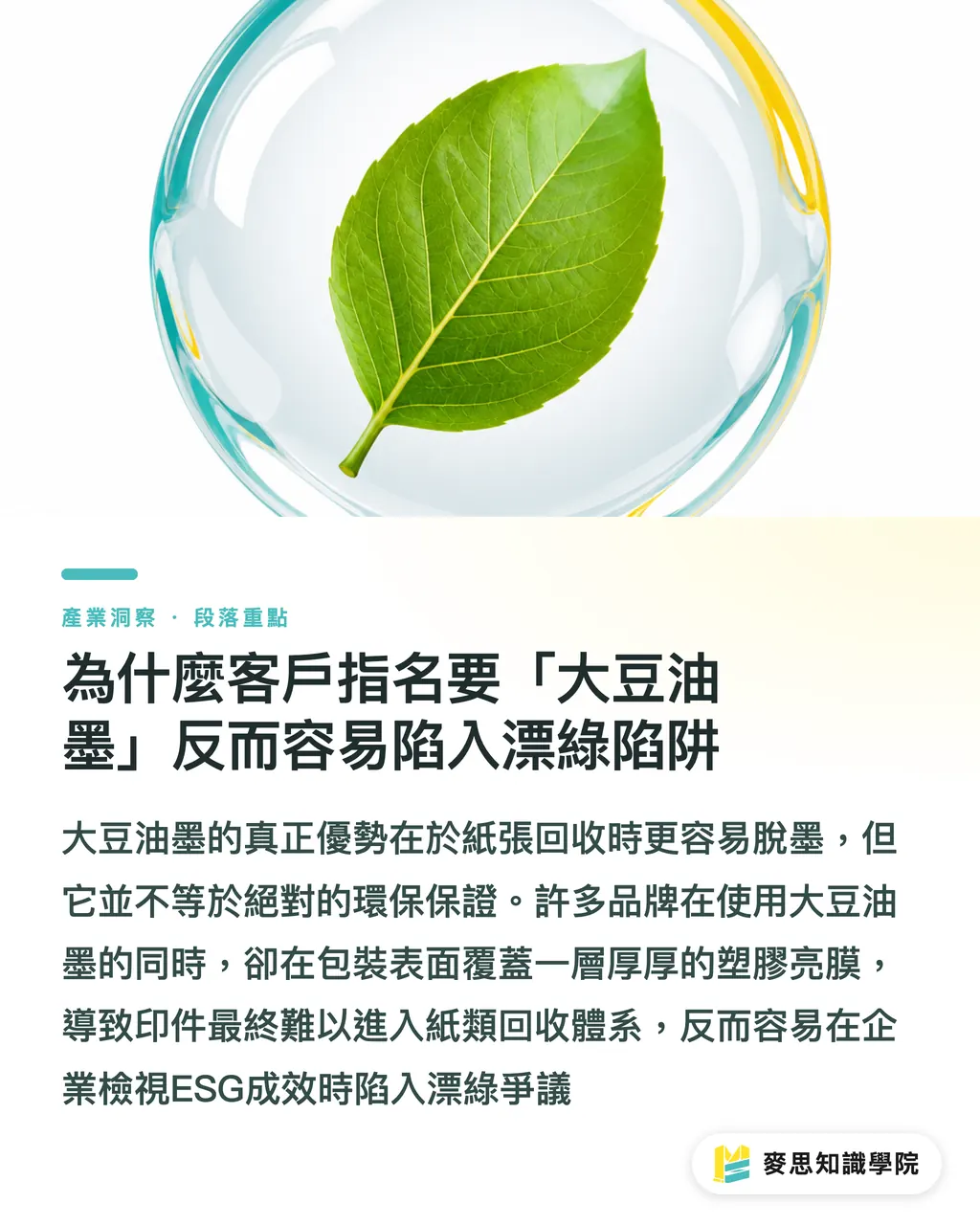
Yet, many brands print with soy ink only to laminate the packaging surface with a thick layer of glossy BOPP plastic film
This print job ultimately remains difficult to integrate into the paper recycling system, easily triggering greenwashing controversies during corporate ESG audits
How Soy Ink Affects Color Performance and Turnaround Times
Soy Ink: An eco-friendly printing ink that uses soybean oil as its primary solvent. It features high transparency and easy deinking properties, with VOC emissions significantly lower than those of traditional petroleum-based inks, making it ideal for paper recycling systems
In recent years, the designers and print buyers we work with often realize, only after the print job comes off the press, that the color saturation falls short of expectations
Soybean oil inherently has a yellowish tint, and the ink itself is highly transparent. When printed on uncoated paper like wood-free paper or kraft paper, the colors are easily absorbed and altered by the substrate's base color
Drying time is another major pitfall in practice. Soy ink dries primarily through absorption and penetration, making it dry much slower than traditional inks
If large solid color blocks are rushed through a tight schedule without allowing sufficient time before cutting or binding, it can easily lead to a disastrous set-off or smudging incident
When dealing with rush orders that must maintain eco-friendly standards, I usually advise clients to evaluate UV-curable soy inks to resolve the drying bottleneck
How SMEs Can Navigate the Requirements for Displaying the Soy Seal
Printing the Soy Seal on packaging is a go-to move for many brands looking to elevate their packaging's premium feel
However, you can't just write the words 'soy ink' yourself; you must use inks certified by organizations such as the American Soybean Association (ASA)
In practice, you need to request certification documents for the ink batch from your printer to ensure the soy oil content meets the regulatory standards, for instance, sheet-fed offset inks require a soy oil content of at least 20%
If you have a green transition demand for high-end commercial printing, MINDS Printing can verify compliant eco-friendly inks and paper right at the source, saving you the communication costs of requesting certifications back and forth
Additionally, be prepared that the procurement cost of imported certified inks is typically 5% to 15% higher than that of conventional inks
Whether this premium is worth it depends on your end-product positioning and regulatory pressures in export markets
How to Manage Green Print Procurement Without Failure
When handling projects with new materials or specific eco-friendly requirements, I strongly recommend following our 'MINDS Three-Step Print Verification' workflow
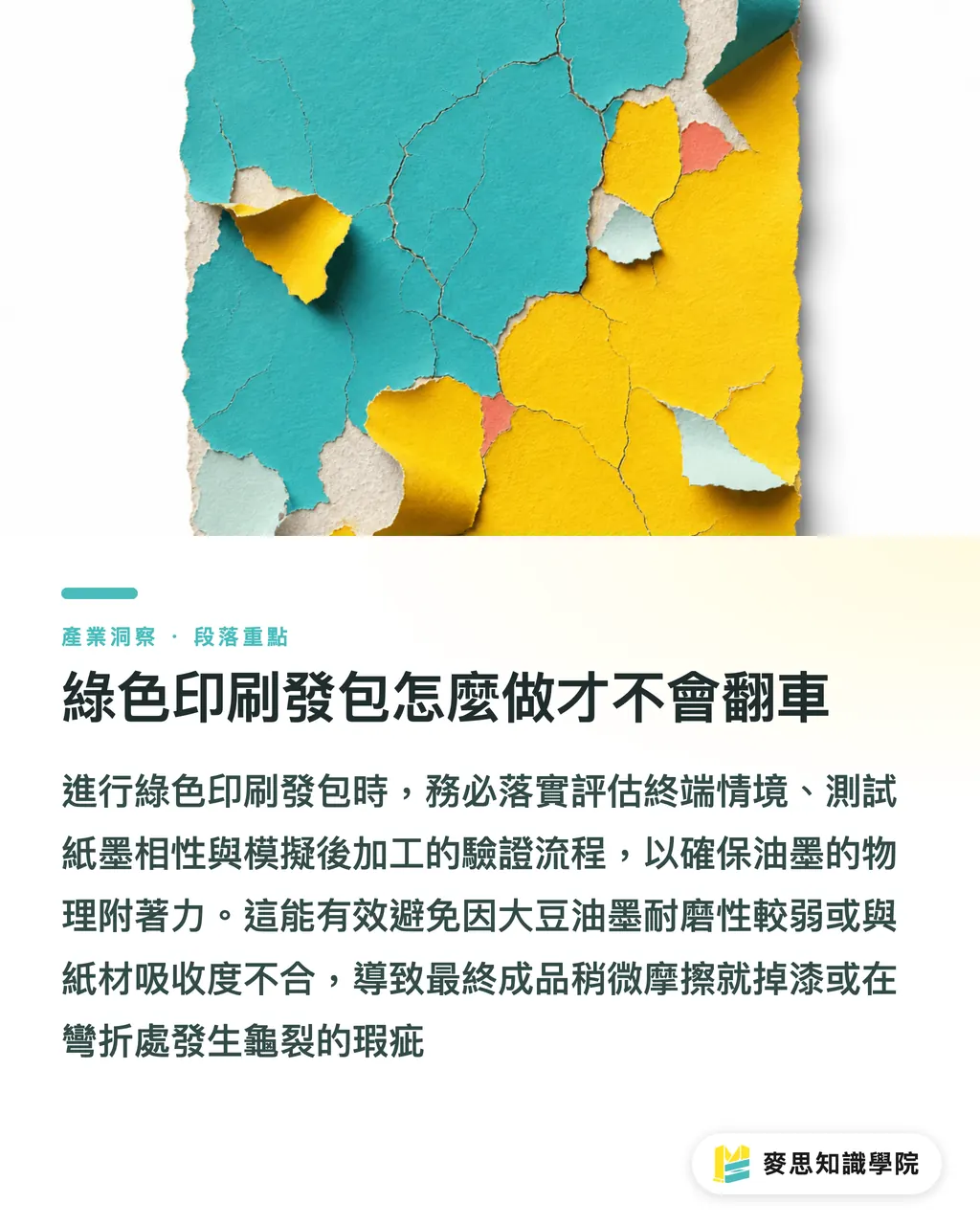
This ensures the physical ink adhesion of the final product is secure, preventing a defective batch where the paint easily flakes off with a slight scratch
・① Clarify the packaging's end-use scenario: Confirm whether the product will be exposed to freezing, high temperatures, or oils. Soy ink has weaker rub resistance and is not suitable for outer packaging subject to frequent friction
・② Match paper substrate and ink compatibility: Test the ink's absorption on specific eco-friendly papers to prevent dull colors or scenarios where the ink is still not dry after two days
・③ Test post-press finishing tolerance: Perform on-press proofing and simulate post-press finishing steps such as folding and die-cutting to ensure the ink does not crack or peel at the folds
Key Takeaways
・Soy ink reduces VOCs and improves the deinking rate of waste paper, but excessive processing like plastic lamination renders these environmental benefits obsolete
・Soy ink has high transparency and dries slowly; when printing large solid color blocks, sufficient drying time must be scheduled for the production line
・Obtaining the Soy Seal requires verifying that the ink's soy oil content meets standards, alongside evaluating the resulting material cost premium
Food for Thought
For SaaS and AI product developers, the complex variables of green printing actually represent an excellent entry point for digitization
Currently, calculations of ink carbon footprints, paper suitability testing, and drying time predictions on traditional production lines rely heavily on the tribal knowledge and experience of veteran pressmen
If these physical properties and compliance standards can be converted into automated evaluation models for the procurement side, it will significantly reduce the cost of trial and error during design handoffs
FAQ
- Does soy ink produce duller or darker printed colors?
- Soy ink is highly transparent and has a slight yellowish tint. When printed on highly absorbent, uncoated paper, it indeed tends to lack saturation
- Is packaging guaranteed to be recyclable as long as soy ink is used?
- Whether paper can be recycled depends on the overall finishing process. If it is laminated with non-biodegradable plastic film, it remains difficult to recycle even if soy ink is used
- Can rush orders use soy ink for printing large solid color blocks?
- Soy ink dries slowly. Printing large color blocks on rush jobs is highly prone to set-off and smudging. We recommend scheduling ample drying time or switching to fast-drying UV soy inks
Related articles
The Print × AI weekly
The print and AI know-how designers, brands and enterprises can use before they commit — one email, every week
MINDS Free Tools
AI background removal, a LINE sticker maker, spine & imposition calculators — all free, right in your browser, no upload.
MINDS Group
Need actual printing or gifting services?
From premium printing to online ordering and festive gifts — the MINDS Group sister brands take it from here.