
Why does specifying "Soy Ink" often lead to greenwashing traps?
In recent years, many brand clients I've worked with often specify "Soy Ink" upfront, assuming it serves as an automatic "get-out-of-jail-free card" for environmental friendliness
In reality, the core contribution of soy ink lies in reducing Volatile Organic Compounds (VOCs) and offering excellent deinking properties during the paper recycling stage
For common catalog and book printing, soy ink is indeed highly effective at reducing environmental impact
However, if your product requires high abrasion resistance or is printed on non-absorbent materials (such as plastic films or pearlescent paper), the drying speed and adhesion of soy ink can become a disaster
Do not ignore the physical requirements of the final printed piece in pursuit of the eco-friendly halo of a single material; doing so often leads to unnecessary waste from proofing and reprinting
How to select inks for food-grade packaging to avoid regulatory pitfalls?
When producing lunch boxes or flexible food packaging, food safety regulations and material limitations are non-negotiable bottom lines
Water-based ink is currently the solution for food packaging because it possesses low-migration properties, significantly reducing the risk of harmful substances penetrating into food
From my practical experience in guiding procurement, producing compliant food packaging requires strict adherence to three principles: using virgin unbleached paper, ensuring heat resistance for oil-proof coatings, and using water-based eco-friendly inks on non-contact surfaces
When procuring, be sure to request that suppliers provide ink composition disclosures and inspection reports confirming compliance with food-contact material regulations
Never rely solely on a manufacturer's verbal assurance of "non-toxicity"; written proof of low-migration testing is the only way to protect your brand
UV curing ink is energy-efficient and quick-drying, but what are the hidden controversies?
Many print shops are now strongly promoting UV curing inks because they use ultraviolet light for instant drying, saving a significant amount of energy typically required for traditional drying, and they are almost universal in terms of material compatibility
For difficult, "temperamental" special materials like art paper or pearlescent paper, UV inks allow designers to materialize their creativity with pinpoint accuracy, avoiding the issues where ink sinks into paper fibers and becomes dull
However, there are hidden risks behind this technology; the photoinitiators in UV ink formulations are highly controversial under certain strict environmental regulations and food safety standards
If you are producing goods for export to Europe or working on scent-sensitive mother-and-baby packaging, you must verify whether the types of photoinitiators are on local regulatory banned lists before choosing UV ink
A practical comparison of the three mainstream eco-friendly ink specifications and press conversion
No matter how good a design looks on screen, choosing the wrong ink or failing to adjust pre-press settings results in a disastrous printed outcome
The most common situation I see on the factory floor is clients deciding to switch to eco-friendly ink at the last minute without leaving enough time for proofing and color matching
These three types of inks have significant differences in physical properties and costs; please use this checklist to align with your print coordinator before placing an order
・Soy Ink: Wide color gamut with vibrant colors; ideal for absorbent, uncoated paper and cultural paper; affordable cost; drawbacks include slow drying and lower rub resistance
・Water-based Ink: Good lightfastness but color saturation is slightly inferior to soy ink; specializes in food packaging and corrugated cardboard; easy equipment cleanup during plate changes; extremely poor adhesion on non-absorbent materials
・UV Curing Ink: Strongest lightfastness and abrasion resistance; applicable to almost all materials including gold/silver foil and plastics; high production efficiency; highest ink cost, and one must be aware of photoinitiator regulatory restrictions
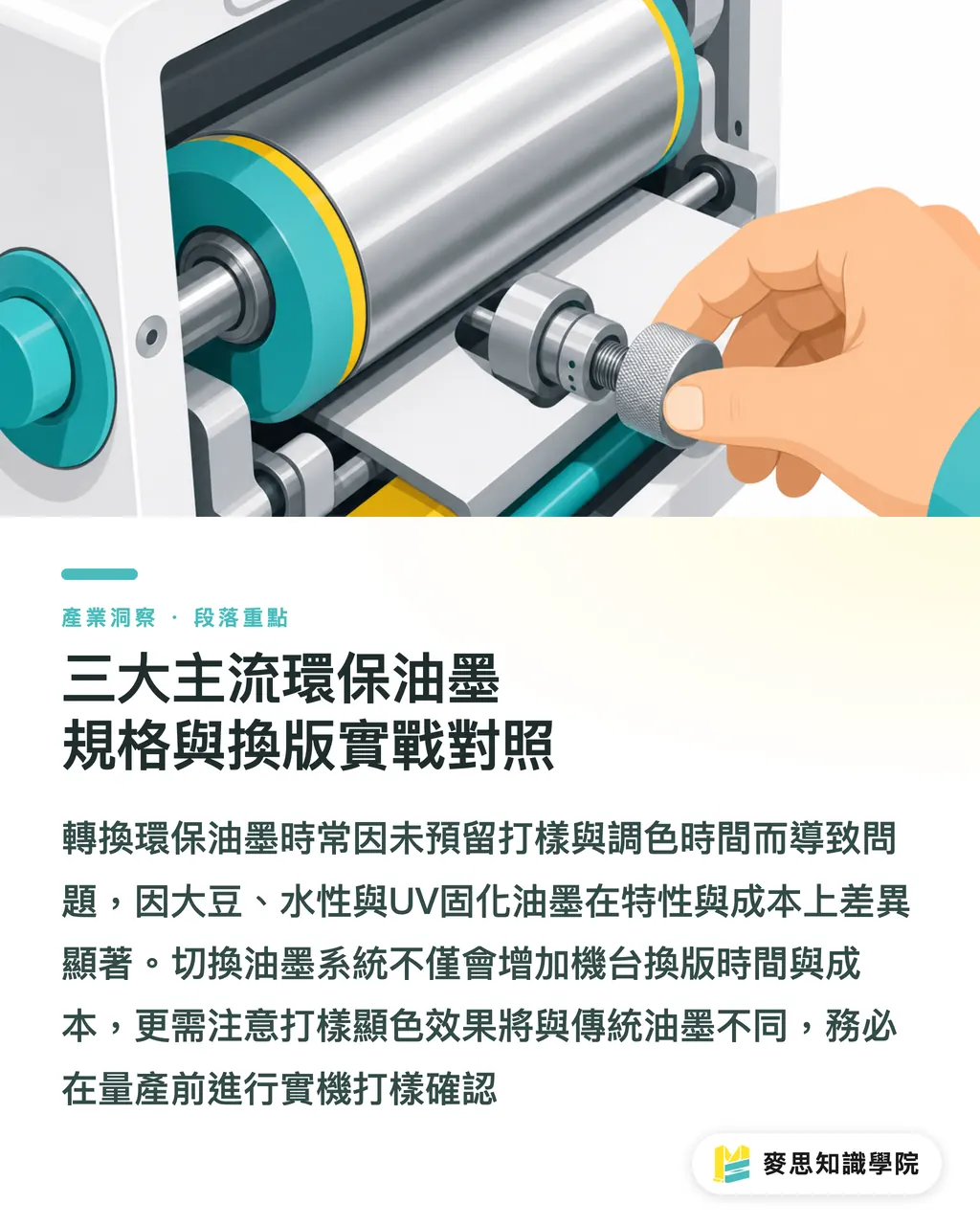
When switching to a different ink system, the printing press blankets and cleaning agents must also be changed, which increases the print shop's plate change time and costs
Be prepared: the color reproduction effect from proofing will definitely differ from traditional inks, so ensure you conduct a thorough on-press proofing before mass production
Key takeaways
The strengths of soy ink lie in easy deinking and low VOCs, making it the top choice for book printing, but it is prone to failure when used on special materials
For food packaging, stick to low-migration water-based inks and strictly require suppliers to provide composition and compliance inspection certificates
UV inks offer excellent color reproduction and versatility with paper, but always check if the photoinitiators in the formulation conflict with environmental regulations in the export market
Switching ink systems directly impacts color performance and press changeover costs; always re-verify with on-press proofing before mass production
Further reflection
Printing sustainability is not a multiple-choice question; no single type of ink works for everything
Brand procurement and designers should consider material characteristics, product use, and post-processing together in the initial conceptual stages
Rather than holding a single "eco-friendly" buzzword to demand from suppliers, it is better to have an open and honest discussion about product requirements and regulatory bottom lines
At MINDS, we use systematic parameter settings and material testing during the pre-press stage to help clients avoid reprinting disasters caused by poor ink compatibility, ensuring real, substantive carbon reduction and cost control
FAQ
- I want to print food packaging; can I use soy ink directly?
- It is not recommended. The first choice for food packaging is water-based ink with low-migration properties, which prevents harmful substances from penetrating and contaminating food. It must also be accompanied by the supplier's inspection reports to be considered safe
- Why does the color of the same file become darker after switching to soy ink?
- Soy ink has a slower drying speed. When printed on highly absorbent uncoated paper, the ink tends to sink into the paper fibers, resulting in decreased color saturation. You must adjust the ICC profiles in pre-press beforehand
- The print shop recommends UV ink, claiming it is both eco-friendly and fast-drying. Are there any hidden drawbacks?
- UV ink is indeed energy-efficient and offers excellent color reproduction, but it is more expensive. Additionally, the photoinitiators in its formulation may leave residual odors or trigger food safety regulatory controversies, making it unsuitable for direct use in highly sensitive packaging
Related articles
The Print × AI weekly
The print and AI know-how designers, brands and enterprises can use before they commit — one email, every week
MINDS Free Tools
AI background removal, a LINE sticker maker, spine & imposition calculators — all free, right in your browser, no upload.
MINDS Group
Need actual printing or gifting services?
From premium printing to online ordering and festive gifts — the MINDS Group sister brands take it from here.