
Overview
Soy ink is often viewed as a greener option than traditional petroleum-based ink, but that doesn't make it automatically greener. When evaluating ink, MINDS (MS, mid-to-high-end fully customized commercial printing) looks at four factors first: substrate, application, regulatory requirements, and print shop process control
The true value of soy ink lies in replacing part of the petroleum solvent with vegetable oil, making the ink source and part of the manufacturing footprint easier to explain. Its real limitation is that it still relies on pigments, resins, additives, and drying systems working together, so you cannot take the word "soy" as a blanket guarantee of sustainability
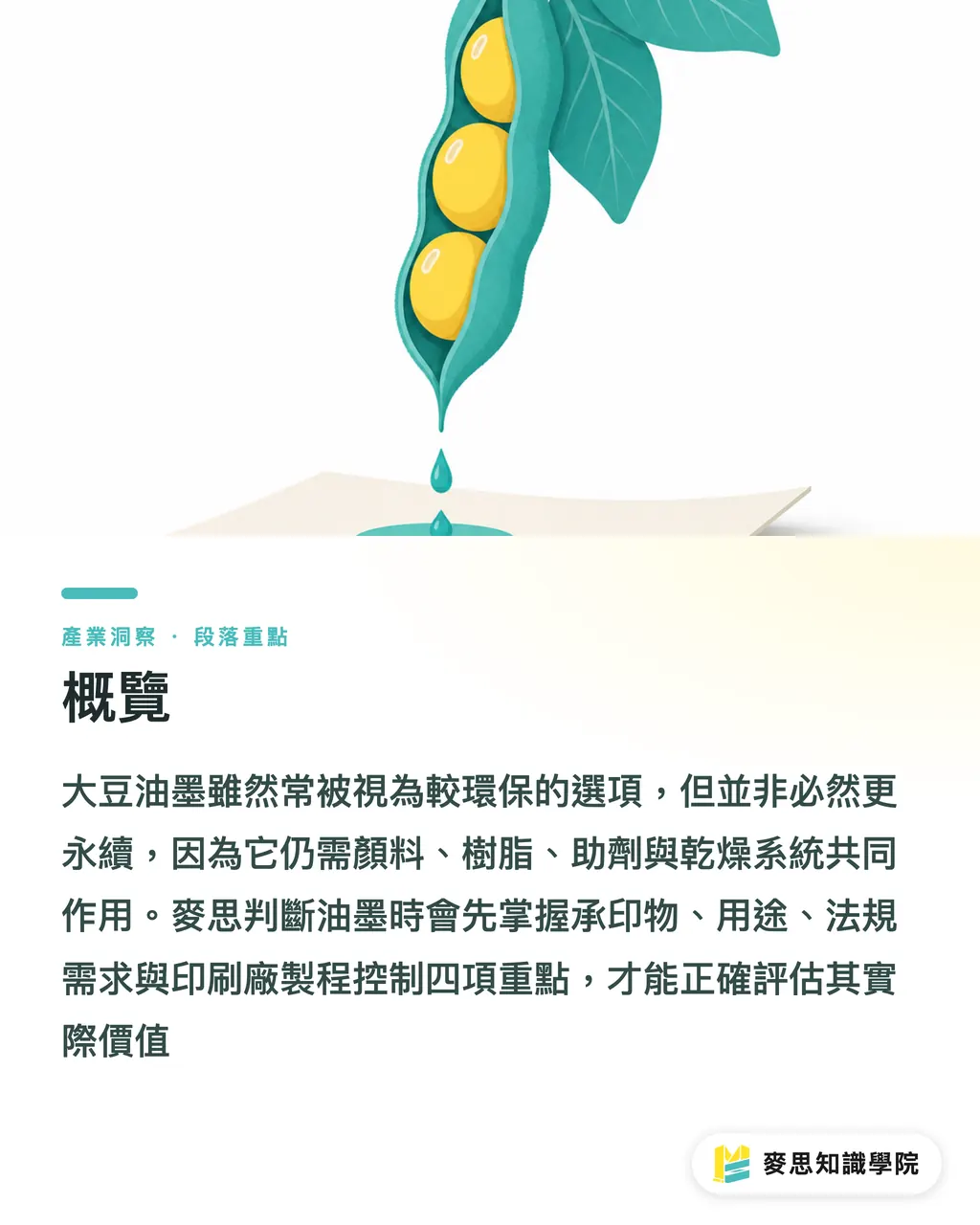
What Is Soy Ink, and Why Is It Called Eco-Friendly?
Soy ink uses soybean oil as part of its carrier system and is common in offset and commercial printing. Its eco-friendly appeal usually comes from its plant oil source, easier de-inking for recycling, and lower reliance on petroleum components
Let's clarify the definition first
Soy ink: Printing ink that replaces part of traditional petroleum solvents with soybean oil. It still contains pigments, resins, driers, and additives. Environmental performance depends on the actual formulation, substrate, and process control, not just the name
The most common misconception I see on press floors is brand clients equating "soy ink" directly with "food grade," "compostable," or "zero pollution." All three claims are jumping the gun
Soy ink is better suited for these scenarios:
・Paper commercial printing: Such as catalogs, cards, manuals, and outer carton printing, where color performance and recycling messaging matter most
・Non-direct food contact packaging: Such as outer box printing, provided ink migration risks and post-press finishing are verified
・Branded print materials needing a sustainability story: "Soy ink used" can be listed as a material option, but don't frame the entire product as completely eco-friendly
Soy ink shouldn't be overhyped
・It isn't made of 100% soy; the ink still contains pigments, resins, and additives
・It doesn't automatically mean low migration, nor is it automatically suitable for food contact surfaces
・Its adhesion and drying speed on certain materials still require press proofing to verify
・Its environmental narrative must be evaluated alongside paper stock, varnishing, lamination, and recycling design
A printed piece is like a dish, and ink is just one seasoning. Choosing the right seasoning helps, but it can't vouch for the whole meal
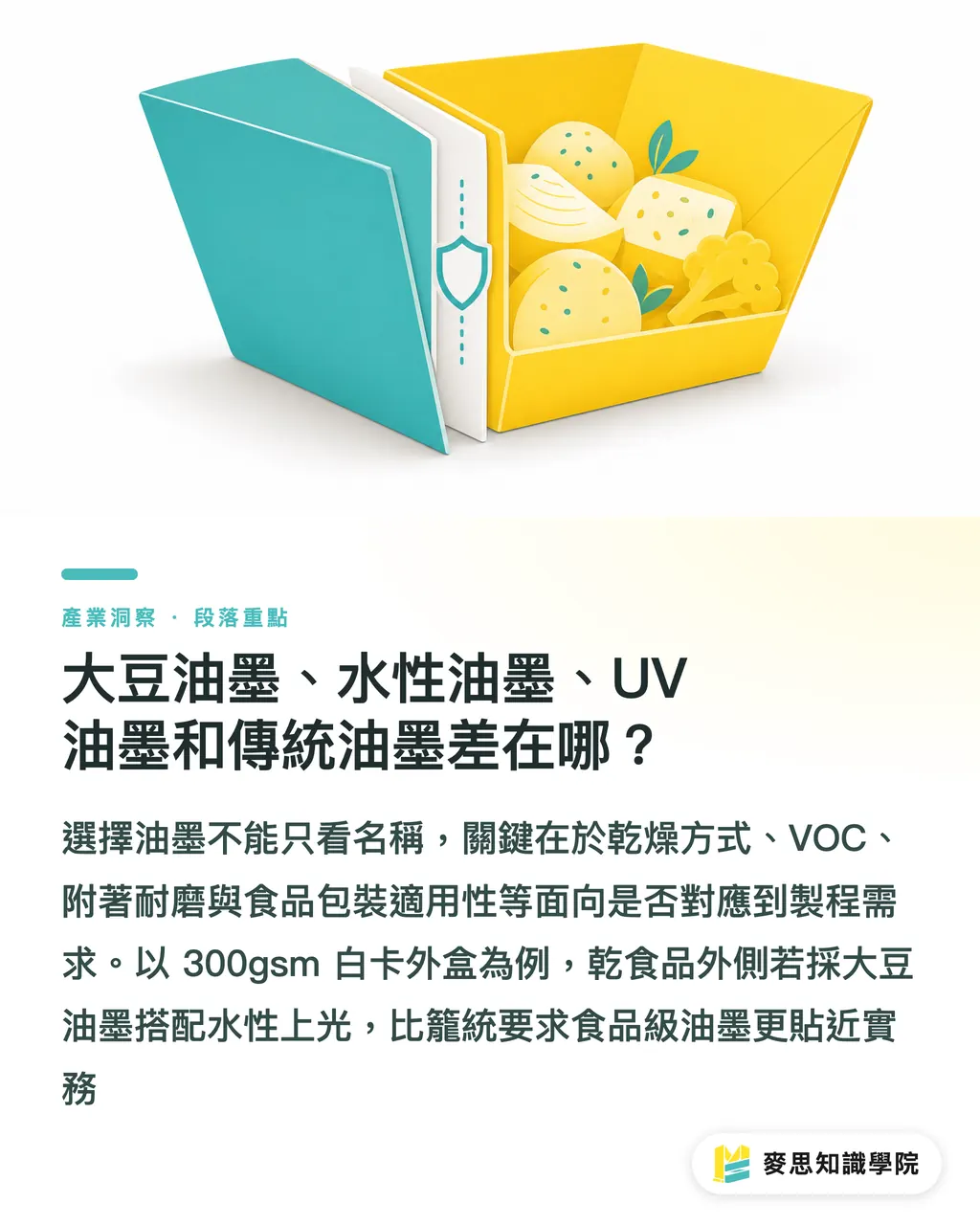
What's the Difference Between Soy Ink, Water-Based Ink, UV Ink, and Conventional Ink?
If you choose ink based purely on product names, it's easy to end up with the wrong process. I look at six aspects first: drying method, VOCs, adhesion, rub resistance, food packaging suitability, and post-press finishing limits
Water-based ink: Ink using water as its main diluent, commonly used for corrugated paper, paper bags, and some flexo packaging. Advantages include lower VOCs, while limitations involve drying energy consumption, paper moisture warping, and rub resistance control
UV ink: Ink that cures rapidly under UV light. Advantages are fast drying, strong surface rub resistance, and vibrant color saturation. Limitations include equipment costs, energy consumption, photoinitiator residue, and low-migration rules for food packaging that require careful auditing
Conventional ink: Refers mostly to petroleum-based solvent or traditional oil-based systems. Mature, stable, and cost-controlled, its drawbacks are higher VOCs, odor, and an environmental narrative that struggles to meet brand sustainability goals
In practical pressroom terms, here is how the differences break down:
・Soy ink: Dries mostly through oxidation or absorption. VOC levels usually leave room for improvement. Performs maturely on paper. Rub resistance requires varnishing or protective film. Food packaging suitability depends on non-contact placement and low-migration needs
・Water-based ink: Dries through water evaporation and absorption. Lower VOCs. Fits paper bags, corrugated boxes, and paper containers. High-coverage solids, heavy paper, or humid environments require strict drying and warping control
・UV ink: Dries through photo-curing, allowing post-press processing within seconds. Strong adhesion and rub resistance. Fits packaging needing fast drying, high gloss, and scratch resistance. Food packaging requires checking low-migration formulas and complete curing
・Conventional ink: Mature track record in drying and adhesion. Stable color, cost, and supply. Weaker eco-narrative. Brand ESG documentation or export projects often require supplementary VOC and safety data
Here is a practical example: For a 300gsm white cardboard outer box holding dry food, printing soy ink with water-based varnish on the exterior is generally more precise than claiming "food-grade ink." If it's frozen packaging or an outer box subject to shipping friction, mentioning soy ink alone isn't enough; you also need to address rub resistance, scratch resistance, and coating choices
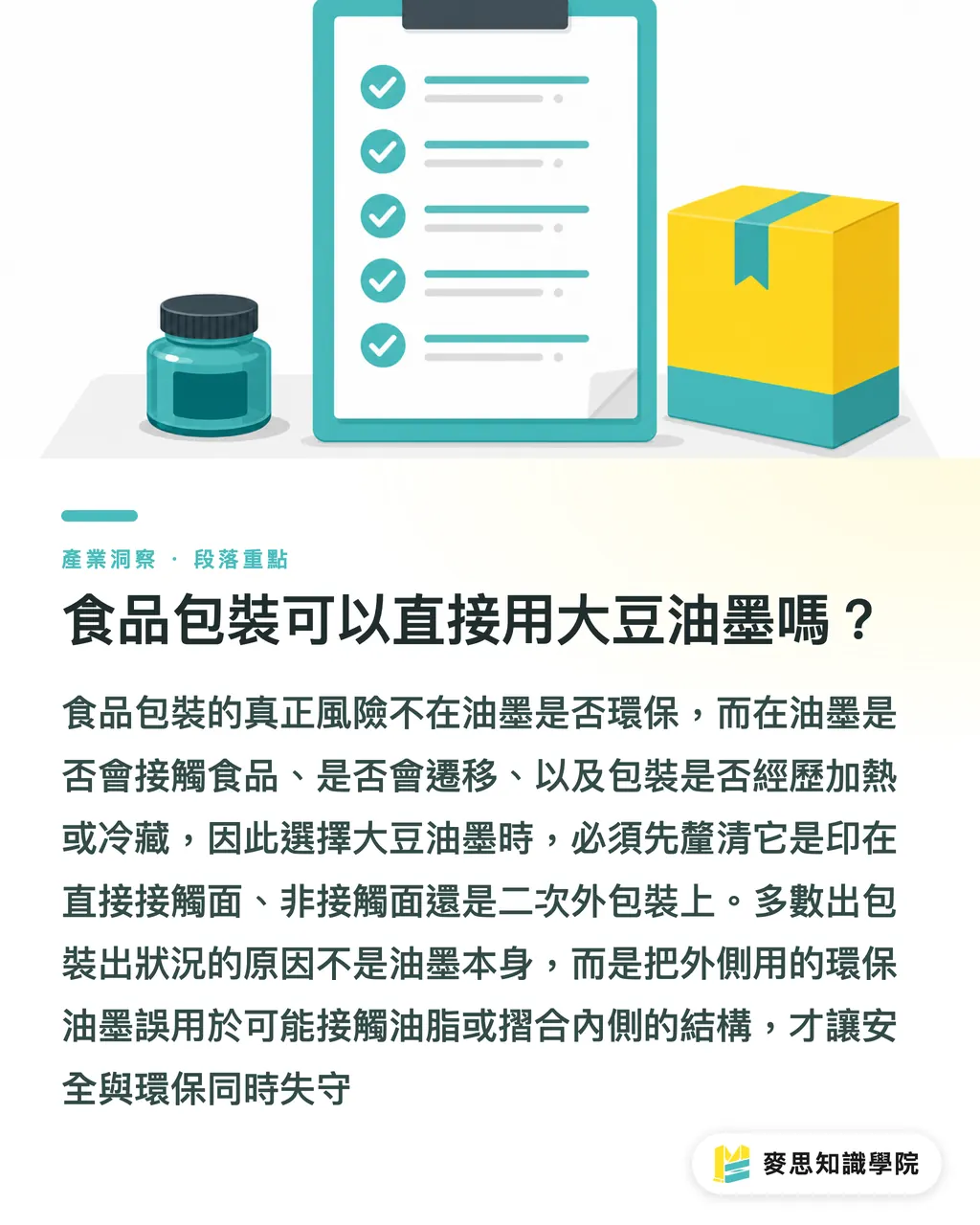
Can Food Packaging Use Soy Ink Directly?
For food packaging, don't just ask if the ink is eco-friendly. Ask first whether the ink will touch food, whether it will migrate, and whether it will undergo heating or refrigeration. These three questions get much closer to actual risk than ink names do
Food packaging commonly seen in small and medium enterprises can be divided into three scenarios:
・Direct food contact: Such as paper liners, cup interiors, or bento box inner walls. As a rule, ink should not be printed directly on contact surfaces
・Non-direct food contact: Such as outer box surfaces or outer packaging labels. Migration, odor, and friction transfer must still be considered
・Secondary outer packaging: Such as gift boxes, shipping boxes, or display cartons. Focus rests primarily on rub resistance, color quality, finishing, and recycling communication
Here is plain advice I give clients: Address safety boundaries before talking about eco-friendly branding
Soy ink can be used on the outer side of food packaging, but buyers should ask at least five questions during procurement:
・Is the ink applied to non-food-contact surfaces?
・Are SDS or ink safety data sheets available for review?
・Is low-migration ink or dedicated food packaging ink required?
・Will the printed sheet undergo varnishing, lamination, foil stamping, or spot UV afterward?
・Will the finished product be stacked, refrigerated, heated, or exposed to greasy food for long periods?
Many print failures don't happen because the ink itself is bad, but because the application was misjudged
For instance, requesting soy ink on the outside of paper meal boxes makes sense. But if the design places heavy dark coverage near score lines while the inside might contact grease, the issue isn't just the ink. Structure, paper stock, grease barrier, folding method, and print layout are all failing together
How Should Designers and Buyers Choose Without Overpromising Sustainability?
I suggest using the MINDS Three-Gate Rule for eco-friendly ink selection. The method is simple: 1. Define the application, 2. Choose the process, and 3. Write claims last
・1. Define the application: Confirm whether the print job is a catalog, paper box, food outer packaging, paper bag, sticker, or shipping box. Different uses have completely different ink priorities
・2. Choose the process: Confirm offset, flexo, screen, digital, UV, or water-based systems. The exact same ink will yield different results on different equipment
・3. Write claims last: Copy can state "printed with soy ink" or "water-based ink used," but avoid hard-to-prove claims like "completely non-toxic," "zero pollution," or "100% eco-friendly."
Design teams should pay attention to four details:
・Heavy solid colors: Large dark areas increase drying and rub resistance demands, and soy ink requires sufficient drying time
・Fine reversed text: Water-based inks on absorbent paper require attention to ink gain and edge sharpness
・Finishing sequence: Varnishing, lamination, embossing, foil stamping, and die-cutting alter ink surface performance
・Compressed lead times: UV fast drying has advantages, but food packaging still requires checking cure completeness and low-migration compliance
Procurement teams can make RFQs clearer directly:
・Substrate: Paper type, thickness, and coating, such as coated paper, white cardstock, kraft paper, or corrugated board
・Ink requirements: Soy ink, water-based ink, UV ink, or low-migration formulas
・Application description: Whether it is food packaging, direct food contact, refrigerated, or heated
・Post-press finishing: Water-based varnish, matte film, gloss film, spot UV, foil stamping, embossing, or die-cutting
・Acceptance criteria: Color tolerance, rub resistance, odor, adhesion, stacking offset, and delivery timeline
For mid-to-high-end custom packaging projects, MINDS usually evaluates paper substrate, ink, varnishing, and finishing together rather than simply answering whether soy ink is available. It takes a little more time upfront, but saves significant reprinting costs
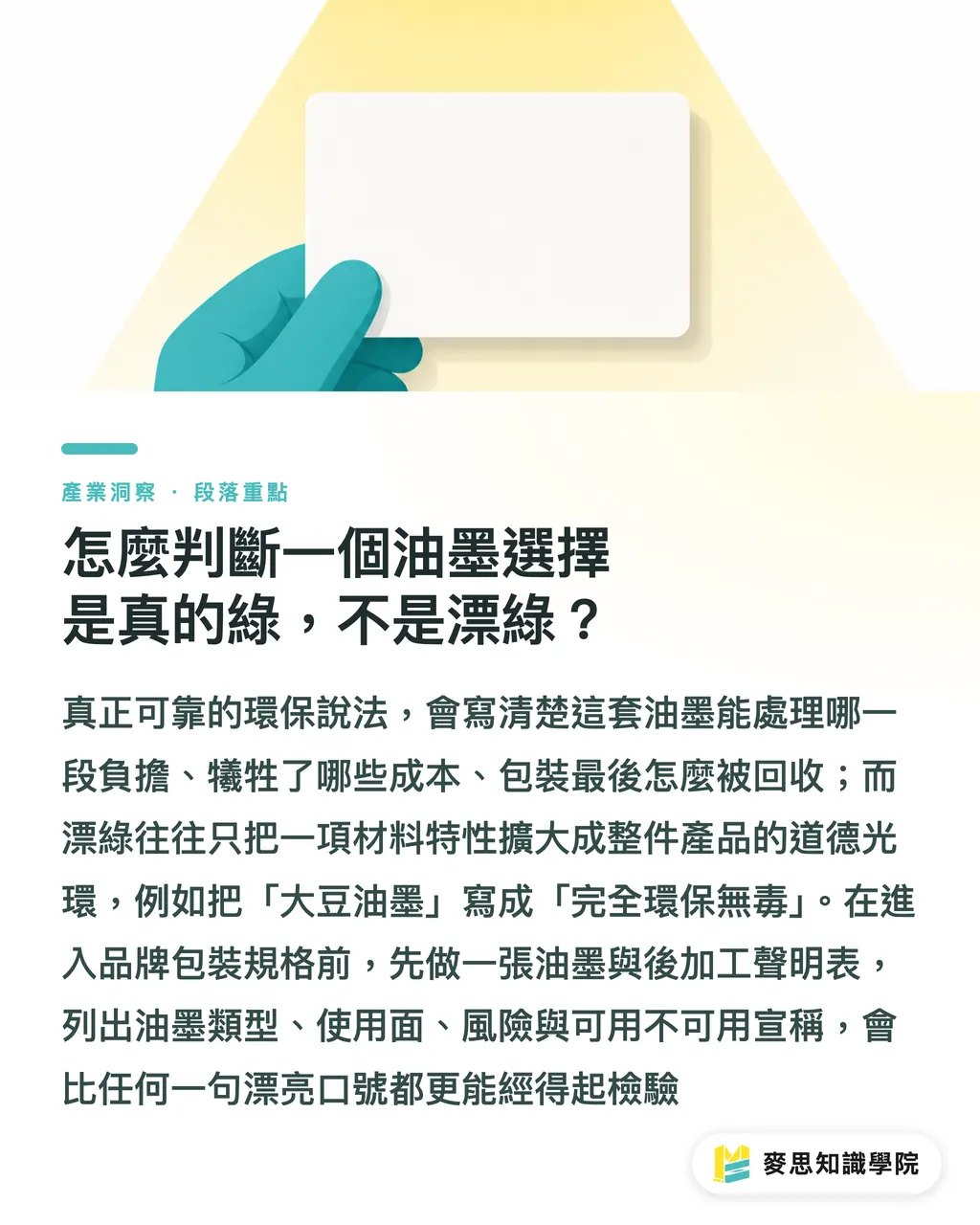
How Do You Tell If an Ink Choice Is Truly Green or Just Greenwashing?
A reliable environmental claim clearly defines its boundaries. The most common feature of greenwashing is taking a single material property and inflating it into a moral halo for the whole product
I use four questions on the press floor to check:
・Which burden does this ink reduce: VOCs, petroleum sources, odor, recyclability, or manufacturing waste?
・Which cost does this ink increase: drying time, energy use, scrap rate, finishing difficulty, or QA labor?
・How is this packaging disposed of in the end: recycling, incineration, general trash, or hard-to-separate mixed materials?
・Can this sustainability copy be proven: Do supplier data, print specs, ink model numbers, and process logs line up?
A usable claim sounds like this: "Printed with soy ink, suitable for paper printing and recycling communication. Actual environmental performance still depends on paper stock, varnishing, and finishing design."
A problematic claim sounds like this: "Made with soy ink, 100% eco-friendly and non-toxic."
The former clarifies conditions, while the latter leaves the risk with the brand and the print shop
If your team needs to include eco-friendly ink in brand packaging specs, the Mai Strategy Knowledge Academy consulting team recommends creating an Ink & Finishing Declaration Sheet first. It should list ink type, application surface, contact risk, finishing, usable claims, and off-limit claims. That sheet is far more useful than a catchy slogan
Key Takeaways
・Soy ink offers environmental advantages, but it is an option, not a guarantee
・Ink suitability depends on substrate, application, regulatory requirements, and process control
・Food packaging should address contact risks and migration before eco-friendly branding
・Water-based ink, UV ink, and soy ink each have their place; picking the wrong one is worse than not using it
・Sustainability copy must be precise. The tighter your conditions, the less likely you are greenwashing
Further Thoughts
For print manufacturers, the competitiveness of eco-friendly ink lies not in slogans, but in stable proofing, process records, and specs that buyers can understand. For designers, choosing soy ink means checking solid colors, paper stock, coatings, and finishing simultaneously, because a pretty layout doesn't guarantee smooth mass production
For AI application and SaaS teams, topics like this are ideal for pre-press checklists: enter the material, application, food contact risk, finishing, and copy claims, and the system can flag potential overclaiming or signal that adhesion testing is needed first. The tools that add real value don't just chant green slogans; they help teams lay out risks in advance
FAQ
- Is soy ink really more eco-friendly?
- Soy ink is often viewed as a greener alternative than traditional petroleum ink because it uses plant oils. However, it still contains pigments, resins, and additives, so actual eco-friendliness depends on formulation, substrate, and process control
- Can soy ink be used on food packaging?
- Soy ink can be used on the exterior of some food packaging, but that does not mean it can directly touch food. Food packaging requires verifying contact surfaces, migration risks, ink safety data, and finishing conditions first
- Is water-based ink always better than soy ink?
- Water-based ink has lower VOCs and is commonly used for paper bags, corrugated boxes, and flexo packaging, but it faces challenges with drying, paper moisture absorption, and rub resistance. Soy ink and water-based ink should be chosen based on substrate and application, not ranked by name
- Is UV ink less eco-friendly?
- UV ink dries fast, offers strong rub resistance, and delivers high color saturation, making it suitable for high-efficiency and high-durability needs. For food packaging, however, low-migration formulas and cure completeness must be verified rather than assuming it applies just because it dries fast
- Can brands state that they use soy ink on packaging?
- Brands can state "printed with soy ink," but should avoid hard-to-prove claims like "completely non-toxic," "zero pollution," or "100% eco-friendly." Good sustainability copy clearly explains materials, applications, and limitations
Related articles
The Print × AI weekly
The print and AI know-how designers, brands and enterprises can use before they commit — one email, every week
MINDS Free Tools
AI background removal, a LINE sticker maker, spine & imposition calculators — all free, right in your browser, no upload.
MINDS Group
Need actual printing or gifting services?
From premium printing to online ordering and festive gifts — the MINDS Group sister brands take it from here.