

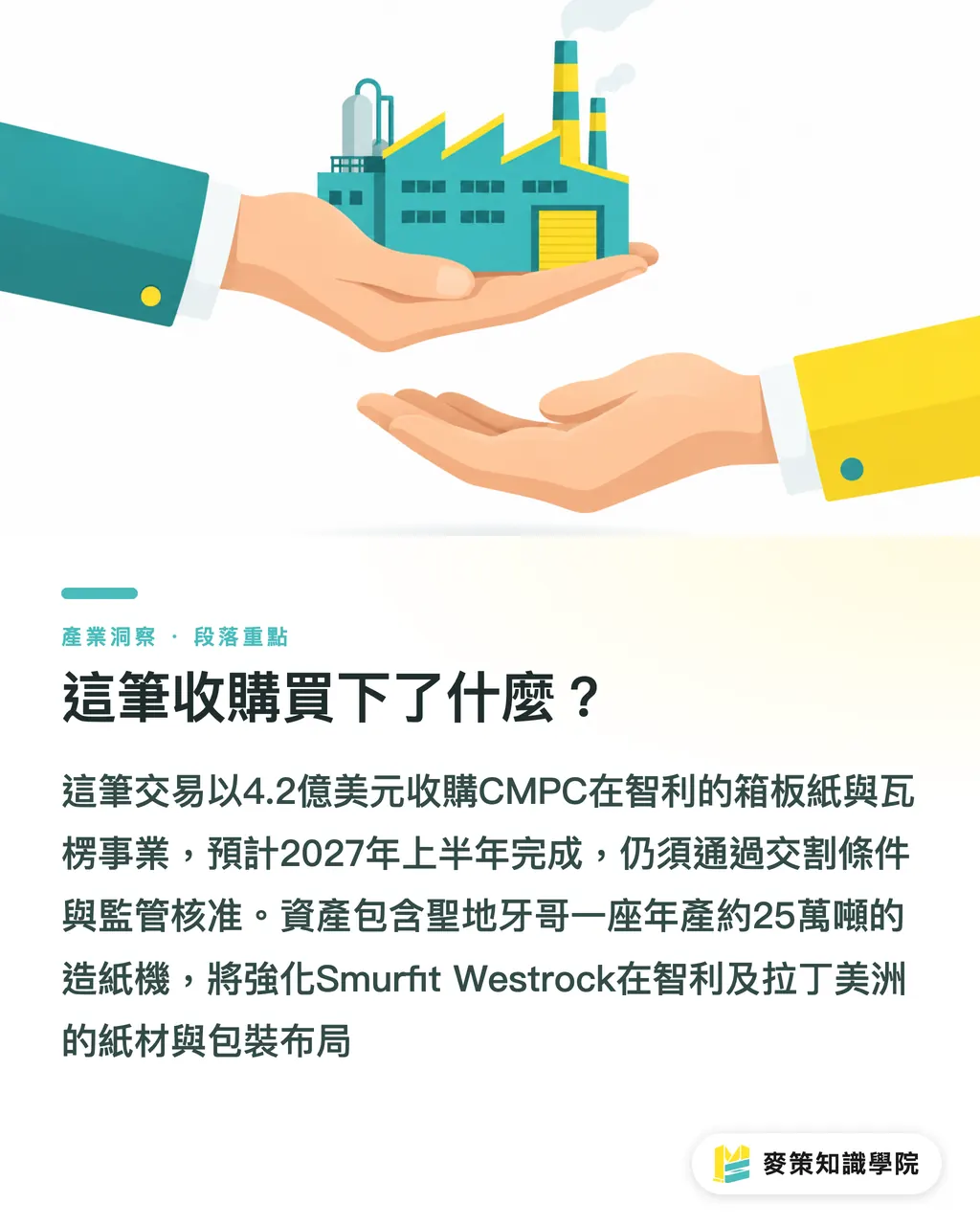
What does this acquisition actually buy?
This transaction covers CMPC's containerboard and corrugated business in Chile, with a purchase price of US$420 million and expected completion in the first half of 2027, subject to customary closing conditions and regulatory approval. Smurfit Westrock, a multinational paper-packaging company, is acquiring from Empresas CMPC S.A., a Chilean pulp and paper company, a group of paper and corrugated assets near Chile's main fishing and agricultural regions
Containerboard is the liner and facing paper used in corrugated board. Corrugated board sandwiches a fluted core between flat sheets, creating a structure that protects products and withstands stacking. The paper machine in Santiago produces about 250,000 tonnes a year and will become part of Smurfit Westrock's regional paper system. The company also says the acquisition will give it a leading position in Chile's containerboard and corrugated business and strengthen its existing Latin American operations. The original report is Smurfit Westrock acquires CMPC's Chilean containerboard and corrugated business
Will paper prices rise immediately?
Paper prices will not rise across the board the day after this deal. What changes first is how paper is allocated across borders, which customers receive priority supply, and the bargaining power in long-term contract negotiations
Not so fast
The transaction is valued at US$420 million. Even with synergies included, the deal multiple is below 6x Adjusted EBITDA (earnings before interest, taxes, depreciation, and amortization). This reflects the buyer's decision to factor cross-regional integration benefits into its assessment of the deal. The company plans to integrate recovered paper into its operations in Argentina, Peru, and Ecuador, and can also bring kraftliner from Brazil and North America into its Chilean assets. Once paper sourcing can be rebalanced across countries, regional customers' long-term contract terms and supply priority may shift as well. Asian printers may not use Chilean paper directly, but they cannot treat this deal as a local South American story
What will small and midsize Asian printers face first?
Small and midsize Asian printers that rely on imported paper should first prepare for supply terms to be renegotiated, slower validation of substitute sources, and more cautious lead-time commitments. The announcement alone is not a reason to conclude that the market will run out of paper the next day. The acquisition is expected to close in the first half of 2027, so procurement teams should treat that date as the deadline for reviewing their supply assumptions
・1. Map each paper's source, grade, substitute grade, and lead time, and identify single-source items first
・2. Ask suppliers to explain long-term contracts, price-adjustment notices, substitute materials, and priority-supply rules. A verbal promise does not count as a completed check
・3. Confirm substitute paper through actual proofs and box-format testing. The same basis weight does not mean the same stiffness, surface, or printability
How should brand owners lay out paper-material risks?
Brand owners should break paper-material risk into three columns, brand experience, packaging performance, and supply source, so changes in paper prices translate into specifications that people can act on. Smurfit Westrock plans to bring recovered paper into its operations in Argentina, Peru, and Ecuador, while routing kraftliner from Brazil and North America into its Chilean assets. This shows that paper origins and flows will become part of supply strategy
・Brand experience: Use approved samples to define appearance, feel, print colors, and the unboxing experience. Spell out any elements that cannot change
・Packaging performance: Put box style, stacking, transport, and protection requirements through sample-box testing. Do not judge by the paper name alone
・Supply source: List the paper mill, paper grade, recovered-paper percentage, and substitution sequence, so design and production receive the same update when procurement changes
If a brand team lacks the staff to coordinate design, procurement, and printing, the Mai Strategy Knowledge Academy consulting team can help turn these conditions into a specification sheet that procurement can use directly for quotation requests and acceptance checks
What three things need to be done before the first half of 2027?
Before the deal closes in the first half of 2027, small and midsize printers should complete three tasks: map paper sources, test substitutes, and communicate with customers. The goal is not to predict a paper-price change that has not happened yet. It is to avoid discovering only after a design is finalized that neither the paper nor the lead time can be changed
・1. Paper-source inventory: Put the suppliers, sources, inventory, lead times, substitutes, and minimum purchasing requirements for key paper items into one shared version
・2. Substitute testing: Have the design team run paper-change proofs first, then have production confirm printing, die-cutting, folding and gluing, and stacking performance
・3. Customer communication: Put potentially changing paper grades, lead times, and quote-validity periods into the quotation, so brand owners can make choices before a redesign or reorder
Supply-chain SaaS, software for managing suppliers, specifications, and lead times in the cloud, can organize supplier responses and flag changes. AI can compare documents, but it cannot replace real-world testing of paper, machines, and finished products
Key takeaways
・The US$420 million deal changes how paper sources are allocated across South America, but paper prices may not change overnight
・The paper machine in Santiago, with annual output of about 250,000 tonnes, becomes a physical anchor for regional paper integration
・Small and midsize Asian printers should map paper sources and test substitutes first. Do not wait until a quotation expires to look for a second source
・When brand owners split paper materials into experience, performance, and source, AI and SaaS have reliable data to work with
One more thought
I would treat this deal as a reminder to review procurement systems. Chilean paper will not hit Taiwan tomorrow just because of an announcement. What needs attention first is the assumptions around substitute materials and lead times. Printing and manufacturing teams should define substitute paper grades and test sample boxes in practice. Design teams should clearly mark which elements can switch to another paper and which cannot. Brand owners should include lead times and quote-validity periods in annual purchasing plans. AI is good for organizing specifications, supplier responses, and change alerts. Supply-chain SaaS works well for letting procurement, design, and production share one version. But whether a switch will actually work still comes down to testing the paper, machines, and finished products
Further reading
FAQ
- Will paper prices rise immediately after Smurfit Westrock acquires CMPC's Chilean business?
- No. The announcement alone does not mean global paper prices will rise. The deal first changes paper allocation in South America, long-term contract negotiations, and supply priority. Actual prices will still depend on regional supply and demand, paper grade, and contract terms
- When will the deal close, and how large is it?
- The purchase price is US$420 million, and completion is expected in the first half of 2027, subject to customary closing conditions and regulatory approval
- What should small and midsize Taiwanese printers do now?
- Start by mapping the source and substitute for every paper material. Ask suppliers to explain long-term contracts and lead times, then confirm substitute paper through proofs and box-format testing. Do not look at basis weight alone
- How can brand owners reduce paper-supply risk?
- Define brand appearance, packaging performance, and substitute paper sources separately, and put paper grades, lead times, and quote-validity periods into procurement specifications. AI or supply-chain SaaS can organize changes, but neither can replace physical testing
Related articles


The Print × AI weekly
The print and AI know-how designers, brands and enterprises can use before they commit — one email, every week
MINDS Free Tools
Spine width and imposition calculators — skip the manual math, free in your browser.
MINDS Group
Need actual printing or gifting services?
From premium printing to online ordering and festive gifts — the MINDS Group sister brands take it from here.