

Introduction: An Underestimated Category of Process Risk
Large solid background areas are among the design choices used most often, yet they cause the most frequent wrecks on the press line. The deep blue on a catalog cover, the pitch black on a packaging box, or the burgundy on the back of a business card looks like a simple color swatch on screen. On the press floor, however, it becomes a high-risk zone where ink film thickness, paper absorbency, drying time, and post-press finishing schedules collide. When these jobs suffer from mottling, uneven solids, or set-off, the loss rarely stops at reprinting a single sheet. It throws the entire delivery schedule into chaos
A clear gap exists between academic research and industry practice on this topic. Print quality measurement studies have long centered on instrumental evaluations of dot gain, color difference, and print uniformity, using flexography as their primary experimental testbed, such as existing research exploring the relationship between printing parameters and print quality metrics [3][4]. On another front, mature standard systems cover the physical testing methods for paper and packaging materials [2]. Both tracks, however, revolve around measurement after the fact. They rarely step back to address an upstream question: what variables can designers and buyers actually adjust before sending files to press? Meanwhile, literature on anti-set-off powder, a standard countermeasure against set-off in offset printing, appears mainly in occupational health publications. Case studies documenting occupational asthma triggered by pea-starch anti-set-off powder [1] show that the true cost of this material extends well beyond print quality
This article makes three contributions, each corresponding to a main section:
・First, it synthesizes three disjointed bodies of literature on paper substrates, ink drying, and anti-set-off powder, pinpointing where existing studies fail to cover short-run offset jobs on fine art paper
・Second, it breaks down the causal chains behind mottling and set-off, separating file-level controllable variables from press-level controllable variables, while explaining why file-level adjustments provide far greater impact
・Third, it translates these analytical findings into actionable practices across three tiers in Taiwan: small and medium print shops, designers, and brand owners, detailing specific workflows, cost structures, and delivery timeline estimates
Taiwan's commercial design and print market is dominated by small and medium print shops running short orders across diverse paper stocks. Fine art paper (defined here as uncoated or lightly treated paper with pronounced surface texture and high ink absorbency) sees much higher usage than in mass-production packaging markets that rely on coated stock. Short runs leave little margin for error during press proofs. Diverse papers make standard parameters unreliable. Together, these two realities make pre-press judgment the decisive factor in final quality
Literature and Industry Review: Three Disconnected Strands
This section groups existing discussions into three categories and outlines how each connects to or differs from our analysis
Group 1: Parametric measurement of print quality. This research thread focuses on the quantitative relationship between printing parameters (impression pressure, anilox ink transfer, plate hardness, press speed) and final quality metrics, relying on flexography as its main vehicle [3][4]. Methodologically, it established repeatable measurement protocols that turn subjective print evaluations into comparable figures. The difference between these studies and our work lies in process and context. Flexography and offset lithography differ fundamentally in ink transfer mechanisms, ink chemistry, and drying paths, so parameter values from flexo cannot simply be applied to solid fills on offset fine art paper. We adopt their methodological approach of breaking quality defects into identifiable chains of variables, rather than borrowing their specific numeric settings
Group 2: Standardized testing systems for paper and packaging materials. International standards organizations have established systematic test standards covering physical properties and packaging applications [2]. Their contribution is creating a shared language across vendors and borders, ensuring that paper absorbency is no longer described merely by an operator's gut feeling. This ties directly into our analysis: disputes over solid fill quality often stem from the lack of a common vocabulary between buyers and printers, and standardized systems provide that foundation. Still, these standards define testing methods for the paper in isolation. They do not answer the combined question of drying risk when a specific paper meets a heavy ink load, which is the question driving procurement decisions
Group 3: Occupational health research on anti-set-off powder. Anti-set-off powder, a fine powder sprayed onto printed sheets in offset printing to create physical separation and prevent wet ink from transferring to the backing sheet, is standard defense against set-off. Literature has documented that pea-starch powders can trigger occupational asthma [1]. The takeaway is clear: anti-set-off powder is not a free quality fix. Increasing powder volume drives up dust exposure on the shop floor. This connects closely with our analysis by turning the shop floor instinct of just spraying a bit more powder from a simple quality trade-off into a multi-variable calculation that includes occupational health costs
Quality measurement studies bypass solid coverage on offset fine art paper, substrate standards ignore the drying risks of specific paper-ink pairings, and powder research remains confined to health journals without influencing process planning. Existing discussions have failed to build an upstream decision-making framework for designers and buyers. This article tackles that gap
Analysis 1: Causal Chains of Mottling and File-Side Leverage
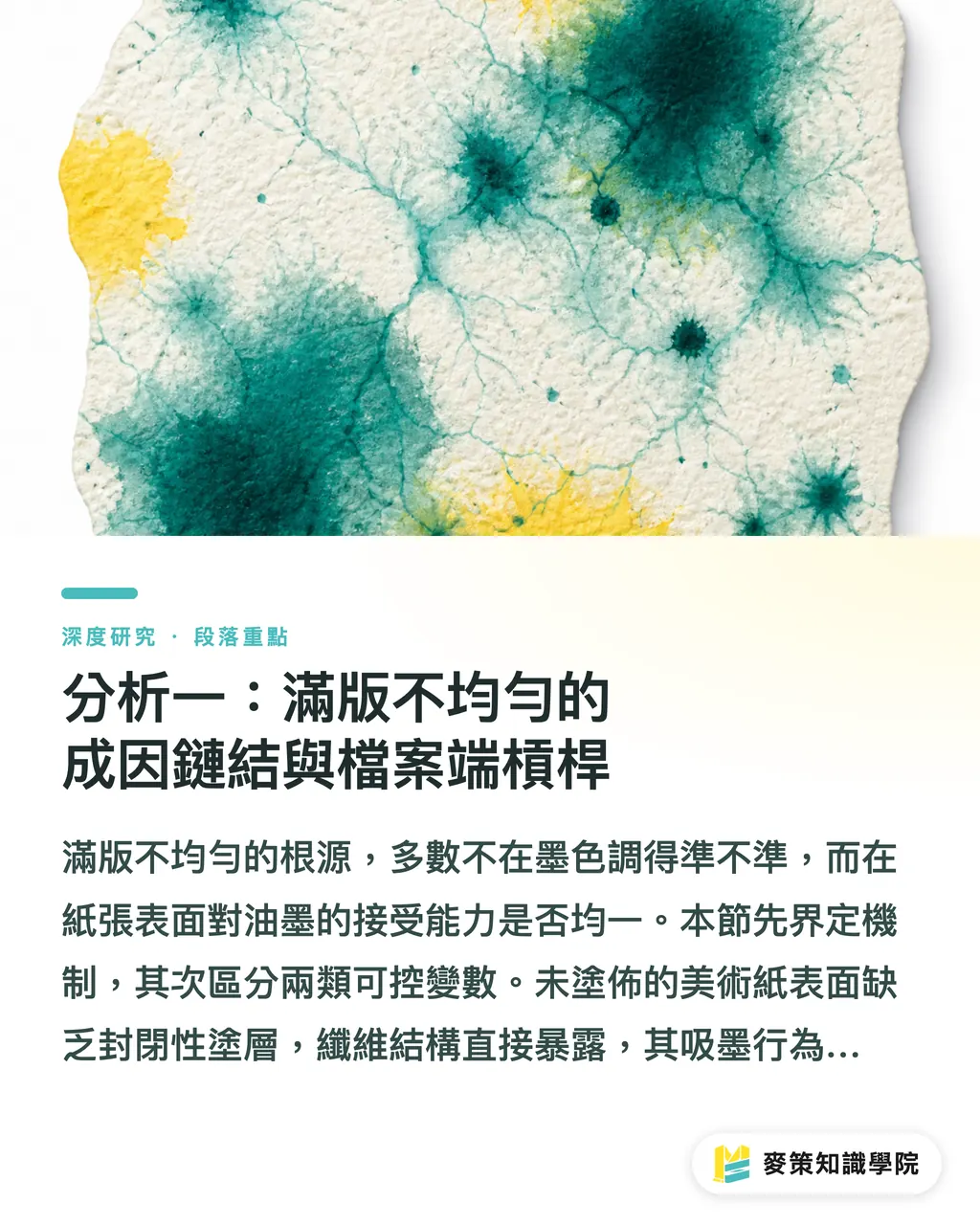
The root cause of uneven solid coverage rarely comes down to ink color matching. Instead, it stems from whether the paper surface accepts ink uniformly. This section defines the underlying mechanism first, then breaks down two categories of controllable variables
Uncoated fine art paper lacks a sealed coating. Its raw fiber structure is exposed, absorbing ink through capillary action like a porous medium. When the ink vehicle (binder) is drawn into the fibers rapidly and unevenly, microscopic variations form in the thickness of the pigment layer left on the surface, creating visible mottling or cloudy patches. In contrast, coated paper seals off most pores, keeping more ink on the surface where it dries through both oxidative polymerization and slow penetration. While coated paper delivers smoother solid coverage, it dries slower. We argue that this represents an unavoidable trade-off: chasing smoother solids increases set-off risk, while prioritizing fast drying means accepting uneven ink absorption on textured sheets
Parametric research confirms that print quality metrics correlate quantitatively with controllable process parameters rather than random fluctuations [3][4]. For our argument, this proves that mottling is a structural, predictable issue rather than bad luck with a paper batch. Because it is predictable, we can intervene before going to press
The primary variable for upstream intervention is Total Area Coverage (TAC, the sum of CMYK dot percentages). When deep solids are built by stacking four process colors, TAC easily approaches or exceeds 300%. An excessively thick ink film worsens two problems at once: it stretches drying times and magnifies uneven absorption across the paper. Conversely, applying Under Color Removal (UCR) or Gray Component Replacement (GCR) shifts neutral gray components from CMY over to black ink, dropping TAC substantially while preserving visual depth. This is why file-level adjustments offer far greater impact than press adjustments: the press operator can only tweak pressure and speed for a fixed ink volume, but the file creator can reduce the ink volume itself
Standardized testing systems provide objective methods to describe paper properties [2]. This means asking a print shop for measurable substrate data, rather than just a brand name and basis weight, is not an unreasonable demand from designers. Existing standards already support this practice
Analysis 2: Drying Kinetics of Set-Off and the Hidden Costs of Anti-Set-Off Powder
Set-off, where wet ink transfers onto the back of the preceding sheet during stacking, occurs under straightforward conditions: the drying rate over time fails to meet the threshold required to withstand the contact pressure of the paper pile. This section walks through drying mechanisms, shop floor remedies, and their associated costs
Traditional offset ink dries along two parallel paths: penetration, where the vehicle is absorbed into paper pores, and oxidative polymerization, where drying oils react with atmospheric oxygen to form a solid film. Penetration is rapid but incomplete; oxidation is slow and dictates final rub resistance. Deep solid coverage creates a bottleneck: thicker ink films impede oxygen from diffusing to the bottom layers, stretching oxidative drying times non-linearly. At the same time, taller delivery piles exert heavy pressure on bottom sheets. These two forces compound each other, explaining why solid coverage carries a far higher set-off risk than standard text jobs
The standard response on the press line is spraying anti-set-off powder to create physical spacing between sheets. Studies have documented that pea-starch powders pose real risks of triggering occupational asthma [1]. For process planning, this evidence shows that powder volume cannot simply be ramped up without limit. Beyond causing gritty textures and poor adhesion in downstream varnishing or laminating, airborne dust exposure creates a tangible occupational health cost that must be factored in rather than treated as zero
Another countermeasure is applying inline aqueous coating. It creates a fast-forming protective film over the ink, minimizing direct friction and transfer risk. Aqueous coating and anti-set-off powder are complementary rather than mutually exclusive: coating addresses rub resistance and transfer, while powder maintains physical clearance in the stack. Coating changes the tactile quality of the sheet, however. For designs that intentionally select uncoated fine art paper for its raw, tactile finish, adding an aqueous coat compromises the original intent. This decision needs to happen during pre-press discussions, not after the run is finished
Digital printing offers a third route. Toner systems fuse via heat and exit the press dry, eliminating the waiting period required for oxidative polymerization and dropping set-off risk to near zero. On heavily textured fine art paper, however, toner can suffer from uneven fusing and micro-cracking across deep solid areas. Liquid ink digital presses generally produce smoother solids and handle a wider range of stocks. For short runs with tight deadlines, the total cost of going digital, including reprint risks and idle waiting time, is often lower than offset. This comparison belongs at the quoting stage, not as an emergency pivot after an offset run fails

Implications for Taiwan's Design and Print Industry
This section details actionable practices across three operational levels. Taiwan's market is defined by small and medium print shops, short runs, and high paper diversity, so the practical takeaways differ by role
Small and medium print shops. The priority is turning implicit shop floor experience into explicit operational rules:
・Log paper-to-ink performance profiles: For frequently used fine art papers, record drying behavior and powder spray volumes across different TAC brackets. Build an internal lookup table instead of relying on guesswork on each shift
・Write drying intervals directly into quotes and production schedules: Schedule fixed waiting windows before post-press finishing (laminating, foil stamping, die-cutting) for deep solid jobs, rather than checking the stack by hand
・Request physical property data from paper merchants using standard testing protocols [2], using objective metrics as a shared language with clients
・Track powder consumption as an environmental health metric rather than a mere consumable, accounting for the documented risks of occupational asthma [1]
Designers. Most actions that determine print quality occur before files are sent to press:
・Always check TAC on dark solids. Use UCR or GCR to shift neutral tones into the black channel, prioritizing lower total ink buildup over heavy individual color densities
・Expect lower color saturation on uncoated fine art papers compared to screens or coated proofs. Adjust compensation curves during pre-press steps rather than complaining about dull colors after production
・Confirm whether clients accept aqueous coating early in the design phase. This decision affects both paper texture and set-off risks, leaving little room for fixes after printing
Brand owners. The main advantage lies in structuring procurement terms:
・Include drying times in delivery estimates: Calculate realistic delivery dates as print date plus drying time plus finishing steps. Rushing schedules almost always compromises ink drying
・Demand short trial runs on actual production stock with target ink loads for large packaging orders, rather than relying solely on digital contract proofs that cannot replicate offset ink drying dynamics
・Factor reprint risks into quote comparisons: The lowest unit price is rarely the cheapest option if it skips drying intervals and trial proofs
We summarize these upstream steps into a three-part pre-flight checklist: Substrate Compatibility (checking if paper absorbency matches design intent), Ink Load Control (confirming TAC is managed via UCR or GCR), and Timeline Scheduling (building drying time into delivery dates). This framework serves as a practical memory aid derived from mechanical analysis rather than a standalone empirical claim
Conclusions and Limitations
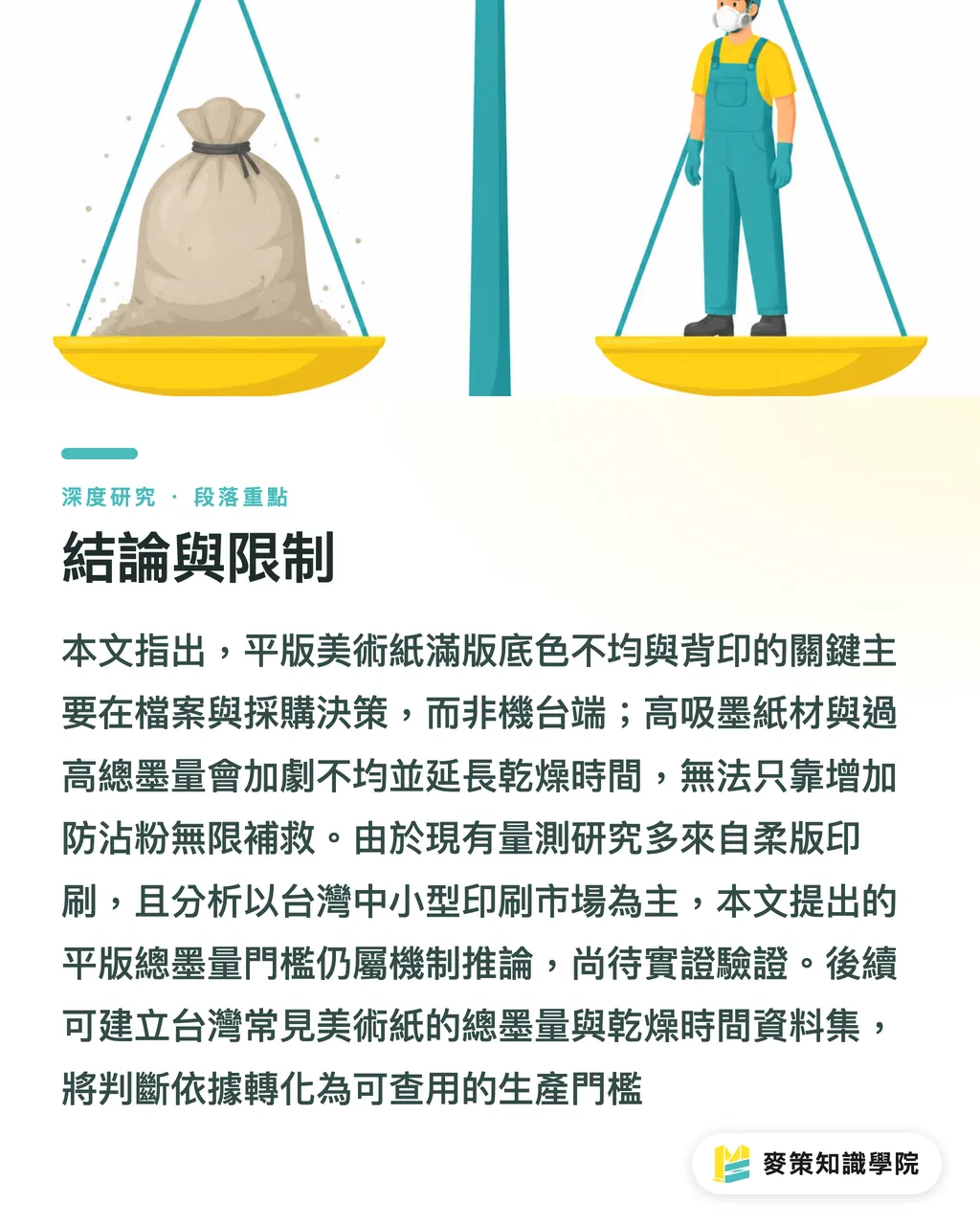
This review addresses the research question posed in the introduction: the outcome of solid color mottling and set-off is decided upstream in file prep and procurement, not at the press console. Uncoated fine art paper's porous nature triggers mottling, excessive TAC prolongs oxidative drying while worsening unevenness, and anti-set-off powder carries occupational health costs [1], ruling it out as an unlimited safety valve. While parametric quality studies prove that print metrics relate quantitatively to process parameters [3][4], and standard frameworks define paper properties [2], neither addresses ink-paper pairing choices for offset fine art paper. That is the gap this review targets
This study carries two specific limitations:
・First, asymmetry in evidence coverage: The available print quality measurement literature relies on flexography [3][4], while our analysis centers on offset lithography. Because the two processes differ fundamentally in ink transfer and drying, we do not extrapolate flexo parameter values directly to offset, adopting only the methodological premise that quality can be parameterized. Quantitative thresholds for solid fills on offset fine art paper, such as safe TAC ceilings for specific stocks, remain theoretical inferences here rather than direct empirical datasets
・Second, geographic boundaries of extrapolation: Our analysis of small and medium print shops, short runs, and paper diversity reflects the structure of Taiwan's market without cross-market statistical validation. These practical recommendations may not apply as directly to mass-market packaging environments
Future research can proceed along three directions:
・First, build an offset dataset mapping TAC against drying times across common fine art papers in Taiwan, converting mechanical deductions into practical threshold tables
・Second, quantify the relationship between anti-set-off powder volume and downstream coating or laminating adhesion, providing a measurable baseline for powder trade-offs while tracking workshop dust exposure [1]
・Third, compare the total costs of offset versus digital paths for short-run solid dark jobs, including reprint probabilities and idle waiting costs, giving printers empirical data for quoting
Key Takeaways
Whether solid fills succeed is largely decided before files reach the press. On-press tweaks are just damage control
Uncoated fine art paper's high absorbency causes mottling, while coated paper offers smoother solids but dries much slower. You cannot optimize both at once
Cutting Total Area Coverage (TAC) through UCR or GCR is the highest-impact move for designers, because the press operator can only work with the ink volume provided in the file
Anti-set-off powder is not a free fix. Research links pea-starch powder to occupational asthma risks, meaning powder volume must be actively weighed rather than cranked up by default
Delivery dates for heavy solid jobs must be calculated as print completion plus drying time plus finishing. Rushing a job cuts into drying time first
Further Considerations
For print manufacturing, moving the relationship between paper, ink volume, and drying time out of senior operators' heads and onto paper creates far more value than spraying more powder or speeding up the press. Building a searchable internal database also protects institutional knowledge as older press operators retire. For designers, the real divide lies in addressing TAC, paper texture, and coating requirements right at the proposal stage rather than handing off the risk to the print shop after sign-off. AI offers a practical entry point here: the variables behind mottling and set-off are finite and structural. The most realistic path is automating pre-flight checks to flag high-TAC areas and heavy solids, then calculating required drying windows based on paper properties. Using machine learning to predict exact color shifts on finished sheets requires training datasets that are hard to build under Taiwan's short-run conditions, so forcing that in the near term makes little sense. For print SaaS platforms, this reveals an open market opportunity: integrating drying times into online quoting and scheduling engines, exposing the true cost of rush orders at checkout instead of leaving the press floor to absorb the risk the day before delivery. The real bottleneck remains data availability: printers have little incentive to log drying curves, individual shop conditions vary widely, and standardizing comparable cross-shop datasets will take more effort than building the algorithms themselves
References
[1] Keirsbilck S., Ronsmans S., Vandebroek E., et al. (2022). Occupational asthma due to exposure to anti-set-off powder (pea-starch). Safety and Health at Work. DOI: 10.1016/j.shaw.2021.12.1541
[2] ASTM International: Standards for Paper and Packaging. ASTM International
[3] Journal of Graphic Engineering and Design: Paper on Flexographic Print Quality. Journal of Graphic Engineering and Design
[4] DiVA Portal / Karlstad University: Doctoral Thesis on Flexographic Print Quality and Printing Parameters (PDF). DiVA Portal / Karlstad University
FAQ
- Why does printing solid background colors on fine art paper frequently cause mottling or unevenness?
- Uncoated fine art paper lacks a sealed surface coating, so exposed fiber pores absorb ink binder directly. Inconsistent absorption rates cause microscopic variations in the pigment layer left on the surface, appearing visually as mottling or cloudiness. Coated paper seals most pores to deliver smoother solids, but it dries slower and increases set-off risks
- What is set-off, and how does it differ from scuffing or scratching?
- Set-off occurs when uncured ink transfers onto the back of the preceding sheet in the delivery pile, caused by insufficient drying combined with stacking pressure. Scuffing or scratching happens when dry ink film gets rubbed and damaged by abrasion. Their remedies differ: set-off requires longer drying times, anti-set-off powder, and shorter stack heights, while scuffing requires varnishing or film lamination to improve surface rub resistance
- What is the most critical check designers should make before sending dark solid files to press?
- Check Total Area Coverage (TAC, the sum of CMYK dot percentages). If dark solids are built by stacking four process colors, TAC often approaches or exceeds 300%, dragging out drying times and magnifying uneven paper absorbency. Using UCR or GCR to shift neutral tones into the black channel lowers total ink volume significantly while preserving visual depth
- Can spraying extra anti-set-off powder solve set-off issues?
- No. Increasing powder volume should never be treated as an unlimited fix. Excessive powder creates a gritty feel and causes poor adhesion during downstream coating or laminating. Research also shows that pea-starch powders can trigger occupational asthma, making respiratory dust exposure on the shop floor a real cost that cannot be ignored
- For short-run dark solid jobs, should you choose offset or digital printing?
- Toner-based digital systems fuse ink with heat and come off the press completely dry, eliminating oxidative waiting times and minimizing set-off risk for urgent short runs. Toner can fuse unevenly on heavily textured fine art paper, however. Liquid ink digital systems generally offer better solid uniformity and wider substrate compatibility. Printers and buyers should compare the total cost of both methods at the quotation stage, factoring in reprint risks and drying downtime
Related articles




The Print × AI weekly
The print and AI know-how designers, brands and enterprises can use before they commit — one email, every week
MINDS Free Tools
Spine width and imposition calculators — skip the manual math, free in your browser.
MINDS Group
Need actual printing or gifting services?
From premium printing to online ordering and festive gifts — the MINDS Group sister brands take it from here.