
Introduction
Color consistency in packaging print has long been the part of the supply chain most likely to blow up into a customer complaint between brand owners and their vendors. Spot colors are used heavily for brand identity and regulatory marking because they hold their saturation and reproduce more reliably on substrates like metallics, films, and labels. But reproducing them depends on three things being in sync at once: a physical swatch, an ink formula, and the state of the press. That coupling is why the same Pantone number can come out visibly different from one supplier to the next. The rise of cloud-based color management as a service is being read across the industry as the moment that age-old craft problem finally turns into something you can measure, quote a price against, and audit
The FastMatch Cloud partnership announced by Siegwerk and X-Rite Pantone in 2025 links the brand-side PantoneLIVE cloud color spec with the ink supplier's formula data and pushes both straight down into the press control layer. The stated, quantifiable wins: cross-plant color reproduction at ΔE<
・1. 5, new-SKU proofing cut from three rounds to one, and ink-mixing cost down roughly 25% [1]. This article takes that case as its core, combines it with the existing color management literature and the industry's current pulse, and looks back at where cloud color-matching services sit in packaging, how the mechanism works, and where it breaks down, then weighs what it all means for Taiwan's design-and-print sector
Specifically, the article tries to answer three layers of research question:
・First, how does FastMatch Cloud, technically and as a business model, reshape the path that turns "packaging color difference" from a complaint trigger into a service you can put a price on?
・Second, what does this architecture actually change in the design-handoff, prepress separation, and on-floor QC workflows?
・Third, for a Taiwan print supply chain dominated by small and mid-sized players, where does the entry barrier sit, what scenarios actually make adoption viable, and what risks are still unresolved? The contribution of this piece can be summed up in four points: a systematic review of how cloud color management in packaging has evolved and where the disagreements lie; a teardown of the two-way sync between PantoneLIVE and ink-formula data; an assessment of how credible the claimed wins actually are, judged on three metrics — ΔE, reproduction rate, and proofing round count; and concrete recommendations for how Taiwan's small and mid-sized printers should take stock of their digital proofing capability and chart an adoption path
Literature and Current-State Review
Cloud color management isn't a new idea. Its industry context can be traced along two main threads
The first thread runs through Pantone's own digitization arc. Pantone's move from physical chips to a cloud spec is best represented by PantoneLIVE, which extends the chip system into a digital color spec accessible through licensed endpoints and ties into X-Rite's measurement-instrument ecosystem. Pantone has also kept putting out print-oriented tools over the years, the 2005 Pantone Essentials and four-color process guide being one example [6] — which shows the system has long run a two-track strategy of physical proofing alongside the digital spec. X-Rite and Pantone also rolled out i1 Paint and a series of seminars between 2019 and 2020 [2][3], extending the measurement side into the coatings industry, a sign that the "measure, spec, formulate" three-layer architecture keeps pushing into adjacent sectors. In 2024, X-Rite, Pantone and Sun Chemical added further color libraries for aluminum packaging [4], which can be read as concrete evidence of cloud color management expanding from paper and film substrates into metallic ones. Section note: the literature above taken together shows that cloud color matching isn't a one-off product but the continuation of a multi-year build by Pantone and X-Rite; FastMatch Cloud is the service-level landing of that architecture
The second thread is about the reverse pressure that compliance and material circularity put on color management. The EU's PPWR (Packaging and Packaging Waste Regulation), EUDR (EU Deforestation Regulation), and the Digital Product Passport (DPP) have been tightening data-transparency requirements on the packaging supply chain since the second half of 2025 [1], pushing color, formula, and ink-component data to be treated as auditable compliance assets. On the substrate side, Voith's 2025 launch of EcoCal HiBulk calendering has pulled lightweight paper's print quality close to that of board. Advisors observing this have pointed out that, if the color management process isn't updated in lockstep, the new substrate will amplify complaint risk, any change at the substrate end feeds straight back into the color management process. Section note: compliance pressure and substrate change together form the "pull" behind cloud color matching, forcing scattered measurement and formula data to be consolidated into a traceable cloud layer
Where these two threads meet is exactly where FastMatch Cloud positions itself. That said, most of what's been published so far is product-launch coverage or single-vendor case studies. There is no systematic analysis of the "servitization" itself, that is, the business-model shift of turning color management from an internal process into a priceable external service, and there is hardly any empirical assessment of the entry barriers for small and mid-sized suppliers. That gap is the main angle of this article
FastMatch Cloud's Technical and Commercial Mechanism
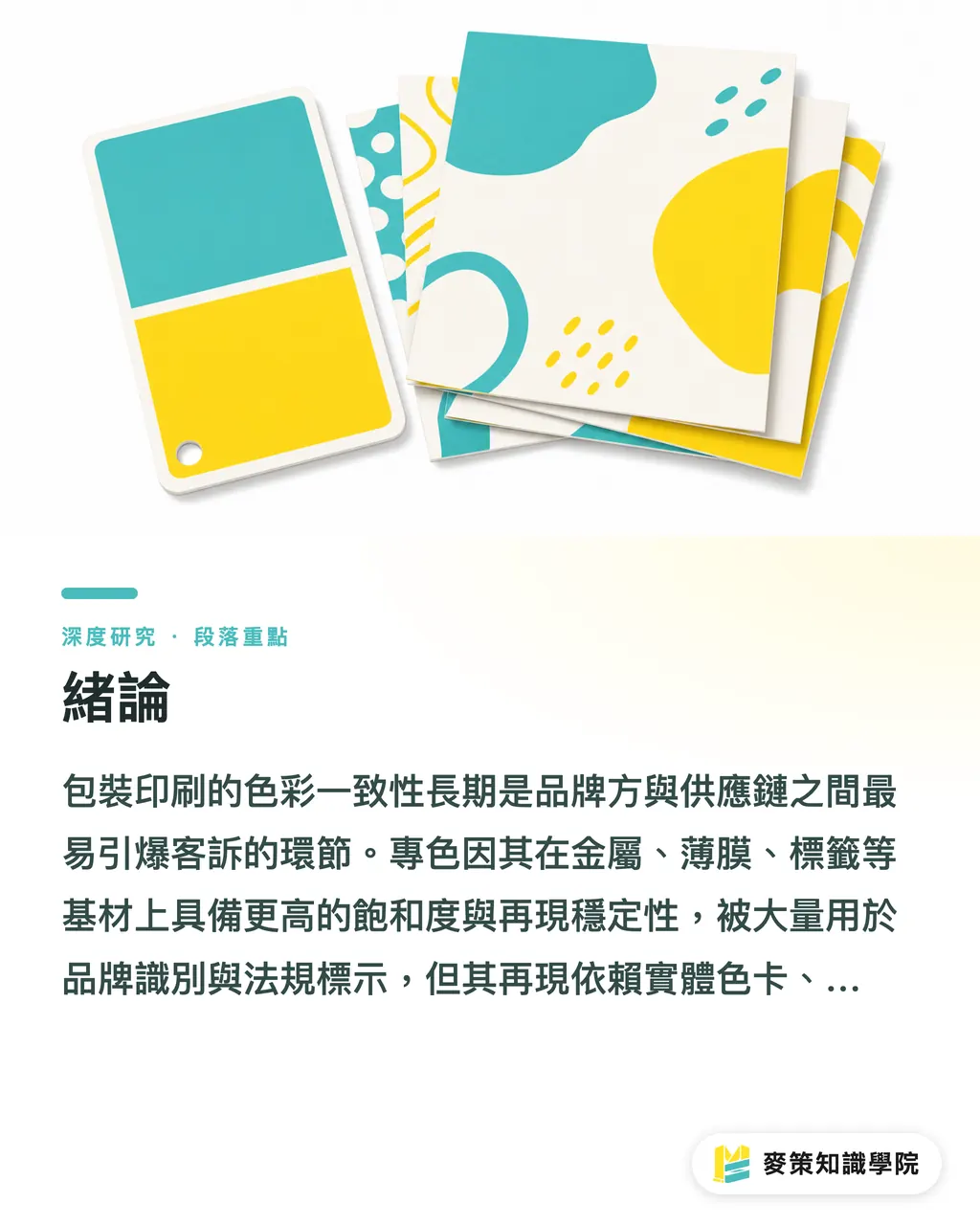
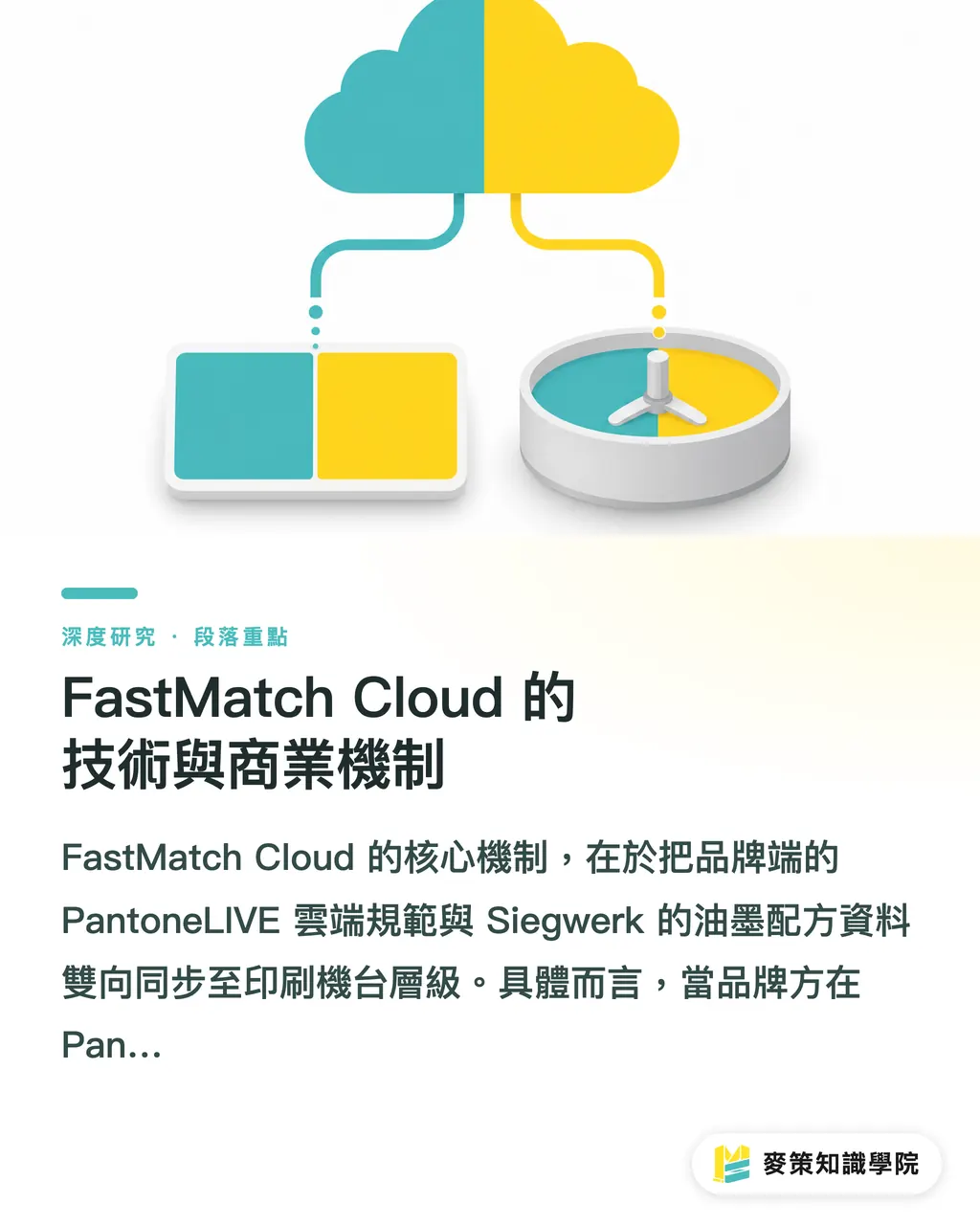
The core mechanism of FastMatch Cloud is the two-way sync between the brand-side PantoneLIVE cloud spec and Siegwerk's ink-formula data, pushed all the way down to the press. Specifically, when a brand owner defines a spot-color spec inside PantoneLIVE, the ink supplier on the formula side can pull up the matching ink combination and target spectral data in the cloud, and the print side gets the spec through a licensed endpoint and compares the press output against it in real time on ΔE. According to the launch material, cross-plant color reproduction can hit ΔE< 1.5 [1]. This article's read is that ΔE< 1.5 is, in most packaging applications, already at a level of reproduction that the eye can't pick out. That means the brand owner's demand for "the same color" can move from a judgment call to a contractual threshold. Whether color difference actually flips from a complaint to a priceable service comes down to whether that threshold gets adopted in real deals
Second, the platform claims new-SKU proofing can drop from an average of three rounds to one, with ink-mixing cost down around 25% [1]. The drop in proofing rounds isn't just about saving substrate, it shortens the new-product time-to-market. The drop in ink-mixing cost reflects that cloud-side formula data reduces the number of physical trial-and-error cycles. This article's read: that benefit lands hardest in label and flexible-packaging applications that lean heavily on spot colors, because in those applications proofing cost usually takes up a higher share of total cost than in folding cartons
Third, FastMatch Cloud's commercial model is fundamentally SaaS, which stands in contrast to the old color management model built around one-time software and hardware purchases. For small and mid-sized printers, that means you don't necessarily have to buy a six-figure spectrophotometer to plug into an international brand-color spec system, but only as long as you already have a baseline of digital proofing and press-state monitoring of your own [1]. This article's read is that baseline is precisely the main barrier for Taiwan's small and mid-sized suppliers, and it's the focus of the chapters that follow
How It Reshapes Prepress Separation, Proofing, and QC
The impact of cloud color-matching services on prepress can be observed on three levels
The first level is separation and handoff. In the traditional flow, separation parameters, ICC profile, total ink limit, color order, are mostly set by the printer based on experience, and the brand owner has no real-time way to intervene. FastMatch Cloud, via PantoneLIVE, lifts the spec layer up to the brand side, so separation parameters can be corrected back against the brand's color spec. This article's read: separation parameters are no longer just craft experience; they become version-controlled digital assets, and the basis for adjustment shifts from the print shop to the brand-side spec layer
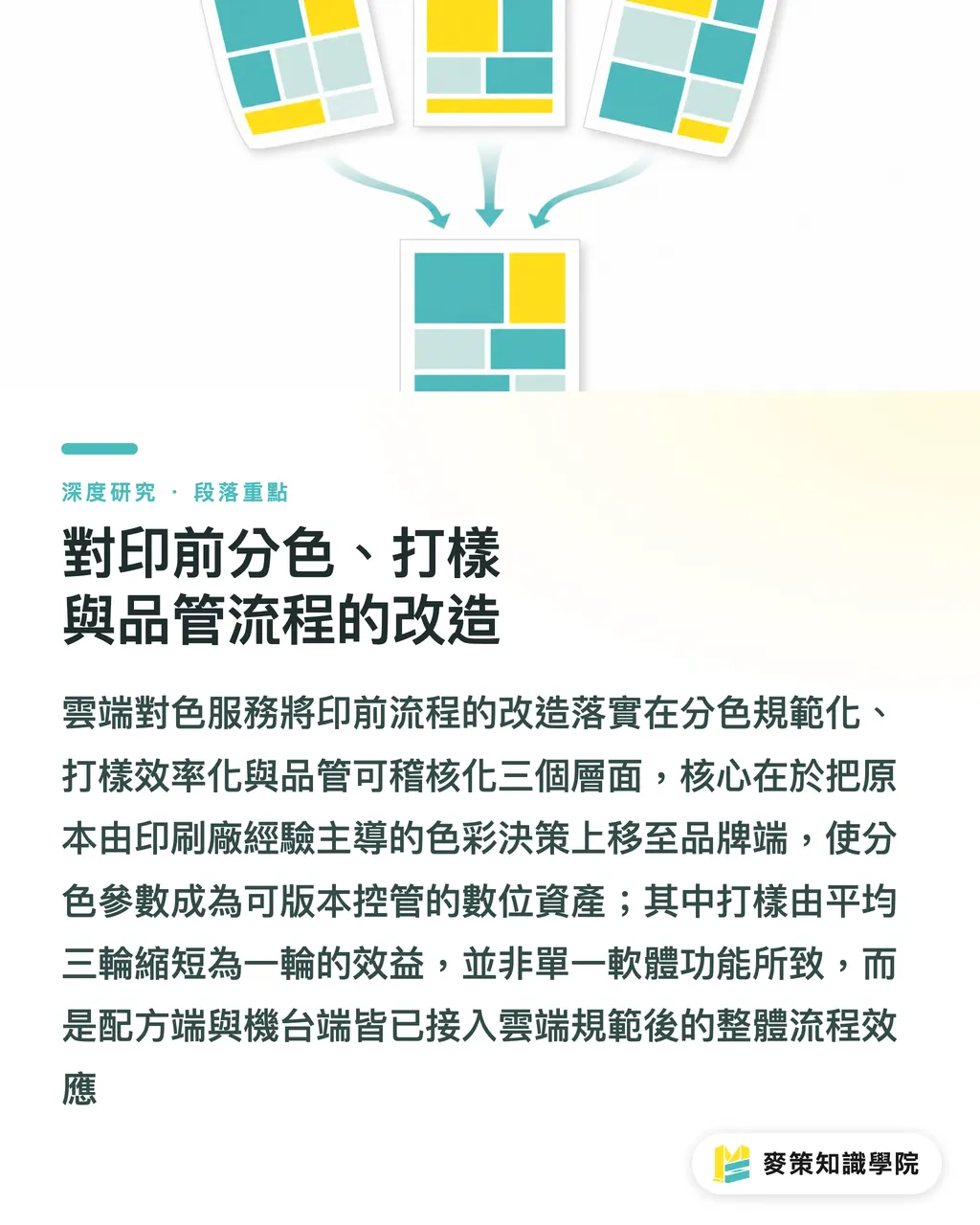
The second level is proofing and makeready. The claimed drop from an average of three proofing rounds to one [1] rests on the assumption that the first proof hits the target ΔE. This article's read: that assumption only holds if both the formula side and the press side are already connected to the cloud spec. If either link is still running on physical swatches or manual color correction, the first-round hit rate drops noticeably. So the proofing-efficiency gain is really a system effect of the whole flow going digital, not a feature of one piece of software
The third level is QC and audit. The cloud spec means every proof and every measurement can leave behind a timestamp and spectral data, which lines up with EU DPP-style compliance requirements [1]. Color data starts to acquire traceability and auditability. This article's read: color reproduction isn't only an aesthetic judgment anymore, it touches compliance and brand-asset protection. That's why legal and sustainability teams are starting to step into color decisions that used to be owned entirely by design and print
Implications for Taiwan's Design-and-Print Industry
The implications for Taiwan need to be broken out by three role layers
・First, small and mid-sized printers. Taiwan's print supply chain is dominated by small and mid-sized players and has a well-known structural feature: press state is controllable, measurement capability is thin. FastMatch Cloud offers an entry path that doesn't necessarily require buying a six-figure spectrophotometer [1], but only after the shop has taken stock of its own digital-proofing capability, whether a digital proofer is already in place, whether press-state data is readable by the cloud, and whether the color-matching and floor staff have at least basic color-management training. The workable path this article recommends: pilot cloud color matching on a single press and a single spot color (say, the brand's hero color), then scale out to the full palette and multiple presses
・Second, design and brand side. For designers, a cloud color spec means the reproduction limits of the target press and substrate can be known up front at the handoff stage, cutting down the chance of being forced to recolor after the fact. For brand owners, color reproduction moves from a complaint event to a priceable service. They can now set a contractual ΔE threshold across multiple suppliers and fold color-difference management into their vendor scorecard
・Third, the software-and-equipment ecosystem. As cloud color-matching services spread, the demand structure for spectrophotometers, digital proofers, and press-side color-control modules will shift. Demand for high-end lab-grade gear may cool off, but mid-range measurement devices that talk to cloud specs, plus press-side sensors that feed back ΔE in real time, are expected to open up new demand. This article's read: that's an evaluable pivot for Taiwan's measurement-instrument distributors and for press-retrofit service providers
Conclusion and Limitations
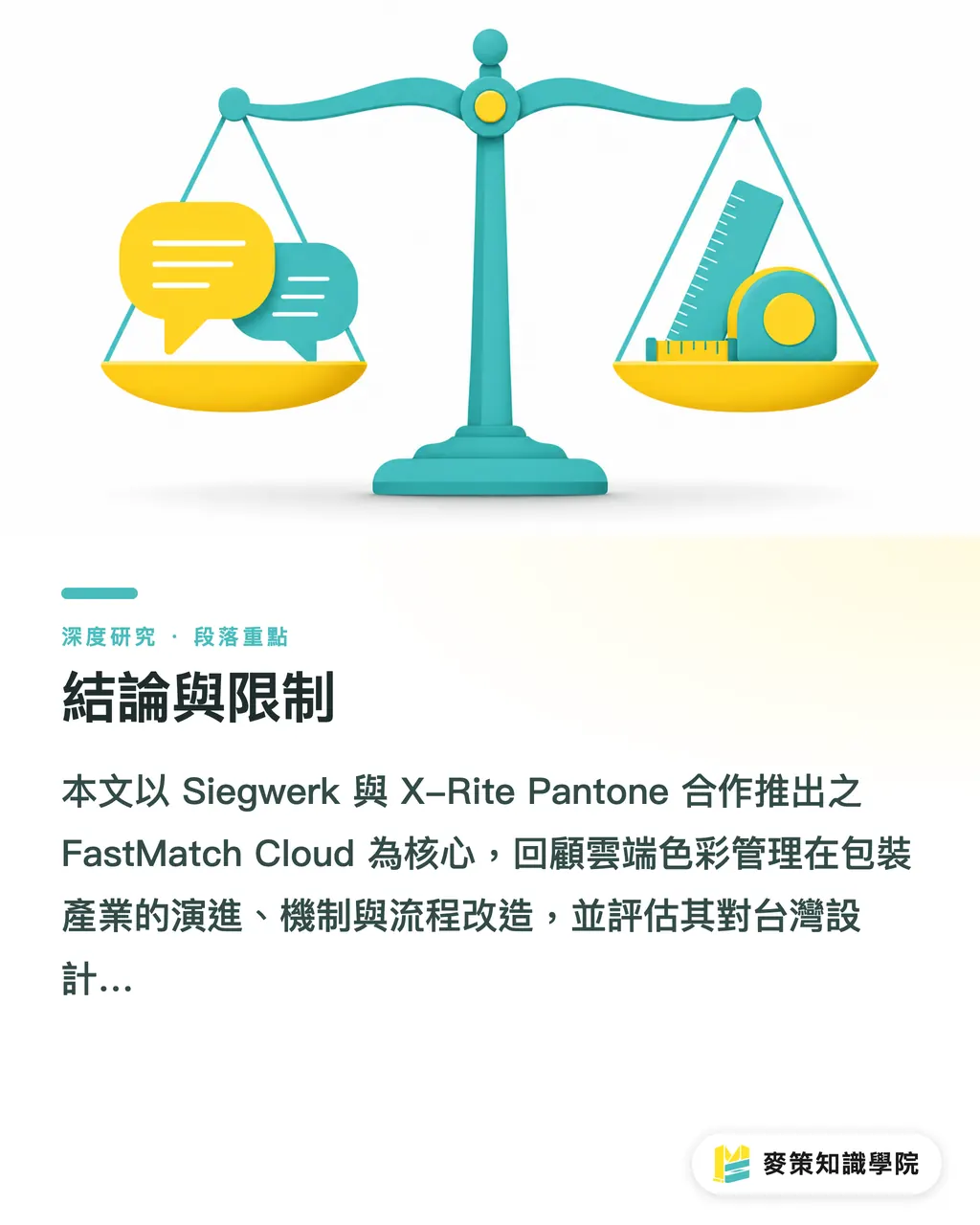
This article takes Siegwerk and X-Rite Pantone's joint FastMatch Cloud as its core case to review how cloud color management has evolved in packaging, how the mechanism works, how it reshapes the workflow, and what it means for Taiwan's design-and-print industry. The finding: FastMatch Cloud's value isn't only in the quantifiable numbers it claims — ΔE<
・1. 5, proofing cut from three rounds to one, ink-mixing cost down about 25% [1] — but more in turning packaging color difference from an unpredictable complaint event into a digital service you can put in a contract, put a price on, and audit. The implications differ for small and mid-sized printers, for design, and for brand owners, but they all point in the same direction: color management has to be treated as a cross-organization data flow
The limitations of this study fall mainly on two sides:
・First, what's publicly available right now is mostly product-launch and single-vendor case material, there's no large-scale cross-plant, cross-substrate empirical dataset, so practical achievability of numbers like ΔE< 1.5 still needs verification against more third-party measurement data
・Second, this article's assessment of the entry barrier for Taiwan's small and mid-sized printers is built on structural observations of the industry and on consultants' field experience, not on systematic fieldwork. Concrete cost and timeline estimates have to be calibrated against what each individual shop turns up in its own audit
Two concrete pieces of work worth pursuing next:
・First, run a pilot adoption of cloud color matching at 5 to 10 label and flexible-packaging suppliers in Taiwan of varying sizes, and quantify the change in proofing round count, ink-mixing cost, and complaint rate
・Second, analyze how EU regulations like DPP and PPWR translate into color-data compliance requirements for Taiwan's export-oriented print suppliers, and build a data model that can plug into international cloud specs, the basic infrastructure Taiwan's supply chain needs to plug into international brand-color systems
Key Takeaways
FastMatch Cloud turns packaging color difference from a complaint into a contractable, priceable digital service. The pivot point is the ΔE<1.5 reproduction threshold
Proofing dropping from three rounds to one and ink-mixing cost falling about 25% only holds if both the formula side and the press side are already on the cloud spec
For Taiwan's small and mid-sized printers, the main barrier isn't the spectrophotometer, it's whether the shop has digital proofing and whether press-state data is readable by the cloud
Cloud color management and EU regulations like DPP and PPWR converge, turning color data into auditable compliance assets
The spectrophotometer market may shift from high-end lab-grade gear toward mid-range measurement devices and press-side sensors that talk to cloud specs
Further Thinking
For print manufacturing, cloud color matching means color management moves from an internal craft to a cross-organization data flow. Press-state digitization and digital handshakes with the formula side will be the next competitive baseline. For design, the handoff stage needs to start factoring in the reproduction limits of the target press and substrate, and getting familiar with cloud-spec interfaces like PantoneLIVE. For AI adoption, cloud color databases are potential feedstock for training "auto color-match prediction" and "color-difference root-cause analysis" models, but the licensing and de-identification of formula data need to be sorted out first. For SaaS providers, the servitization of color management proves out the feasibility of "turning craft data into a subscription service," a reference model for other craft-heavy industries (textiles, ceramics, coatings). Open questions: how to protect IP and trade secrets inside cloud specs, how to share the cost of adoption among small and mid-sized suppliers, and whether a unified model for cross-substrate color reproduction is even possible
References
[2] X-Rite, Pantone LLC Launch i1 Paint. Focus on Powder Coatings. DOI: 10.1016/j.fopow.2019.09.024
[3] X-Rite and Pantone Announce Seminar Series. Focus on Powder Coatings. DOI: 10.1016/j.fopow.2020.04.015
[4] X-Rite, Pantone and Sun chemical add colour libraries for aluminium packaging. Focus on Powder Coatings. DOI: 10.1016/j.fopow.2024.11.062
[5] Bideaux R. (2026). "Cloud Dancer": Pantone's Color of the Year Reveals the Risks of an Aesthetic of Retreat. DOI: 10.64628/aak.acnwegp6u
[6] Pantone unveils new Pantone(R) essentials and 2005 4-color process guide. Pigment & Resin Technology. DOI: 10.1108/prt.2005.12934fad.004
FAQ
- What is FastMatch Cloud?
- FastMatch Cloud is the cloud color management platform launched jointly by Siegwerk and X-Rite Pantone. It syncs the brand-side PantoneLIVE color spec with the ink supplier's formula data and pushes both to the press in real time, claiming cross-plant color reproduction at ΔE<1.5 [1]
- What does ΔE<1.5 mean in packaging print?
- ΔE is the unit used to measure color difference, the smaller the number, the closer the color is to the target. ΔE<1.5 is widely treated in most packaging applications as a level of reproduction the eye can't pick out, and it can serve as a contractual reproduction threshold between brand owners and their suppliers
- For Taiwan's small and mid-sized printers, what's the biggest barrier to adopting FastMatch Cloud?
- Per the launch material, the model offers an entry path that doesn't necessarily require buying a six-figure spectrophotometer [1] — but the prerequisite is that the shop already has digital proofing capability and press-state data readable by the cloud. The bottleneck isn't the spectrophotometer; it's whether the shop's process and data have already gone digital first
- Why is FastMatch Cloud positioned as a "priceable service" rather than one-off software?
- Because the commercial model is SaaS. It shifts color management from a one-time software-and-hardware purchase to a subscription service, letting brand owners set a contractual ΔE threshold across multiple suppliers and fold color-difference management into their vendor scorecard
- How does cloud color management connect to EU packaging regulations?
- Regulations like the EU PPWR and the Digital Product Passport demand data transparency and traceability across the packaging supply chain [1], turning color, formula, and ink-component data into auditable compliance assets. Cloud color management platforms happen to offer exactly that architecture
Related articles


The Print × AI weekly
The print and AI know-how designers, brands and enterprises can use before they commit — one email, every week
MINDS Free Tools
Imposition calculator and preflight file check — free prepress tools, right in your browser.
MINDS Group
Need actual printing or gifting services?
From premium printing to online ordering and festive gifts — the MINDS Group sister brands take it from here.