
Introduction: Why Brand Color Identity and Spot Colors Matter
In today's commercial landscape, brand color is more than a core element of visual identity; it's the carrier of brand value and emotional connection. But from digital screens to physical print, color drift is a headache every designer and brand owner knows too well, and nothing stings more than a brand color that prints wrong. Beyond the damage to brand consistency, it triggers endless re-proofing and reprints, burning time and money
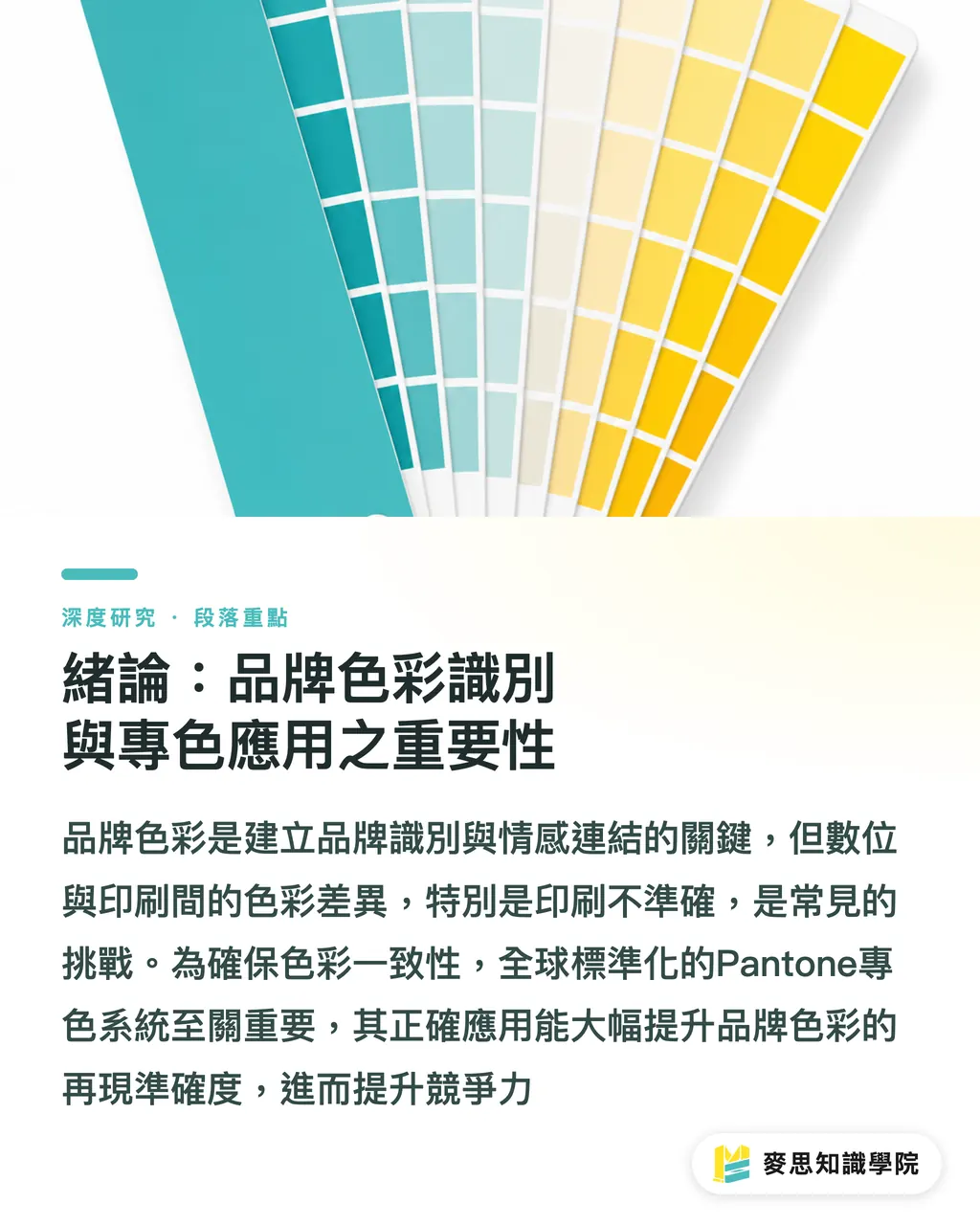
・A precise color management system is essential if you want brand color to hold up across different media. The Pantone Matching System (PMS) is the global standard for spot colors, used across design, print, textiles, and plastics. But even though Pantone is everywhere, the right way to choose a color, the right way to specify it in digital design software, and the right way to communicate with the print shop are still common sources of confusion. This study takes a close look at the principles of Pantone spot color application and lays out a systematic guide for designers and print buyers, with the goal of improving color accuracy. It starts from the fundamental difference between spot and four-color printing, then moves into selection strategy, the technical rules of digital workflows, and the constraints and communication tactics needed for special print conditions. For Taiwan's design and print industry, if SMEs and brand owners can master Pantone spot colors, it will boost their international competitiveness and tighten up production efficiency
Literature and Current State: Spot vs. Four-Color Printing and the Standardization Gap
Color reproduction is ultimately about getting color to land accurately on different physical surfaces. Current print technology splits into two main camps: four-color process printing (Process Color, CMYK) and spot color printing. Four-color printing uses halftone dots of Cyan, Magenta, Yellow, and Black ink laid on top of each other in different proportions to simulate thousands of colors, and the range it can reach is limited by the CMYK gamut. Spot color printing, on the other hand, uses a pre-mixed single ink printed directly, which gives you a much cleaner, more consistent result. Because of that direct application, spot colors are more accurate than CMYK builds [Source 1]
・The Pantone Matching System (PMS) is the most widely used standardized tool for spot colors, giving designers a precise reference through physical swatch books. But how a color is perceived isn't just about the ink itself; it's tightly bound to the physical substrate. The same Pantone number will look noticeably different on Coated versus Uncoated paper, because of differences in absorbency, gloss, and surface texture [1, 3, 5]. That's why Pantone publishes separate swatch books for different substrates. Designers need to pick the right swatch book based on the actual material being printed, so the expected effect matches the finished product
・Even though spot colors are more precise, converting a Pantone spot color to CMYK almost always produces a color shift. CMYK's gamut is generally smaller than a spot color's, especially for highly saturated colors and fluorescents, which CMYK simply cannot reproduce [Source 1]. Color management in digital design software can give you a Pantone-to-CMYK preview or conversion, but it's only a simulation. The final result still depends on the print shop's ink mixing and press calibration. Most existing literature focuses on reflectance and transmittance measurements done with instruments to lock down quantitative color standards [1, 2, 3, 4, 5], but there's a lack of systematic practical guidance for designers and print buyers on how to bridge the gap between digital specification and physical reproduction, and how to handle the constraints of spot colors across different substrates and special finishes. That's the gap this paper aims to fill
Core Analysis: Spot Color Selection Strategy and Technical Considerations
Choosing spot printing isn't just about wanting a unique color. Cost, color reproduction needs, and brand strategy all factor in. Brand logos and corporate standard colors, because of how critical they are to brand identity, are usually the prime case for adding a fifth spot color, so they hit the highest accuracy on every printed piece [Source 1]. Beyond that, colors that sit outside the CMYK gamut, such as fluorescents, metallics, or other highly saturated hues, make spot printing a must. These colors are printed directly with pre-mixed ink, producing visual effects that CMYK builds can't touch
・The printing substrate has a huge impact on how a spot color reads. The Pantone swatch system separates Coated (gloss coated paper) and Uncoated (offset/woodfree paper) editions to reflect how ink behaves on different surfaces [1, 3, 5]. Coated paper absorbs less ink because of its surface coating, so colors tend to come out more vivid and glossier. Uncoated paper lets the ink soak in, so colors look softer and slightly less saturated. At the start of color selection, designers should reference the Pantone swatch book that matches the actual paper being used, to avoid a gap between expectation and output. This step is critical for color consistency and should be a standard part of the workflow
Pantone Specification and Output Rules in the Digital Design Workflow
In the digital design workflow, specifying and managing Pantone spot colors correctly is the key step that prevents output errors. Professional tools like Adobe Illustrator or InDesign have spot color swatches built in, so designers can pick Pantone numbers directly. The important thing is that these spot colors should be assigned as their own swatch, not just a CMYK approximation of a Pantone color. When the file is ready for output, make sure the spot color option is kept as "Spot Ink" and isn't automatically converted to CMYK before output. If this isn't set correctly, the print shop can lose the spot color information at plate-making stage, and all spot color content ends up being built from four-color process, which causes color drift [Source 1]
・Screen calibration and soft proofing play a supporting role in getting the digital file and the final print to match. With a properly calibrated monitor and the right color management settings, designers can preview something close to the printed result on screen and catch potential color issues before sending the file to print [Existing view: screen color never quite matches print]. But soft proofing is always a simulation, especially for demanding spot colors. Hard proofing on a real press is still the gold standard for final color sign-off. Designers should understand the limits of digital preview and set up a clear proofing confirmation process with the print shop
Special Print Applications and Communication with the Print Shop
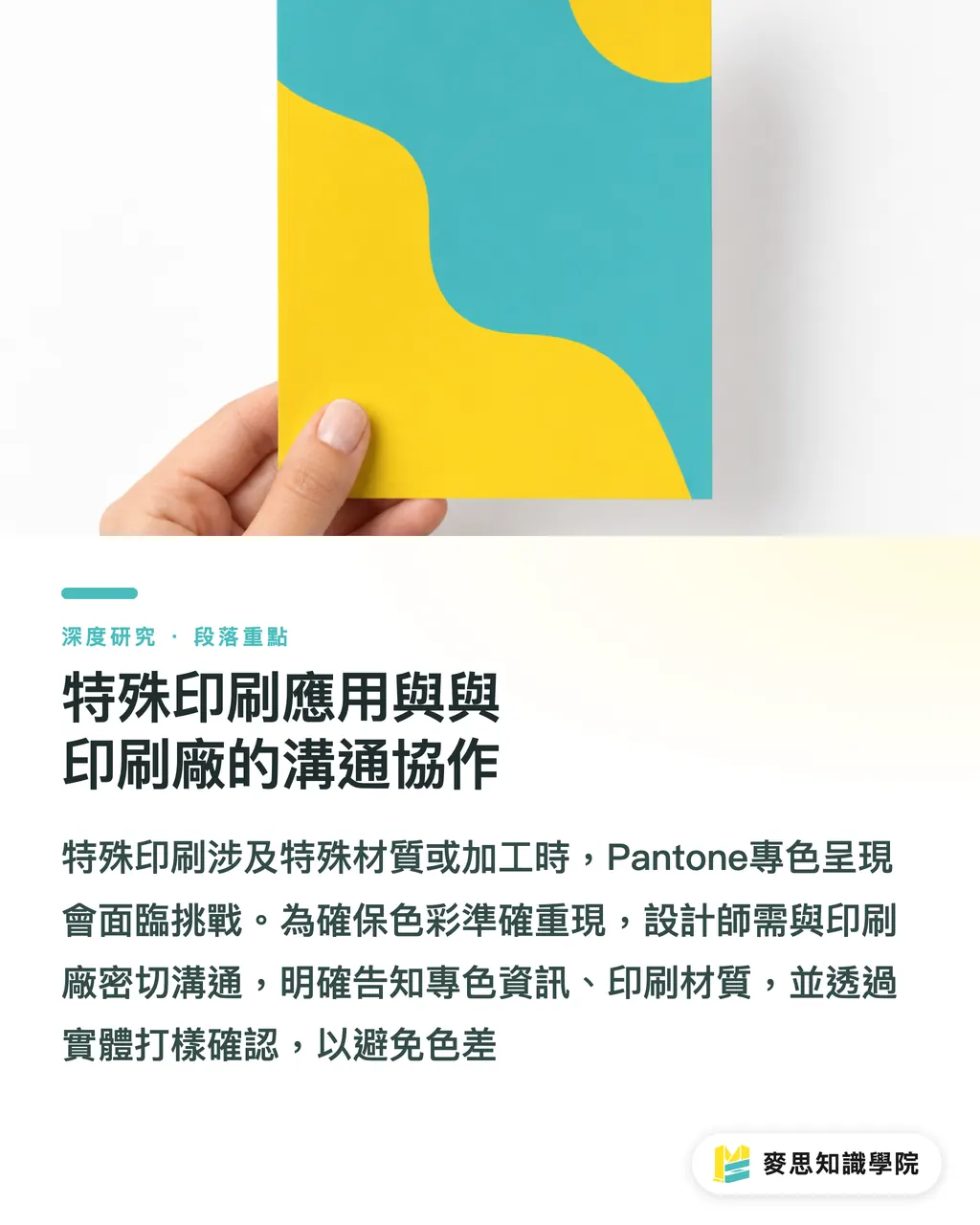
When the job involves unusual substrates or special finishes, Pantone spot colors run into extra constraints. On synthetic paper, metallic foils, and other non-traditional materials that don't absorb ink the usual way, ink adhesion and color development behave very differently from standard paper, and you may need a special ink formula or a different print process [Source 1]. On top of that, UV coating or spot varnish can shift the gloss and hue of a spot color, and designers need to factor that in. In these complicated cases, front-end communication with the print shop, sample testing, and technical evaluation become essential
・Clear communication is the core of getting Pantone spot colors right. Designers and print buyers should explicitly tell the print shop to "Retain Spot Color," and provide the exact Pantone number, the swatch book version used (for example, Pantone 293 C or U), and the intended substrate. When handing off the file, supplying a complete design file (usually PDF/X format) plus a physical Pantone swatch as the final color reference is the best practice. For critical colors, hard proofing is recommended, and the designer or brand representative should sign off in person, to reduce the risk of batch-to-batch color variation [Existing view: why does the color look different from the last run]. Using scientific methods like color measurement instruments and standardized light sources can shrink the color gap between production runs and keep the brand visual consistent [Existing view: why does the color look different from the last run]
What This Means for Taiwan's Design and Print Industry
For Taiwan's design and print industry, accurate Pantone spot color application carries multiple layers of upside. For small and medium print shops, having precise ink mixing know-how with water-based inks and other ink types, enough to deliver custom colors that hit Pantone swatch level, is a real competitive edge [Existing view: water-based ink mixing]. It satisfies the client's strict color accuracy demands and expands the shop's service range, opening the door to more high-value spot color work
・For designers, a deep understanding of how the Pantone system works and how to apply it means they can build a more effective "brand color system," keeping the visual identity consistent from the logo to every printed piece [Existing view: building a brand color system]. It cuts down on rework caused by poor color communication, and lifts the designer's professional standing and efficiency with clients. Brand owners and procurement teams should treat Pantone spot color selection as part of brand asset management. Using spot colors strategically on core identity elements, and putting a standardized communication protocol in place with print suppliers, will tighten up the print procurement workflow, control costs, and keep the brand image stable
Conclusion and Limitations
The Pantone spot color system is a non-negotiable tool for getting brand color right. This paper has laid out a systematic analysis and guide covering the fundamental difference between spot and CMYK, selection strategy, digital workflow rules, and communication for special print conditions. Understanding and applying Pantone correctly doesn't just improve color accuracy and consistency, it also cuts the communication friction and production risk caused by color drift. For any business that cares about a strong brand image, and for any design or print operation that wants to deliver high-quality work, these are practical rules you can't ignore
・The limitation of this paper is that it focuses on Pantone spot color application in traditional print environments. It doesn't go deep into the new developments in digital printing technology for spot color simulation and reproduction, or the potential applications of AI in color management and prediction. Future research could explore how these emerging technologies affect the scope and accuracy of Pantone spot color application, and offer more diverse color management solutions for Taiwan's design and print industry

Key Takeaways
・Pantone spot colors use pre-mixed ink, so color accuracy is higher than CMYK four-color builds
・When choosing a Pantone number, you must reference the swatch book that matches the actual substrate (Coated or Uncoated)
・In digital design software, assign Pantone as an independent swatch and avoid automatic conversion to CMYK at output
・When communicating with the print shop, explicitly request "Retain Spot Color" and supply a physical swatch for calibration
・Mastering spot color application lifts brand visual consistency and tightens up print cost and lead time
Further Reflections
・For the print manufacturing side, this paper underlines the importance of precise ink mixing and client collaboration, and encourages the adoption of color measurement instruments and standardized workflows. The design industry should weave Pantone knowledge into brand design guidelines, improving color management from screen to print. AI and SaaS adoption is likely to play a bigger role going forward in color prediction, automated calibration, and supply chain color communication, especially in scenarios with complex substrates and special inks, delivering more efficient solutions and further cutting down on human error and communication overhead
References
[1] C14 Committee (None). Practice for Instrumental Reflectance Measurement of Color for Flat Glass, Coated, and Uncoated. DOI: 10.1520/c1650-25
[2] C14 Committee (None). Practice for Instrumental Transmittance Measurement of Color for Flat Glass, Coated and Uncoated. DOI: 10.1520/c1649-14
[3] C14 Committee (None). Practice for Instrumental Reflectance Measurement of Color for Flat Glass, Coated, and Uncoated. DOI: 10.1520/c1650-14
[4] C14 Committee (None). Practice for Instrumental Transmittance Measurement of Color for Flat Glass, Coated and Uncoated. DOI: 10.1520/c1649-14r21
[5] C14 Committee (None). Practice for Instrumental Reflectance Measurement of Color for Flat Glass, Coated, and Uncoated. DOI: 10.1520/c1650-14r21
FAQ
- What's the fundamental difference between Pantone spot colors and CMYK four-color printing?
- Pantone spot colors use a pre-mixed single ink printed directly, giving you cleaner and more accurate color. CMYK four-color printing simulates color by layering halftone dots of Cyan, Magenta, Yellow, and Black
- Why does the same Pantone number look different on different papers?
- Because different papers (Coated or Uncoated) have different surface characteristics, absorbency, and gloss, which changes how the ink shows up on the sheet
- How do I make sure a Pantone color doesn't get auto-converted to CMYK in design software?
- Assign the Pantone color as an independent spot color swatch in the software, and make sure the "Retain Spot Color Ink" option is turned on in the output settings
- What's the most important thing when communicating a Pantone color to the print shop?
- Explicitly tell the print shop to "Retain Spot Color," and provide the exact Pantone number, the swatch book version used, and a physical Pantone swatch as the final calibration reference
- When should I consider using the more expensive Pantone spot color?
- When a brand logo or core identity color demands extremely high color accuracy, or when the color you need falls outside the CMYK gamut (such as fluorescents or metallics), Pantone spot color is the way to go
References
- PANTONE Matching System (PMS spot color system) · Pantone LLCThe standard swatch numbering system for spot colors — a common language for specifying colors across printers
- ISO 12647-2 — dot and color control standard for offset printing · International Organization for Standardization (ISO)Defines target chromaticity, dot gain, and gray balance for CMYK printing — the international reference printers use for color matching
Related articles


The Print × AI weekly
The print and AI know-how designers, brands and enterprises can use before they commit — one email, every week
Tool Library
RGB↔CMYK conversion, ΔE color difference and brand color print analysis — free color management tools, computed right in your browser.
MINDS Group
Need actual printing or gifting services?
From premium printing to online ordering and festive gifts — the MINDS Group sister brands take it from here.