
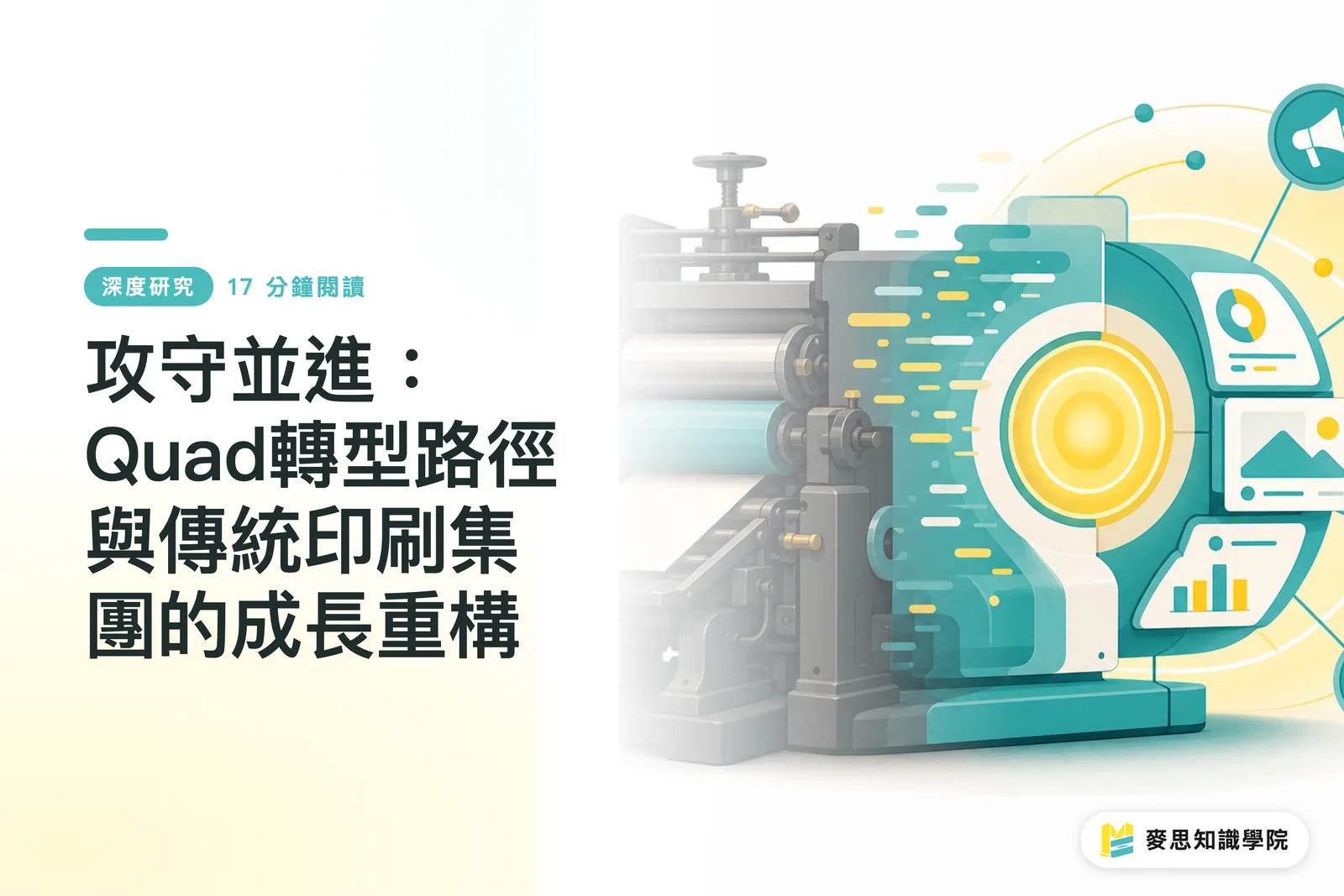
Introduction: The Growth Question in an Industry in Structural Decline
Whether a traditional commercial printing group can find a new growth curve amid the long-term headwinds of media digitization is one of the most representative strategic questions in the printing industry today. After Quad, a NYSE-listed U.S. group, released its first-quarter 2026 results, CFO and Treasurer Tony Staniak described the company's strategy as "both offense and defense," publicly defining its operating logic as a transformation that advances offensive and defensive moves at the same time [1]. This article uses Quad as a case to examine one core question: when the core printing business continues to suffer organic decline, through what mechanism does a company turn "contraction" into resources for "renewed growth," and where are the limits of that mechanism?
This question has direct reference value for Taiwan's design and printing industry. Mid-sized commercial printers in Taiwan have long faced a situation similar to Quad's: traditional volumes such as catalogs, publications, and advertising inserts are in structural decline, capacity use is under pressure, and most companies still respond mainly by cutting prices to win orders. What Quad demonstrates is a possible path of "service upgrading instead of pure price competition," so its success or failure and internal logic deserve a careful breakdown, not just an inspirational retelling
This article makes three contributions:
・First, it places Quad's management narrative back into the cross-disciplinary conceptual context of the "offense and defense" framework, identifying the analytical value and limits of this metaphor
・Second, it uses available financial data to break down the cash flow direction and business mix evolution behind its offensive and defensive strategy
・Third, it distills the analysis into practical implications for different layers of Taiwan's industry, including manufacturers, design teams, and brand owners, while marking the boundaries of the data and inferences honestly
Literature and Current Context: The Cross-Disciplinary Background of the "Offense and Defense" Framework and the Gap in Printing
"Offense and defense in tandem" is not analytical language invented by Quad. It is a strategic metaphor that cuts across multiple disciplines. In sports research, offense and defense are framed as two coordinated sides of the same system, stressing the dynamic shift of formations and resources between attack and defense [3][5]. In public policy and behavioral science discussions, "playing both offense and defense" is used to describe a two-front operation in which a field facing external shocks must defend existing ground while actively opening new discursive space [2]. In strategic studies, the dialectic between offense and defense is raised to a core dilemma: resources put into defense and resources put into attack crowd each other out, making the balance between offense and defense an unavoidable tradeoff [4]. Even in biomedical metaphor, the same substance is described as "both sword and shield," carrying both offensive and defensive roles [6]
Placing these cross-disciplinary uses side by side, two shared features of the "offense and defense" framework emerge:
・First, offense and defense are not two opposing strategies, but two ways of allocating the same resource pool. The core tension lies in resource crowd-out and reallocation [4]
・Second, the value of offense and defense often appears along the time dimension: defense buys time and stability, while offense determines long-term position [2][3]. These two features form the analytical lens for examining the Quad case
Yet existing literature on offense and defense is mostly produced in fields such as sports, military affairs, policy, and life sciences. It has rarely been applied in a systematic way to transformation analysis in mature manufacturing. Commercial printing, as an industry in structural decline that still produces relatively ample cash flow, differs from those fields in one key respect: defense, meaning the shutdown of inefficient capacity, can itself release cash flow that is then reinvested in offense. Between offense and defense, there is a funding handoff in which defense feeds offense. This mechanism has not been fully described in existing cross-disciplinary discussions, and it is the entry point of this article. This article argues that analysis of the Quad case should not stop at the slogan of "offense and defense in tandem," but should focus on the cash and timing handoff structure between the two
As things stand, Quad's data shows a transformation that is not yet complete. The group has made clear that revenue is not expected to return to growth before 2028, and that it is only "approaching" that inflection point [1]. Any description of Quad as having "successfully transformed" is therefore an overclaim. A more accurate positioning is this: a live case in the middle stage of transformation, with financial data revealing how offensive and defensive resources are being allocated
The Nature of Defense: Releasing Cash Through Contraction, Not Merely Stopping the Bleeding
The core of a defensive strategy is not cost cutting itself, but repositioning the declining core business as a "source of cash." Quad's legacy businesses cover magazines, catalogs, and advertising inserts, categories that continue to show organic decline, prompting the group to adjust capacity and its cost structure [1]. In practice, management commentary does not treat these businesses as burdens to be dumped quickly. Instead, it stresses that they "continue to generate cash flow," and that the group reinvests that cash into growth engines [1]
The data supports both the scale and the unevenness of the decline. In 2025, revenue from catalogs, publications, retail inserts, and directories fell 15% to USD 1.26 billion. Full-year group revenue fell 9.4%, or 4.8% excluding the impact of the sale of the European business [1]. First-quarter 2026 revenue was USD 581 million, down 7.7% year over year, or down 4.3% excluding the impact of the European business sale [1]. These figures say two things:
・First, the decline in the core business is real and continuing
・Second, the gap between the "reported basis" and the "excluding divestiture impact" basis reflects how the group has actively reshaped its business footprint in recent years through asset disposals, such as the sale of its European operations. That itself is part of defense
This article's analysis is that the sophistication of Quad's defense lies in treating "contraction" and "cash conversion" as separate tasks. Manufacturing companies caught in decline often fall into a cycle of taking low-priced orders to maintain capacity use, with revenue and gross margin deteriorating at the same time. Quad's approach is to acknowledge structural volume decline, actively shut down inefficient plants, and compress fixed costs so that the shrinking core business can still produce positive cash flow at a smaller scale [1]. In other words, the goal of defense is not to restore declining businesses to growth. It is to keep them generating reallocatable cash along a controlled downward curve
This mechanism echoes the argument in strategic studies about resource crowd-out between offense and defense: defensive spending and offensive spending compete with each other [4]. Through disciplined contraction of capacity and costs, Quad is in effect reducing the resource burden of defense, thereby freeing more resources for offense. Defense works only on the condition that the declining core business can still generate cash. Once cash flow from the core business turns negative, this "defense feeds offense" handoff breaks. That is the key premise when assessing the sustainability of this strategy

The Substance of Offense: Shifting the Business Mix from Printing Capacity to Marketing Execution
The substance of the offensive strategy is to move the company's value positioning upward from "supplier of printing capacity" to "integrated marketing execution partner." Quad has expanded its business mix into a combination of print production, campaign execution, media placement, data mining, and automation solutions [1]. This means the group no longer sells only printed output. Instead, it embeds print into a service chain that runs from creative to execution and spans digital and physical channels
The makeup of the growth engines reveals where reinvested resources are going. The group is putting cash released by defense into direct mail, folding carton packaging, retail, integrated marketing services, and services operated on behalf of clients [1]. In the data, direct mail and other printed products grew against the trend in 2025, up 2.5% to USD 624.6 million, in sharp contrast with the 15% decline in traditional catalog and publication categories [1]. This comparison clearly shows that offense is not a vague "digital transformation," but a resource tilt with specific category choices
The basis of offensive differentiation is Quad's command of data in the mail market. Staniak noted that, excluding letters and parcels, about 10% of advertising mail in the United States comes from Quad [1]. The group argues that this market position helps it better understand consumer behavior and target campaigns to the audiences most likely to respond, which in turn supports multi-channel operations [1]. Management's narrative states clearly that "omnichannel campaigns are the most effective form," and that the group can support customers end to end, from creative to execution, across digital and print, and into media placement [1]. Branded Solutions, launched in 2025 with a focus on personalized promotional products, further demonstrates the integration direction of "production + consulting + data + brand consistency" [1]
This article's analysis is that the essence of offense is to redefine print from a "procurement item in a cost center" into "one link in the marketing performance chain." When print is quoted on its own, it inevitably falls into price competition. But when it is packaged into a one-stop service covering data, placement, and execution, pricing shifts from "unit price per ream" to "overall marketing performance." This is the core of how Quad is trying to rebuild its working relationship with brand clients. It should be stated carefully that the repeatability of this offensive model depends heavily on Quad's scale and data assets, including its 10% share of advertising mail [1]. That is a structural advantage small and mid-sized companies cannot replicate in the short term
The Timing Game Between Offense and Defense: Inflection Point, Guidance, and Uncertainty
Whether offense and defense in tandem succeeds ultimately depends on whether offensive growth can take over before defensive cash runs dry. This is a clear timing game. Quad has said that the revenue inflection point is expected in 2028, and that the organic annual decline in the core business shows signs of "gradually easing" [1]. This means the central task at the current stage is to have the growth rate of offensive businesses gradually approach and eventually surpass the decline rate of the core business
The 2026 guidance gives this game quantitative boundaries. The group expects full-year revenue to decline between 1% and 5%, adjusted EBITDA to be between USD 175 million and USD 215 million, and free cash flow to be between USD 40 million and USD 60 million [1]. This article's analysis is that this guidance is itself a numerical expression of the offense-and-defense strategy: revenue is still expected to decline, meaning defense has not yet stopped the bleeding, but positive EBITDA and free cash flow are maintained, meaning defense is still supplying cash, preserving financial room for offensive investment. In other words, the group is betting that "within the window while cash flow is still positive, it can grow the growth engines enough for them to take over."
The risks in this game should also be stated plainly:
・First, if the core business declines faster than expected or macro advertising spending contracts, defensive cash flow may weaken earlier than planned, compressing the ability to reinvest in offense
・Second, the offensive businesses, including integrated marketing services, packaging, and direct mail, face competitors that are not only other printers, but also marketing agencies, data service providers, and packaging specialists. Quad may not hold the same relative position in these new arenas that it has in its core printing business. Based on the available materials, this article cannot determine whether the profit structure of the offensive businesses is better than that of the core business. This is an important data limitation of the study
Implications for Taiwan's Design and Printing Industry
The most important lesson from the Quad case for Taiwan's industry is to break "offense and defense" down into concrete practices that can be applied by layer, rather than copying the whole model outright. Taiwan's industry structure differs greatly from Quad's, especially because it lacks mail-market data assets at the 10% level. The implications therefore need to be handled by role
For small and mid-sized commercial printers, the practical focus of defense is to "convert declining businesses into cash first, then talk about transformation." Specific actions include reviewing the marginal contribution of each category rather than looking only at revenue, making disciplined contractions in equipment lines with low use and high fixed costs, and avoiding the cycle of cutting prices just to maintain capacity. This article's analysis is that a common mistake among Taiwanese printers is to equate defense with "cutting all costs to survive," while missing the real purpose of defense: releasing cash that can be reinvested. On the offensive side, small and mid-sized printers cannot easily replicate Quad's data scale. A more practical entry point is a "narrow and deep" service upgrade, such as focusing on specific categories like folding carton packaging or direct mail, and packaging printing together with proofing, logistics, and simple data feedback into a small one-stop service to raise customer stickiness and switching costs
For the design side, including designers and design studios, Quad's move to embed print into the "creative to execution" chain means design should not stop at handing over print files. A practical direction is to extend downstream into execution and performance, bringing brand consistency, personalized version management through variable data, and channel placement into the service scope, so design shifts from a one-time fee into ongoing collaboration tied to campaign results. This also echoes Quad's Branded Solutions logic of integrating "production + consulting + data + brand consistency" [1]
For brand owners, the Quad case points to a shift in procurement logic. Contracting print, media placement, and data separately often creates coordination costs and makes performance attribution difficult. Using an integrated execution partner may sacrifice the lowest price for a single procurement item, but it can deliver consistency and trackability for omnichannel campaigns [1]. This article's analysis is that Taiwanese brand owners can gradually expand supplier evaluation from "unit price" to "overall marketing execution capability," while remaining alert to the risk of vendor lock-in and preserving portability of key data
In terms of timing and cost, this article recommends that Taiwanese companies plan transformation rhythm around the "cash-flow window" rather than the "annual budget." That means first confirming how long defense can maintain positive cash flow, then setting payback milestones for offensive investment accordingly. Quad's approach of using 2028 as the inflection point and calibrating progress through quarterly guidance [1] offers a reference model for managing transformation with financial indicators rather than slogans
Conclusion and Limitations
In response to the research question raised in the introduction, this article's analysis shows that Quad's mechanism for turning structural decline into resources for renewed growth is not simply revenue expansion or cost control. It is a timing game of "using defensive cash to hand off to offensive growth." Defense turns the declining core business into cash through disciplined contraction and reduces resource use. Offense then puts the released cash into direct mail, packaging, and integrated marketing services, using the data and scale advantages of the printing core, such as a 10% share of advertising mail, as the basis for differentiation [1]. The key link between the two is cash-flow reallocation and the time window before the 2028 inflection point
The limitations of this article must be stated honestly:
・First, the analysis depends heavily on management commentary and financial-report summaries from a single first-hand source [1]. It lacks independent data on the profit structure, customer retention, and competitive situation of the offensive businesses, so it cannot determine whether the strategy will ultimately succeed
・Second, although the "offense and defense" framework has cross-disciplinary conceptual support [2][3][4][5][6], these sources come from fields such as sports, strategy, and life sciences. When transferred to manufacturing transformation analysis, they can serve only as an interpretive lens, not empirical proof
・Third, the implications for Taiwan's industry in this article are normative inferences and have not yet been tested in the field
Future research can go deeper in three directions:
・First, track Quad's segment revenue and profitability through 2028 to test whether the hypothesis that offense can take over from defense holds
・Second, conduct field cases on mid-sized Taiwanese printing companies to test the applicable boundaries of the "defense feeds offense" mechanism under conditions lacking large-scale data assets
・Third, build quantitative indicators for offensive and defensive resource allocation in the printing industry, moving the qualitative framework in this article toward a comparable and searchable analytical tool
Key Takeaways
・Quad's "offense and defense in tandem" is, at its core, a timing game: using cash released by defense to hand off to offensive growth, betting that the growth engines can become large enough to take over before the 2028 inflection point [1]
・The key to defense is not cost reduction itself, but converting the declining core business into cash: actively shrinking inefficient capacity so the smaller business can still generate positive cash flow [1]
・Offense has clear category choices: direct mail grew against the trend by 2.5% to USD 624.6 million, contrasting with a 15% decline in traditional catalog and publication categories, with data assets from a 10% advertising-mail share as the basis for differentiation [1]
・For small and mid-sized Taiwanese printers, the practical path is a "narrow and deep" service upgrade, not a direct copy of Quad's scale-based data play. The pace of transformation should be planned around the cash-flow window rather than the annual budget
・Quad has not yet returned to growth. Any claim that it has "successfully transformed" is an overstatement. Its value lies in offering a live example of managing transformation through financial indicators [1]
Further Reflection
For print manufacturing, the core insight from the Quad case is to separate capacity contraction from cash conversion, avoiding the dead-end cycle of cutting prices to keep machines running. For the design side, the opportunity is to extend downstream along the "creative to execution" chain, shifting design from one-time delivery to ongoing collaboration tied to performance. The right entry point for AI is not replacing print, but strengthening the capabilities needed for offense, such as personalized version generation through variable data, audience segmentation, and campaign performance attribution. The SaaS opportunity lies in giving small and mid-sized printers that lack Quad-level data assets affordable customer-data and placement-feedback tools, filling the scarcest data layer in "service upgrading." The unresolved question is whether, in Taiwan's market without scale-based data advantages, the profit structure of integrated marketing services can support the reinvestment needed for transformation. That still requires empirical testing
References
[1] How is Quad using an "offense and defense" strategy to return an old-line printing group to growth?
[2] Science GRO plays offense and defense in wake of new congressional attacks on behavioral science. PsycEXTRA Dataset. DOI: 10.1037/e519152012-002
[3] Zone Offense and Defense. Zone Offense and Defense. DOI: 10.5040/9781350892613
[4] Nuclear Offense and Antinuclear Defense: Principles and Dilemmas. Strategic Impasse. DOI: 10.5040/9798216987789.0007
[5] Team Offense and Defense: 4-on-4, 5-on-5. Team Offense and Defense: 4-on-4, 5-on-5. DOI: 10.5040/9781350891227
[6] Eisen J. (2015). Faculty Opinions recommendation of Serotonin is a sword and a shield of the bowel: serotonin plays offense and defense.. Faculty Opinions, Post-Publication Peer Review of the Biomedical Literature. DOI: 10.3410/f.725513209.793506967
FAQ
- What exactly does Quad's "offense and defense" strategy mean?
- It means advancing two tracks at the same time: defense closes inefficient plants and compresses fixed costs so declining legacy businesses such as magazines and catalogs can still maintain cash flow. Offense then reinvests that cash into growth engines such as direct mail, packaging, and integrated marketing services, while packaging print into a one-stop service that includes data and placement [1]
- Has Quad already returned to growth?
- Not yet. The group has stated clearly that revenue is not expected to return to growth before 2028, and that it is only "approaching" the inflection point. First-quarter 2026 revenue was still down 7.7% year over year [1]
- Why can Quad's offensive strategy avoid price competition?
- Because it redefines print from a separately quoted procurement item into one link in a marketing performance chain that includes data, media placement, and execution. Pricing shifts from "unit price per ream" to "overall marketing performance," with data assets from roughly 10% of U.S. advertising mail serving as the basis for differentiation [1]
- Can mid-sized Taiwanese printing companies copy Quad's approach directly?
- They should not copy it outright. Quad's offensive strategy depends heavily on its scale and data assets. A more practical path for small and mid-sized printers is a "narrow and deep" service upgrade, focusing on specific categories and packaging print with proofing, logistics, and simple data feedback into a small integrated service [1]
- What is the most important risk in evaluating this strategy?
- The risk is that the funding handoff of "defense feeds offense" may break. Once cash flow from the declining core business turns negative earlier than expected, the ability to reinvest in offense will be squeezed. In addition, competitors in the new offensive arenas include marketing agencies and packaging specialists, where Quad may not have the same relative advantage it has in its core printing business [1]
References
- Quad如何用「攻守並進」策略讓老牌印刷集團重返成長? · printindustry.news
- Science GRO plays offense and defense in wake of new congressional attacks on behavioral science · doi.org
- Zone Offense and Defense · doi.org
- Nuclear Offense and Antinuclear Defense: Principles and Dilemmas · doi.org
- Team Offense and Defense: 4-on-4, 5-on-5 · doi.org
- Faculty Opinions recommendation of Serotonin is a sword and a shield of the bowel: serotonin plays offense and defense. · doi.org
Related articles


The Print × AI weekly
The print and AI know-how designers, brands and enterprises can use before they commit — one email, every week
MINDS Free Tools
AI background removal, a LINE sticker maker, spine & imposition calculators — all free, right in your browser, no upload.
MINDS Group
Need actual printing or gifting services?
From premium printing to online ordering and festive gifts — the MINDS Group sister brands take it from here.