
Introduction: Why a "Finished Failure Case" Deserves Another Look
Kodak has long been fixed in management literature and business school cases as the standard failure story of "missing digital transformation," but its recent financial performance is challenging that label. Eastman Kodak posted revenue of USD 311 million in Q2 2026, up 18% year over year, marking its fourth consecutive quarter of growth [1]. If "missing digitalization" were a complete explanation, then a company that had already lost the digital imaging war and entered bankruptcy protection in 2012 should not be delivering double-digit growth more than a decade later in printing and materials. That gap is the research problem
This article defines the research question on three levels:
・First, whether Kodak's growth momentum comes from a rebound in demand or from an active replacement of its revenue structure
・Second, if it is the latter, what the concrete mechanism of that replacement is, and whether it can be abstracted into a transferable set of strategic principles
・Third, what workable implications those principles hold for Taiwan's design and printing supply chain, which is largely built around hardware and consumables
The gap in the current discussion has three parts:
・First, existing literature on Kodak mostly focuses on validating single technology dimensions, such as comparing the print quality of the Prosper inkjet system with offset lithography [2], or evaluating Kodak imaging products in specialized fields such as heavy charged particle autoradiography [5] and radiotherapy portal verification [6]. These studies confirm technical capability, but they do not address the business model question
・Second, studies on the Kodak brand and its emotional connection with consumers, such as the narrative mechanism of Kodak Moments [3], deal with B2C emotional assets, precisely the battlefield Kodak chose to leave after bankruptcy
・Third, industry discussions on the transformation of traditional printing groups often use an "offense and defense at the same time" portfolio reallocation frame, but rarely isolate the specific path of "unchanged technology, changed customer structure" for separate examination
This article makes three contributions, each tied to one section of the main text
・Contribution one: Using Q2 2026 financial data as the anchor, it breaks down the three-pillar structure behind Kodak's growth and argues that gross profit growth far above revenue growth implies a signal of pricing power, corresponding to the section "Anatomy of the Growth Structure."
・Contribution two: It proposes "Imaging-as-a-Service," meaning a business model that takes existing imaging and image-processing core technologies and shifts the revenue center from one-time equipment sales to consumables, software subscriptions, and service contracts, as the analytical frame, while distinguishing it from ordinary SaaS conversion, corresponding to the section "From One-Time Hardware Sales to Consumables Annuities."
・Contribution three: It applies this frame to Taiwan and gives concrete operating implications by layer for printing equipment and peripheral makers, small and mid-sized print shops, designers, and brand owners, down to process, cost, and timeline, corresponding to the section "Implications for Taiwan's Design and Printing Industry."
This topic matters to Taiwan because the structure is similar. Taiwan has a large number of small and mid-sized manufacturers, often decades old, whose core business lies in printing peripherals and consumables. Their technical assets are solid, but their charging models are still stuck in one-off transactions. This article argues that the Kodak case should not be copied by scale. What is more useful is the path it took: changing how existing technology is charged for, and in doing so extending the life of the company
Literature and Current Context: Three Research Clusters That Do Not Talk to One Another
Existing research related to Kodak can be divided into three clusters. Their problem frames diverge, and none directly answers the business model question raised here
Cluster one: technical performance validation. This body of research treats Kodak products as test subjects and focuses on output quality and physical performance. Rong's 2010 paper at the NIP & Digital Fabrication Conference directly compared the print quality of the Kodak Prosper series with offset lithography [2]. This is the most important literature anchor for this article because, sixteen years before the business results appeared, it had already confirmed at the technical level that Prosper had the quality foundation needed to stand in dialogue with offset printing. In the same cluster, Ilić et al.'s 1980 study on Kodak maximum resolution plates for heavy charged particle autoradiography [5], together with Geyer, Blank, and Alheit's 2006 evaluation of the KODAK ACR 2000 RT storage phosphor plate system and EC film in radiotherapy position verification [6], shows that Kodak's imaging technology has long delivered verifiable performance in high-precision professional settings. This cluster serves as the technical premise for this article: Kodak's technical assets are real. But these studies do not address how the same technology was later repriced. This article picks up from there
Cluster two: brand and narrative asset research. Rieger's 2015 Kodak Moments study, presented at the International Symposium on Technologies for Digital Photo Fulfillment, examines how images carry personal narrative and emotion [3]. Discussions of Kodak Paper as a cultural object in the context of art publishing [4] point in the same direction, toward the cultural sediment of the brand. This cluster reveals that Kodak's strongest intangible assets were concentrated in the B2C emotional layer. This article argues that this cluster actually highlights the turn in Kodak's recovery path: the company put down the emotional assets most often discussed by academia and shifted toward B2B customers who care more about specifications and delivery schedules. Existing literature says too little about this choice to actively abandon a strength
Cluster three: industry discourse on the transformation of traditional printing groups. The mainstream frame in this cluster is "offense and defense at the same time," meaning defending traditional businesses that still generate cash flow while directing cash into new businesses. This article argues that this frame describes the direction of resource allocation, but does not specify the charging-model dimension of transformation. Both may be called "defense," but defending equipment sales and defending consumables annuities produce very different cash-flow quality and customer stickiness
Taken together, the three clusters have addressed technical performance, brand assets, and resource allocation, but they have not analyzed "unchanged technology, changed customer structure and charging model" as an independent question. This article uses Kodak's actual Q2 2026 financial results [1] as the evidence base to fill that missing link
Anatomy of the Growth Structure: Three Pillars and the Gross Profit Signal
Kodak's Q2 2026 financial data shows that its growth is not uniform. It is being driven by several clearly structured business segments
Pillar One: volume and pricing both rising in printing. The printing business contributed USD 195 million in revenue, up 10% year over year [1]. This article reads that as follows: printing remains the revenue base, accounting for about 63% of total revenue, but its 10% growth rate is below the company's overall 18% growth rate, meaning it is a stabilizer rather than an accelerator. For a company that once came close to liquidation, a still-growing base business gives it the time and cash needed to run other experiments
Pillar Two: rapid expansion in Advanced Materials & Chemicals. This segment generated USD 105 million in revenue, up 40% year over year [1]. This article reads that as the strongest signal in the entire dataset. It shows Kodak turning a century of accumulated coating and chemical process capability from something that "serves its own imaging products" into something that "serves external industrial customers." In effect, a cost center has been turned into a profit center. Compared with the long-term performance record of Kodak photosensitive materials in radiological fields documented in the cluster one literature [5][6], this expansion is not a brand-new business out of nowhere. It is a repricing of existing materials capability
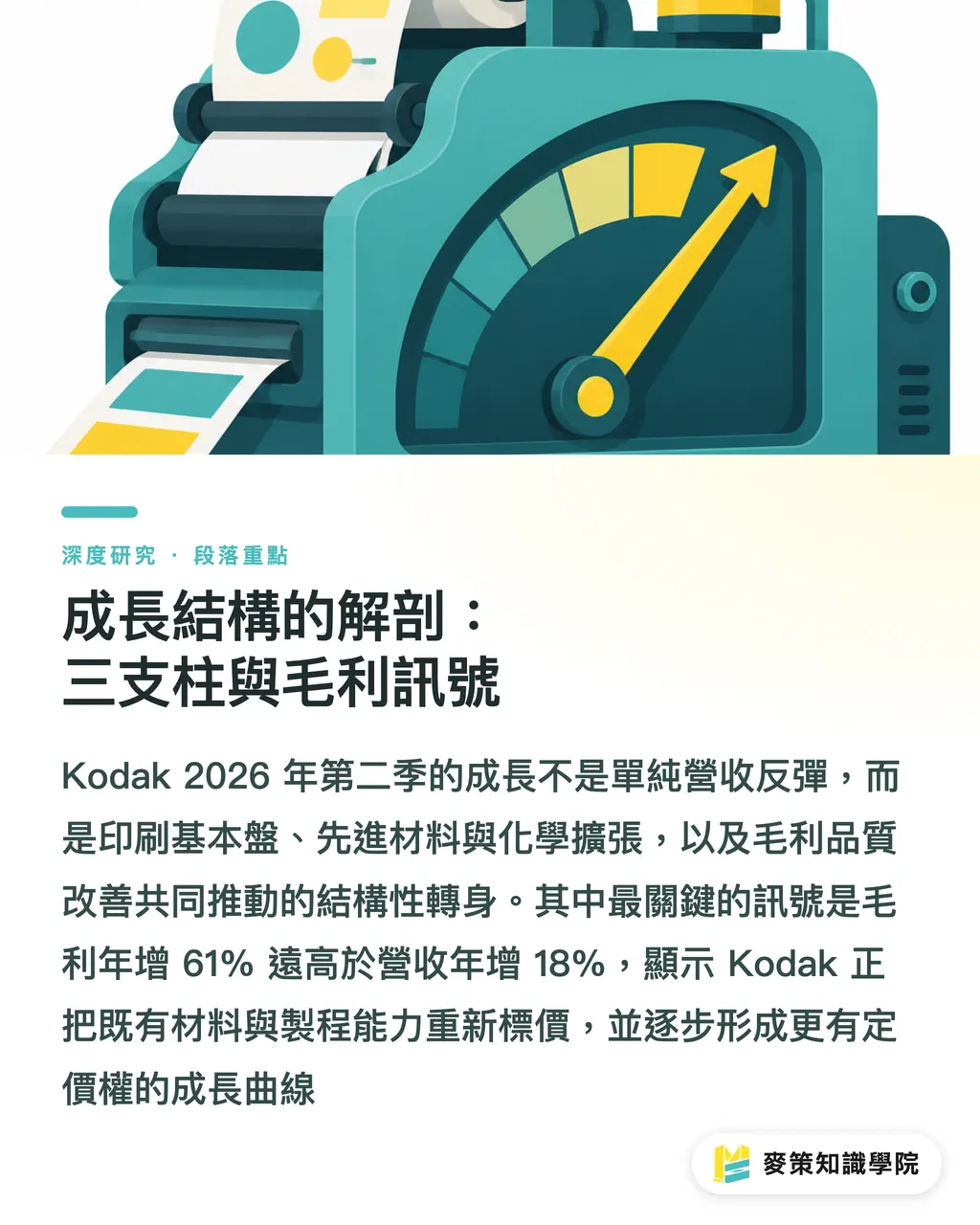
Pillar three: a leap in profit quality. Gross profit for the quarter was USD 82 million, up 61% year over year. Operating EBITDA was USD 36 million, four times the level of the same period in 2025, and the company returned to GAAP net income of USD 17 million, reversing a loss in the prior-year period [1]. This article reads the 61% gross profit increase, far above the 18% revenue increase, as the most important analytical anchor in the case. Revenue growth can come from cutting prices to drive volume, but gross profit growing at more than three times the pace of revenue can only come from one of three sources, or a mix of them: higher selling prices, a product mix shift toward higher-margin items, or lower unit costs. Kodak officially attributed the momentum to higher shipment volume, improved pricing, and better operating efficiency, and this growth was achieved while silver and aluminum costs kept rising [1]. This article argues that expanding gross margin while key raw materials are getting more expensive is direct evidence of pricing power. In the printing industry, pricing power usually comes from customer switching costs, not product novelty
The boundary of the evidence. It must be stated clearly that the first-hand source does not disclose the separate shares of plate consumables and equipment sales within the printing business [1]. Therefore, "consumables annuitization" in this article is an inference based on industry structure, not a fact directly proven by the financial report. Kodak also stated that it will increase R&D investment to support growth in commercial printing and advanced materials [1]. This article reads that as management treating these two areas as sustainable growth curves worth continued investment, not as a one-time rebound
From One-Time Hardware Sales to Consumables Annuities: Breaking Down Imaging-as-a-Service
This section defines and breaks down the core analytical frame of this article. "Imaging-as-a-Service" is defined here as follows: based on existing core technologies in imaging and image processing, the revenue center shifts from one-time hardware sell-through to a recurring revenue structure made up of consumables, software subscriptions, and service contracts
Mechanism one: the technology stays, the customer changes. Kodak's core silver-halide and inkjet technologies have not been replaced. The Prosper inkjet system was already being compared with offset lithography in academic print quality research as early as 2010 [2], so the technology lineage is continuous. What changed is who buys it: from hundreds of millions of consumers whose relationship ended after buying a camera once, to a limited number of commercial printers and packaging plants that purchase plates and ink on a fixed monthly basis. This article argues that Kodak traded a smaller customer count for a longer cooperation cycle. The number of customers shrank by several orders of magnitude, while the lifetime value and predictability of each customer clearly rose
Mechanism two: consumables are a natural subscription. Printing plates and inkjet inks have one property that SaaS struggles to copy: consumption is physically inevitable, and the customer does not need to make an active renewal decision. Once equipment is installed, consumables purchasing becomes part of the production workflow. This article argues that, in cash-flow predictability, the traditional consumables model is materially equivalent to a subscription, with churn that is naturally lower than pure software subscriptions. The condition is that the installed equipment base must be defended. This also explains why the equipment business cannot be abandoned even when margins are lower: it is the ticket into the consumables annuity
Mechanism three: two-way expansion into software and packaging. Enterprise imaging software services and the digital inkjet packaging market form two paths for expansion. The packaging market is unusual because it is one of the few parts of the printing industry less exposed to replacement by electronic media. Physical goods need physical packaging. This article argues that directing a proven-quality inkjet technology [2] toward an end market with structurally stable demand is a more efficient use of resources than fighting for share in a shrinking market
How it differs from ordinary SaaS conversion. "Imaging-as-a-Service" is not the same as turning a hardware company into a software company. What it charges for is physical consumables, not licensed seats. Gross margin is directly affected by raw material prices, as seen in Kodak's exposure to rising silver and aluminum costs [1]. Customer switching costs also come mainly from equipment compatibility, not data migration. This article argues that confusing the two is the most common misread among Taiwanese equipment makers during transformation. They rush to build their own SaaS platforms while overlooking the fact that their existing consumables channels may be a more stable source of annuity-like revenue
Implications for Taiwan's Design and Printing Industry: Workable Paths by Layer
This section applies the above frame to Taiwan and gives concrete practices across three layers. The premise is honest scale awareness: Kodak's quarterly revenue of USD 311 million [1] is not comparable with most Taiwanese companies. What can be transferred is the mechanism, not the scale
Layer one: printing equipment and peripheral manufacturers
・Charging model audit: Over a three-month period, break down the revenue composition of each current product line one by one, and clearly calculate the ratio of "one-time equipment revenue" to "recurring consumables or service revenue." This article argues that if recurring revenue accounts for less than 30%, the company's cash flow is still project-based in nature, not annuity-based
・Installed base before single-machine margin: In equipment pricing, companies can consider accepting lower margins in exchange for a larger installed base, provided the consumable specifications have exclusivity or compatibility advantages. Even though Kodak's printing business grew by only 10%, it remained the carrier of overall growth [1]
・Externalize materials capability: Examine whether coating, chemical, or precision-processing capabilities developed internally for the company's own products can be sold independently to external customers. The 40% growth of Kodak's advanced materials segment [1] shows that this path may grow faster than the core business. In terms of timeline, this kind of shift often requires a 12- to 24-month customer qualification cycle, so planning should use that as the baseline
Layer two: small and mid-sized print shops
・Equipment purchasing decisions should be based on Total Cost of Ownership, or TCO, rather than the equipment sticker price. Under a consumables annuity model, low-priced equipment is often paired with high-priced consumables, and the five-year total cost can flip the comparison. Before purchasing, shops should complete a calculation that covers five years of consumables, maintenance, and downtime losses
・Before taking digital inkjet packaging orders, quality benchmarks should be confirmed first. Existing research has compared the quality of Prosper inkjet and offset printing [2]. In practice, this article recommends making proofing comparisons using the shop's actual substrates instead of relying on the equipment supplier's specification sheet
・Supply-chain cost sensitivity: The Kodak case shows continuing increases in silver and aluminum costs [1]. This article argues that Taiwanese companies should build raw-material adjustment clauses into quotations to avoid long-term contracts being locked at pre-increase prices
Layer three: designers and brand owners
・Designers should understand that the maturation of digital inkjet in packaging means lower cost barriers for short runs, multi-version work, and variable-data printing. What changes is the boundary of design proposal feasibility: regional limited editions or personalized packaging that used to be rejected because of minimum print runs may now work on inkjet production lines
・When evaluating print suppliers, brand owners should include the stability of the supplier's consumables sources in the assessment. A single consumables source carries a double risk during periods of raw material inflation: shortage and price hikes
・For print submission workflows, this article recommends a three-gate checking discipline. Gate one confirms the color management baseline, including whether the output device profile and proofing conditions match. Gate two confirms compatibility between substrate and finishing, including the adhesion of inkjet ink to coated substrates. Gate three confirms the data integrity of variable-data fields. These three gates could be handled together in the traditional offset era. In digital inkjet and short-run, multi-version scenarios, they must be verified separately
Conclusion and Limitations
Returning to the three questions from the introduction, this article reaches the following conclusions
First, Kodak's growth momentum comes mainly from an active replacement of its revenue structure, not from a broad rebound in demand. The evidence is that gross profit grew 61%, far above the 18% increase in revenue, and this improvement happened while silver and aluminum costs were rising [1]
Second, the replacement mechanism can be summarized as follows: the core imaging technology stayed the same, the customer structure shifted from B2C to B2B, the charging model moved from equipment sell-through to recurring revenue from consumables and services, and internal materials capability was externalized into an independent business. Existing literature has separately verified Kodak's technical performance [2][5][6] and brand emotional assets [3], but the recovery path chose the former and abandoned the latter
Third, the implication for Taiwan's industry is that the transformation lever may not lie in developing new technology, but in redesigning the charging model and customer structure
This article has two limitations that must be stated specifically
The first is the limitation of the data time range. The financial evidence in this article comes only from the single quarter of Q2 2026 [1]. Although this was the fourth consecutive quarter of growth, four quarters are still not enough to distinguish structural recovery from cyclical rebound. Raw material prices, tariff policy, and exchange rates in particular can all reverse within a few quarters. Any long-term investment judgment based on this article should wait for verification over a longer time series
The second is the limitation of source coverage. The financial data comes from a single industry media report [1] and has not been cross-checked against Kodak's official 10-Q filing. That source also does not disclose the split between plate consumables and equipment sales inside the printing segment. Therefore, this article's argument about "consumables annuitization" is an inference from industry structure, not financial-report proof. On the literature side, the available academic studies related to Kodak are concentrated in technical performance and brand narrative, with a lack of peer-reviewed literature on the business model. The construction of this frame therefore depends heavily on the author's industry analysis
Future research can move forward in three specific directions:
・First, obtain Kodak's segment financials across eight to twelve consecutive quarters, using gross margin rather than revenue growth as the main variable to test whether the pricing-power hypothesis holds
・Second, conduct structured interviews with Taiwanese printing equipment makers to measure the actual distribution of recurring revenue shares and test whether the 30% threshold proposed here has distinguishing power
・Third, run repeated local-substrate experiments on the actual quality performance of digital inkjet in packaging applications, extending existing comparisons between Prosper and offset print quality [2] to substrate conditions common in Taiwan
Key Takeaways
Kodak posted Q2 2026 revenue of USD 311 million, up 18% year over year, but gross profit grew 61%. That gap points to pricing power and product mix shift, not price-cutting for volume
The Advanced Materials & Chemicals segment grew 40% year over year, showing that externalizing internal materials capability into an independent business may deliver a higher growth rate than the core business
The core of "Imaging-as-a-Service" is not turning a hardware company into a software company. It is moving the revenue center from one-time equipment sales to physically necessary consumables and services
Consumables are materially equivalent to subscriptions in cash-flow terms and have lower churn, but the installed equipment base is the ticket in. That is why lower-margin equipment business cannot be abandoned
A practical starting point for Taiwanese companies: first calculate recurring revenue as a share of total revenue. If it is below 30%, the cash-flow nature of the business is still project-based
Further Reflection
For print manufacturers, the Kodak case points to a counterintuitive priority: before investing in new technology R&D, first recalculate how existing technology is charged for. Taiwanese equipment makers often already hold mechanical and materials capabilities proven over decades. What they lack is often not technology, but the commercial design needed to rewrite one-off transactions into long-term contracts. The 40% growth of the advanced materials segment suggests that internal support capability may be an undervalued asset. For the design side, the maturation of digital inkjet in packaging is loosening the long-standing constraint of minimum print runs. Designers should actively retest which short-run and personalized proposals that were rejected in the past now make sense. If AI adoption is to be judged first by gross margin, the entry point should be on the production-process side, such as color prediction, consumables usage estimation, and preventive equipment maintenance. SaaS also cannot simply be copied as "building a platform." In the printing industry, the first step toward service-based business is more likely to be packaging maintenance, consumables replenishment, and color management into annual contracts. Three questions remain unresolved: how long consumables compatibility exclusivity can last after third-party supply chains mature, how raw-material adjustment clauses can be accepted in a buyer's market during inflation cycles, and whether Taiwan's small and mid-sized manufacturers can afford 12- to 24-month customer qualification cycles without scale
References
[2] Rong X. (2010). Print Quality Comparison Between Kodak Prosper and Offset Lithography. NIP & Digital Fabrication Conference. DOI: 10.2352/issn.2169-4451.2010.26.1.art00069_1
[3] Rieger J. (2015). Tell My Story with Kodak Moments. International Symposium on Technologies for Digital Photo Fulfillment. DOI: 10.2352/issn.2169-4672.2015.6.1.art00006
[4] Kodak Paper Itc "Kodak Paper 1". Only the Road / Solo el Camino. DOI: 10.2307/j.ctv11318vf.166
[5] Ilić R., Humar M., Najžer M. et al. (1980). HEAVY CHARGED PARTICLE AUTORADIOGRAPHY USING KODAK MAXIMUM RESOLUTION PLATE. Solid State Nuclear Track Detectors. DOI: 10.1016/b978-0-08-025029-8.50084-6
[6] Geyer P., Blank H., Alheit H. (2006). Portal Verification Using the KODAK ACR 2000 RT Storage Phosphor Plate System and EC® Films. Strahlentherapie und Onkologie. DOI: 10.1007/s00066-006-1476-1
FAQ
- How exactly did Kodak perform financially in Q2 2026?
- Kodak reported Q2 2026 revenue of USD 311 million, up 18% year over year. Gross profit was USD 82 million, up 61%. Operating EBITDA was USD 36 million, four times the level of the prior-year period, and the company returned to GAAP net income of USD 17 million. This was its fourth consecutive quarter of growth
- What is "Imaging-as-a-Service"?
- It refers to a model built on existing core technologies in imaging and image processing, shifting the revenue center from one-time equipment sell-through to recurring revenue made up of consumables, software subscriptions, and service contracts. Its difference from ordinary SaaS conversion is that the chargeable item is a physical consumable, so gross margin is directly affected by raw material prices
- Did Kodak recover by switching to new technology?
- No. Its core silver-halide and inkjet technology lineage is continuous. The PROSPER inkjet system was already being compared with traditional offset printing in academic quality research back in 2010. What changed was the customer structure, from B2C to B2B, and the charging model, from sell-through to consumables and services
- What concrete lesson can small and mid-sized Taiwanese print shops take from this case?
- The most direct step is to shift equipment purchasing decisions from comparing sticker prices to comparing five-year Total Cost of Ownership, or TCO. Under a consumables annuity model, low-priced equipment often comes with high-priced consumables, and the five-year total cost may reverse the apparent advantage. Another step is to build raw-material adjustment clauses into quotations to deal with continuing cost increases in materials such as silver and aluminum
- How strong is the evidence behind this analysis?
- The financial data comes from a single industry media report on Q2 2026 and has not been cross-checked against Kodak's official 10-Q filing. The source also does not break down the share of consumables and equipment within the printing segment. Therefore, "consumables annuitization" is an inference from industry structure, not financial-report proof. Four quarters are also not enough to fully distinguish structural recovery from cyclical rebound
Related articles





The Print × AI weekly
The print and AI know-how designers, brands and enterprises can use before they commit — one email, every week
MINDS Free Tools
Spine width and imposition calculators — skip the manual math, free in your browser.
MINDS Group
Need actual printing or gifting services?
From premium printing to online ordering and festive gifts — the MINDS Group sister brands take it from here.