

Introduction: Why an Equipment Investment Serves as an Industry Signal
When an industrial inkjet equipment manufacturer with an annual revenue of over 430 million euros announces an investment of about 20 million euros to set up Durst Como, a dedicated digital textile division in Como, Italy, this amount is not striking given the overall scale of the group [1]. What really deserves the attention of industry researchers is not the absolute value of the investment, but the location where this capital is placed, an industrial cluster famous for silk and fashion textiles for generations [1]
The core question this article aims to answer is: why does a manufacturer whose core business is industrial printing equipment choose to enter textile printing through an asset-heavy approach, instead of continuing to deepen its presence in the existing wide-format and signage markets? What is the business logic behind this crossover, and what opportunities and risks does it mean for Taiwan's design and printing industry, which is highly dependent on equipment imports and focused on OEM and customization?
This issue is important for the Taiwanese industry because Taiwan's printing and apparel supply chains have long occupied a dual position as both equipment receivers and application takers. Strategic moves by equipment manufacturers often lead demand shifts in downstream application markets by several years. Understanding the crossover logic of leaders like Durst is equivalent to reading an early indicator of the cost curves and market structures of digital textile printing. This article contributes by framing a single corporate investment event as a general mechanism of equipment manufacturers repositioning along the value chain, and using this to derive distinct implications for Taiwan's small and medium-sized printing factories, designers, and brands
The structure of this article is as follows: first, it reviews existing discussions on the understanding and gaps regarding printing crossing over into textiles, second, it breaks down the business logic and location signals of Durst's investment, then, it analyzes the value chain mechanisms of industrial inkjet penetrating into textiles, and finally, it discusses the implications for the Taiwanese industry in layers, while honestly disclosing analytical limitations

Literature and Status Review: The Evolution of Discussion from Equipment Growth to Value Chain Restructuring
This section first defines the three main lines of existing discussions, then points out where they have not yet converged
Existing discussions on digital textile printing can be roughly divided into three stances. The first is the market size school, focusing on the growth curves of equipment installations and ink consumption, treating digital printing as a replacement technology for traditional screen printing, with the discussion centering on when the golden cross will occur. The second is the environmentally driven school, emphasizing the advantages of digital printing over traditional methods in terms of water use, waste liquid, and sampling waste, attributing technology diffusion to sustainability regulations and brand ESG pressures. The third is the demand structure school, arguing that the rise of small batches, fast response, and personalized orders has fundamentally changed the cost structure of orders under 500 units, making digital methods economically viable in specific ranges
These three lines do not conflict with each other, but they mostly stop at demand-side explanations of why downstream applications are growing. They rarely address a supply-side question: why is it the equipment manufacturer itself that actively pushes deep into textile applications, rather than just passively supplying machines? In other words, existing discussions analyze digital textile printing as a market in terms of its size and speed, but rarely analyze it as a value chain position to see who is re-dividing profits
From the perspective of B2B strategic positioning, a company's market entry is often not a simple chase for scale, but rather allocating resources around a core story that can be held long term, aligning the brand, technology, and customer base into a consistent narrative [2]. This perspective suggests that Durst's crossover is more likely a statement of positioning, rather than an opportunistic expansion of production capacity. Existing demand-side literature leaves a clear gap here, namely the lack of a mechanistic explanation of vertical repositioning by equipment manufacturers. Taking this gap as an entry point, this article argues that Durst Como should be viewed as a signal of value chain restructuring rather than a single production expansion event
Core Analysis 1: The Business Logic of Durst Como is Not Expansion, But Repositioning
The key assertion of this section is that the essence of Durst's investment is moving along the value chain toward high-margin, high-stickiness application markets, rather than simply increasing the capacity of existing product lines
The first piece of evidence supporting this assertion is that this investment is explicitly tied to a growth commitment. Durst declared its goal to double its revenue within the next five years, pointing out that this growth will be driven particularly by industrial textile printing technology [1]. For a company with an existing revenue of over 430 million euros, doubling means hundreds of millions of euros in new revenue. This scale cannot be achieved through the linear expansion of the existing wide-format and signage markets, it requires opening up new application areas with structural growth potential [1]. Textile printing is therefore not a marginal business, but a bet placed at the heart of the group's growth narrative
The second piece of evidence is the organizational form of the investment. Durst Como is positioned as the group's third development and production center with R&D capabilities, following Brixen-Bressanone in Italy and Lienz in Austria, rather than just a simple factory or sales outlet [1]. This site will host textile inkjet technology, software, and application research, focusing on fashion and home textiles, with future plans to co-develop with customers, work on automation, and develop software specifically designed for the textile industry [1]. This configuration of technology plus software plus application research shows that Durst intends to capture more than just hardware profits from selling machines, extending instead into higher-value stages of process integration and software services
The third piece of evidence is that this crossover was not a rushed decision. Durst Como directly took over the integration of Aleph, an Italian manufacturer specializing in inkjet technology for direct printing on fabrics and paper, which the group acquired in 2025 [1]. On a longer timeline, Durst has invested nearly 50 million euros in the textile industry over the past 12 years [1]. This analysis argues that this cumulative path of over a decade, combining acquisitions and self-building, aligns with the B2B strategic logic of putting core positioning first and gradually gathering resources [2], rather than opportunistic speculation
Combining these three pieces of evidence, this article argues that Durst Como represents a shift for equipment manufacturers from providing printing tools to defining printing processes. For equipment manufacturers, software, automation, and customer co-creation in downstream applications offer higher stickiness and margins than simple machine sales. This is precisely the economic incentive for vertical repositioning

Core Analysis 2: Choosing Como is a Market Positioning Statement
The key assertion of this section is that Durst's choice of Como holds symbolic and industrial cluster benefits that far outweigh simple production convenience, constituting an external positioning statement
Como is a historic hub of top-tier global silk and fashion textiles, where locals have printed textiles for the world for generations [1]. The statement by Christoph Gamper, CEO and co-owner of Durst, is highly indicative. He emphasized that Como has printed textiles for the world for generations, and Durst is not a passing visitor but is here to stay, defining Durst Como as a long-term commitment of European technology, developed here, serving the world [1]. This analysis argues that the real audience for these words is not equipment buyers in Taiwan or Asia, but the brand clients of European high-end fashion and home textiles. The location choice itself sends a signal to this client base that we are rooted in the heart of your industry
From the perspective of industrial clusters, placing an R&D site in an established textile cluster allows for recruiting local talent, staying close to the demands of the most discerning high-end clients, and getting rapid feedback on application research. Alessandro Manes, Durst's Global Sales Director for Industrial Textiles, pointed out that the goal is to build a highly specialized technology and manufacturing center in Como, which can bring together expertise, nurture new professional skills, and create new opportunities for the local area [1]. This shows that Durst values not just production, but the spillover of capabilities brought by coexisting with the cluster
In fact, this expansion adopts a clear division of labor rather than replacement. The existing site in Kufstein, Austria will continue to focus on wide-format and special applications, especially drying technologies for the textile and signage markets [1]. This analysis argues that this dual-site division of labor, with Kufstein maintaining the core and Como tackling high-end fashion and home textiles, further supports the repositioning argument: Durst is not moving old business to a new location, but is allocating dedicated resources for a new premium market segment
In addition, the site is based on the renovation of an existing building, with plans to replace gas heating with heat pumps, install a photovoltaic system of about 600 kWp, and set up beehives just like other group locations [1]. These sustainable features might be secondary in function, but when facing ESG-sensitive European fashion brand clients, they are part of the positioning narrative, echoing the observations of the environmentally driven school on the drivers of digital printing diffusion
Core Analysis 3: Value Chain Mechanisms of Industrial Inkjet Penetrating into Textiles
The key assertion of this section is that industrial inkjet entering textiles follows a value chain upward path from equipment supply to process and software integration, and this path can be generalized
The most critical difference between digital textile printing and traditional screen printing lies in the absence of plate-making, variable patterns, and short sampling cycles, which gives it a structural advantage for small-batch, multi-pattern, and fast-response orders. This analysis argues that it is precisely this soft process characteristic that allows equipment manufacturers to extend their profit sources from one-time machine sales to recurring revenues like ink consumables, color management software, automated production lines, and customer co-development. The arrangement at Durst Como, which plans to incorporate software and automation and co-create with clients, is a concrete demonstration of this mechanism [1]
The second layer of the mechanism is acquisition for capability gap-filling. Printing directly onto fabric requires different ink chemistry, pre- and post-treatment, and fabric transport control compared to traditional printing on paper. Durst acquired Aleph, which specializes in direct printing on fabrics and paper, to fill these capability gaps [1]. This shows that vertical integration is often accelerated by buying key process know-how rather than developing it from scratch. For researchers, this suggests a testable rule: when equipment leaders cross over into application markets, they tend to acquire process integration capabilities while building their own R&D and brand locations
The third layer of the mechanism is the time structure. Durst planned to announce this project in April 2025, with related reports published in mid-2026 [1], while the group's involvement in the textile field dates back over a decade [1]. This long cycle indicates that value chain repositioning is a gradual process of capital and capability accumulation, rather than a one-time market switch. This analysis argues that for downstream operators, this long cycle provides a predictable observation window: the vertical moves of equipment manufacturers typically lead terminal application demand by several years, making them valuable as early indicators

Implications for Taiwan's Design and Printing Industry: A Layered Analysis
The key assertion of this section is that the implications and actionable approaches of the same signal differ significantly depending on the position in the Taiwanese industry chain, and should not be generalized
For small and medium-sized printing factories and custom fabric providers, Durst's repositioning confirms the mature direction of digital textile printing as an independent profit pool. Actionable approaches can be split into three steps:
・First, before investing in machinery, take on small-batch, multi-pattern custom fabric orders through OEM or outsourcing to verify costs and yields in the sub-500-unit range with actual orders, rather than making heavy asset investments first
・Second, shift the focus of procurement evaluation from machine unit price to total cost of ownership, incorporating ink consumables, color management software, pre- and post-treatment, and capacity operating rate into calculations, since equipment manufacturer profits are shifting to these segments [1]
・Third, treat post-processing and line automation as bottlenecks rather than secondary items, assessing in advance the integration capabilities for drying, color fixation, and cutting
For designers, the features of digital printing, such as no plate-making and variable patterns, turn short-run, custom, and personalized designs from cost-prohibitive zones into viable businesses. This analysis argues that the opportunity for designers lies not in owning equipment, but in mastering pattern design capabilities and color specifications that can be directly produced by digital printing. By standardizing design files to interface with the printing process, designers can negotiate higher design value-add with upstream suppliers or directly run small quantities of their own products
For brands, Durst's establishment in the high-end fashion cluster of Como, combined with sustainable configurations [1], suggests a supply strategy of localization plus fast response plus low waste. Actionable directions include: for brands that need to frequently update patterns and pursue small-scale market tests, digital printing shortens the timeline from design to finished product, making the business model of testing the waters with small quantities before scaling up more feasible. Brands should simultaneously demand verifiable evidence of color consistency and eco-friendly processes from the supply side to align with their own ESG narratives
Across all layers, the single most important takeaway to emphasize is that the vertical movements of equipment manufacturers lead terminal demand. Taiwanese operators should treat such events as early readings of the application market structure two to three years down the road, rather than irrelevant European news
Conclusion and Limitations
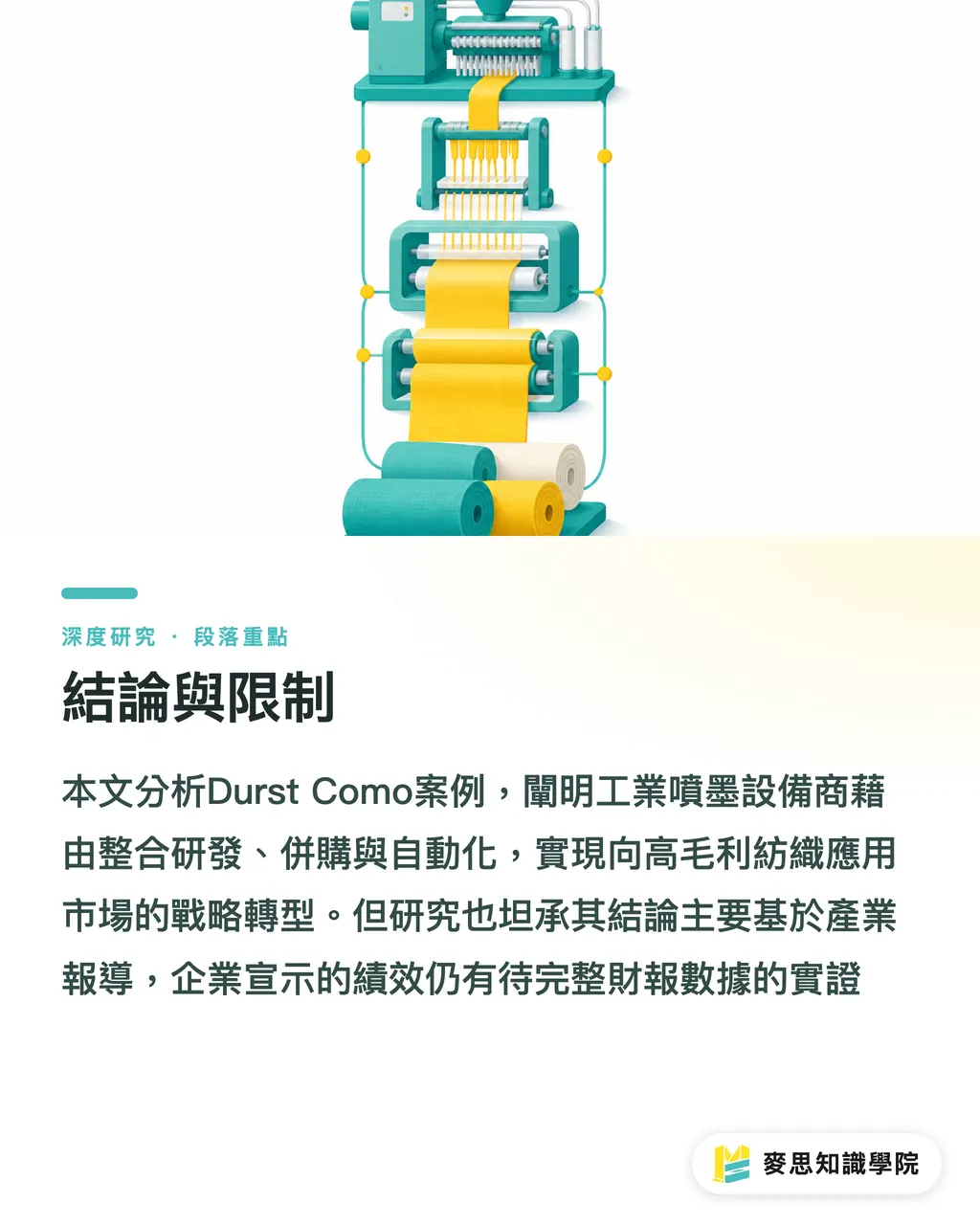
Returning to the research question in the introduction: where is the business logic of printing crossing over into textiles? This article answers that the essence of Durst Como is the repositioning of industrial inkjet equipment manufacturers along the value chain toward high-margin, high-stickiness textile application markets. This is achieved through building R&D sites, acquiring process capabilities, and integrating software and automation. The signal is amplified by the symbolic value of choosing Como, a top-tier textile cluster [1][2]. This explanation fills the gap in existing demand-side literature regarding supply-side vertical repositioning
This article must also honestly disclose limitations:
・First, the first-hand facts on which this analysis is based come primarily from a single industry report and existing background knowledge, and do not cover Durst's full financial statements, production capacity data, or customer structure. Therefore, declarations such as doubling revenue in five years can only be viewed as corporate strategic intent rather than realized performance [1]
・Second, the generalization of the value chain repositioning mechanism in this article represents the author's analytical view, and its general applicability remains to be tested through horizontal comparisons of more equipment manufacturer cases
・Third, the derivation of implications for the Taiwanese industry is built on the assumption that equipment manufacturer actions lead terminal demand. The magnitude and stability of this lead-time relationship require subsequent verification using time-series data on installation volumes and order structures
Future research can extend in three directions: first, horizontally comparing the crossover paths of multiple industrial inkjet manufacturers to test the commonality of the self-building plus acquisition mechanism, second, establishing empirical cost curves for digital textile printing in Taiwan to locate the economic threshold batch size for the local market, and third, tracking the actual adoption rates of brands under small-run, fast-response models to verify the real speed of demand-side shifts
Key Takeaways
・Durst's investment of about 20 million euros to establish Durst Como is in essence a repositioning along the value chain toward high-end textile applications, rather than a simple production expansion [1]
・Choosing Como, a top-tier silk cluster, is a positioning statement aimed at European fashion brands, where symbolic and cluster benefits outweigh production convenience [1]
・The crossover runs along three parallel tracks: building R&D locations, acquiring Aleph's process capabilities, and integrating software and automation, shifting profit sources from machines to consumables and services [1]
・The vertical actions of equipment manufacturers typically lead terminal demand by several years, and Taiwanese operators should treat this event as an early indicator of application market structure
・The implications differ for three types of roles in Taiwan: printing factories should first verify small-batch costs, designers should master patterns ready for digital production, and brands should deploy local fast-response and ESG evidence
Extended Thinking
For the printing manufacturing side, the real revelation of this signal is that the profit pool is shifting from hardware toward consumables, software, and process integration. If Taiwanese equipment agencies and printing factories still focus on machine unit price as the core of procurement, they will miscalculate the total cost of ownership and long-term competitiveness. For the design side, the lack of plate-making and variable patterns turn short-run customization from a cost-prohibitive zone into a business opportunity, where the designer's strength lies in standardized patterns and color specifications that can directly interface with the printing process. For AI implementation and SaaS, Durst's emphasis on customer co-creation, automation, and textile-specific software indicates that color management, pattern generation, and prepress automation will become the next software value peaks. An open question for Taiwanese operators to consider is: in the absence of local empirical cost curves, how to determine the critical threshold batch size for purchasing equipment versus outsourcing, and how to connect the data flow from design to finished product into a complete loop optimizable by software
References
[2] Durst C. (2025). Positionierung, Der Weg zur Core Story. B2B Digital Marketing Playbook. DOI: 10.1007/978-3-658-45379-4_1
FAQ
- How much is Durst investing, and what is its purpose?
- Durst is investing about 20 million euros to set up a brand-new digital textile division, Durst Como, in Como, Italy, which serves as the group's third development and production center with R&D capabilities, focusing on inkjet technology, software, and application research for fashion and home textiles [1]
- Why did Durst choose to set up a site in Como?
- Como is a historic hub of top-tier global silk and fashion textiles. The choice of location offers talent, cluster, and symbolic benefits, serving as a declaration of a long-term commitment to European high-end textile brands. This article views it as a statement of positioning rather than simple production convenience [1]
- What is the connection between this crossover and Aleph?
- Durst Como directly took over the integration of Aleph, which the group acquired in 2025. Aleph specializes in inkjet technology for direct printing on fabrics and paper, allowing Durst to quickly fill key process capability gaps in direct fabric printing [1]
- Is this an opportunity or a threat for Taiwanese printing factories?
- It is both. It confirms that digital textile printing is a mature profit pool. Taiwanese small and medium-sized factories can first verify small-batch costs through outsourcing before deciding to purchase machinery, and shift their procurement focus from machine unit price to the total cost of ownership, including ink, software, and post-processing [1]
- What are the advantages of digital textile printing?
- Compared with traditional screen printing, digital printing does not require plate-making, allows variable patterns, and has short sampling cycles. It holds structural cost advantages in small-batch, multi-pattern, and fast-response orders, and more easily interfaces with brands' ESG and local fast-response needs
References
- Durst 砸 2000 萬歐元建數位紡織部門:印刷跨界紡織的商業邏輯在哪裡 · printindustry.news
- Durst, Marius · doi.org
- Durst, Auguste · doi.org
- (A Story by) The Spellshop by Sarah Beth Durst · doi.org
- Durst, Alan Lydiat · doi.org
- Positionierung,Der Weg zur Core Story · doi.org
Related articles




The Print × AI weekly
The print and AI know-how designers, brands and enterprises can use before they commit — one email, every week
MINDS Free Tools
Spine width and imposition calculators — skip the manual math, free in your browser.
MINDS Group
Need actual printing or gifting services?
From premium printing to online ordering and festive gifts — the MINDS Group sister brands take it from here.