

1. Introduction: From a Single Pricing Variable to a Multi-Variable Quoting System
Packaging quotes have long treated print volume as the main pricing variable, but the structure of the base paper market in 2026 has already made that model lose its explanatory power. Traditional quoting logic assumes that material costs remain relatively stable during the quote validity period, so print volume, number of plates, and converting processes are treated as the main cost drivers. When base paper prices are adjusted three times within a single year, the material item itself becomes the most volatile variable, not a background constant
This issue has direct operational significance for Taiwan's design and printing industry. Taiwan's packaging paper depends heavily on imports and is closely tied to international pricing. Price-hike signals for North American and European containerboard usually feed through to Taiwan's import floor prices within a few months. At the same time, the long-term quotes and annual contracts commonly used by small and midsize printing plants in Taiwan leave all price risk on the manufacturing side when material costs move frequently. This article argues that this is a quoting system design problem, not simply a procurement negotiation problem
Current discussion has three specific gaps:
・First, academic literature on base paper mostly focuses on material performance and environmental performance, with less attention to linking specification differences to quotes and cost structures
・Second, research on recycled fiber quality control emphasizes inspection automation on the production side, but does not extend the discussion to how quality fluctuation turns into procurement and lead-time risk
・Third, tariffs and cross-border trade variables are almost absent from the literature on packaging costs, yet in the actual 2026 context they have become one of the main sources of quoting uncertainty
This article makes three contributions, each corresponding to one main section:
・First, it systematically breaks down the cost pass-through mechanism behind the third round of price hikes in 2026, explaining why different increases for linerboard, white-top, and medium change product-mix decisions (see Section 3)
・Second, it repositions existing material science and life cycle literature as sources of quoting variables, showing that base paper grade, coating choice, and fiber source all carry measurable cost implications (see Sections 2 and 4)
・Third, it proposes a layered quoting-risk approach structured around three axes, base paper, contract terms, and tariffs, and maps it to the workflows of small and midsize printing plants, designers, and brand owners in Taiwan (see Section 5)
2. Literature and Current Conditions: Three Research Lines That Do Not Meet
Existing research on packaging base paper can be divided into three groups. They look at different layers of the issue and rarely intersect. This section first defines the core argument of each group, then points out the problem they all leave untouched
The first group covers base paper material performance and coating research. Research on white-top linerboard compares the effects of two biodegradable coatings on the properties of paper used for food packaging in low-temperature environments, showing that coating choice materially changes how base paper performs in specific use cases[2]. This type of research establishes an important premise: white-top linerboard is not freely interchangeable with general linerboard. Its specification choice is tied to specific functional requirements. It provides a material-level basis for the idea that different base paper grades cannot be simply substituted. But when white-top and general linerboard see the same scale of price increase, whether brand owners should keep the original specification remains unresolved. Section 3 discusses this cost and specification tradeoff
The second group looks at quality control at the recycled fiber input stage. Research on automated incoming wastepaper inspection at Smurfit Kappa Beograd deals with quality judgment and process automation when wastepaper raw material enters the plant[3]. The implied premise is that recycled fiber quality varies significantly, and a systematic inspection mechanism is needed to keep downstream production stable. This article argues that this premise has a cost-side implication that the research group does not extend: when recycled fiber supply tightens, input quality variation may widen, which can then affect finished-goods yield and lead-time stability. That research mainly treats quality control within the context of production technology. This article takes it further and includes it in quoting as a lead-time and yield-risk item
The third group is life cycle carbon analysis of packaging products. A case study on making linerboard and corrugating medium from nonwood residues establishes a life cycle carbon analysis method for these two product types[4]. Its contribution is that it formally links raw material source, meaning fiber type, with environmental performance, making fiber choice a decision variable that can be measured. This research demonstrates the analytical logic that raw material sources create measurable downstream effects. However, the metric used there is carbon emissions. This article borrows the same logic and shifts it toward cost and supply stability, discussing how fiber source affects quoting risk
What all three groups leave unresolved is integration at the quoting level. Material research explains why specifications are not interchangeable. Quality-control research shows that input-side variation exists. Life cycle research shows that fiber source has downstream effects. But none of these groups integrates those variables as inputs to a quoting model. That integration gap is exactly where this article begins: when base paper costs change frequently, how should quotes reflect material specifications, contract terms, and trade policy at the same time?
3. Cost Pass-Through Mechanism: The Structural Signal in the Third Price Hike
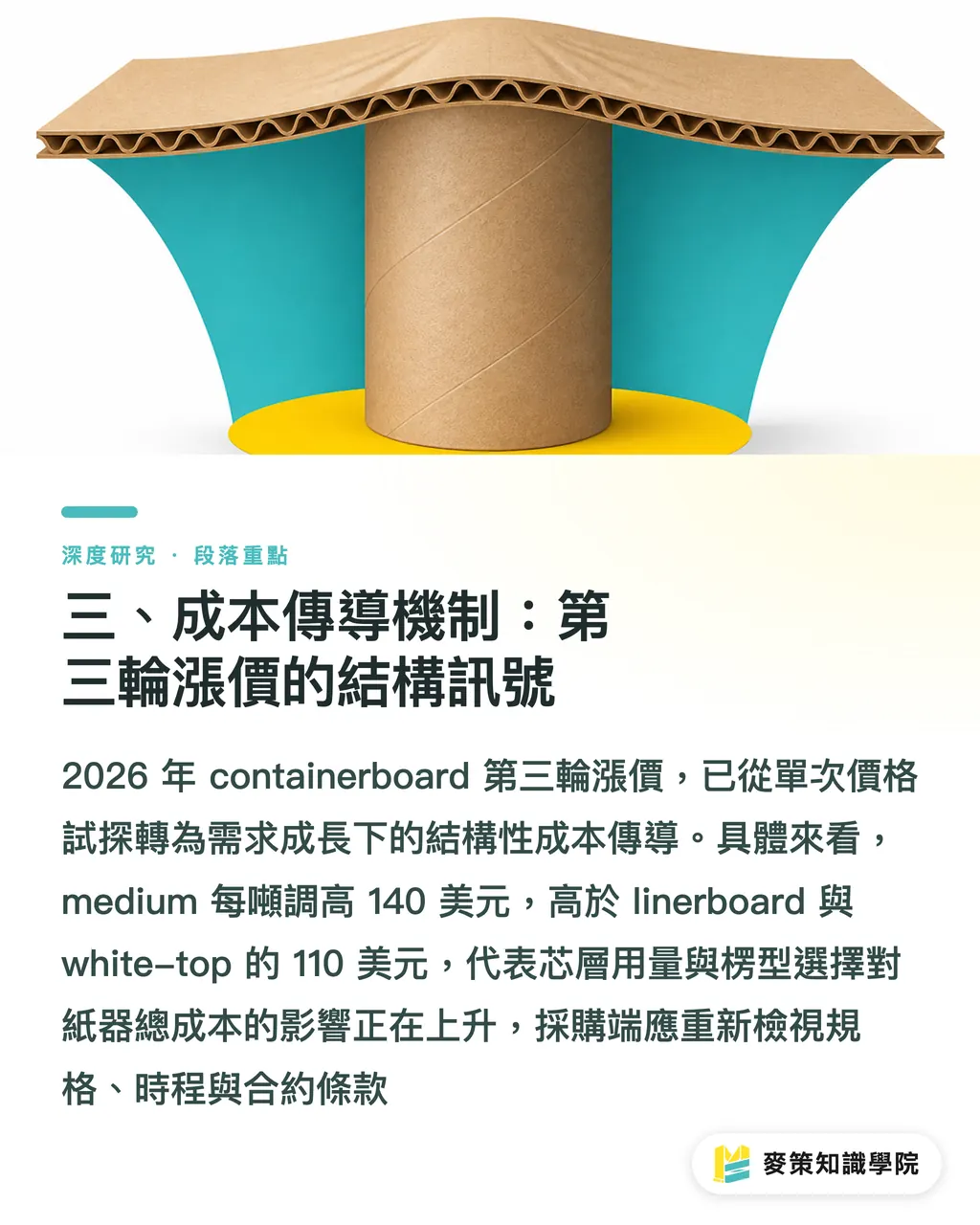
The 2026 containerboard price hike is no longer a single event. It is a structural adjustment across three consecutive rounds. Cascades reported net sales for the second quarter of 2026 of CAD 1.22 billion, up 2.7% year over year, net income of CAD 21 million, total packaging segment shipments up 9% quarter over quarter, and boxboard shipments up 6% quarter over quarter[1]. These numbers show that producers were still pushing price increases while shipment volume was growing for the quarter. This round is not passive price defense under weak demand. It is closer to cost pass-through in a demand-growth setting, so it has more staying power than a typical price test
The internal difference in increase size is the core observation in this section. Starting September 8, 2026, linerboard and white-top will rise by USD 110 per ton, while medium will rise by USD 140 per ton[1]. This article argues that medium rising more than linerboard has clear specification implications: the cost increase for the core layer of corrugated board, medium, is larger than that of the surface layer, linerboard. Under the same paperboard structure, flute selection and medium usage are gaining weight in total cost. Quoting habits that previously treated surface-layer grade as the main cost differentiator need to re-examine the cost sensitivity of core-layer specifications
The industry-wide nature of the price hike rules out the possibility of negotiating around it with a single supplier. PCA, Smurfit Westrock, and International Paper are also pushing increases in the same wave[1]. This means the adjustment has become a synchronized industry move. Procurement teams will find it difficult to avoid the increase by shifting orders to other major suppliers. The available room for adjustment lies instead in specifications, schedules, and contract terms
The input-side cost structure further explains why the increase may persist. Cascades' CEO pointed to inflation in input costs such as recycled fiber and tight supply of fiber rolls as the main causes, while OCC (old corrugated containers, recycled corrugated boxes) rose another USD 5 per ton that week[1]. This signal matches the earlier premise in recycled fiber quality-control research[3]: when recycled fiber faces price increases and tight supply at the same time, the risk of input quality variation should rise. This article argues that this means quotes should account not only for material unit price, but also for yield and rework risk as separate items, instead of folding them into the existing rough estimate for waste
4. The Tariff Dimension: A New Source of Quoting Uncertainty
Tariffs have also entered the packaging cost structure. The United States added a 50% tariff on certain imports from Canada, clearly increasing uncertainty in the cost of cross-border packaging materials[1]. What makes this policy variable unusual is that it does not follow the more predictable adjustment rhythm of base paper prices. It can change landed cost within the quote validity period in a non-gradual way
For Taiwanese companies, the tariff impact path is indirect but real. Tariff friction inside the North American market changes the flow of paper materials between regions. When cross-border trade costs rise, suppliers tend to serve their local markets first, reducing the remaining volume available for export to Asia. This article argues that this is a quantity effect rather than a price effect. As a result, Taiwan's import side may first feel longer lead times and tighter allocations, while price increases appear later. Monitoring only import quotes therefore underestimates when the risk actually begins
The tariff dimension also changes the logic for evaluating substitute materials. Existing life cycle research has shown that nonwood residues can serve as raw material sources for linerboard and corrugating medium, with measurable differences in carbon performance[4]. From a cost perspective, this research is worth a fresh look. When traditional fiber sources face pressure from both pricing and trade policy, evaluating alternative fibers is no longer only about sustainability. It is also about supply chain resilience. This article sees this as a direction that still needs empirical testing, because existing literature measures carbon emissions, not cost or supply stability, and the relationship between the two has not been verified
The limits of this section must be stated clearly. The specific scope, item classification, and effective dates of tariff policy change with policy adjustments. This article can only analyze the directional signals already announced[1]. It cannot make a quantitative prediction of the actual tax burden for specific items
5. Implications for Taiwan's Design and Printing Industry: Three Layers of Workflow Adjustment
This section explains actionable adjustments by role. Each layer has a different operational focus
For small and midsize printing plants, the core adjustment is in the quote document itself:
・First, shorten the quote validity period: in an environment where base paper is adjusted three times in one year[1], a fixed quote lasting more than 30 days effectively leaves the manufacturer alone to carry material risk
・Second, quote material items and processing items separately, so material cost changes do not require reopening the entire quote
・Third, clearly define price-adjustment triggers and reference sources in the contract, such as using the announced price movement of a specified base paper item as the trigger threshold
・Fourth, list core-layer and surface-layer specifications separately, because medium and linerboard have already shown different price increases[1]. Listing them together hides the real change in the cost structure
For designers, the adjustment happens during specification setting and proofing. Paperboard structure design directly determines medium usage, and medium cost has increased by a larger margin[1], so flute selection now carries more cost weight than before. At the same time, the functionality of white-top linerboard is determined by coating and paper-surface properties[2]. If the design goal is only visual whiteness rather than a specific functional need, downgrading is open for discussion. But if low-temperature or food-contact use is involved, specification downgrading needs material-level validation and should not be decided on cost alone
For brand owners, the adjustment is in procurement lead time and supplier management:
・First, move procurement lead times earlier than current practice, because the quantity effect caused by tariffs may show up first as lead-time pressure, not price
・Second, establish dual sourcing for key items to avoid a total supply break from one origin when trade policy changes
・Third, include a material price-adjustment mechanism in annual contracts. Accept floating material items in exchange for stable prices on processing and service items. This article argues that this has lower transaction cost than repeatedly renegotiating the whole contract
At the workflow level, the adjustments above can be narrowed into a three-check process. The first check, at the specification stage, confirms whether the surface-layer and core-layer specifications are functionally necessary. The second check, at the quoting stage, confirms whether material items are listed separately and covered by price-adjustment terms. The third check, before order placement, confirms origin, lead time, and tariff applicability. Through this process, the three dimensions of material, contract, and trade become fixed parts of the workflow, instead of being judged case by case at the last minute
6. Conclusion and Limits
The research question of this article is: when base paper costs change frequently, what variables should packaging quotes include that existing models do not cover? The analysis identifies three: differences in price increases across base paper grades (USD 110 per ton for linerboard and white-top, USD 140 per ton for medium)[1], the design of contract price-adjustment clauses, and the quantity and lead-time effects caused by cross-border tariffs[1]. What they share is that none of them changes in proportion to print volume, so they cannot be absorbed by a quote model that uses print volume as its single variable
This article has two specific limits:
・First, the data period and geographic scope are limited: the core event data comes from North American market announcements in the second quarter of 2026 and one company's earnings report[1]. It does not include price data from European and Asian markets over the same period, nor actual transaction prices on Taiwan's import side. As a result, the lag and magnitude of the "North American signal passing through to Taiwan" are inferences in this article and have not been verified with local data
・Second, there is inferential distance between the cited literature and quoting practice: the three papers cited here respectively deal with coating performance[2], automated incoming wastepaper inspection[3], and life cycle carbon analysis[4]. None of them directly studies quote models. This article uses their conclusions as source material for quoting variables. That bridge is the author's analytical construction, not the original claim of the literature
Two follow-up research directions are actionable:
・First, build a time-series comparison between Taiwan's import base paper quotes and North American containerboard announced prices to quantify pass-through lag and pass-through coefficients. This would require at least two years of monthly import price data
・Second, track several small and midsize printing plants as case studies after they adopt separate material-item quoting and price-adjustment clauses, then examine changes in gross margin to test whether the quoting adjustments proposed here actually reduce price-risk exposure on the manufacturing side
Key Takeaways
Containerboard prices rose for the third time in 2026. Starting September 8, linerboard and white-top will increase by USD 110 per ton, while medium will increase by USD 140 per ton, with PCA, Smurfit Westrock, and International Paper joining the same wave of increases
Medium rose more than linerboard, meaning the cost sensitivity of the core layer in corrugated structures is increasing. Flute type and medium usage now carry more weight in quotes than before
Cascades announced a price increase while shipments were up 9% quarter over quarter, showing that this is cost pass-through under demand growth and has more staying power than a typical price test
The United States added a 50% tariff on certain imports from Canada. For Taiwan, the effect may first appear as longer lead times and tighter allocations, while price signals lag behind
The three most actionable adjustments for small and midsize printing plants are shortening quote validity periods, separating material items from processing items in quotes, and clearly defining price-adjustment triggers in contracts
Further Thoughts
For print manufacturers, this wave of price increases pushes "quoting" back from a sales activity into a cost engineering problem. Material items need independent cost tracking and price-adjustment mechanisms, not a fixed total price folded into a single quote. For designers, the cost responsibility of structural design is increasing. Medium usage and flute selection need to be assessed alongside material prices at the specification stage, instead of discovering after proofing that the budget has been exceeded. The concrete entry point for AI is price-signal monitoring and pass-through tracking: the lag relationships among North American announced prices, the OCC index, tariff item lists, and Taiwan import quotes are suited to continuous automated tracking, with requote prompts triggered when thresholds are reached. This catches non-cyclical policy changes better than manual periodic price checks. At the SaaS level, the opportunity lies in the data model of quoting systems. Most current quoting tools treat material as a fixed unit-price field. If that field becomes dynamic, tied to external price sources and validity periods, with built-in automatic calculation for price-adjustment clauses, the three-axis risk discussed in this article can become part of the system. The unresolved issue is empirical pass-through coefficients: how much North American announced prices change, how long it takes, and at what magnitude they show up in Taiwan's import costs. There is currently no public quantitative basis for this, and any automated quote model has to solve that first
References
[2] Kasmani J., Samariha A. (2024). Comparison of the effects of two biodegradable coatings on the characteristics of white-top linerboard used in packaging food materials in cold environments. BioResources. DOI: 10.15376/biores.19.2.3489-3504
[3] Smurfit Kappa Beograd d.o.o, Beograd, Srbija, Juričić T. (2024). AUTOMATIZATON OF INPUT CONTROL OF WASTE PAPER IN SMURFIT KAPPA BEOGRAD COMPANY. Proceedings / XXV međunarodni simpozijum iz oblasti celuloze, papira, ambalaže i grafike. DOI: 10.46793/cpag24.129j
[4] SUAREZ A., GHOSH A., PAULSEN F. et al. (2024). Life cycle carbon analysis of packaging products containing nonwood residues: A case study on linerboard and corrugating medium. TAPPI Journal. DOI: 10.32964/tj23.3.131
FAQ
- What were the size and timing of the 2026 containerboard price increase?
- Starting September 8, 2026, linerboard and white-top will increase by USD 110 per ton, while medium will increase by USD 140 per ton. This is the third price increase in 2026, with PCA, Smurfit Westrock, and International Paper also pushing increases in the same wave
- Why is medium rising more than linerboard, and how does that affect quotes?
- Medium is rising by USD 140 per ton, while linerboard is rising by USD 110 per ton, so the core layer is increasing more than the surface layer. This means flute selection and medium usage in corrugated board now carry more weight in the cost structure. Quotes should list core-layer and surface-layer specifications separately to avoid hiding cost changes in a combined quote
- How will U.S. tariffs on Canada affect packaging costs in Taiwan?
- The United States added a 50% tariff on certain imports from Canada. The main effect on Taiwan comes through changes in paper material flows within North America. Suppliers prioritize their local markets, reducing the remaining volume exported to Asia. Taiwan may therefore see longer lead times and tighter allocations first, while price-increase signals usually appear later
- How should small and midsize printing plants adjust their quotes now?
- The three most direct adjustments are to shorten quote validity to under 30 days, separate material items from processing items in quotes, and clearly define price-adjustment triggers and reference announced price sources in contracts. This way, when material costs change, the entire quote does not need to be reopened
- Can white-top linerboard be downgraded to save cost?
- It depends on the use case. The functional performance of white-top linerboard is tied to coating characteristics. If the requirement is only visual whiteness, downgrading can be discussed. If low-temperature use or food contact is involved, any specification downgrade needs material-level validation and should not be decided on cost alone
Related articles





The Print × AI weekly
The print and AI know-how designers, brands and enterprises can use before they commit — one email, every week
MINDS Free Tools
Imposition calculator and preflight file check — free prepress tools, right in your browser.
MINDS Group
Need actual printing or gifting services?
From premium printing to online ordering and festive gifts — the MINDS Group sister brands take it from here.