

Overview
Let's start with a pitfall many people have run into. A client brings in a 3D-printed PLA part and says, "Just mold and cast this directly." Everything looks reasonable: cheap to print, fast revisions, and the material is even labeled biodegradable. Then the casting comes out with pitted surfaces, internal porosity, and dimensions off by tenths of a millimeter
The issue isn't printing accuracy. It's that once PLA enters the shell mold and heats up during burnout, its behavior is nothing like wax
This is where biodegradable materials often get stuck on the way to volume production: a material can carry an eco-friendly label, but once inside an existing process, it still has to run stably through every single condition. So what happens when a PLA pattern goes into investment casting, and what conditions need to be met for volume production? That's what we need to examine here
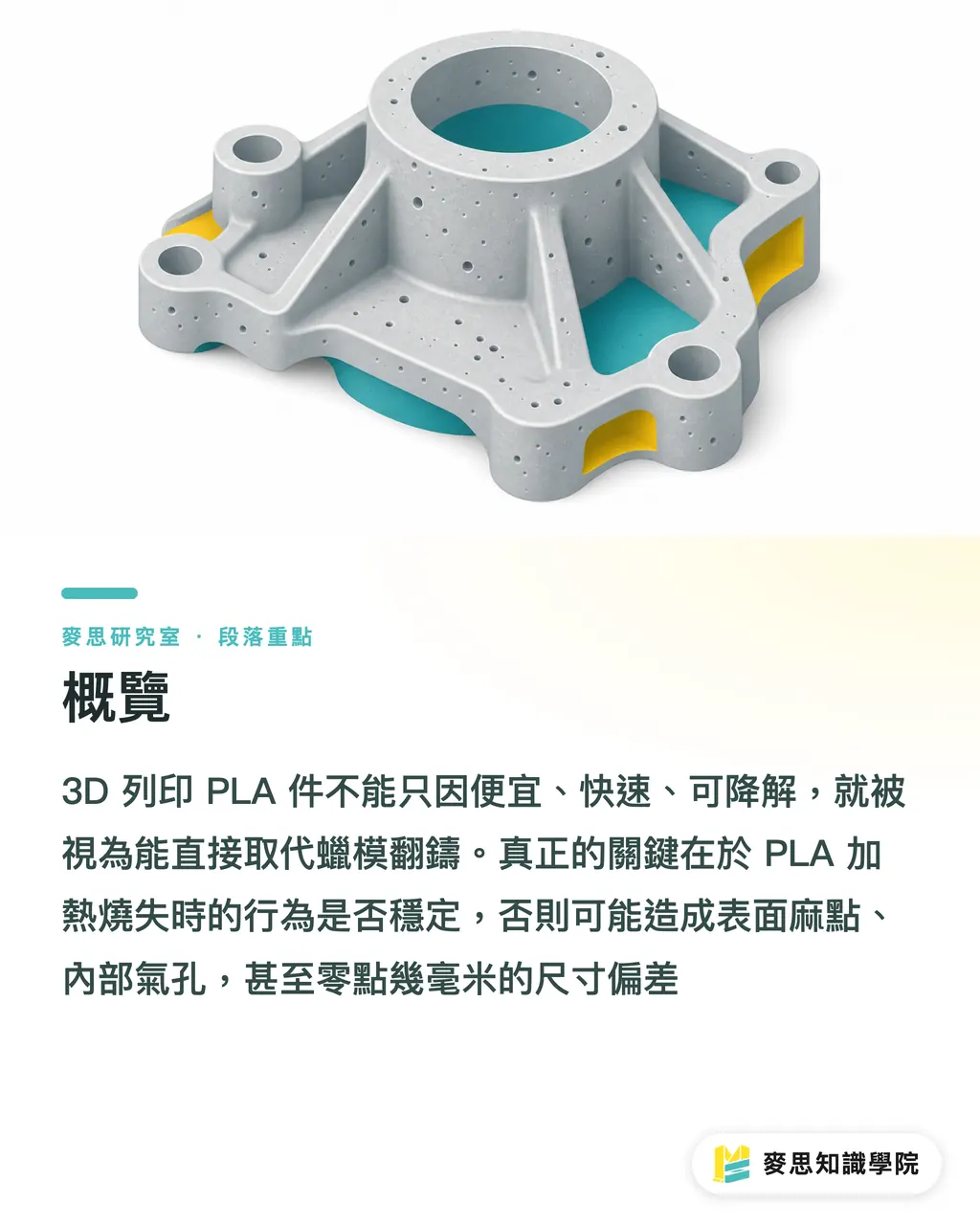
What Happens During Burnout When Using PLA as a Casting Pattern?
The core risk with PLA is that it's a thermoplastic. When heated, it softens and expands before decomposing, instead of melting out cleanly like wax. Recent research on the thermal behavior of PLA-based patterns in aluminum casting used experiments paired with numerical simulations to analyze how pouring temperature, filling time, and gating design affect porosity and casting quality, moving this problem from guesswork into a measurable parameter space [1]
Softening and expansion is the key step. Wax shrinks in volume during burnout, pulling away from the shell mold. PLA, around its glass transition temperature, softens first and then expands, exerting an outward push on the shell mold's inner walls. If the shell mold lacks sufficient thickness or has uneven sintering, that outward push is where cracks begin
Residue is the second variable. If organic carbon residue doesn't burn away completely, molten aluminum reacts with it and produces gas, turning straight into internal porosity. That's why the exact same set of PLA patterns can yield vastly different casting results just by changing the burnout curve. The difference usually comes down to process tolerance
The third factor comes from 3D printing itself: FDM printed parts have infill rates and gaps between layers. During burnout, these voids create exhaust pathways completely different from solid wax patterns. Setting burnout times based on the intuition for a "wax pattern of the same volume" usually underestimates what's needed
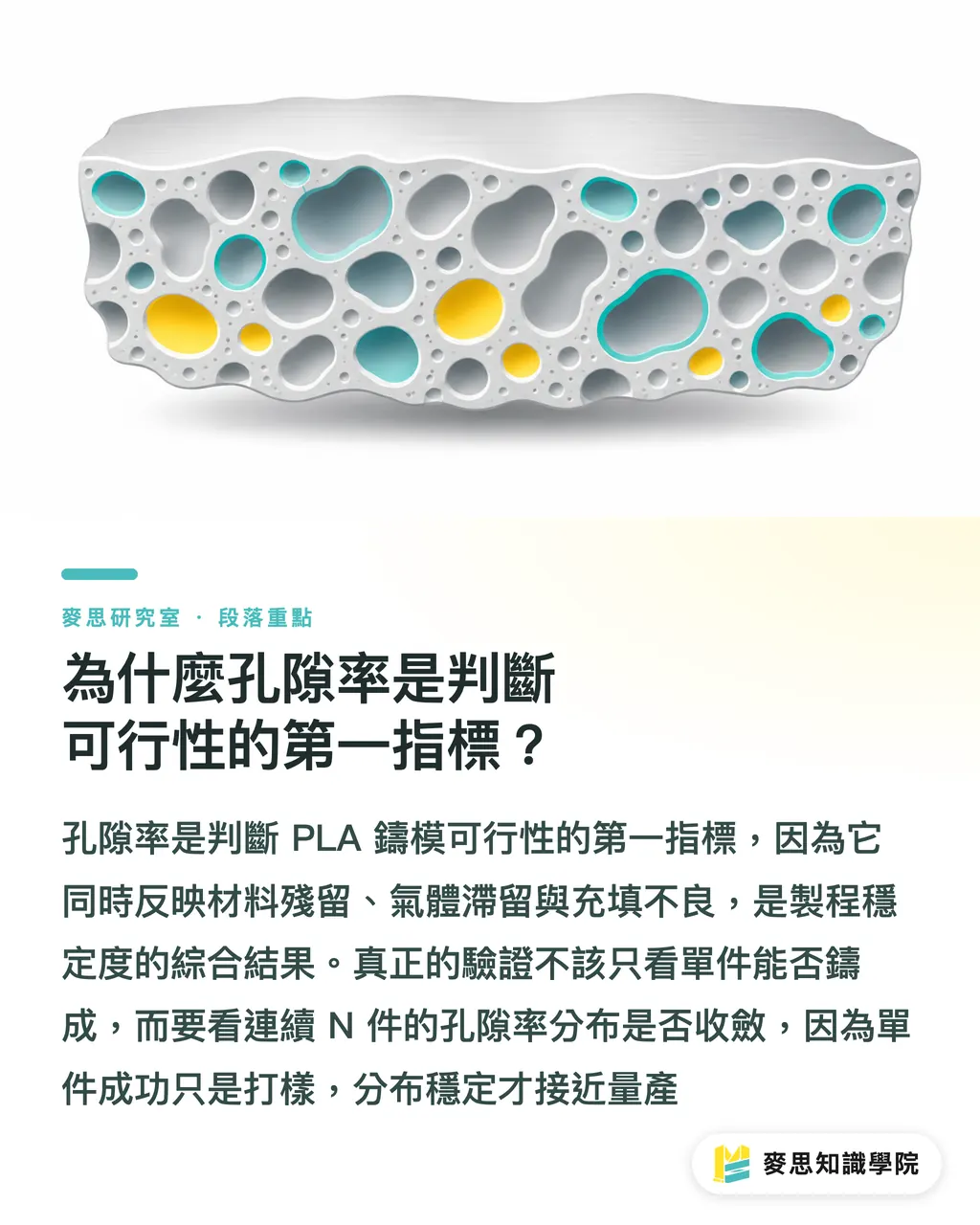
Why Porosity Is the Primary Metric for Feasibility
Porosity reveals issues best because material residue, trapped gas, and poor filling all show up in it. The study mentioned earlier analyzed pouring temperature, filling time, and gating design together with porosity, which proves this exact point: they are not independent dials you can turn in isolation [1]
The aluminum casting industry has had a consensus on this for a long time. Research on aluminum alloy refining processes points out that controlling gases and inclusions in the melt is the core step that decides final casting quality [4]. In other words, even if the PLA side is flawless, if the gas content in the melt isn't controlled, porosity will still appear. That means blaming all defects on the "new material" is usually a misjudgment
Interactions among process parameters aren't new either. Research on stir-cast aluminum matrix composites relied on systematically optimizing stirring parameters to bring quality to a repeatable standard [2]. The same logic applies to PLA patterns: raising the pouring temperature alone might improve mold filling, but it can also worsen carbon residue and melt gas levels, pulling in opposite directions
Here is my take: feasibility for PLA casting patterns shouldn't be judged by "can you cast one single part." It should be judged by "the width of the porosity distribution across N consecutive parts." Making a single piece is just prototyping. Only when you run consecutive parts and keep the porosity distribution tight do you have what it takes for volume production
From Prototyping to Volume Production: Where Does It Get Stuck?
It gets stuck on the width of the process window, not on the absolute performance of the material. Prototyping allows manual tweaks and piece-by-piece inspection. Volume production demands running a single set of parameters across hundreds of parts and staying within spec
Casting is inherently a tradeoff among multiple options. An engineering guide on casting process selection systematically lists the conditions and limits of different casting methods, reminding us that "choosing the right process" is often far more effective than "pushing a single process to its limit" [3]. If the window for PLA patterns is too narrow, the sensible response may be switching casting routes, rather than forcing investment casting to its absolute edge
Simulation brings real value here. Research on green smart aluminum casting used simulation-assisted multi-process integrated optimization, incorporating energy consumption and quality into the objective function [5]. This matters especially for biodegradable materials. The motivation to adopt PLA is mostly environmental benefit, but if it prolongs burnout time and raises scrap rates, the total carbon footprint can actually rise instead of fall. Any carbon saved on material gets eaten up by the extra furnace runtime
Don't overlook downstream heat treatment either. Research on artificial aging optimization in precision sand casting shows that the final mechanical properties of a casting are significantly influenced by subsequent aging processes. Knocking the casting out of the mold isn't the finish line. The process window has to account for everything right through to the end of heat treatment
So How Should You Actually Decide Whether to Adopt It?
Ask about the application first, then the material. My suggested order is straightforward:
・ Confirm volume and tolerances. Small batches, loose tolerances, and cosmetic parts make PLA patterns worth a shot. For tight tolerances, load-bearing parts, and high volume, look at the porosity distribution data first
・ Test the burnout curve as an independent variable. Don't carry over the furnace profile from wax patterns. Infill density, shell wall thickness, and vent hole design must all go into the DOE together
・ Check the melt side at the same time. Gas and inclusion control forms the foundation of casting quality [4]. Rule out issues on that side first before blaming defects on PLA
・ Narrow the experimental scope with simulation. Simulation-assisted multi-process optimization has already proven its worth in aluminum casting [5], saving both time and material compared to blind trial and error
・ Factor energy consumption into the sustainability balance sheet. If the motivation is environmental benefit, burnout energy use and scrap rates must be calculated as well
The operating boundaries need to be stated clearly: the takeaways above apply to aluminum alloy investment casting. Switch to copper alloys, cast iron, or other metals with higher pouring temperatures, and PLA's residue and expansion behavior will be magnified even further. The leeway described here won't apply. Likewise, if your PLA comes from a different supplier or uses different print settings, its thermal behavior must be re-verified rather than relying on someone else's window
A sustainability label on a material only means it's worth evaluating. Whether the process tolerance is wide enough is what decides if it can hit the production line. Those two questions are worth asking separately before you even quote a job
Key Takeaways
The risk of PLA casting patterns doesn't lie in print accuracy. It lies in burnout, where softening, expansion, and carbon exhaust behavior differ fundamentally from wax
Porosity is the primary metric for judging PLA pattern feasibility, as it simultaneously reflects material residue, gas entrapment, and poor filling
Casting a single successful part only proves prototyping works. Volume production feasibility depends on whether the porosity distribution narrows and stays consistent across multiple consecutive parts
Gas and inclusion control on the melt side is the foundation of casting quality. Without ruling that out first, defects cannot be accurately blamed on PLA
If burnout energy consumption and scrap rates rise, the overall environmental gains of adopting biodegradable materials can be completely wiped out
Broader Implications
For printing and packaging manufacturers, this PLA pattern case study goes beyond casting itself. It offers a practical perspective on adopting sustainable materials: look at how wide the operating window is once the material enters an existing process before talking about environmental benefits. The exact same logic applies to running bio-based substrates on press, the sealing window for biodegradable films, and converting compatibility for molded fiber alternatives. For designers, the takeaway is that specs should specify the "process window," not just the material name. AI and simulation tools have a clear role here. Simulation-assisted multi-process optimization has already proven in aluminum casting that it can balance quality and energy consumption together [5]. The same framework can be applied to packaging material selection, swapping endless physical prototyping rounds for parameter space computation. For SaaS, the unsolved problem is data portability. PLA from different suppliers, varying print parameters, and different furnaces each have thermal behavior data that is almost never shared. Every factory ends up running the exact same DOEs from scratch. Turning this manufacturing data into comparable, reusable knowledge is our best bet for eliminating the trial-and-error cycle that plagues sustainable material adoption
References
[2] Sahu M., Sahu R. (2018). Fabrication of Aluminum Matrix Composites by Stir Casting Technique and Stirring Process Parameters Optimization. Advanced Casting Technologies. DOI: 10.5772/intechopen.73485
[3] Casting Process Options. Aluminum Castings Engineering Guide. DOI: 10.31399/asm.tb.aceg.t68410021
[4] Rizaeva N., Tursunbaev S., Tadjiev N. et al. (2026). Investigation of The Refining Process of Aluminum Casting Alloys. American Journal of Applied Science and Technology. DOI: 10.37547/ajast/volume06issue03-13
[5] Liu W., Zhao C., Peng T. et al. (2023). Simulation-assisted multi-process integrated optimization for greentelligent aluminum casting. Applied Energy. DOI: 10.1016/j.apenergy.2023.120831
FAQ
- Can 3D-printed PLA parts be used directly as patterns for investment casting?
- Technically yes, but PLA doesn't melt out cleanly like wax. Heating causes it to soften and expand before decomposing, which can crack the ceramic shell and leave carbon residue behind. Recent research analyzed the thermal behavior of PLA-based patterns in aluminum casting using experiments and numerical simulations, along with how pouring temperature, filling time, and gating design affect porosity [1]
- What is the most common casting defect when using PLA patterns?
- Porosity is the most common defect. It stems from gas released by decomposing PLA carbon residue, poor venting during burnout, and improper filling parameters. Because of this, porosity serves as the primary metric for evaluating whether a PLA pattern process is stable
- Is porosity always caused by the PLA?
- Not necessarily. Gas content and inclusion control in the aluminum melt are also core factors in casting quality [4]. If you don't rule out issues on the melt side first, blaming all defects on PLA is usually a misjudgment
- Is replacing wax with PLA patterns always more environmentally friendly?
- Not necessarily. If burnout times stretch out and scrap rates go up, the extra furnace power and rework can cancel out the carbon saved on the raw material. Research on simulation-assisted multi-process integrated optimization factored both energy consumption and quality into aluminum casting targets [5]. Any adoption assessment should take the same end-to-end view
- When should you avoid using PLA casting patterns?
- Avoid them for tight-tolerance structural components, high-volume production runs, and applications with higher pouring temperatures like copper alloys or cast iron, where PLA expansion and residue risks are amplified. It's best to gather porosity distribution data across consecutive parts before deciding
Related articles


The Print × AI weekly
The print and AI know-how designers, brands and enterprises can use before they commit — one email, every week
MINDS Free Tools
AI background removal, a LINE sticker maker, spine & imposition calculators — all free, right in your browser, no upload.
MINDS Group
Need actual printing or gifting services?
From premium printing to online ordering and festive gifts — the MINDS Group sister brands take it from here.