

Overview
A familiar scene on the floor: the inspection system fires an alarm, the operator rushes over, and finds nothing on the sheet. After a few rounds of this, the pressman dials sensitivity down two notches. The alarms stop, and then actual scratches start slipping through
This isn't a machine breakdown. It's a disconnect between the user and the system over what counts as a defect. To fix that, you have to understand what the algorithm behind the camera is looking for. It searches for contours: closed boundaries formed by sharp changes in grayscale or color within an image. Once you understand how contours are extracted and tracked across frames, you can figure out which parameters to adjust on your press line and where to invest your budget

Why 'Contours' Are the Core Language of Print Inspection
Because contours are the only feature that machines can reliably quantify while still matching how the human eye judges defects
Computer vision established contour-based real-time multiple object tracking years ago, using contour features to detect and track multiple targets simultaneously in dynamic video [1]. While that research wasn't written for printing, the problem structure is nearly identical to web press inspection: the sheet is in constant motion, multiple targets appear at once, and everything has to happen in real time
Translated into print terms:
・ Hickeys: Small, high-contrast closed contours appearing in blank areas where no contour should exist
・ Scratches: Slender contours with extreme aspect ratios, usually running along the web direction
・ Color misregistration: Not a new contour, but a spatial shift of the same graphic contour across different color plates. This is the key difference: it is an alignment error between existing contours, not an extra object appearing out of nowhere
To the vision system, these three defects represent completely different mathematical problems. That explains something I see all the time in pressrooms: a system that nails hickey detection often misjudges registration. Detecting hickeys relies on finding unwanted contours, while judging registration relies on comparing relative shifts between existing contours. They don't share the same threshold parameters at all. When a vendor sells you a system, you usually end up tweaking only one set of dials
How Does Real-Time Multi-Object Tracking Differ from Single-Frame Snapshot Comparison?
The difference lies in identity. Tracking manages the identity of the same defect across consecutive frames, rather than just asking whether this single frame has an anomaly
The core value of contour-based real-time multi-object tracking is maintaining the identity and position of multiple targets at once in dynamic video [1]. On a press line, the practical impact is concrete: it determines whether the system counts the exact same defect ten times
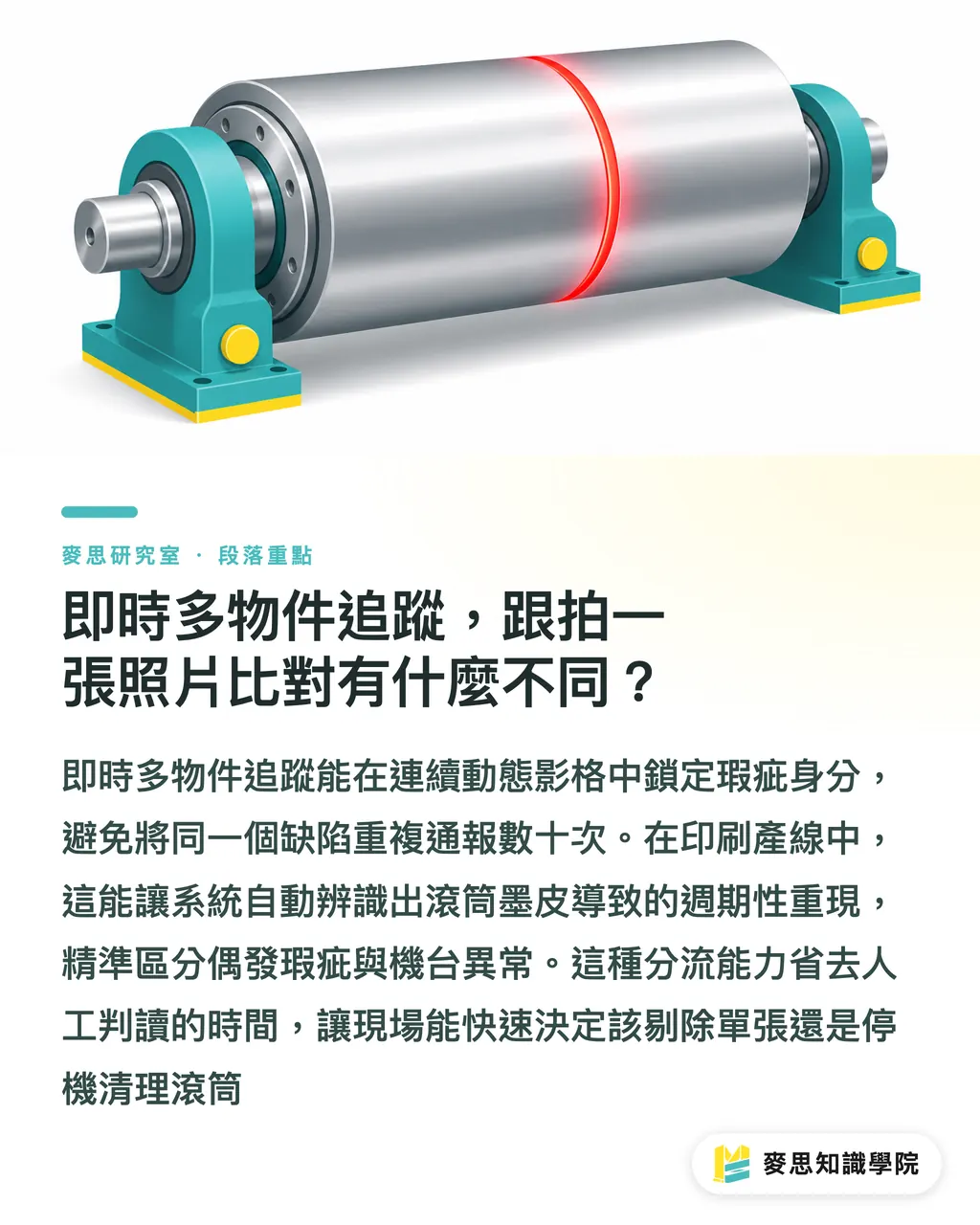
Run the numbers and it becomes obvious. At a print speed of 300 m/min (about 5 meters per second), a camera capturing at 30 frames per second will see a persistent cylinder contaminant, such as dried ink stuck on the impression cylinder, show up across dozens of consecutive frames. (This is an estimated calculation; actual values depend on the press and camera settings.) A system without tracking logs this as dozens of separate defects, burying real random flaws under noise. A system with tracking recognizes that this is the same contour repeating periodically, pinpointing the issue to the cylinder rather than the paper substrate
Separating random defects from periodic defects is the biggest operational payoff of contour tracking. Random flaws just need to be sorted out, but periodic flaws mean stopping the press to clean the cylinder. If a system only flags a binary yes or no, you will always be stuck relying on the gut instincts of veteran pressmen to tell the difference
Why Are False Alarms So Hard to Reduce?
Because most false alarms come from legitimate contours that aren't defects. Halftone dots, paper grain, textures, and crisp tiny text all look like valid contours to an algorithm
This is where printing differs from typical industrial inspection. When you inspect a machined bolt, the background is clean. When you inspect a printed sheet, the background is packed with contours. A 4-color job at 175 lpi contains tens of thousands of halftone dots per square inch, and every single dot has a boundary. Catching a 0.3 mm hickey against that background is searching for a faint signal in heavy noise
In practice, cutting false alarms requires three sequential steps:
・ 1. Check if your optical resolution is sufficient. This is a hardware ceiling that software cannot rescue. A rough calculation: if a 4096-pixel line scan camera covers a 1000 mm web width, each pixel represents roughly 0.24 mm. Trying to reliably detect a 0.3 mm defect with only one or two pixels is gambling. To catch a 0.3 mm defect consistently, the defect needs to span at least three to five pixels. When resolution falls short, tweaking software parameters is a waste of time
2. Calibrate your golden sample. If your reference sheet has slight smudges or color drift, the system will flag every subsequent good sheet as defective
3. Adjust thresholds only as the final step. These must be configured by zone: solid ink areas, fine text, and blank margins have completely different contour density tolerances. Applying a single global threshold across the entire form is a recipe for failure
The most common mistake on the floor is skipping the first two steps and jumping straight to adjusting thresholds. That attempts to compensate for hardware limits and flawed reference samples using software tweaks. The end result is the scene from the opening: the alarms go quiet, and real defects slip right past
What Questions Should You Ask Vendors Before Buying?
Ask about tracking and classification capabilities, not just whether the system can spot a mark. That is the real dividing line in system value
Specifically, four questions are worth settling before signing a contract:
・ Can the system distinguish random defects from periodic ones? This shows whether it has cross-frame contour tracking rather than basic sheet-by-sheet comparison
・ Under what web width and press speed was the minimum detectable defect size measured? These three numbers must be evaluated together; quoting 0.2 mm in isolation is meaningless
・ What mechanism is used to determine color misregistration? If the vendor uses the same threshold logic as hickey detection, registration is likely just an afterthought feature
・ Can false alarm data feed back into retraining? A system that does not learn from an operator's 'false alarm' button will inevitably have its sensitivity dialed into oblivion within three months
A practical next step is simple: hold off on replacing your system. Pull alarm logs from the past month, manually tag which were real defects and which were false alarms, and sort them by defect type. This sheet will usually show you right away whether your bottleneck is resolution, reference samples, or threshold settings. It costs a few hours of labor and can save you from a bad capital expenditure
Let's be clear about the operational boundaries. The points above assume your job has a stable, repeating graphic structure. Short runs, variable data printing (VDP), and personalized sheets with unique artwork have no golden sample to compare against. They require rule-based anomaly detection rather than template comparison, which makes step two moot. Similarly, transparent substrates, holographic foils, and high-gloss finishes create extreme optical variations where contour extraction becomes far less reliable. Those challenges require customized lighting setups, not software tweaks

Key Takeaways
The underlying language of AI print inspection is contours. Hickeys are unwanted contours, scratches are extreme-aspect-ratio contours, and color misregistration is the relative shift of existing contours. Each represents a distinct mathematical problem and requires separate threshold parameters
Real-time multi-object contour tracking maintains the identity and location of multiple targets in dynamic video [1]. On the press floor, its key value is separating random flaws from periodic defects, signaling when to stop the press and clean the cylinder
The correct order to reduce false alarms is optical resolution, golden sample calibration, and zoned thresholds. Skipping the first two steps to tweak thresholds attempts to mask hardware limits with software, silencing alarms while letting real defects pass
To reliably identify a defect of a given size, the defect should span at least three to five pixels. If it only covers one or two pixels, optical resolution is your hard ceiling
Before buying a system, verify whether it can separate random from periodic defects, and confirm under what web width and press speed its minimum defect size was measured
Further Considerations
For print manufacturing, contour tracking shifts quality control from sorting out bad sheets to diagnosing equipment health. When a system flags recurring periodic contours, inspection data becomes a live health indicator for cylinders, blankets, and inking units, turning QC costs into predictive maintenance insights. For designers, layout directly influences inspectability: dense halftone backgrounds and hair-thin knocked-out lines squeeze the system's signal-to-noise ratio, meaning future design for manufacturability (DFM) audits should factor in inspection friendliness. For teams deploying AI, the practical advice is to stop betting every dollar on the model; most pressroom bottlenecks stem from lighting, optics, and reference samples rather than algorithm complexity. For SaaS developers, the real opportunity lies in closing the false-alarm feedback loop. A cloud platform that captures operator overrides, pools defect datasets across facilities, and tunes parameters holds far more commercial value than a marginally smarter model. Three open problems remain: reference-free inspection for variable data printing without golden samples, standardized illumination and contour extraction for specialty finishes like hot foil, spot UV, and clear film, and defect severity scoring. A camera can confirm a contour exists, but determining whether a customer will reject the job still leans heavily on human judgment, leaving a critical quantitative gap across the industry
References
[1] MS (2016). Contour Based Real Time Multiple Object Tracking. International journal of Emerging Trends in Science and Technology. DOI: 10.18535/ijetst/v3i08.10
FAQ
- How does AI print inspection actually 'see' defects?
- It detects closed boundaries created by sharp shifts in grayscale or color, known as contours. Hickeys are read as unwanted small contours in blank areas, scratches appear as slender contours with extreme aspect ratios, and color misregistration is tracked as relative shifts of the same graphic contour across different color plates
- What is the difference between contour tracking and single-frame snapshot comparison?
- The difference is whether the system can identify the same defect across consecutive frames. Real-time multi-object contour tracking maintains the identity and location of multiple targets in dynamic video [1], allowing it to distinguish random flaws from repeating periodic flaws caused by dirty cylinders, which signal an urgent press stop rather than routine sorting
- What should you do if an inspection system produces too many false alarms?
- Check three things in order: whether optical resolution allows the target defect to span three to five pixels, whether the golden sample has smudges or color drift, and whether thresholds are set by zone. Dialing down sensitivity right away is the most common and dangerous mistake, causing real defects to slip through
- Why is print inspection harder than typical industrial inspection?
- Because the background itself is packed with legitimate contours. A high-screen 4-color job has tens of thousands of halftone dots per square inch, and each dot is a boundary. The system must find a faint signal inside dense noise, a challenge never faced when inspecting parts with plain backgrounds like screws or metal sheets
- Can short runs and variable data printing use this same inspection logic?
- Not directly. Comparison-based inspection requires a stable, repeating graphic structure and a golden sample. Personalized jobs with unique sheets have no reference baseline, so they must use rule-based anomaly detection instead, such as checking barcode readability, color gamut boundaries, and margin anomalies without relying on a sample sheet
Related articles





The Print × AI weekly
The print and AI know-how designers, brands and enterprises can use before they commit — one email, every week
MINDS Free Tools
Spine width and imposition calculators — skip the manual math, free in your browser.
MINDS Group
Need actual printing or gifting services?
From premium printing to online ordering and festive gifts — the MINDS Group sister brands take it from here.