

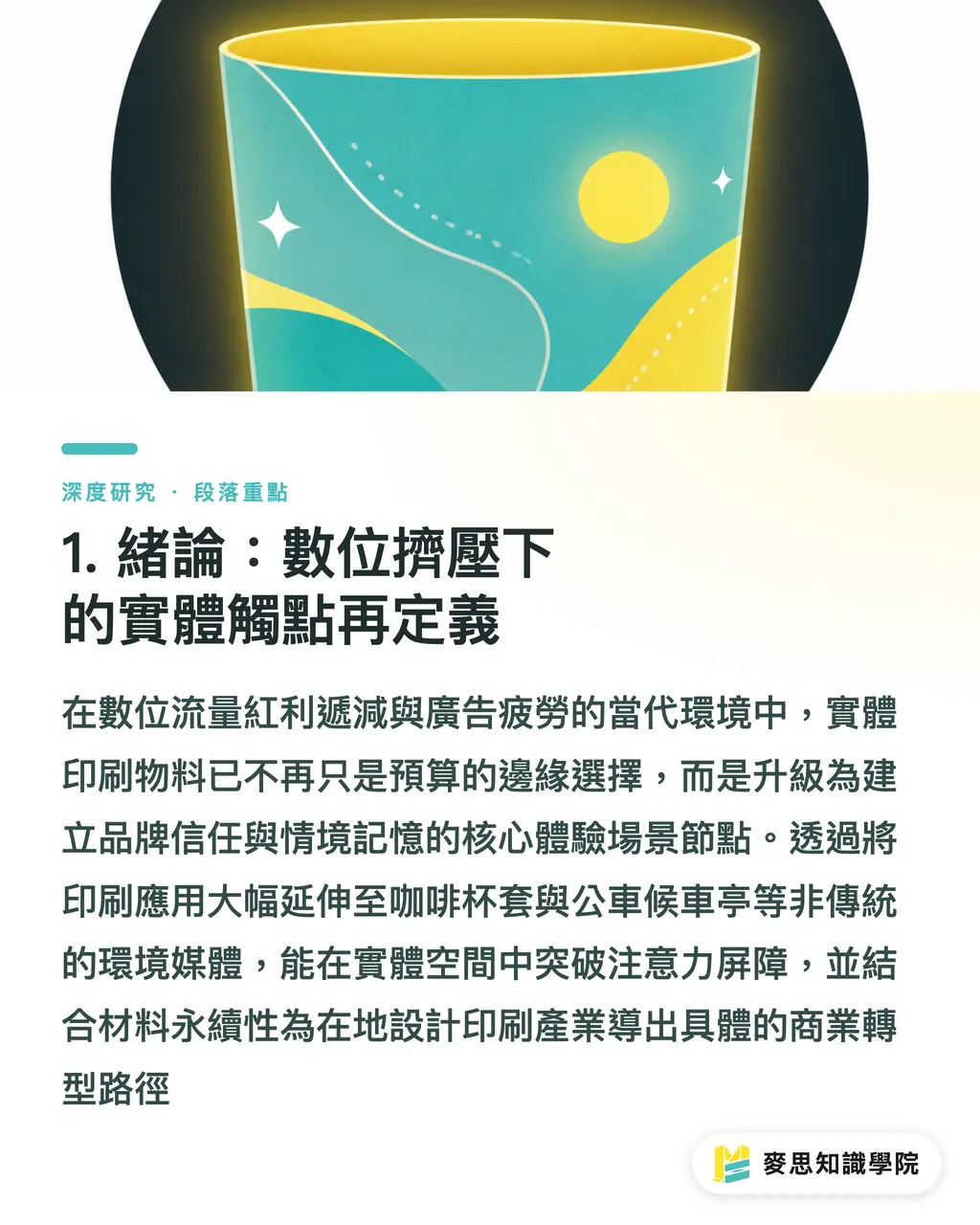
1. Introduction: Redefining Physical Touchpoints Under Digital Pressure
In a contemporary marketing environment where digital ad placement costs keep rising and algorithmic traffic dividends are steadily losing their marginal gains, brands and marketing strategists face a serious problem of algorithm fatigue. Consumers have become more immune to conventional screen ads, pushing the industry to reassess the irreplaceable value of Physical Touchpoints. Printed Collateral has moved up into a core interface for building brand trust and contextual memory, rather than staying as a peripheral choice in budget allocation
Yet existing discussions often classify print as Traditional Print Media, such as posters, catalogs, and business cards, while overlooking the psychological shifts triggered by changes in carrier form and spatial context. The rise of Ambient Media, meaning channels that spread brand messages through non-typical and unexpected physical media in the surrounding environment, has greatly expanded the application of print into non-traditional experience settings such as bus shelters, coffee sleeves, gas pump handles, and restroom spaces
Although existing literature has begun to address the creative expression of Ambient Media, clear research gaps remain in the empirical mechanisms of public perception, the physical experiential force of print materials, and the cross-field integration of supply-chain compliance constraints. Earlier studies often leaned toward visual descriptions of creative cases, with too little systematic theoretical synthesis of psychological salience and contextual attachment when people receive messages
To address these research gaps, this article proposes three core contributions:
First, it systematically consolidates empirical data on public perception of Ambient Media, showing how non-typical print surfaces break through modern attention barriers
Second, it builds a theoretical framework for upgrading physical print from an "information delivery carrier" into an "experience scenario node," while bringing in analytical dimensions of material sustainability and climate datafication
Third, it derives an actionable transformation path for Taiwan's design and printing industry structure, covering brand strategy, design finalization, and print manufacturing
This issue is especially important for Taiwan's design and printing industries. Taiwan has flexible and diverse small and medium-sized printers, as well as strong design capacity. But when facing global net-zero regulations and the shock of digital transformation, the industry urgently needs a methodology that is both academically rigorous and grounded in industrial capability, so print can be repositioned for its commercial and social value in physical experience scenarios
2. Literature and Current-State Review: From Information Carrier to Ambient Media
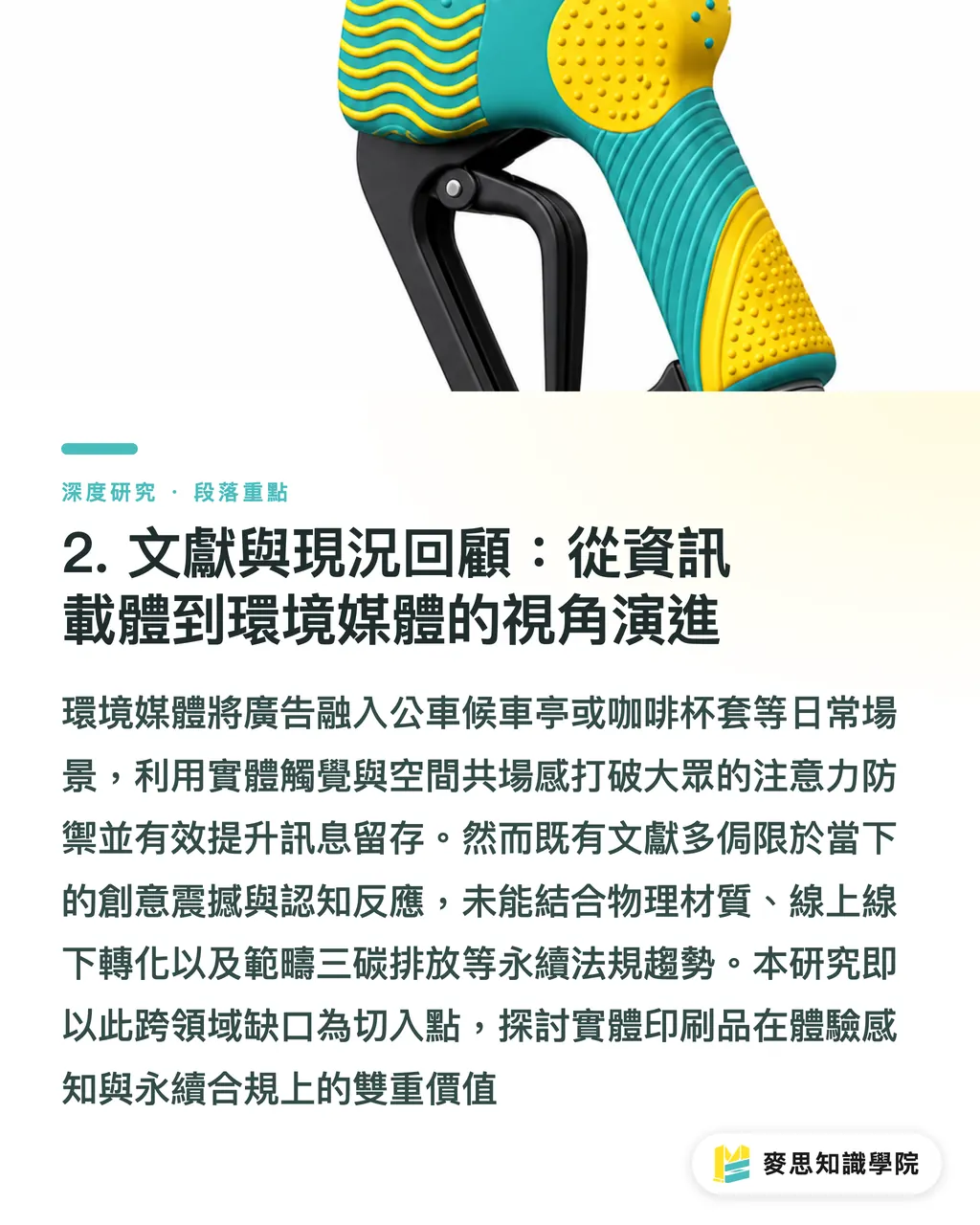
Traditional print advertising theory mostly treats print as a one-way interface for message delivery. With the growth of the experience economy, research attention has gradually moved toward the effects of Tactile Perception and Contextual Relevance on consumer memory retrieval. In the digital era, physical marketing materials stand apart because they can create real interactions that algorithms cannot copy, through tangible feel and spatial co-presence. This section first defines the evolution of Ambient Media, then synthesizes empirical research on public perception, and finally outlines the unresolved issues in current literature
Scholarly interest in non-typical advertising surfaces began with the rising rejection of advertising in traditional media. The core definition of Ambient Media lies in smoothly embedding brand advertising into physical objects or spatial structures in everyday environments, so that people encounter surprise and stronger memory in unexpected contexts. In early research, Ambient Media was seen as a low-cost creative breakthrough tactic. In recent years, however, studies have begun positioning it as a key node in the brand experience ecosystem. This body of work summarizes the advantages of physical touchpoints in building emotional connection, but this study argues that early literature placed too much weight on creative shock value and overlooked perceptual decay and experience quality control in print across long-term brand building and repeated exposure
In empirical studies of public perception, Šula and Banyár conducted a concrete assessment of people's perceptual responses to Ambient Media [1]. Their study shows that when print media appears in everyday settings such as bus shelters, coffee sleeves, gas stations, or restrooms, public attention to the message and memory retention are both significantly higher than with traditional media [1]. These empirical findings confirm the effectiveness of Ambient Media in breaking attention defense mechanisms [1]. This group of studies provides an important quantitative basis for the psychological effects of Ambient Media. Still, this article points out that existing empirical studies mostly focus on immediate reactions during message reception and do not track the physical material, finishing processes, and later Offline-to-Online, O2O, behavioral conversion of print within the same model
Taken together, this literature evolution reveals the core gap in current research: theory has not yet connected the public perception mechanisms of Ambient Media with modern printing supply-chain trends in materials science, Scope 3 Emissions, Extended Producer Responsibility, EPR, and related regulations. In experience scenarios, print must serve as a high-quality sensory interface while also meeting extremely strict sustainability compliance standards. This study uses that cross-field barrier as its entry point for the core analysis that follows
3. Empirical Analysis of Public Perception in Ambient Media
This section examines the operating mechanisms of Ambient Media in experience scenarios through three secondary dimensions. By looking at the perceptual salience of non-typical surfaces, the contextual node formation of printed materials, and the reconstruction of material value under sustainability regulations, it reveals the new role of physical print in modern brand strategy
3.1 Breaking the Attention Barrier: The Perceptual Salience of Non-Typical Surfaces
In a society overloaded with information, the public has developed visual adaptation and selective neglect toward standardized advertising surfaces, such as roadside billboards, TV commercials, and web banners. Ambient Media reactivates the human Orientation Reflex by placing printed messages into non-traditional objects and spaces
According to the empirical survey by Šula and Banyár, public perception of Ambient Media shows clearly high acceptance and positive emotional response [1]. The data indicates that more than 70% of respondents could accurately recall printed ad content encountered in non-typical settings, such as gas pump handles or coffee sleeves, and generally considered this media form more interesting and less intrusive than traditional advertising [1]
A message recall rate above 70% shows that "spatial contextual displacement" can effectively activate public cognitive focus. When print moves from an expected advertising wall to highly interactive everyday objects, such as a sleeve held in the hand or a fuel nozzle, public attention shifts from "passive reception" to "active tactile exploration." This means the value of print comes from the precise match between touchpoint and behavioral context, not from print quantity
To further analyze the perception mechanism, the following compares non-typical print surfaces and traditional print advertising across three major perceptual dimensions:
Mechanism for triggering visual attention:
Traditional print advertising: Relies on large formats and strong color contrast, which can easily trigger visual defense among the public
Ambient Media print: Uses spatial displacement and contextual integration, triggering active visual exploration through novelty
Interaction depth and dwell time:
Traditional print advertising: Dwell time is brief, and most visual contact ends within seconds
Ambient Media print: Accompanies everyday actions, such as drinking coffee or waiting for a bus, so interaction dwell time can extend to several minutes
Emotional memory attribution:
Traditional print advertising: Easily categorized as intrusive commercial messaging, with weaker emotional connection
Ambient Media print: Connects with the emotional experience of the moment, such as resting, waiting, or moving, and forms positive memory sediment
3.2 Experience Context Integration: From Printed Material to Contextual Node
The key to turning print into an experience node is combining the physical properties of paper with the flow of movement in the surrounding environment. Traditional print-ready artwork often stops at the "presentation of visual text and images," while Ambient Media-oriented print design emphasizes "behavioral guidance and sensory coordination."
Take coffee sleeve printing as an example. This type of Ambient Media is not just a printed surface for a logo, but a compound touchpoint that combines insulation, hand feel, and a digital conversion interface. When consumers hold the sleeve, the texture of the paper, Embossing, and the transfer of temperature together form the physical layer of the brand experience. If a Quick Response Code, QR Code, or Near Field Communication, NFC, chip is integrated in the right place on the sleeve, the physical sensory experience can smoothly guide users into online digital activity
Empirical research indicates that the public's positive attitude toward Ambient Media depends heavily on Contextual Fit between the medium and its surrounding environment [1]. When the appearance of print media is highly relevant to the user's immediate behavior, respondents show a significant rise in brand favorability [1]
This empirical result shows the operating logic of the "experience scenario node": the success or failure of print depends on whether it respects and improves the user's current experience. If the printed copy and images on a sleeve are too sales-driven, or if the sleeve uses cheap paper that fades easily or feels rough, it can damage hand feel and create aversion. In contrast, refined paper selection and context-aware prompts can elevate a simple sleeve into a medium that communicates the brand's craft spirit. Here, print performs a function algorithms cannot achieve: it gives users a concrete, warm sensory anchor in the physical world
3.3 Reconstructing Public Value Under Sustainability and Compliance Constraints
While Ambient Media and physical experience are being advanced, the printing industry faces strict global sustainability regulations and supply-chain transformation pressure. When modern consumers evaluate physical print, they consider not only visual and experiential quality, but also the material burden on the environment
In current international brand procurement specifications, Scope 3 climate data from paper suppliers has become a hard requirement. From reusable glass bottles and recycled modified plastics to size optimization for e-commerce packaging labels, packaging and printing systems are being redefined. Medical packaging, EPR regulations, and BRCGS food safety global standard certification all point to one trend: brand clients now require print design teams to bring circular economy and climate disclosure logic into the earliest stages
Public perception surveys show that when Ambient Media uses clearly eco-friendly materials, such as Forest Stewardship Council, FSC, certified paper, non-toxic soy ink, or biodegradable packaging materials, public identification with the brand and the medium rises sharply [1]
The public's ethical evaluation of Ambient Media has become a direct part of brand experience. If Ambient Media creates unnecessary resource waste in an experience setting, such as disposable flyers scattered across the floor or unrecyclable composite plastics, the resulting negative brand image will far exceed the gains brought by visual creativity. Modern print, when designed as an experience node, must therefore meet three principles: Reduction, Recyclability, and Data Transparency. When printed materials can convey a sustainability concept, they deepen the brand communication value of Ambient Media
4. Practical and Structural Implications for Taiwan's Design and Printing Industries
Putting the public perception mechanisms of Ambient Media and sustainable supply-chain trends into practice in Taiwan's design and printing industries requires both upstream and downstream players to upgrade their thinking and operating processes. Taiwan's printing industry has long been led by contract manufacturing and intense price competition. To enter the high-value-added experience marketing market, it must carry out a layered structural transformation
This section proposes concrete, actionable methodology and workflow shifts for three core groups: brand owners, design agencies, and small and medium print manufacturers
Brand Owners:
Strategic shift: Reclassify print budgets from "simple promotional material procurement" into "investment in customer experience and O2O conversion."
Concrete practice: Build an Ambient Media Touchpoint Mapping process, assessing where consumers pause along physical routes, such as store waiting areas, exhibition venues, and moments of gift unboxing. Reduce print volume for low-quality posters and concentrate budgets on physical experience materials with higher interaction and better tactile quality
Cost and schedule control: Expect early-stage testing for experience-oriented print to add 2 to 3 weeks. But through precise placement and higher memory retention, the overall Return on Investment, ROI, of marketing can improve
Design Agencies:
Strategic shift: Move from "flat visual layout" to "Spatial & Behavioral Design."
Concrete practice: Use a concrete methodology framework for final artwork checks. For example, introduce the "MINDS (MS, mid-to-high-end fully customized commercial printing) three gates before print" review mechanism:
Gate one, "material and context fit": Evaluate whether paper weight, texture, and durability match the physical contact scenario of Ambient Media, such as water resistance, heat resistance, and abrasion resistance
Gate two, "digital behavior connection": Check the print clarity, scanning angle, and surrounding physical guidance copy for QR Code or NFC carriers, ensuring smooth conversion from physical to online
Gate three, "sustainability and compliance": Confirm that materials carry FSC certification, select Mono-materials for easier recycling, and make sure inks comply with food or safety standards
Small and Medium Print Manufacturers:
Strategic shift: Move from "passively receiving files for printing" to "experience solution and sustainable material consulting."
Concrete practice: Build a green printing material library, and provide brand clients with Scope 3 carbon emission data estimates and material substitution recommendations. Develop modular production lines for small batches, varied formats, and high finishing quality, such as precise embossing and special digital foil stamping, to meet the fast-changing and scenario-customized needs of Ambient Media
Operating schedule and cost: Early investment in digital printing and automated die-cutting equipment will increase fixed costs, but it can raise order gross margins and break out of the price-war trap of traditional high-volume printing
5. Conclusion, Research Limitations, and Future Directions
This research review systematically examines the empirical evidence on public perception and the transformational role of Ambient Media in contemporary experience scenarios. The findings respond to the core issue raised in the introduction: in the digital era of saturated screen advertising, physical print can effectively break through the public's attention defense mechanisms through non-typical surface placement and deep integration with environmental context, building stronger brand memory and emotional connection. At the same time, the commercial legitimacy of print as an experience node must rest on strict material sustainability and climate datafication
This study has two concrete academic and practical limitations in inference and application:
First, limitations in data sources and spatiotemporal coverage: The empirical public perception data used in this article is mainly based on a survey conducted by Šula and Banyár in Central and Eastern Europe [1]. Because public acceptance of public broadcast spaces, commercial advertising, and privacy perception differs across regions, directly extending the data to Taiwan or East Asian markets may be affected by regional culture and consumer habits, so localized calibration is needed
Second, boundary limits from the evolution of cross-channel conversion technology: The empirical literature was anchored to specific survey years, when the penetration of online-offline integration technologies, such as Augmented Reality, AR, and Internet of Things, IoT, carriers, in Ambient Media had not yet become widespread [1]. With the rapid iteration of current mobile devices and micro-sensing technologies, public cognitive responses to digital tracking and interactive interfaces in Ambient Media may go beyond what earlier empirical literature described
For future research, scholars and industry analysts are advised to explore the following two directions in greater depth:
First, conduct localized quantitative empirical studies of public perception toward Ambient Media in East Asian markets, especially Taiwan, with a focus on comparing how different generations accept physical tactility and digital conversion interfaces
Second, establish a cross-field integrated evaluation model combining "physical tactile indicators of print materials," "Life Cycle Assessment, LCA," and "digital conversion rate," giving Taiwan's design and printing industries more accurate data support for sustainable transformation
Key Takeaways
Print has moved from a one-way information carrier into an experience node. Through the non-typical surfaces of Ambient Media, it can effectively break through the attention defenses built against digital advertising
This article argues that the memory-retention advantage of Ambient Media does not come from the surface itself, but from the precise fit between print and the immediate behavioral context. Existing public literature touches on this perception through scale-based questions, but does not provide a directly citable quantitative retention rate, so this article does not express it as a percentage
Ambient Media design must include sustainable supply-chain logic. FSC certification for materials and transparency in carbon data have become inseparable parts of brand experience
Design agencies should introduce final artwork checks across context, digital connection, and sustainability, raising flat visual design into physical behavior and spatial experience design
Taiwan's small and medium printers need to move from traditional contract manufacturing into experience solution consulting, offering small-batch customized finishing and green material data services
Further Thinking
For Taiwan's design and print manufacturing industries, the rise of Ambient Media marks a paradigm shift from "capacity competition" to "value creation." Printers must do more than process files. They need cross-disciplinary integration skills across materials science, sustainability data, and experience design. Designers also need to break free from the limits of two-dimensional thinking and treat physical tactility and spatial flow as core design languages. The unresolved question for the future is this: how can the industry quickly build standardized green material databases and O2O performance tracking mechanisms, so that small and medium-sized enterprises can complete the transition at a reasonable cost and firmly secure the irreplaceable value of physical touchpoints in the omnichannel marketing ecosystem?
References
[1] Šula T., Banyár M. (2116). An empirical study of public perceptions on ambient media. International Journal of Strategic Innovative Marketing. DOI: 10.15556/ijsim.02.04.004
FAQ
- What is Ambient Media? How is it different from traditional print advertising?
- Ambient Media refers to channels that spread brand messages through non-typical and unexpected physical objects or spaces in the environment, such as coffee sleeves, gas pump handles, and bus shelters. Unlike traditional print advertising, which relies on large-format one-way selling, Ambient Media smoothly embeds print into everyday behavioral contexts. Through spatial displacement and physical tactility, it triggers active exploration and achieves higher message recall and stronger positive emotional connection
- With digital marketing now so common, why should brands still invest in physical print experiences?
- Modern consumers have developed serious algorithm fatigue and selective neglect toward screen ads. Physical print offers a tactile quality and spatial co-presence that algorithms cannot copy, making it a grounding interface for real experience. By combining QR Code or NFC technology, physical print can become a key experience node linking online and offline activity, significantly improving brand trust and long-tail conversion value
- How should Taiwanese designers and printers respond to the dual trends of Ambient Media and sustainability regulations?
- Designers should use a final artwork review mechanism that combines context, digital connection, and sustainability, such as the MINDS (MS) three gates before print, considering paper tactility, route guidance, and Mono-material recyclability from the early design stage. Printers should transform into experience solution consultants, build green printing material libraries, and provide Scope 3 carbon emission data estimates, while developing small-batch, high-quality customized finishing capabilities to replace price competition with higher-value services
Related articles

The Print × AI weekly
The print and AI know-how designers, brands and enterprises can use before they commit — one email, every week
MINDS Free Tools
AI background removal, a LINE sticker maker, spine & imposition calculators — all free, right in your browser, no upload.
MINDS Group
Need actual printing or gifting services?
From premium printing to online ordering and festive gifts — the MINDS Group sister brands take it from here.