
Introduction: Why "Doing Sustainability" and "Being Believed to Have Done Sustainability" Are Two Different Problems
There has long been an asymmetry between the resources companies invest in sustainability practices and the market's perception of their sustainable image. This asymmetry is not a marketing technique problem. It is a communication architecture problem. Existing research has already pointed out that the link between branding and Corporate Social Responsibility, CSR, requires a strategic communication framework if corporate values are to be conveyed effectively, rather than staying at the level of surface-level promotion [1]. This proposition has a specific operational meaning in the design and printing industry: packaging, catalogs, back labels, and retail display materials are the most frequent landing points for sustainability messages, and also the places most likely to lose points under regulatory review and consumer skepticism
The core research question defined in this article is: when a company's sustainability actions must be communicated through physical printed media, what kind of communication framework can make that message both persuasive and verifiable?
There are three gaps in the current discussion:
・First, CSR communication research mostly focuses on corporate-level message strategy and stakeholder management. It pays less attention to the technical constraints that appear when a message "lands on a physical carrier," such as conflicts among print layout, certification mark arrangement rules, material labeling, and supply-chain traceability
・Second, practical discussions of sustainable packaging are mostly operating guides, such as what words to use and what words to avoid. They lack an analytical framework that connects these practices back to CSR communication theory
・Third, the strategic framework literature on the link between CSR and branding mostly uses large European and American companies as its objects of observation [1]. The organizational resource conditions assumed in that literature differ sharply from Taiwan's industry structure, which is dominated by small and medium-sized printing firms and external design workers. Directly applying those assumptions has limited external validity
On that basis, this article proposes three contributions, each corresponding to one main section:
・Contribution 1: It redefines "greenwashing risk" as a defect in the verifiability of the communication architecture, rather than a copywriting problem caused by improper wording, and breaks down how that risk occurs. This corresponds to the section "From Message Design to Evidence Design."
・Contribution 2: It proposes a three-layer alignment framework of "claim, evidence, and carrier," explaining where sustainability claims break down and where they can be repaired. This corresponds to the section "The Three-Layer Alignment Framework."
・Contribution 3: It analyzes the communication characteristics that distinguish physical printed media from digital channels, explaining why they are both high-risk and high-credibility interfaces. This corresponds to the section "Carrier Characteristics," and is then translated into process recommendations that Taiwan's industry can actually apply
This issue matters to Taiwan's industry because Taiwan's design and printing sector relies heavily on export-oriented brand clients and e-commerce packaging demand, while the EU and other major markets have continued tightening scrutiny of environmental claims. When a brand's sustainability copy is challenged overseas, the cost and pressure of reprinting often fall back onto printing firms and designers in the supply chain. Yet in the current communication process, these two roles usually have no say
Literature and Current Conditions: Three Diverging Lines of Discussion
This section divides existing discussions into three groups, and explains at the end of each group how it relates to, or differs from, this article's analysis
The first group: strategic frameworks linking CSR and branding. This branch of research is concerned with how companies can make CSR not just an add-on PR activity, but part of the brand value proposition. The related literature argues that effectively communicating corporate values requires strategic communication design, rather than one-way announcements of CSR information [1]. The key insight of this research is that CSR communication usually fails not because there is too little information, but because information lacks consistency with the brand promise. This article accepts that premise, but moves the level of analysis down to "how the message is realized through a concrete carrier," because existing frameworks stop at the level of corporate message strategy and do not address the physical and regulatory constraints that appear during implementation
The second group: leadership and internal organizational brand practice. Another line of discussion treats branding as a practice that must be led and carried out inside the organization. It examines how brand claims are fulfilled through organizational behavior by looking at concrete application fields, or Anwendungsfelder, and business cases [2]. This line reminds researchers that the credibility of external communication comes from the consistency of internal execution. If an organization has not built processes that support the claim, the external message will eventually be overturned by actual behavior. This article adopts that view of "internal and external consistency" and makes it concrete as a supply-chain-level problem: for the printing industry, internal consistency means that purchasing specifications, material certificates, and copy claims must be governed by the same process, rather than belonging to three departments that do not talk to each other
The third group: operational discussions of sustainable packaging. Industry-side discussions focus heavily on executable details, including the precision of environmental-claim wording, the correct arrangement of environmental marks, the evidentiary threshold for material claims, and the tightening review of generic claims in different markets. The value of this group lies in its closeness to production reality. Its weakness is that it is not sufficiently theorized: it can tell practitioners "do not write 'friendly to the Earth,'" but it has difficulty explaining why some specific claims can pass review while others cannot. The purpose of this article's analysis is to supply that missing mechanism, reconnecting operating rules to the higher-level criterion of verifiability
Gap positioning. Taken together, the three groups reveal one common unresolved issue: CSR communication research provides frameworks but does not touch the carrier; organizational brand research provides the principle of consistency but does not move down to the technical layer of the supply chain; practical guidance provides rules but lacks criteria. This article enters through that intersectional gap, taking physical printed media as the unit of analysis and rebuilding the verifiability criteria for CSR communication
From Message Design to Evidence Design: Breaking Down the Mechanism of Greenwashing Risk
The essence of greenwashing risk is the gap between a claim and the available evidence, not a moral flaw in wording. This section first defines the mechanism, then explains why copywriting rhetoric alone cannot solve this structural problem
Existing CSR communication frameworks stress that companies need to go beyond surface-level promotion and build consumers' genuine trust in sustainability commitments [1]. This article argues that, at the operational level, "genuine trust" can be broken down into a testable condition: for any external claim, is there a corresponding document that a third party can verify, and does the scope covered by that document fully match the scope of the claim? The key point in this definition is "scope match." In practice, the most common failure is not that a company has no evidence at all, but that the scope of the evidence is smaller than the scope of the claim
Using packaging as an example, there are at least three typical forms of scope mismatch at the mechanism level:
・Component-to-whole mismatch: the paper box body has forest certification, but the claim on the package describes the entire package as environmentally friendly, without covering the inner liner, coating, or adhesive
・Stage-to-full-life-cycle mismatch: the source of the material can be proven, but the claim extends to recyclability at the disposal stage, even though the local recycling system in that region does not accept the composite structure
・Single-batch-to-long-term mismatch: one batch uses recycled material, but the claim is printed on the package as a brand-level ongoing commitment, while the physical life of the package is much longer than that batch's procurement cycle
The common structure behind these three mismatches is this: once a claim is printed on a physical carrier, it loses flexibility for revision, while the evidence behind it remains dynamic. This article argues that this is the fundamental difference in risk attributes between sustainability communication on physical carriers and sustainability pages in digital channels. A webpage can be revised after a dispute occurs. One hundred thousand paper boxes that have already shipped cannot
Extending the perspective of internal organizational consistency [2], this problem cannot be solved by copywriting alone. If purchasing decisions, material certificates, and copy review belong to different process nodes with no mandatory cross-check, then no matter how carefully the copywriter chooses words, scope mismatches will keep recurring systemically. Therefore, this article argues that the governance focus of sustainability communication should shift from "message design" to "evidence design": first determine the boundaries of the evidence, then decide how far the claim can go, rather than writing the appeal first and searching for evidence later to fill the gap
The Three-Layer Alignment Framework: Claim, Evidence, and Carrier
Effective CSR communication requires scope alignment among the claim layer, evidence layer, and carrier layer. Any misalignment in one layer creates a gap that can be questioned. This section defines the three layers in sequence and explains the criteria for alignment
The claim layer refers to the sustainable value content a company expresses externally, including brand-level value statements and product-level claims about specific attributes. Existing research points out that the effectiveness of this layer depends on whether it is strategically integrated with the brand's overall value proposition, rather than being an isolated message push [1]. This article adds one operational criterion: the claim layer should distinguish between "commitment claims," which point to future goals, and "factual claims," which point to a state already achieved in the present. The evidentiary requirements for the two are different, and mixing them is a frequent source of practical risk
The evidence layer refers to the set of verifiable documents that support the claim, including material specifications, certification documents, supplier statements, and measurement data. The core criterion for this layer is scope coverage: the object scope, time scope, and life-cycle stages covered by the evidence must be greater than or equal to the scope implied by the claim. When the evidence layer is thinner than the claim layer, the difference is the exposure to greenwashing risk
The carrier layer refers to the physical or digital interface that actually carries the message. In the context of design and printing, this mainly means packaging, back labels, catalogs, and display materials. This layer determines how editable the message is, how long it remains in circulation, and the context in which it is read. This article argues that the carrier layer has been systematically underestimated in existing CSR communication literature, because theoretical frameworks often assume messages can be adjusted flexibly, while printed media specifically do not have that trait
The sequence for testing three-layer alignment should start from the evidence layer, not the claim layer. This reversal in sequence is the core methodological argument of this article: the common practical workflow is that the brand first sets the appeal, the design side executes the visuals, and the printing side discovers only at the end that the material certificate cannot support the claim. At that point, revision costs are highest. If the order is reversed, the actual coverage of the evidence layer is inventoried first, the writable boundary of the claim layer is then defined accordingly, and only after that does visual arrangement at the carrier layer begin. Risk is then moved forward and resolved at the lowest-cost stage
This thinking can correspond to a phased checking method such as the "Mai Strategy three-gate print submission" process: three checkpoints are set before proofing, before going on press, and before shipment, respectively verifying the evidence scope, claim boundary, and correct arrangement of certification marks. This article treats it as a process-based alignment tool. Its academic significance lies in turning the abstract principle of consistency into auditable nodes, rather than relying only on the judgment of individual executors
Carrier Characteristics: Why Physical Print Is Both a High-Risk and High-Credibility Interface
The physical irreversibility of printed media magnifies both communication risk and credibility potential. This section analyzes that dual nature and explains what it means for strategy design
The mechanism on the risk side has already been defined in the previous sections: non-editability makes the cost of repairing incorrect claims extremely high, and printed materials already in circulation become ongoing physical evidence. In addition, the limited layout space of package back labels forces claims to become compressed, and compression often causes qualifiers to be removed, turning an originally precise claim in scope into a generic claim. This article argues that layout pressure is an underestimated technical cause of greenwashing risk: many scope mismatches do not come from an intent to mislead, but from the byproduct of layout tradeoffs
The mechanism on the credibility side comes from the same physical trait. Existing CSR communication research focuses on how to build consumers' genuine trust in sustainability commitments [1]. This article argues that physical carriers have three advantages here that digital interfaces struggle to reproduce:
・Non-instant editability as a signal of commitment: precisely because a printed piece cannot be quietly revised after printing, consumers can read it as a signal that the company is willing to bear higher risk. This mechanism is consistent with the view that a brand promise must be fulfilled through organizational behavior [2]
・Physical retention and comparability: consumers can keep the package and compare it with the company's later behavior, creating a consistency test across time
・Self-evidence through touch and material: the fibrous texture of recycled paper and the actual hand feel of a reduced-material structure serve as evidence that does not require words. Their persuasive power does not depend on consumer trust in the copy
The third point deserves particular strategic attention. When the material itself can be perceived, the role of the written claim should shift from "persuasion" to "explanation," meaning that it should provide specific verifiable information, such as material percentage, certification number, and corresponding standard, rather than adjectives. This article argues that this is the single most effective adjustment for reducing greenwashing risk while improving credibility: replace unverifiable value adjectives with verifiable concrete information. The two take up similar layout space, but their risk attributes are entirely different
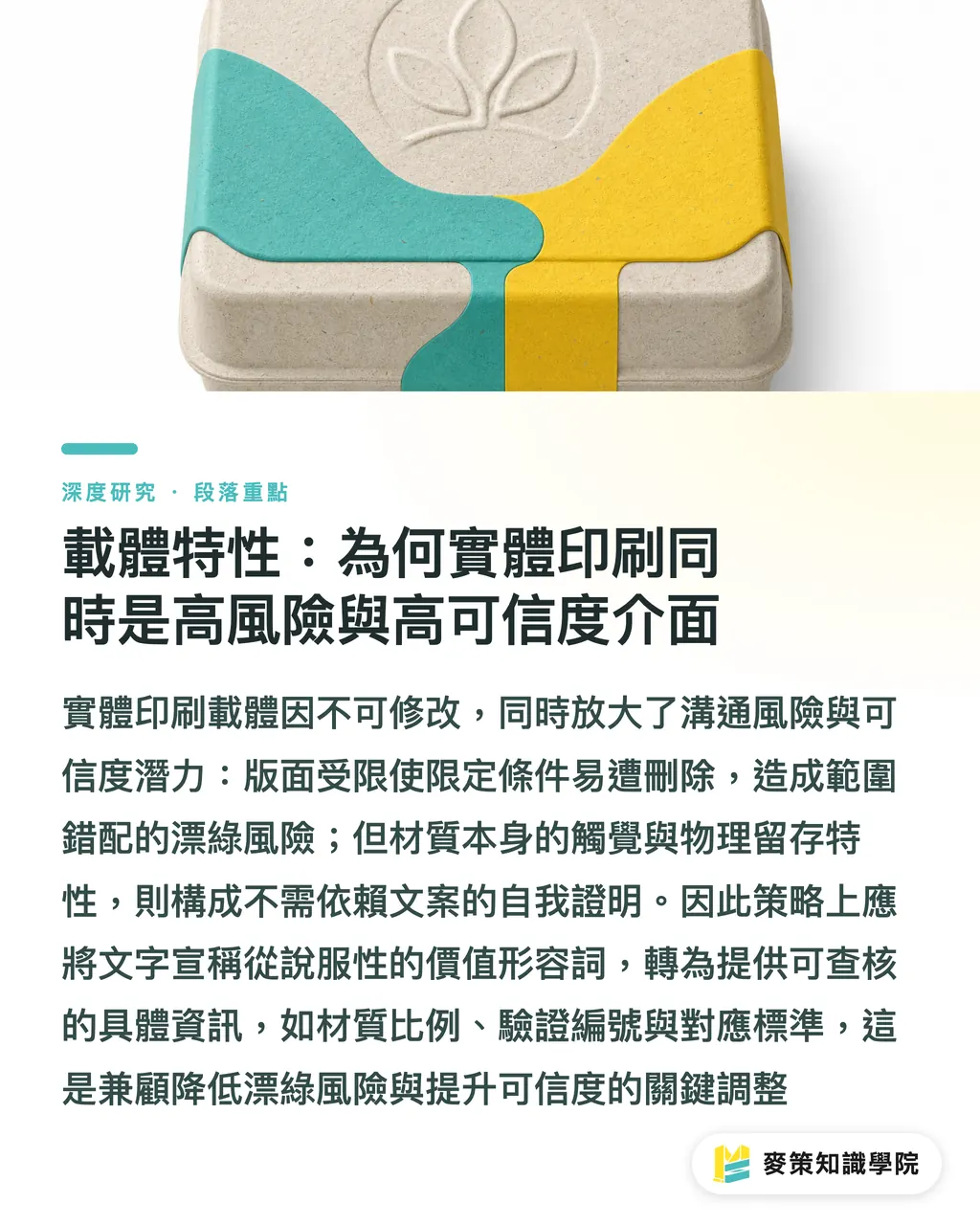
Implications for Taiwan's Design and Printing Industry
Taiwan's design and printing industry sits downstream in the CSR communication chain, but in practice it bears most of the technical risk. This section explains actionable paths for three types of roles
Small and medium-sized printing firms. It is recommended that quotation and work-order processes add a field matching material certificates to claims: when a client's artwork contains environmental-claim keywords, the work order must include the certificate number for the corresponding material. Otherwise, it should move to manual confirmation. The cost of this change mainly falls on expanding fields in the existing ERP or work-order form and building a one-time keyword list. It does not require additional headcount. Its benefit is that disputes are intercepted before going on press, avoiding full-batch reprints. In practice, once a claim dispute occurs after shipment, reprint costs and delivery delays are usually much higher than the labor hours spent on upfront review
Designers and design studios. It is recommended that the proposal stage already distinguish between "claims with existing proof" and "claims pending confirmation," and reserve adjustable modular areas in the layout for the latter. The concrete method is to separate environmental claims and certification mark areas into a standalone layer or component, so that when evidence confirmation changes, they can be replaced locally without rebuilding the entire layout. In addition, certification marks each have requirements from the issuing body for minimum size, clear space, and proportions. The design side should include these constraints when building the template, rather than correcting them after final artwork is completed
Brand owners. It is recommended that the review point for sustainability copy be moved forward to the material procurement decision stage, rather than the marketing planning stage. This article argues that the actual process for most brand owners is that marketing sets the direction first and purchasing executes afterward. This sequence inevitably causes the evidence layer to lag behind the claim layer. If the reverse sequence is adopted, the brand owner needs to record, within the purchasing specification, the claim scope that each material can support, creating a mandatory cross-check between purchasing and copy
A shared recommendation across roles. Build an organization-level "claim-evidence correspondence table" that records, line by line, every sustainability phrase that may be used externally, its corresponding proof document, expiration date, and applicable product scope. The maintenance cost of this table is not high, but it can solve two of the three scope mismatches described earlier: component-to-whole and single-batch-to-long-term
Conclusion and Limitations
This article responds to the research question raised in the introduction: a communication framework that allows sustainability messages to be both persuasive and verifiable does not center on message rhetoric, but on scope alignment among the claim layer, evidence layer, and carrier layer, and the testing sequence should start from the evidence layer. Existing research has established that CSR and branding must be strategically linked to communicate value effectively [1], and has pointed out that brand claims must be fulfilled in organizational practice [2]. This article's addition is to move that principle down to physical printed media, showing that the carrier's non-editability is both a risk amplifier and a source of credibility
This article has two specific limitations that must be stated clearly
First, the cited base has limited coverage. The academic sources cited in this article cover only two lines: the strategic communication framework linking CSR and branding [1], and organization-level brand leadership practice [2]. They do not include primary literature on environmental-claim regulation, empirical consumer perception, or Life Cycle Assessment, LCA, methodology. Therefore, this article's discussion of types of scope mismatch, the mechanism of layout pressure, and the credibility advantages of carriers is the author's analysis based on the practical structure of the industry, not the result of empirical testing. Readers should treat it as a hypothesis awaiting validation
・Second, the boundary of extrapolation. This article's analysis is based on the organizational structure of Taiwan's design and printing industry, namely a division-of-labor model dominated by small and medium-sized processing firms and external design workers, while brand owners hold the authority to decide claims. The recommendations under this structure, such as moving review forward to the procurement stage, assume that different links belong to different organizations. In companies with a high degree of vertical integration, or brands with their own production lines, the process friction described above may be greatly reduced, and the marginal benefit of this article's recommendations will also decline. In addition, review standards for environmental claims vary across markets, and
・this article does not analyze the specific rules of any particular jurisdiction
Future research can move forward in three concrete directions:
・First, use content analysis to collect a sizable set of real packaging samples, code their environmental-claim types and whether qualifiers are present, and test the distribution of the three types of scope mismatch proposed in this article in actual practice
・Second, use controlled experiments to compare "value-adjective claims" and "verifiable concrete-information claims" in terms of consumer trust and purchase intention, testing this article's strategic argument about replacing adjectives with information
・Third, track printing firms that introduce an upfront evidence-checking process, measure changes in their claim-related reprint rates and dispute counts, and assess the actual benefits of process intervention
Key Takeaways
The essence of greenwashing risk is that the claim scope is larger than the evidence scope, not improper wording, so copy-only revisions cannot fix the root problem
Effective sustainability communication requires scope alignment among the claim layer, evidence layer, and carrier layer, and the testing sequence should start from the evidence layer rather than the claim layer
The non-editability of physical printed media is both the biggest source of risk and the strongest credibility signal. Strategy design must handle both sides at the same time
Layout-space pressure can force qualifiers to be removed, causing precise claims to degrade into generic claims. This is an underestimated technical cause of greenwashing risk
Replacing value adjectives with verifiable concrete information, such as material percentage, certification number, and corresponding standard, takes up similar layout space but carries completely different risk attributes
Further Thinking
For printing manufacturers, evidence control for sustainability claims is moving from "the client's business" to a shared responsibility across the supply chain. Adding material-certificate cross-checks to the work-order system is the lowest-cost entry point. For the design side, environmental claims and certification mark areas should be treated as modular components with independent life cycles, not as fixed parts of the layout. This will directly affect how templates are built. The opportunities for AI adoption are quite clear: automatic detection of claim keywords, automatic checking of certification mark arrangement rules, and automatic comparison between claims and proof-document validity periods are all tasks with clear rules and accumulable samples, making them suitable for deployment as checking support rather than generation. The unresolved SaaS-level issue is that maintaining a "claim-evidence correspondence table" requires data to cross purchasing, design, and marketing systems. At present, most toolchains in the printing industry still center on production scheduling and do not yet cover structured management of this kind of compliance data. That is a real gap in industry tools
References
[1] Villagra, Lopez (2116). Connecting branding and Corporate Social Responsibility: strategies to communicate values in an effective way. International Journal of Strategic Innovative Marketing. DOI: 10.15556/ijsim.03.02.001
[2] Grubendorfer C. (2012). Business Cases, Application Fields of Leadership Branding. Leadership Branding. DOI: 10.1007/978-3-8349-3706-3_4
FAQ
- Why does writing "eco-friendly material" on packaging so easily cause problems?
- Because broad claims of this kind usually cover the entire package, while the proof documents a company has often cover only one component, such as the paper box body, and do not cover the inner liner, coating, or adhesive. This creates a claim scope that is larger than the evidence scope. Switching to specific material percentages, certification numbers, and corresponding standards can greatly reduce this risk
- At what stage should sustainable packaging copy be confirmed?
- It should be confirmed at the material procurement decision stage, not after marketing planning or final artwork. The evidence layer determines the writable boundary of the claim layer. If the order is reversed, the design and printing sides may discover only at the end that the proof cannot support the appeal, when revision costs are highest
- How do the communication risks of physical packaging and an official website's sustainability page differ?
- A website page can be revised after a dispute occurs. Printed products that have already shipped cannot. This makes the repair cost of incorrect claims on physical carriers extremely high, but it also makes correct claims a stronger signal of commitment, because consumers know the company cannot quietly change them afterward
- What can small and medium-sized printing firms do to reduce clients' greenwashing risk?
- They can add a material-certificate matching field to the work-order process. When artwork contains environmental-claim keywords, the corresponding proof document number should be required. Otherwise, the job should move to manual confirmation. This change only requires expanding existing work-order form fields and building a one-time keyword list, and it can intercept disputes before going on press
- What is the difference between CSR communication and ordinary brand marketing?
- Ordinary brand marketing mainly judges a claim by its appeal. CSR communication must also pass a verifiability test, meaning every claim must be supported by a third-party-verifiable document with a matching scope. Existing research points out that CSR and branding need strategic integration, not surface-level promotion, in order to build genuine trust
Related articles




The Print × AI weekly
The print and AI know-how designers, brands and enterprises can use before they commit — one email, every week
MINDS Free Tools
AI background removal, a LINE sticker maker, spine & imposition calculators — all free, right in your browser, no upload.
MINDS Group
Need actual printing or gifting services?
From premium printing to online ordering and festive gifts — the MINDS Group sister brands take it from here.