

How to Communicate Sustainable Packaging to Consumers Without Hitting Pitfalls?
External communication for sustainable packaging requires three things: put only verifiable labels and figures on the package, host a dedicated sustainability page on your website with full documentation, and align messaging and banned terms before media interviews. Missing any of these three layers leaves you vulnerable to callouts from competitors or journalists. This is the core principle of the 'complete evidence workflow' that Mai Strategy Knowledge Academy emphasizes most when advising clients
Why Doing It Right Isn't Enough Without Saying It Right
In recent years on the production floor, I've noticed a clear shift: clients no longer just ask 'can this bag be recycled?', but press further with 'how do you prove it?' Many brands have invested in materials, switching to FSC-certified paper, recycled plastic, or soy ink, yet their messaging stays stuck in vague adjectives like 'earth-friendly' or '100% sustainable'
The issue is that regulators in the EU, the US, and Canada are cracking down on broad environmental claims. Their logic is simple: only claims backed by specific conditions count. Although Taiwan does not yet have a dedicated law like the EU Empower Consumers Directive, existing fair trade rules on misleading claims are already enough to fine brands. Once media or environmental groups catch a product using exaggerated wording, years of brand investment get wiped out
In our experience across production lines and client proofing, at least one-third of cases fall into this 'right materials, ruined copy' trap. Printers know that raw paper, ink, and glue can all carry third-party certificates, but the packaging text itself is something only the brand can control
How to Write Back-of-Pack Copy Safely
Words You Can Print vs. Words You Must Verify
The first step in copyediting is swapping adjectives for verifiable conditional statements. My personal benchmark is simple:
・Can you pull up the matching certificate or test report within 30 seconds? ・Does it point to a specific percentage, weight, or recycling process? ・Would this sentence work for any brand? If yes, it's too generic, cut it
In practice, handle this across three layers:
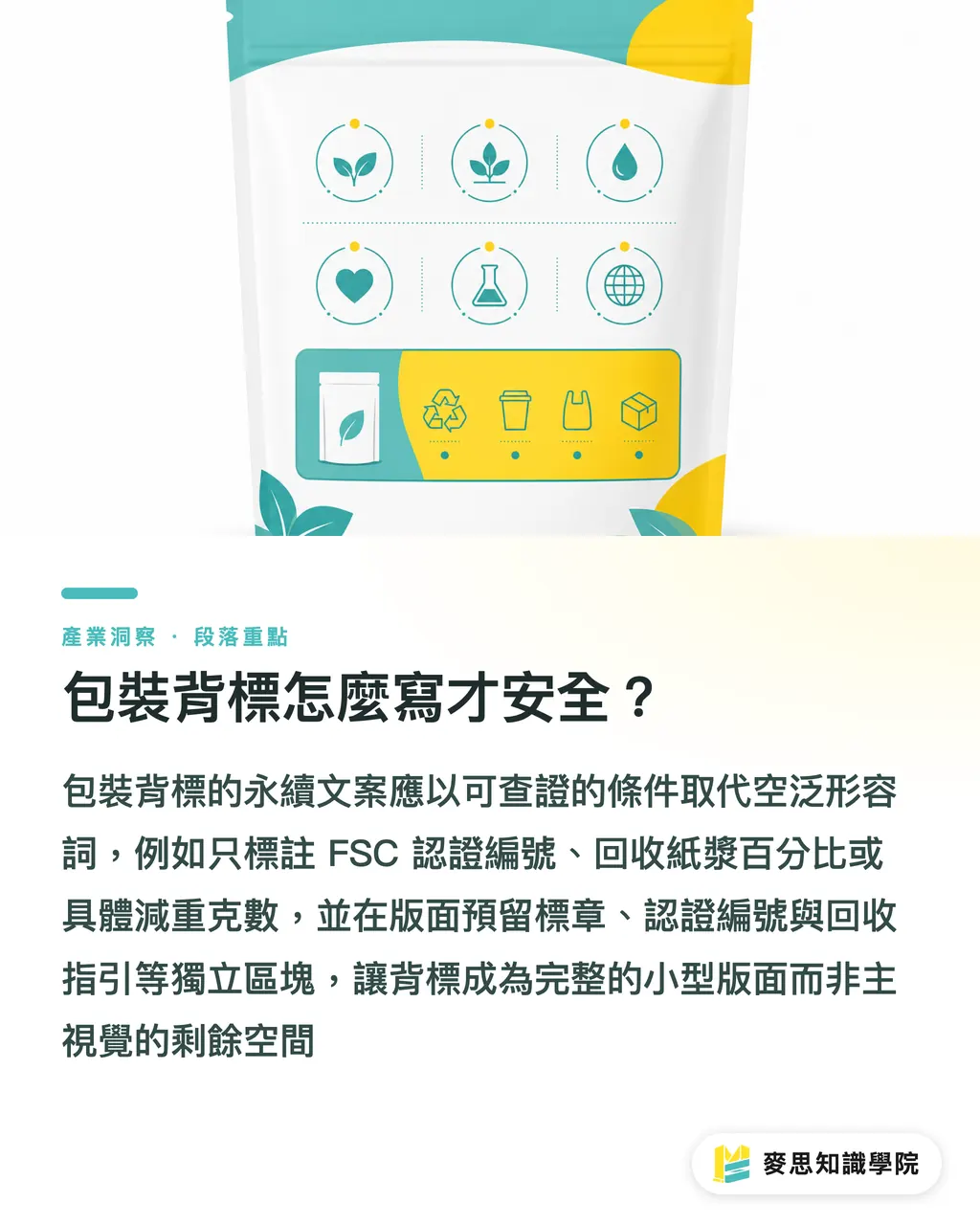
・Material layer: Write 'Made with FSC-certified paper, license # XXXX' instead of fluff like 'forest-friendly'. ・Recycling layer: Write 'This packaging is made of X% recycled pulp' and 'Please recycle with paper waste', not 'naturally decomposable'. ・Reduction layer: Write 'N grams lighter than previous generation', not 'lowest carbon footprint'
Logos for certifications like FSC, PEFC, or recycled paper can be printed, but each logo must be accompanied by its license number and issuing body. This is a baseline requirement under brand usage guidelines
What Layout Spaces Should You Reserve for Logos?
From a print perspective, improper logo placement is another common trap. Designers must reserve space for the following blocks during layout:
・Logo image area: FSC, PEFC, and recycling logos should be kept at a physical print size of at least 15×15mm. Anything smaller gets blurry and violates logo guidelines. ・License number area: Leave room next to each logo for horizontal or vertical license numbers. ・Recycling guidance area: Place recycling symbols with short instructions, like 'Recycle with paper / Clean before recycling'. ・Regulatory labeling area: Manufacturer, material composition, and country of origin. These aren't about sustainability, but they shouldn't be sacrificed just because space is tight
I often tell designers to treat the back-of-pack label as a self-contained layout, not just leftover space after the front visual. Clear communication requires a complete layout
What Should Go on Your Website Sustainability Page?
The back of the packaging can only hold two or three key facts. The complete story belongs on your website. Journalists and consumers now scan the QR code whenever they see 'Learn More' on a box. If that link leads to empty slogans, you undermine your own credibility
An audit-ready sustainability page should follow this structure:
・Concrete data: Annual carbon reduction in tons, recycled material ratios, and renewable energy shares, each with calculation scope and reporting year. ・Third-party verification: Downloadable PDFs for ISO 14001, PAS 2060 carbon neutrality, FSC CoC certificates, etc. ・Supply chain disclosures: Raw paper sourcing, ink formulation, and print vendor environmental policies. ・Progress and goals: What was done this year, targets for next year, and current progress. ・Statements on what isn't done: For example, 'This product makes no carbon-neutral claim because upstream supply chain data inventory remains incomplete.'
Few brands include that last point, but doing so builds trust. Admitting unfinished work earns far more credibility than pretending to be perfect
Placement of the QR code on packaging matters too. Don't hide it on a side flap or bottom cover if you want people to find it. Link directly to the sustainability page without redirecting through marketing campaign landers
How to Prepare Messaging Before Media Interviews
What Will Journalists Ask?
Taiwanese media, especially business and lifestyle outlets, frequently run features on brand ESG and sustainability. Their questions usually cluster around a few themes:
・'Is your packaging actually eco-friendly?' ・'How did you calculate those carbon reduction figures?' ・'How does this compare to peers in your industry?' ・'How should consumers recycle this?'
The common thread across these questions is simple: reporters don't want corporate vision, they want hard numbers and concrete stories
What Talking Points Are Off-Limits?
When helping clients prepare interview briefs, I insist on building a 'banned words list'. Common entries include:
・Absolute claims like '100% eco-friendly' or 'zero harm to the planet'. ・Comparative claims like 'industry's greenest' or 'lowest carbon' (never use these without explicit baseline data). ・Technical terms like 'carbon neutral' that require formal PAS 2060 or ISO 14068 certification. ・Phrases like 'naturally decomposable' without stating required degradation conditions. ・Overly emotional messaging like 'saving the planet' or 'protecting forests'
If asked about something you haven't calculated yet, the standard answer is: 'We are currently auditing those figures internally and will publish them on our website once completed.' Never improvise on the spot
What Should You Talk About More?
Rather than abstract statements, reporters and consumers prefer hearing about the trade-offs you made. For example:
・Why you chose FSC paper over recycled paper due to supply chain stability and cost trade-offs. ・Why you switched from petroleum-based to soy ink, even though it slightly compromised color gamut. ・Why weight reduction stopped at 5 grams due to structural integrity testing limits
Why B2B and B2C Messaging Must Be Separated
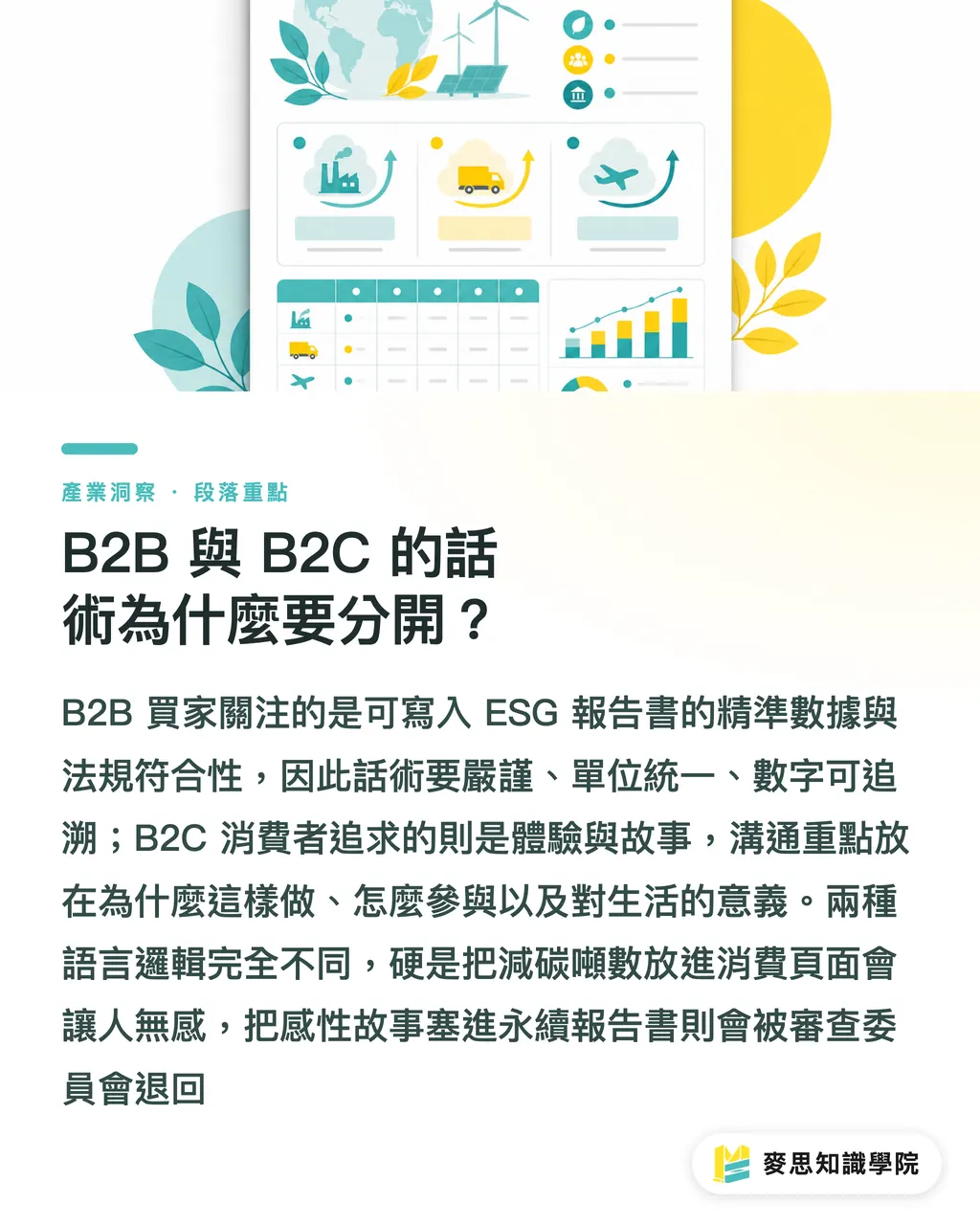
B2B buyers, especially suppliers for international brands, need figures they can put into ESG reports. Communication must focus on Scope 1/2/3 emissions, water usage, electricity consumption, hazardous substance control, and regulatory compliance. These clients will ask for CDP questionnaires and factory audit reports. Your messaging must be precise, units standardized, and figures traceable
B2C consumers care about experiences and stories. The focus shifts to 'why we did this', 'how I can participate in recycling', and 'what this means for my life'. Linking a QR code to a traceability page, sharing paper sourcing stories on IG Stories, or placing recycling guides in retail stores fit B2C contexts
Never mix the two. B2B carbon reduction tonnages on a consumer page will be ignored or misunderstood. Emotional consumer stories in an ESG report will get rejected by audit committees
Social Media Copy Templates for Content Creators
Here are three templates I regularly share with clients, ready for direct use:
Template 1: New Product Launch
・Opening: Product name + a specific sustainability metric. ・Middle: Design choices behind that number (why weight was reduced, why materials changed). ・Closing: Actionable steps for consumers (how and where to recycle). ・Hashtags: Include 2-3 relevant hashtags; don't stuff generic tags like #sustainability to greenwash the post
Template 2: Responding to Inquiries or Criticism
・Opening: Address the issue directly without dodging. ・Middle: Attach certificate numbers or website links. ・Closing: Outline current progress and next steps. ・Tone: Calm, factual, numbered, and emotion-free
Template 3: Annual Review
・Opening: Sustainability progress this year compared to last year. ・Middle: What went right, what went wrong, and what to fix next time. ・Closing: A concrete call to action inviting consumer participation
I always remind social media managers: read your draft aloud after writing. Strip out abstract verbs like 'we are committed to', 'we believe', or 'we hope', and replace them with concrete actions. You'll find your sentences become half as long, but far punchier
Red-Flag Vocabulary Checklist (Recommended Internal Circulation)
I've organized common problematic phrasing into a checklist split into three categories:
・Strictly banned: '100% eco-friendly', 'zero carbon', 'zero waste', 'completely recyclable', 'most sustainable', 'earth-friendly'
・Conditionally allowed: 'Eco-friendly' (must be followed by specific conditions), 'Recyclable' (must specify regions where recycling systems exist), 'Biodegradable' (must specify environmental degradation conditions)
・Safe to use: 'Made with X% recycled materials', 'N grams lighter than previous generation', 'FSC-certified (License # XXXX)', 'Carbon footprint X kg CO2e (per ISO 14067)'
Distribute this list to design, marketing, sales, and customer service teams to ensure alignment. When five departments speak externally for the same product, a lack of unified standards creates internal vulnerabilities first
Key Takeaways
・Turn eco-claims from vague adjectives into verifiable numbers and certificate license numbers. If you can't provide specifics, don't print it
・Back-of-pack labels drive traffic; website sustainability pages provide complete proof. Ensure QR codes link directly to the right page
・Prepare a banned words list before media interviews. Never improvise unverified numbers on the spot
・Separate B2B and B2C messaging; never mix raw audit metrics with consumer storytelling
・Internal alignment matters more than external messaging. Design, marketing, sales, and customer service should share the same red-flag word list
Further Reflections
From a printing industry perspective, sustainability communication will expand from a brand-level responsibility into shared supply chain accountability. Packaging converters, printers, and ink suppliers will all be asked for Scope 3 emissions data. This means plant energy management, wastewater and exhaust treatment, and hazardous substance reporting will all be quantified. I advise clients to start inventorying factory environmental metrics now, formatting them for easy reference by brand partners (such as GRI metrics or ISO 14064 inventory tables). Proactive prep takes far less effort than reacting later
For designers, back-of-pack layout planning is becoming a core essential. The arrangement of logos, license numbers, recycling instructions, and mandatory regulatory text will face much stricter scrutiny from brand clients
For copywriters, writing skills must upgrade from crafting emotional copy to crafting evidence-based emotional copy. These two capabilities don't conflict; they stack. If you don't know where to begin, schedule an initial assessment with the consulting team at Mai Strategy Knowledge Academy. When heading into production, whether choosing structural packaging materials or verifying logo legibility, MINDS works alongside clients during proofing to ensure logos don't blur or license numbers don't print wrong
Further Reading
FAQ
- Does sustainable packaging require an FSC certification to count?
- No. FSC is just one international forest certification scheme, alongside PEFC, Taiwan's CSA, and others. The key isn't which specific label you use, but whether you have a traceable third-party certificate and license number
- Can printing 'eco-friendly' on packaging lead to fines?
- Writing 'eco-friendly' alone is a vague adjective. Regulators typically require brands to add specific qualifying conditions; otherwise, it can be treated as misleading under fair trade laws. Adding a conditional phrase like 'Eco-friendly (made with X% recycled paper)' is much safer
- What should you do if asked about unverified data during a media interview?
- Say directly: 'We are auditing those numbers internally and plan to publish them on our website in [Month].' Never estimate numbers on the spot. Once an estimated figure is quoted, correcting it later costs far more than admitting work is still in progress
- What is the difference between B2B and B2C sustainability communication?
- B2B buyers need precise data and certifications to include in ESG reports, while B2C consumers want experiential stories and recycling guidance. They use different vocabulary, units, and reference standards; mixing them pleases neither audience
- What core elements belong on a website sustainability page?
- Concrete metrics with calculation methodologies, downloadable third-party certificates, supply chain disclosures, and updates on progress along with unfinished goals. Transparently acknowledging work in progress actually boosts trust
Related articles




The Print × AI weekly
The print and AI know-how designers, brands and enterprises can use before they commit — one email, every week
MINDS Free Tools
AI background removal, a LINE sticker maker, spine & imposition calculators — all free, right in your browser, no upload.
MINDS Group
Need actual printing or gifting services?
From premium printing to online ordering and festive gifts — the MINDS Group sister brands take it from here.