
Introduction
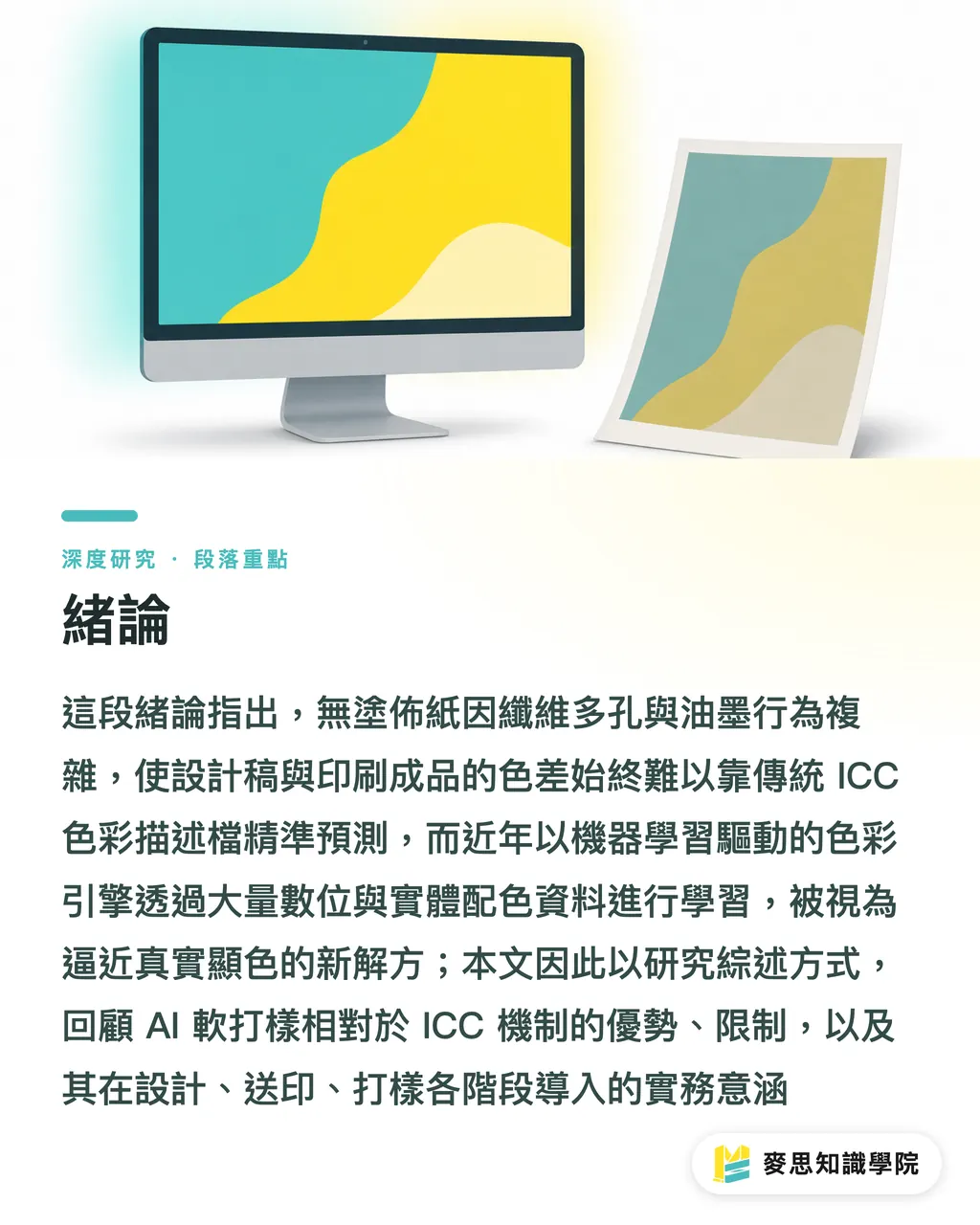
The color discrepancy between digital screen displays and physical prints has long been a core pain point in the design and printing industries. When the printing substrate is uncoated paper, such as woodfree paper or fine paper, the lack of surface coating results in ink penetration and light scattering behaviors that are vastly different from those of coated paper. This makes color prediction significantly more challenging, often leading to irreversible color differences between design drafts and the final product
In traditional printing workflows, the ICC profiles established by the International Color Consortium (ICC) serve as the backbone mechanism for cross-device color conversion. Through mathematical mapping between device color spaces and standard color gamuts (such as Lab and CMYK), screen displays, digital printing, and conventional offset printing can theoretically align their colors [1]. However, an ICC profile is inherently a static description based on measurements and interpolation. When dealing with the porous fiber structure, non-linear ink superposition, and variations in paper whiteness of uncoated paper, it often fails to accurately describe the actual color reproduction. This gap forms the research starting point of this paper
In recent years, with advancements in machine learning and deep neural networks, the industry has begun exploring data-driven approaches to construct color prediction engines. By learning from thousands of paired data points consisting of 'digital input values and physical print measurement values,' these models attempt to approximate the ink penetration and ink spread effects within paper fibers, producing real-time screen soft proofing results. This review examines this emerging approach and analyzes its advantages, limitations, and industrial implications compared to traditional ICC mechanisms
The contributions of this paper are as follows:
1. Systematically compile traditional methods for predicting color reproduction on uncoated paper alongside their physical and mathematical bottlenecks
2. Analyze the methodological foundations, training data requirements, and model characteristics of AI color engines
3. Evaluate the reliability and implementation conditions of AI-driven soft proofing in the pre-design, pre-press, and proofing stages
4. Explore the practical implications and feasible implementation pathways of this technology for small and medium-sized print shops, designers, and brands in Taiwan
Literature and Current Status Review
Applicability of Traditional ICC Color Management to Uncoated Paper
ICC profiles establish mappings between inputs and outputs by measuring the device's color gamut and using look-up tables (LUTs) or matrix calculations, serving as the industry-wide foundation for color management. The specification itself emphasizes the exchange of device-independent colors and handles color gamut mapping using multiple rendering intents [1]. For coated paper, the optical properties of the surface are stable and ink reproduction is dominated by surface reflection, allowing ICC profiles to generally provide acceptable color predictions. However, for uncoated paper, the ink partially penetrates the fibers, causing color reproduction to be influenced by the interaction of spectral reflection, bulk scattering, and paper whiteness. This significantly reduces the prediction accuracy of static LUTs. Existing literature mostly centers around the standard framework and interoperability issues of ICC, with relatively limited exploration of the unique color reproduction mechanisms of uncoated paper. This paper argues that a structural tension exists between the 'universal, interoperable' design intent of the ICC mechanism and the 'highly variable, material-dependent' nature of uncoated paper, creating an opportunity for new methodologies to intervene
Physical and Optical Mechanisms of Color Reproduction on Uncoated Paper
Because uncoated paper lacks starch or calcium carbonate coatings, its surface consists of exposed fibers and pores. When ink contacts the paper surface, the following processes occur simultaneously: (: ・1) downward penetration into the fiber interior, ( ・2) horizontal spreading along the fibers, forming the so-called 'dot gain' (dot gain), ( ・3) multiple scattering at the fiber-air interface, resulting in decreased saturation and contrast, and making the overall visual appearance darker and grayer. While the printing industry widely recognizes this phenomenon, quantitative prediction tools are limited. Although the traditional Yule-Nielsen modified model attempts to account for optical scattering of paper, it remains an empirical parameter adjustment that struggles to handle non-linear behavior across the entire color gamut. This body of research reveals the physical complexity of color reproduction on uncoated paper and points out the bottlenecks in parameterizing traditional models. This paper suggests that this is precisely where data-driven approaches can step in, using high-dimensional non-linear function approximations rather than being constrained by a few analytical physical parameters
Rise of Data-Driven Color Prediction
With the enhancement of computing resources and automated print measurement, the industry has begun using machine learning regression (such as random forest and gradient boosting) and deep learning models (such as CNN and U-Net) to learn color mappings from large quantities of training samples. Compared to ICC's look-up table interpolation, these models offer superior non-linear fitting capabilities and material adaptability. This line of research is still in its early stages, with limited publicly verifiable peer-reviewed literature, mostly appearing as technical reports and industry white papers. This paper notes that this current status means that industrial adoption must place greater emphasis on model interpretability, transparency of training data sources, and the reproducibility of verification methods
Research Gap Localization
Synthesizing the three aforementioned literature groups reveals: (: ・1) the ICC framework is stable but struggles to handle material variations; ( ・2) physical models provide mechanistic grounding but are difficult to parameterize; ( ・3) AI approaches show potential but empirical evidence and reproducibility have yet to accumulate. This paper focuses on the third group, examining how AI color engines produce reliable screen soft proofing after absorbing large volumes of physical print data, and evaluating their role in design and print workflows
Core Analysis I: Methodological Foundations of AI Color Engines
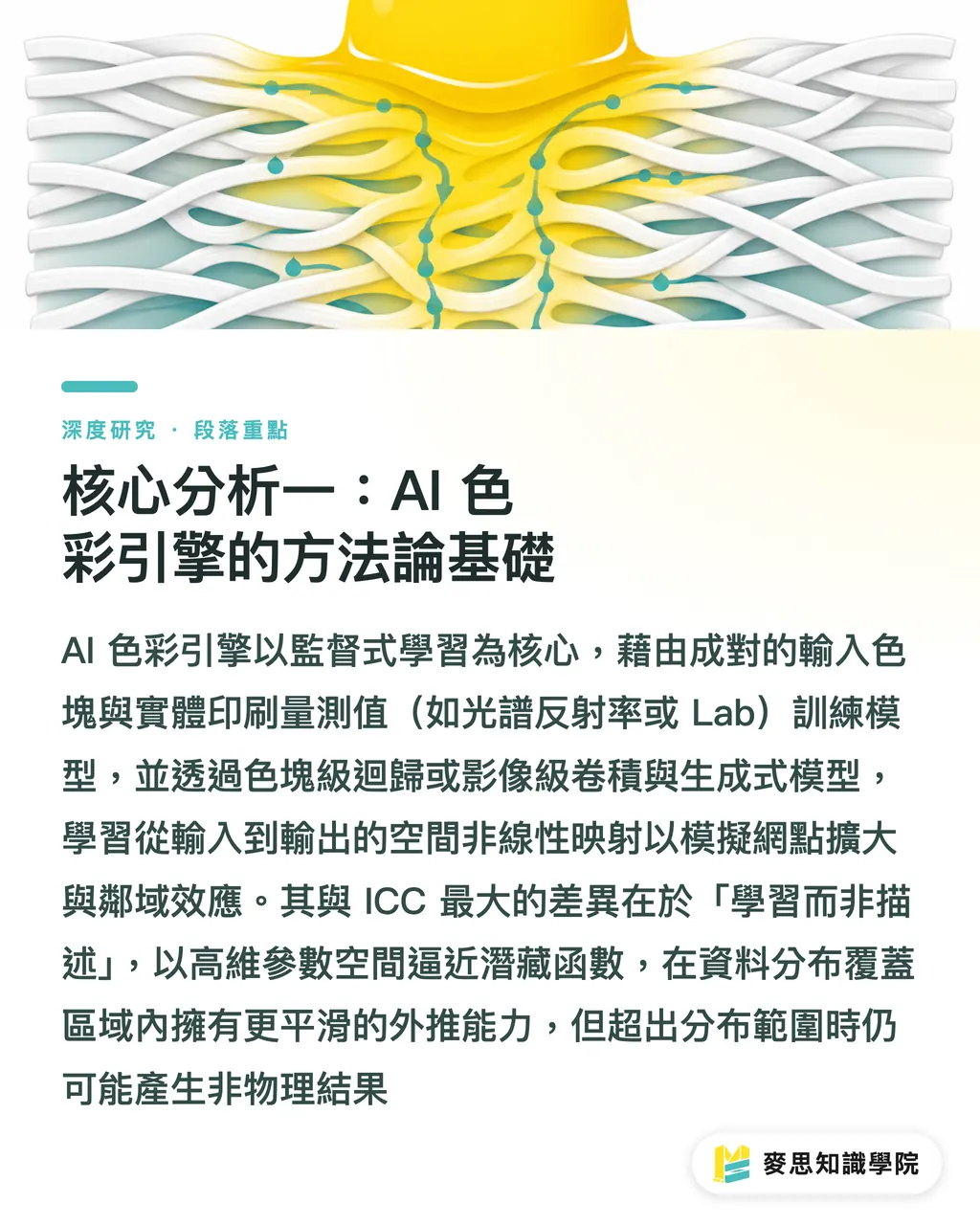
The core architecture of AI color engines is supervised learning: training the model using paired data of 'input color patches (or CMYK values) and physical print measurement values (such as spectral reflectance or Lab).' The training data typically comes from color targets (such as IT: ・8.7/4 or EC I ・2009) produced by actual proofers or printing presses under controlled conditions, with spectral data then acquired via spectrophotometers or spectral imaging systems
At the model level, industrial implementations mostly adopt two strategies: (: ・1) patch-level regression models that fit each color patch as an independent sample; ( ・2) image-level convolutional or generative models that learn the spatial non-linear mapping of the entire image from input to output. The latter is better at simulating dot gain and neighborhood effects, which are particularly critical for predicting high-frequency details
This paper suggests that the key difference between AI color engines and ICC lies in 'learning versus description.' ICC establishes a limited set of samples through manual measurements and interpolates between them, whereas AI approximates the underlying functions within a high-dimensional parameter space. The former can produce significant errors for unencountered color combinations, while the latter typically offers smoother extrapolation capabilities within the covered regions of the data distribution. However, when moving out-of-distribution, it may produce non-physical results, meaning its applicability boundaries must still be carefully defined
Core Analysis II: Learning the Penetration and Spread Effects of Uncoated Paper
Ink penetration and ink spread on uncoated paper are two independent yet coupled optical mechanisms. The former reduces the surface ink layer thickness, leading to decreased saturation, while the latter expands the visual area of dots, darkening the midtones and shadows. In AI models, these two effects can be implicitly learned at the data level. As long as the training data covers a sufficient variety of paper types, ink overprints, and dot percentage variations, the model can reconstruct approximate visual results during inference
In practice, if a model only uses Lab as the target variable, spectral information is lost, limiting future implementations of metamerism matching. Therefore, adopting spectral reflectance as the supervision signal has become a more rigorous direction. This paper argues that spectral-level supervision, compared to color-level supervision, can more strongly handle metamerism under different light sources, which is particularly critical for brand color consistency
Core Analysis III: Reliability of Soft Proofing and Workflow Reshaping
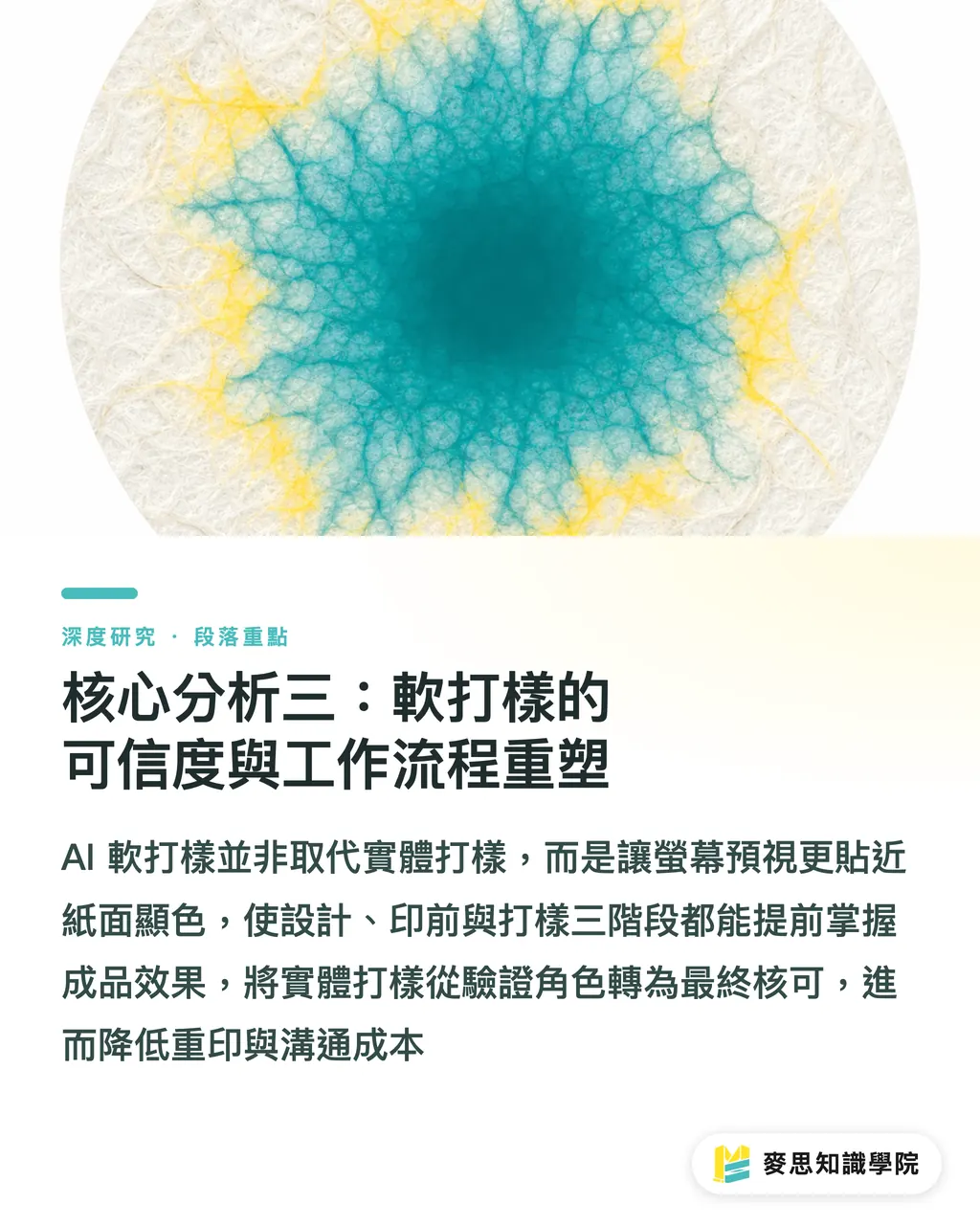
The value of soft proofing lies in 'foreseeing the finished product before sending it to print.' AI-driven soft proofing makes screen previews much closer to the actual color reproduction on paper. Designers can simulate the final appearance of specific substrates and inks on an RGB monitor, allowing them to adjust tones early and avoid reprints
Workflow reshaping can be observed across three levels:
・Design Stage: Designers can specify the target paper substrate and press type while confirming brand colors, and the AI engine instantly generates an approximate color rendering
・Pre-press Stage: Pre-press operators use AI soft proofing to replace some physical proofs, reducing the consumption of paper, ink, and press time
・Proofing Stage: Physical proofing is still used for final approval, but the gap between it and the screen preview is significantly minimized, reducing communication costs
This paper concludes that AI soft proofing is not meant to replace physical proofing entirely, but rather to shift its role from 'verification' to 'final approval,' making the overall process more cost-effective
Implications for Taiwan's Design and Printing Industry
For small and medium-sized printing houses, the primary barrier to adopting AI color engines is the building of training data: they must establish a controlled measurement environment (such as using spectrophotometers and stable printing conditions) and accumulate sufficient datasets of paper substrates and ink combinations. Practical steps include using existing digital presses alongside a registry of paper whiteness and surface characteristics to build an internal database in stages, followed by evaluating the feasibility of importing pre-trained models. In terms of cost, AI soft proofing reduces the consumption of proofing paper and ink, with the initial investment expected to be recovered in projects with high reprint rates
For the design end, the key change is 'substrate-aware design': designers can preview the impact of different substrates on brand colors at the early stages of design, choosing brand-color-friendly papers and finishing processes rather than being forced to compromise after sending to print. This helps enhance brand visual consistency and reduces back-and-forth communication with the printing shop
For brands, AI soft proofing shifts brand color management from 'post-rectification' to 'pre-decision.' This allows brands to integrate color variation rules mapped to different substrates within their brand guidelines, thereby minimizing color shifts across different printers and materials
Conclusions and Limitations
This paper reviews the approach of AI color engines to predicting color reproduction on uncoated paper, highlighting its advantages over the ICC framework and traditional physical models. By approximating ink penetration and spread effects through data-driven non-linear functions, it provides screen previews with higher fidelity in soft proofing scenarios. For Taiwan's industry, this technology offers an actionable path for designers, printers, and brands to reduce reprint rates and accelerate decision cycles
The limitations of this study are as follows:
1. The availability of peer-reviewed literature is relatively limited, and current public empirical evidence comes mostly from technical reports and industry white papers. Consequently, accuracy metrics (such as the magnitude of ΔE2000 improvement) must rely on individual system providers' disclosed data, requiring caution when extrapolating
2. The model's capacity to extrapolate across materials is limited by the distribution of the training data. When encountering rare substrates or specialty inks, predictions may deviate from physical results. Industrial adoption must be accompanied by a clear definition of the 'known applicable scope'
Future research can progress in three directions: (: ・1) establishing peer-reviewed, spectral-level benchmark datasets for fair comparison among different models; ( ・2) developing model interpretability tools to clarify which color gamut edges AI predictions might fail at; ( ・3) exploring the potential of extending AI prediction to specialty printing (such as metallic and fluorescent inks)
Key Takeaways
Using supervised learning, AI color engines approximate the penetration and spread effects of ink on uncoated paper based on extensive physical print measurement data, providing screen soft proofing that is closer to the physical reality than traditional ICC profiles
Spectral-level supervision signals are superior to Lab-level signals, offering more strong handling of metamerism, which is particularly critical for brand color consistency
AI soft proofing is not meant to replace physical proofing, but rather to shift its role from 'verification' to 'final approval,' reducing the cost of repeated proofing
The barriers to adoption for Taiwan's small and medium-sized print shops lie primarily in building training data and acquiring measurement equipment, while the design end must establish the working habit of 'substrate-aware design.'
The models may produce non-physical results in out-of-distribution scenarios (rare substrates, specialty inks); hence, the applicable scope must be clearly defined and supplemented by physical proofing approvals
Further Considerations
For print manufacturers, AI color engines can be integrated into the digital front-end (DFE) as a color simulation module, but its value depends on the breadth and representativeness of the training data. For designers and brands, the key lies in shifting 'substrate' from a variable known only after printing to a parameter that can be specified at the early stages of design. For SaaS and tool providers, consideration could be given to developing a 'substrate-aware brand color management platform.' This platform would integrate previews of paper whiteness, ink types, and post-press finishing, expanding brand color management from standalone devices and single factories into a cross-factory, cross-material consistency system. Unresolved questions include how to build reliable models with limited samples and how to share training data without exposing proprietary manufacturing secrets
References
[1] Multi-Factor Authentication Interoperability Profile Working Group (2016). Charter for a Strong Identity Proofing Profile Working Group. DOI: 10.26869/ti.42.1
FAQ
- Why do colors that look vibrant on screen always print darker and grayer on uncoated paper?
- Because uncoated paper lacks coating, its surface is composed of exposed fibers and pores. Ink penetrates downward and spreads horizontally, causing the surface ink layer to thin out and lose saturation, while light multiple-scatters at fiber interfaces, making the visual appearance gray. Traditional ICC profiles struggle to fully describe this mechanism, leading to a significant gap between screen previews and physical results
- What are the differences between AI color engines and traditional ICC profiles?
- ICC profiles establish look-up tables through manual measurements and generate color mapping via interpolation, whereas AI color engines use supervised learning to approximate color functions from large volumes of physical printing data. The former is universal and interoperable but sensitive to material variations, while the latter exhibits stronger fitting capabilities within the data coverage area, though out-of-distribution predictions require caution
- Can AI soft proofing completely replace physical proofing?
- The current consensus is that it cannot completely replace it. AI soft proofing can effectively reduce upfront communication and test printing costs, but physical proofing remains irreplaceable during the final approval stage, especially when specialty inks, post-press finishing, and rare substrates are involved
- What are the fundamental requirements for adopting an AI color engine?
- It requires stable, controlled printing conditions, repeatable measurement procedures (such as using spectrophotometers or spectral imaging), and training data covering the target substrates and ink combinations. Additionally, the model's applicable scope must be clearly defined, and physical proofing must be retained as the final verification
- Why use spectral reflectance instead of Lab as the supervision signal for AI models?
- Because spectral information preserves metameric differences, allowing the model to predict consistent visual results under different light sources (such as D50 and D65). This is particularly critical for managing brand color consistency across different factories and devices
Related articles



The Print × AI weekly
The print and AI know-how designers, brands and enterprises can use before they commit — one email, every week
MINDS Free Tools
AI background removal, brand stamping, and a LINE sticker maker — free design tools, right in your browser, no upload.
MINDS Group
Need actual printing or gifting services?
From premium printing to online ordering and festive gifts — the MINDS Group sister brands take it from here.