

Why Does Foil Stamping Smudge or Break?
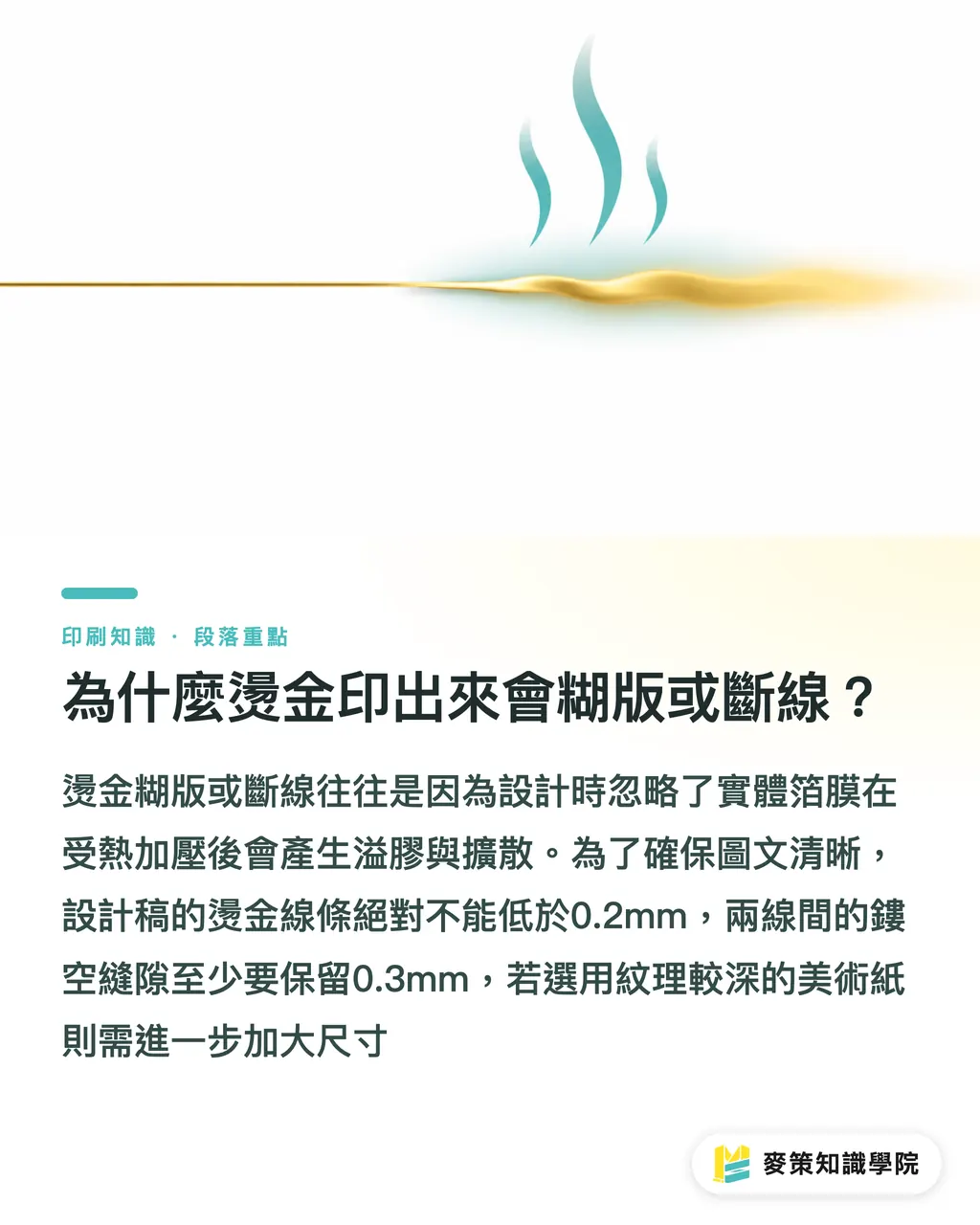
Lines that are too thin, font sizes that are too small, or failing to account for how paper behaves under pressure are the most common culprits behind smudged foil
Many designers zoom in close on their screens, forgetting that physical foil bleeds and spreads slightly under heat and pressure
From my years reviewing artwork on press floors and with clients, foil lines should never go below 0.2mm, and negative space between lines needs at least 0.3mm
For serif fonts with delicate strokes, keep font sizes at 8pt or larger
If you pick heavily textured fine paper for your stickers, the press needs heavier stamping pressure, so minimum line weights and gaps must be increased even further
How Should You Set Up Foil Black Artwork and Sticker Die-lines?
Foil areas must be set as pure K100 vector shapes, separated from the background artwork and die-lines on independent layers
Platemaking machines only recognize solid black. Any grayscale, gradients, or 4-color rich black will make plate production impossible
When setting up artwork in Illustrator, build three layers:
・ Background Layer: Place all CMYK color print content here
・ Foil Layer: Include only K100 vector objects meant for stamping
・ Die-line Layer: Mark the sticker cut path with a spot color
Before submitting files, make sure the foil layer is not set to overprint, which can cause unpredictable reactions between the underlying ink and foil
If you run into confusing layer conflicts, ask the Mai Strategy Knowledge Academy consulting team to review your file structure and verify platemaking logic
How Do You Calculate Foil Area to Avoid Budget Blowouts?
Foil die costs are calculated using the total bounding rectangle of your foil elements. Scattered designs drastically drive up the cost of metal dies
Suppose you have a 10×10 cm sticker with a small foiled logo in the top-left corner and a foiled line of text in the bottom-right corner
For the print shop, the die area is not the sum of those two small graphics, but the full 10×10 cm box that encompasses both
To keep costs down, cluster your foil elements into a tighter grouping to shrink the bounding box dimensions
Alternatively, account for die fees early in design so you are not surprised when finishing costs exceed the base sticker print price
How Do You Choose the Right Substrate for Foiled Stickers?
Smooth materials with minimal texture work best for foil stamping. Coated paper stickers or laminated synthetic papers give foil the strongest adhesion
Different substrates require foils with matching adhesive coatings and release properties
Uncoated fine papers with high ink absorbency often yield uneven, rough foil edges
For waterproof stickers with PE plastic coatings, heat management is critical because excess temperatures can warp or melt the sticker
I usually advise clients to test paper samples against foil swatches to confirm material compatibility before finalizing design decisions

Key Takeaways
・ Keep line weights above 0.2mm and gaps at 0.3mm minimum as a baseline against smudging
・ Build artwork on dedicated layers and set all foil areas to solid K100 vector shapes
・ Die pricing is based on total bounding box area. Grouping elements tightly keeps finishing costs in check
Final Thoughts
For designers, foil stamping is never as simple as picking a color swatch. It is a physical collision of pressure, temperature, and paper stock
Next time you design a sticker, factor die boundaries and stroke limits into your initial sketching phase
This saves revision cycles and protects your client from runaway print quotes, which is where real craft shows
Related Reading
・ Complete Guide to Hot Foil Stamping: Effects, Materials, Costs, and File Pitfalls
・ Foil Stamped Sticker Production Guide: Avoiding Smudges and Estimating Costs
・ How to Write Foil Stamping Quotes Without Missing Hidden Costs
・ Foil Stamping Prepress Pitfall Guide
FAQ
- Can foil stamping artwork include gradients or transparency?
- No. Foil stamping uses physical metal dies for heat transfer, meaning an area is either stamped or not. Artwork must be set as 100% solid K100 vector objects and cannot reproduce gradients or semi-transparent effects
- If the background artwork overlaps with the foil area, do I need to knock it out?
- No knockout is needed. Foil stamping is the final finishing step. Metallic foil is completely opaque and lays right over printed ink, so leave your background artwork intact
- Why does the quote differ between two print runs of the exact same foiled sticker?
- The first run typically includes initial die-making fees. For reprints using the existing metal die, that tooling charge drops off, leaving only stamping labor and material costs
- My design has lots of fine lines. Are there alternatives to hot foil stamping?
- If lines are too delicate for hot stamping, consider cold foil or metallic gold ink. Both hold fine details better than traditional hot stamping, though their metallic shine and depth are less pronounced
Related articles



The Print × AI weekly
The print and AI know-how designers, brands and enterprises can use before they commit — one email, every week
MINDS Free Tools
Spine width and imposition calculators — skip the manual math, free in your browser.
MINDS Group
Need actual printing or gifting services?
From premium printing to online ordering and festive gifts — the MINDS Group sister brands take it from here.