
Overview
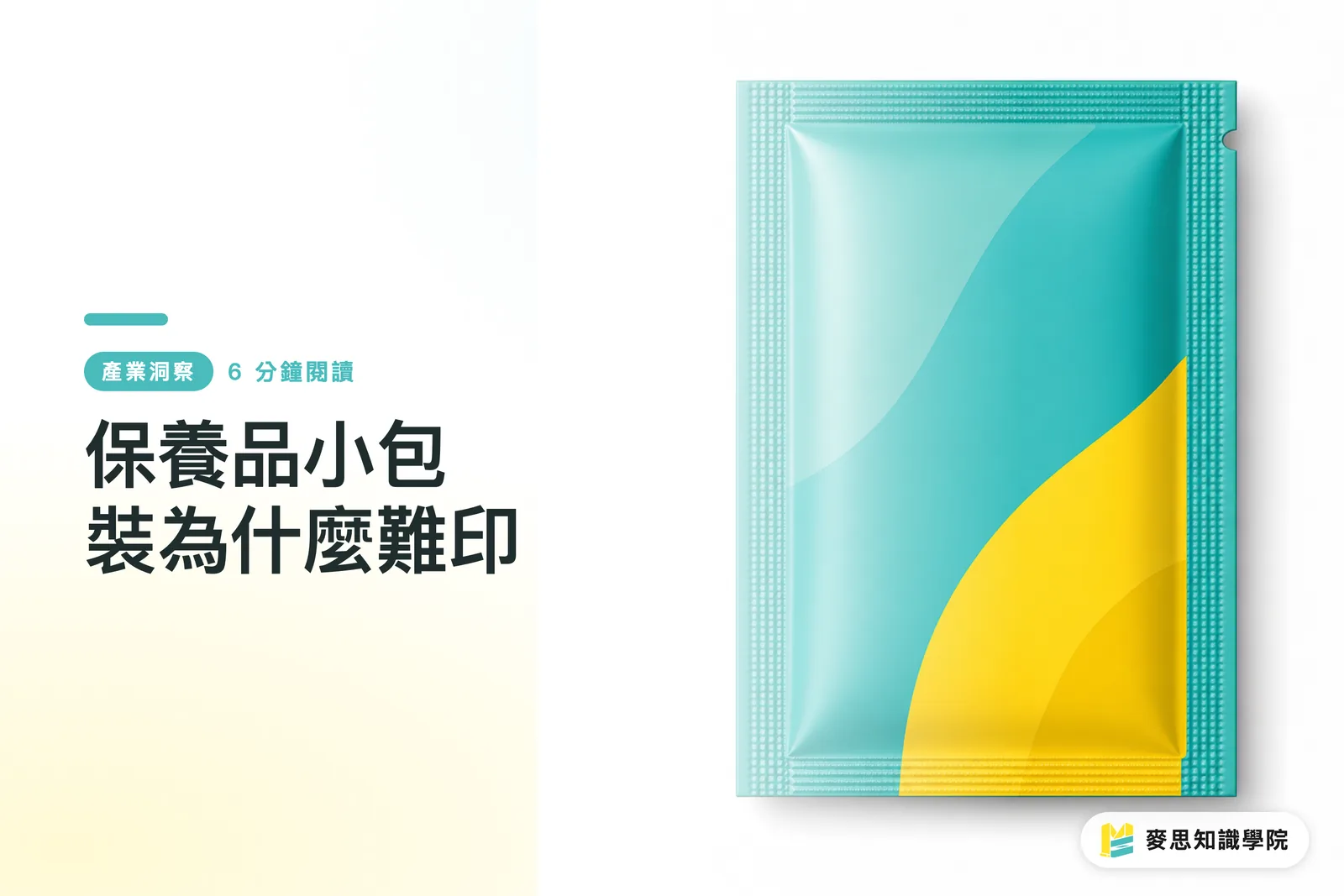
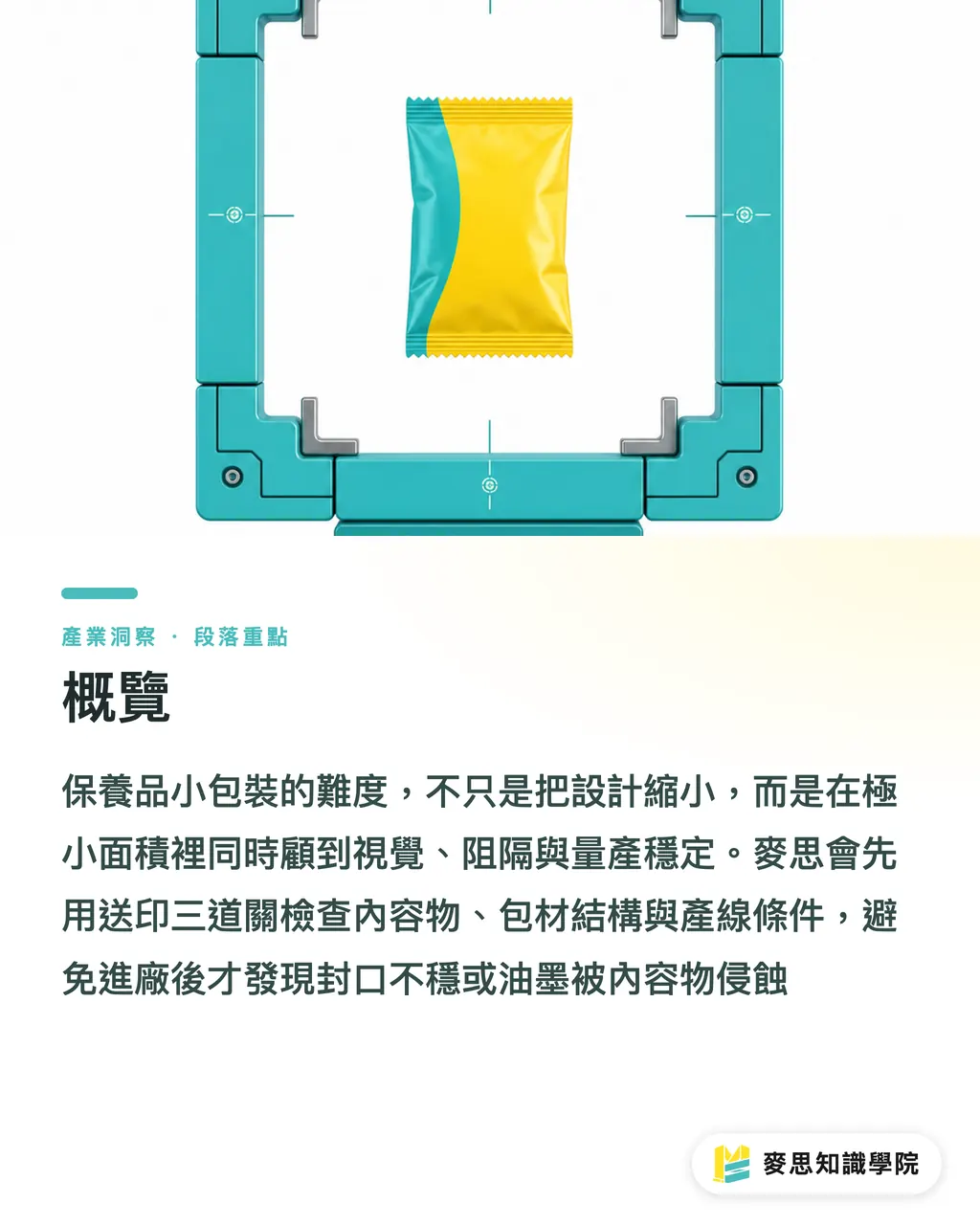
Small skincare packets are hard to print because a very limited space has to protect the visual design, barrier performance, product resistance, sealing, tear notch, and mass-production efficiency all at once. When MINDS (MS) reviews this kind of job, it starts with the "MINDS (MS) three prepress gates": product contents, packaging structure, and production-line conditions. The goal is to catch problems before a good-looking file reaches the plant and turns into failed seals, poor tearing, or ink attacked by the formula
Why Do Sachets and Stick Packs Go Wrong So Easily?
The APC flexible packaging applications for personal care, published by FPA on July 23, 2026, notes that personal care packaging affects shelf appeal, product protection, environmental performance, and production efficiency. On sachets and stick packs, all 4 of those pressures get squeezed into the same sealed edge
A sachet is a flat single-use pouch, often used for samples and travel packs. The challenge is fitting printing, sealing, tear opening, and product protection into a small area
A stick pack is a slim, elongated pouch, often used for serums, powders, or single-use products. The layout is narrow and the sealed edges are long, so registration tolerances and seal-cut tolerances can amplify each other
The files I dread most on press are the ones with a polished front design, while the back crams ingredients, batch codes, tear notches, and seal-safe margins into one tight mess. Small packs leave no room for error. A 0.5mm shift can push brand typography into the heat-seal area
What Material and Sealing Tradeoffs Make Small Packs So Hard?
APC's listed applications include flow wraps, overwraps, sachets, stick packs, lidding, and preformed pouches. These 6 flexible packaging types may all work for personal care products, but each has its own opening method, sealing area, and machine rhythm
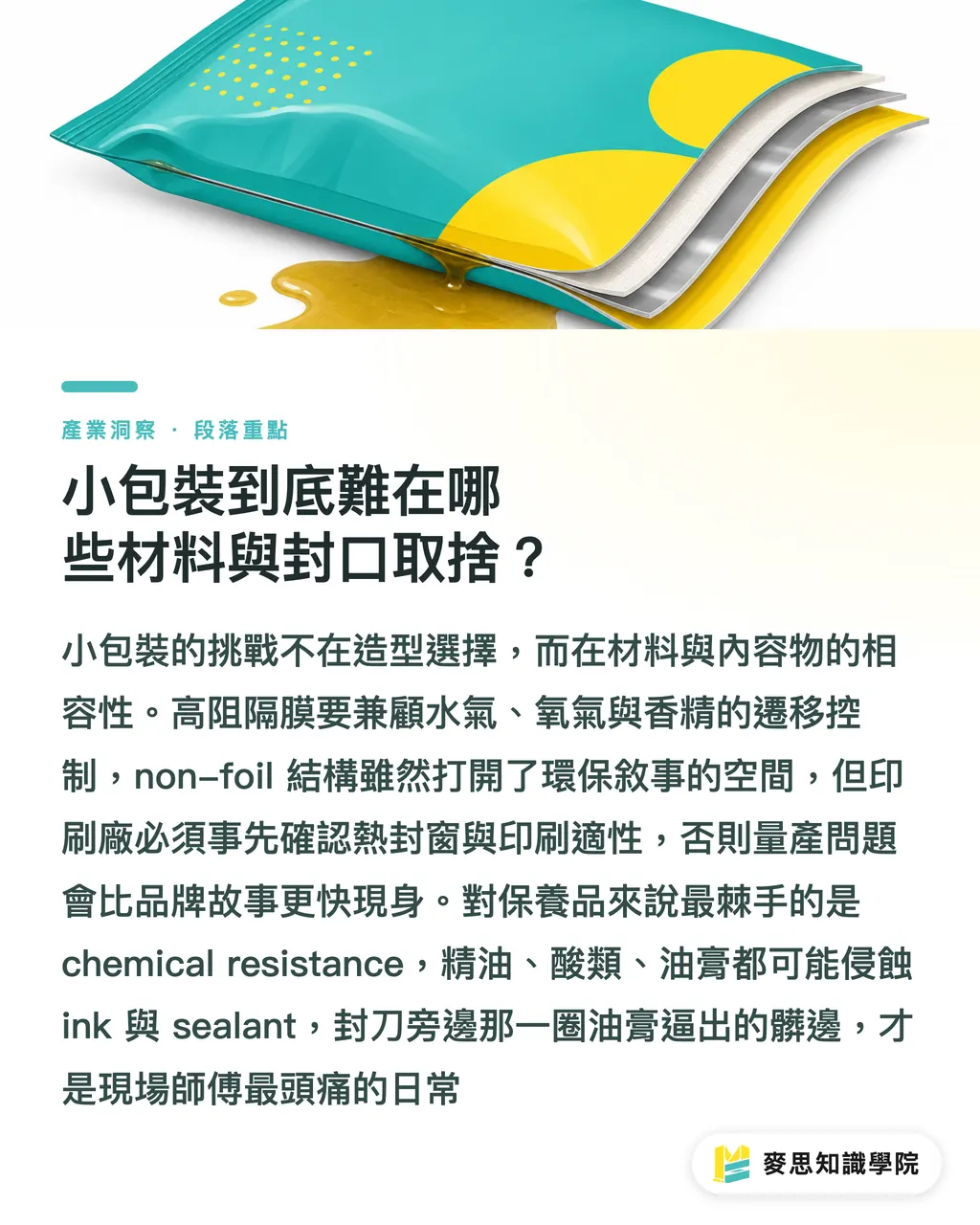
High-barrier film uses single-layer or multilayer film, coating, and barrier layers to control the migration of moisture vapor, oxygen, fragrance, and oils. It suits formulas that are volatile, unstable, or prone to leakage
The benefit of non-foil barrier structures is that brands may reduce their dependence on aluminum foil, leaving more room for environmental and recycling claims. But the printer first has to verify barrier performance, stiffness, heat-seal windows, and printability. Otherwise, the sustainability story gets dragged right back to production-floor problems
Chemical-resistant packaging is a serious issue for skincare. Essential oils, alcohol, acids, ointments, and fragrances can all affect ink, coating, lamination, and sealant. What makes machine operators frown is often not color variation, but the dirty edge squeezed out by ointment around the sealing jaw
What Three Questions Should Designers Ask Before Sending Files to Print?
The MINDS (MS) three prepress gates are simple, but every gate needs an answer. Designers should not hand over only AI concept images, mockups, and beautiful dielines. At minimum, the brief should state the product state, storage needs, opening experience, and planned pack format
・1. Product gate: Is this pack for lotion, serum, powder, wet-wipe liquid, or a formula containing alcohol or fragrance? The contents directly affect chemical resistance and sealant selection
・2. Structure gate: Will this be a sachet, stick pack, lidding, or preformed pouch? Different pack formats require different print margins, seal widths, tear-notch positions, and layout directions
・3. Production-line gate: Will this be a small manual trial run, or will it go onto a high-speed filling and sealing line? The production method determines acceptable tolerances, film stiffness, and sealing stability
Do not rush
When a design gets stuck on material choices or dispensing feel, the Mai Strategy Knowledge Academy consulting team can review the file, formula, and pack-format conditions first. Catching prepress risks one round earlier is usually far easier than remaking plates after the job enters the plant
How Should Small and Mid-Sized Printers in Taiwan Handle These Jobs?
When small and mid-sized printers in Taiwan take on small skincare packaging jobs, they should not only ask, "How many colors?" and "Do you need a matte film?" The specialty inks, films, coatings, and sealant technologies mentioned by APC have already pushed these jobs to the border between materials engineering and packaging experience
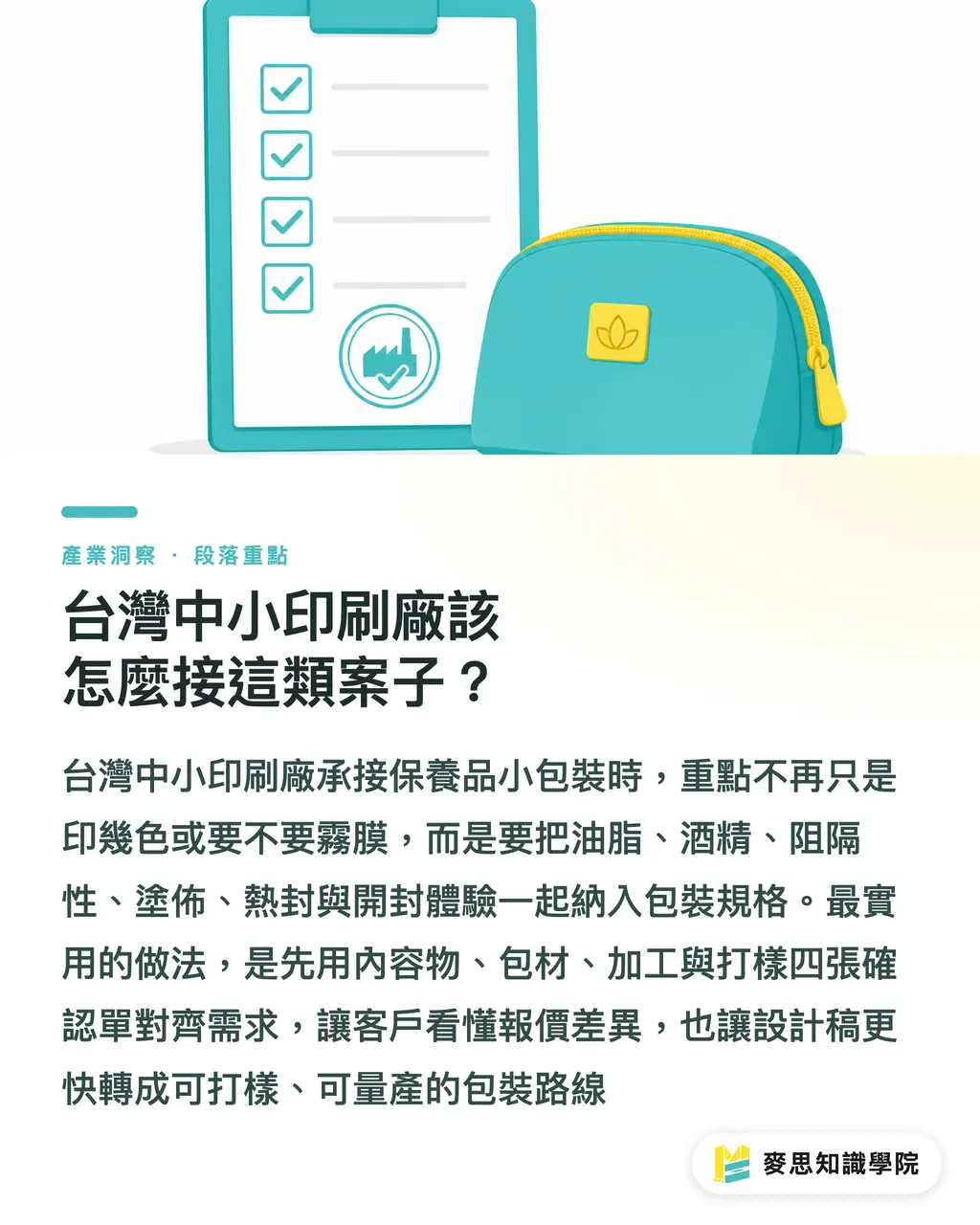
Printers can split small skincare packaging into 4 confirmation sheets. Clients will understand pricing differences more easily, and a lot of back-and-forth guessing can disappear
・Product confirmation sheet: formula type, fragrance, oils, alcohol, acidity or alkalinity, storage conditions
・Packaging material confirmation sheet: film structure, barrier requirements, and whether non-foil barrier structures are being considered
・Processing confirmation sheet: printing method, coating, lamination, sealant, tear notch, and reclose design
・Proofing confirmation sheet: filling test, heat-seal test, opening test, and transport abrasion test
If the project already involves mid- to high-end fully custom commercial printing, brand color management, and launch packaging integration, MINDS can help turn design files into specs that are ready for print, proofing, and discussion. The client sees more than a quote. They see a packaging path that can actually be produced
Key Takeaways
・The smaller the pack, the less design freedom you have. Sealed edges, tear notches, batch codes, and regulatory text all fight for layout space
・The difficulty of sachets and stick packs is not the name of the pouch format. It is the way the contents, film, ink, coating, and sealant all affect one another
・Non-foil barrier structures can reduce reliance on aluminum foil, but barrier performance, stiffness, heat-seal windows, and printability must be tested first
・Before sending small skincare packaging to print, ask about 3 things first: the contents, the structure, and the production line. Many remakes can be avoided early
Further Thinking
For print manufacturers, small skincare packaging needs to shift from "taking a print job" to "taking a packaging-spec job," with contents, film, ink, sealing, and opening tests written into a standard questionnaire. For designers, even the best-looking mockup still has to leave room for sealed edges, tear notches, batch codes, and regulatory text. For AI and SaaS teams, the most valuable work is not guessing film materials for clients. It is organizing briefs, risk Q&A, proofing records, and supplier specs into a process that can be checked later, so the next sachet or stick pack quote does not waste time on avoidable detours
Further Reading
FAQ
- Why are skincare sachets harder to print than regular paper boxes?
- Skincare sachets have to handle printing, sealing, tear opening, product protection, and regulatory text within a small area. Lotions, essential oils, alcohol, or fragrances can also affect ink, coating, lamination, and sealant
- What kinds of skincare packaging are stick packs suitable for?
- Stick packs work well for single-use, slim-format serums, powders, or travel products. But the layout is narrow and the sealed edges are long, so designers need to avoid the seal area and tear-notch area from the start
- What are non-foil barrier structures?
- Non-foil barrier structures are barrier structures that do not rely on aluminum foil. They usually use film, coating, or multilayer materials to control the migration of moisture vapor, oxygen, and fragrance, making them suitable for flexible packaging that needs both protection and better environmental performance
- What should be prepared before sending small skincare packaging to print?
- Before printing, prepare at least the product state, pack-format choice, storage conditions, opening method, planned production line, and testing requirements. Only then can the printer judge whether the film, ink, coating, and sealant are suitable
Related articles
The Print × AI weekly
The print and AI know-how designers, brands and enterprises can use before they commit — one email, every week
MINDS Free Tools
Imposition calculator and preflight file check — free prepress tools, right in your browser.
MINDS Group
Need actual printing or gifting services?
From premium printing to online ordering and festive gifts — the MINDS Group sister brands take it from here.