
Overview
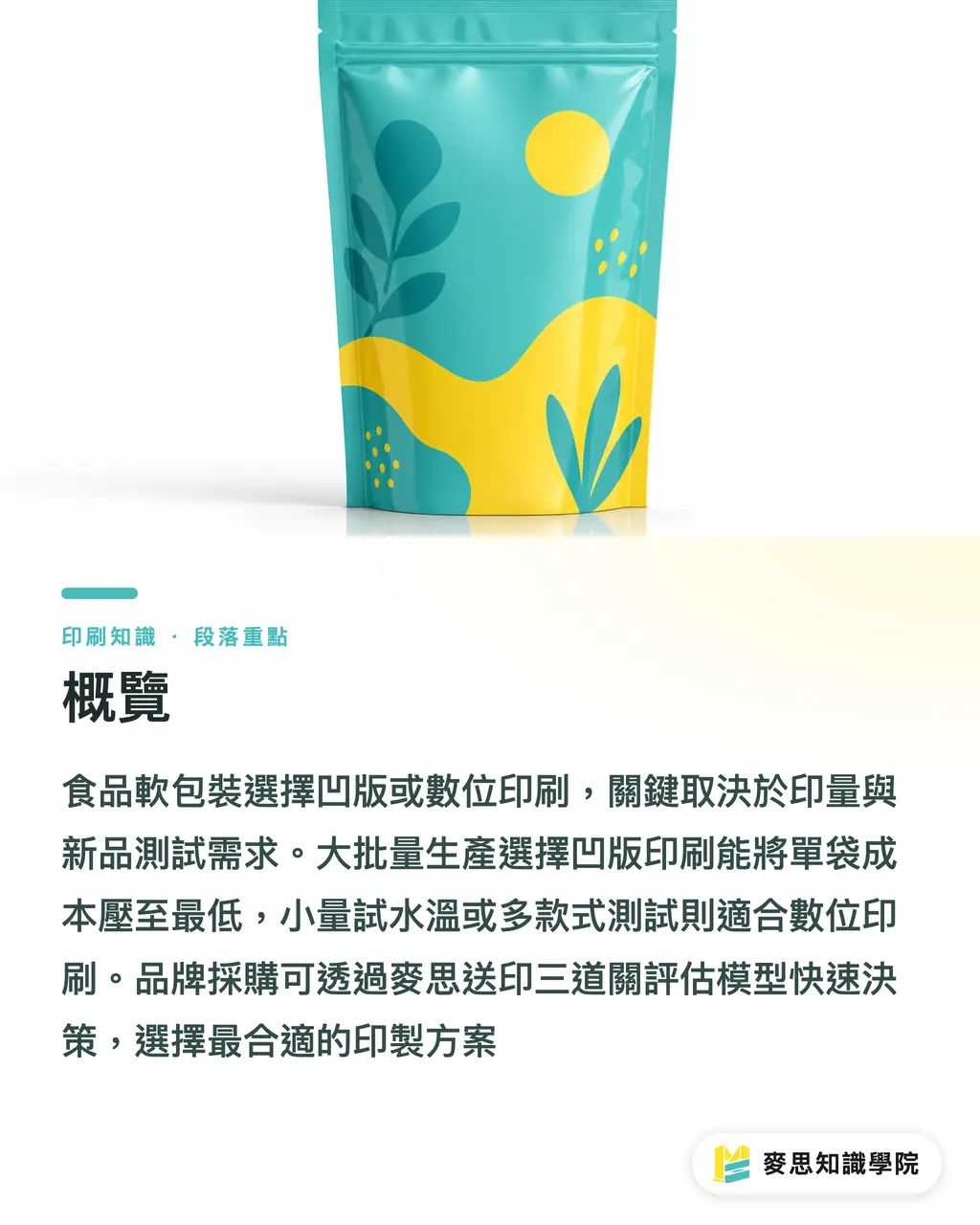
When choosing between engraved gravure cylinders and digital printing for food flexible pouches, the key comes down to single-run quantity and new product testing needs! For large-scale production, gravure printing drives the per-pouch cost to the lowest level. For small test runs of new products or short runs across multiple styles, digital printing is the better fit. Brand buyers can make quick decisions with the "MINDS Printing (MS, mid-to-high-end fully custom commercial printing) three-gate print assessment" model used by MINDS Printing
Flexible packaging for food refers to flexible pouch bodies made by laminating plastic films and aluminum foil into composite structures. It offers light blocking, moisture protection, and sealing suitability, and is commonly used for stand-up pouches and sealed packs
Why Are Gravure Cylinder Plate Fees So Expensive? Breaking Down Steel Cylinders and Mass Production Costs
Many brand clients bring in snack bags or skincare samples and ask right away whether they can print 500 bags first. My usual answer is direct: hold on! Gravure printing is the clear king of long-run packaging, but the entire entry barrier sits in the cylinder-making cost
The operating logic of gravure printing is to engrave graphics and text onto electroplated metal cylinders by laser or mechanical engraving, then harden them through chrome plating. One steel cylinder costs about NT$3,000 to NT$6,000. If the design includes CMYK four-color printing plus spot colors and white ink, a full set of 5 to 7 steel cylinders can bring the setup cost to NT$20,000 to NT$40,000
The steel cylinder fee looks shocking, but once production rises above 100,000 bags, that fixed cost is spread across such a large base that it becomes almost negligible! A gravure press can run 150 to 300 meters per minute. Ink film coating is even, and color saturation stays extremely stable across batches. The per-pouch printing cost has an overwhelming advantage! For large-volume production projects, MINDS Printing still sees gravure as the best choice for locking in the lowest unit price for clients
・Advantages of gravure printing: fast speed, extremely stable ink color, wear-resistant metal plates, ultra-low unit cost above 100,000 bags
・Disadvantages of gravure printing: expensive setup fees, long preparation lead time of 3 to 4 weeks, and any artwork revision requires a full set of new cylinders
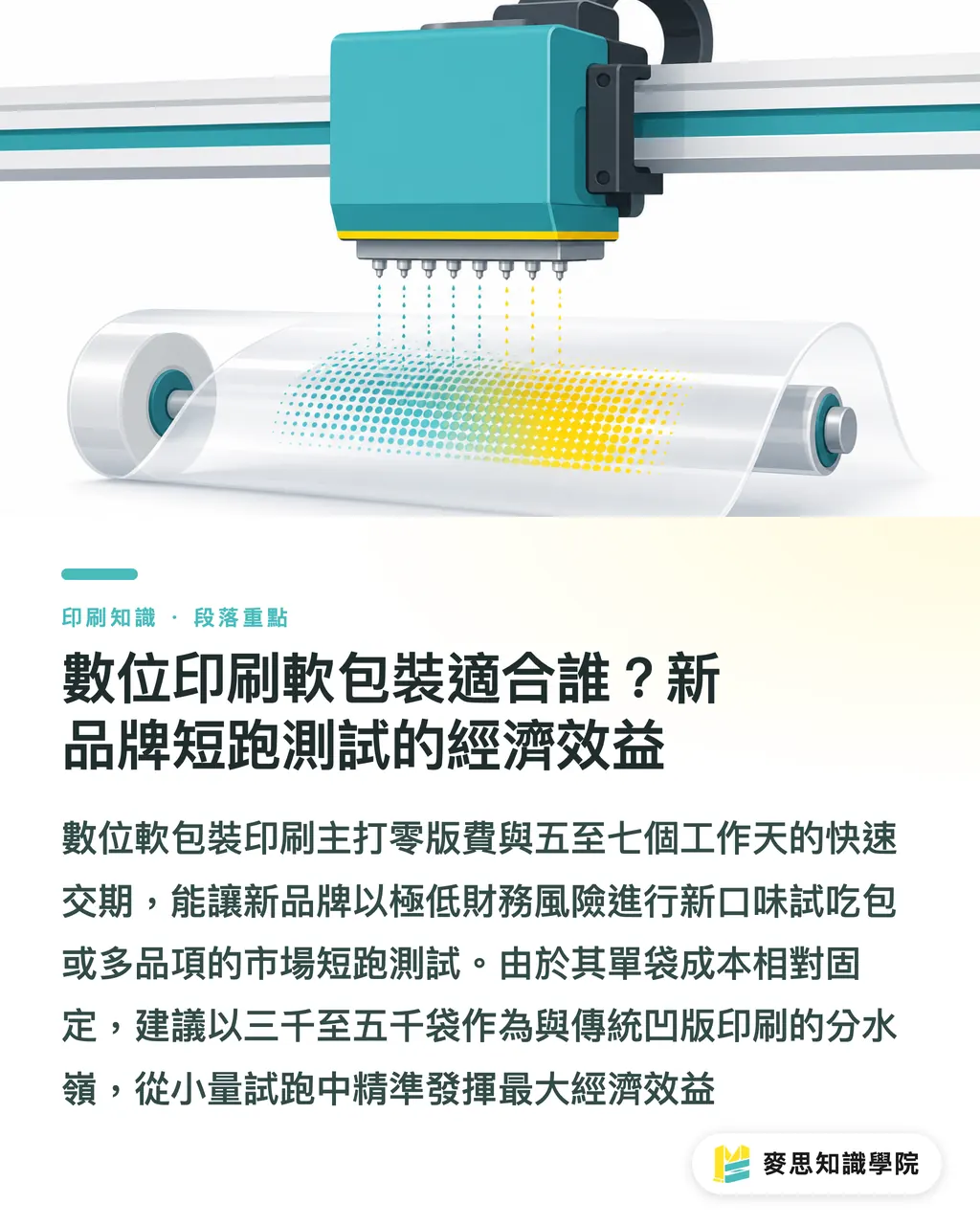
Who Is Digital Flexible Packaging Printing For? The Economics of Short-Run Testing for New Brands
If your brand is about to launch a new flavor, or you only want 500 sample packs for a trade show tasting, forcing the job onto engraved gravure cylinders will let plate fees eat up all your profit! In that case, digital flexible packaging printing is the most reasonable solution
Digital printing needs no physical plates at all. Once the file is approved, it can be output directly onto film material! That means zero plate fees, and lead time can drop from the traditional several weeks to 5 to 7 business days! For multiple SKUs or seasonal packaging, digital printing lets brands run short market tests with very low financial risk
In terms of cost structure, digital printing has a relatively fixed per-pouch price, and it does not fall sharply as quantity increases! Once the print quantity reaches more than 5,000 bags, the accumulated ink and material costs of digital printing gradually overtake the total cost of gravure! From the small-quantity ordering platform MINDS Print to fully custom planning through MINDS Printing, we usually advise clients to treat 3,000 to 5,000 bags as the dividing line between digital and gravure
・Advantages of digital printing: zero plate fees, only 5 to 7 days of lead time, ideal for small-batch variety and very short-run testing
・Disadvantages of digital printing: higher per-pouch cost than gravure in mass production, and special spot-color performance is limited by the ink system
How Should You Choose PET/AL/PE Laminated Materials? The Key to Moisture Protection and Heat Sealing for Food
A flexible pouch is never just a single layer of film. It is a laminated structure made by bonding multiple materials together! Choose the wrong material combination and the light problem may be ink peeling. The serious problem may be spoiled food or leaking air
The most common food-grade three-layer structure is PET/AL/PE, meaning polyester film / aluminum foil / polyethylene! The printed PET layer (12μm) gives excellent color performance and flatness. The middle AL layer (7μm) provides a strong light-blocking and moisture-barrier function, with a water vapor transmission rate (WVTR) below 0.5g/m²·24h. The heat-seal PE layer (60-80μm) ensures the pouch mouth bonds tightly under high-temperature pressure without air leakage! This type of structure is designed for nuts, dry foods, and premium skincare products that need strong moisture protection
If transparent product display or a leaner budget matters more, a PET/CPP two-layer structure can be used! PET handles printing and tensile strength, while unoriented polypropylene CPP (30-50μm) provides good transparency and heat-seal strength. It suits cookies or snacks with shorter shelf-life requirements! When planning materials, MINDS Printing first clarifies the contents' water resistance, oil resistance, and shelf-life needs, then decides the best production method
・PET/AL/PE: high-barrier three-layer structure that blocks light and moisture, suitable for long shelf life and highly sensitive foods
・PET/CPP: high-transparency two-layer structure that shows the product inside, suitable for short shelf life or general dry-goods packaging
・NY/PE: nylon laminated with polyethylene, excellent puncture resistance and freezing suitability, often used for liquids or frozen fresh foods
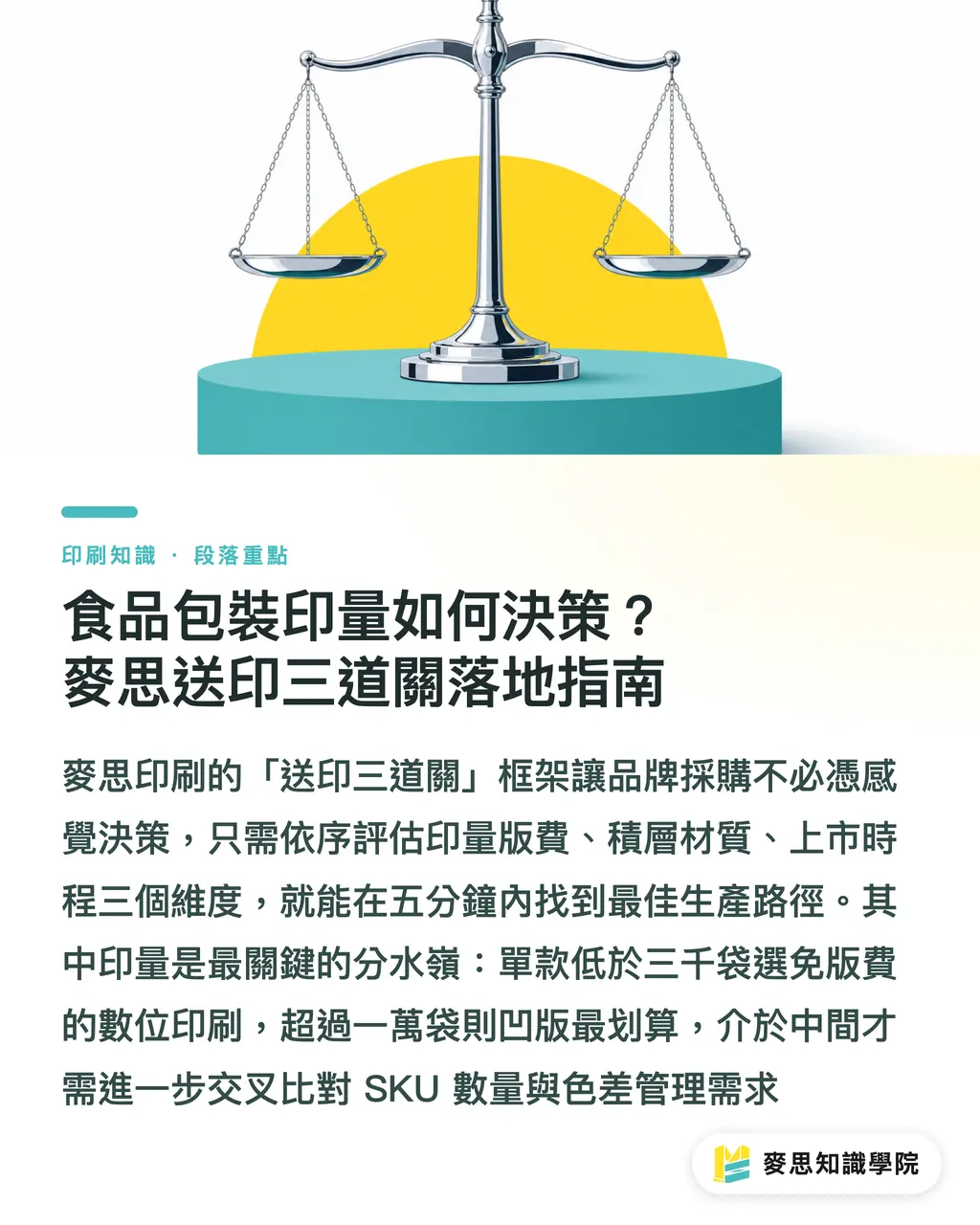
How Should Food Packaging Quantity Be Decided? A Practical Guide to the MINDS Printing (MS) Three-Gate Print Assessment
When facing production method and material choices, brand buyers do not need to guess by feel! MINDS Printing has condensed years of production-line experience into the "MINDS Printing (MS) three-gate print assessment" framework, helping teams find the best production path within 5 minutes
It is simple! Review the project through the following three gates in order, and you can keep cost and quality in balance:
・①Quantity and plate-fee estimate: if the estimated quantity for a single design is below 3,000 bags, choose digital printing with no plate fee directly. If the quantity exceeds 10,000 bags, gravure steel cylinder fees will be fully diluted by volume, making gravure the most cost-effective choice. Between 3,000 and 10,000 bags, compare against the number of SKUs
・②Laminated material and physical-property assessment: check whether the contents contain oil, moisture, or require light blocking! For long shelf-life foods, prioritize PET/AL/PE laminated structures. For general dry goods, PET/CPP or transparent laminated structures may work
・③Launch schedule and color-difference control: if the product must be on shelves within two weeks, choose digital printing for speed. If it is a core evergreen product and requires zero color difference across batches, schedule mass production with engraved gravure cylinders
Key Takeaways
・Engraved gravure cylinders suit mass production above 100,000 bags, with low per-pouch cost and minimal color variation
・Digital printing has no plate fee and only 5 to 7 days of lead time, making it the precise choice for new products and multi-item short-run testing
・For food moisture protection and light blocking, PET/AL/PE three-layer lamination is the first choice. For general transparent display bags, PET/CPP two-layer lamination works well
・Use 5,000 bags as the dividing line for printing methods. With the MINDS Printing (MS) three-gate print assessment model, teams can make the best planning decision within 5 minutes
Further Thinking
As markets iterate faster, packaging procurement strategy can no longer rely on one production method from start to finish! Experienced planners use the flexibility of digital printing for early proofing and small-batch trial sales, quickly collecting market feedback. Once a product proves itself as a core bestseller, they switch immediately to engraved gravure cylinders to reduce large-scale production cost! If manufacturers and design teams also connect this process with a web quotation system or AI automated layout tools, they can greatly reduce the communication time from file review to production outsourcing, helping products reach retail channels at the fastest speed and with the best cost-performance ratio
Further Reading
FAQ
- What is the usual minimum order quantity for food flexible pouches?
- With digital printing that has no plate fee, production can start at 100 to 500 bags. With traditional engraved gravure cylinder printing, because steel cylinder setup and tank-cleaning costs are involved, a single run of at least 5,000 to 10,000 bags is recommended for real economic value
- Why does gravure printing require plate fees of tens of thousands of NT dollars?
- Gravure printing uses laser-engraved electroplated metal steel cylinders as plates. A full-color print set needs 4 to 6 dedicated steel cylinders, and each cylinder costs several thousand NT dollars. This makes the upfront setup cost higher, but the cylinders can withstand millions of impressions
- Can PET/AL/PE laminated bags be heated in a microwave?
- Absolutely not! The AL layer is metallic aluminum foil, which can create sparks in a microwave and cause danger. If microwave heating is required, switch to high-barrier transparent films such as transparent high-barrier PET or NY laminated PE
Related articles
The Print × AI weekly
The print and AI know-how designers, brands and enterprises can use before they commit — one email, every week
MINDS Free Tools
Spine width and imposition calculators — skip the manual math, free in your browser.
MINDS Group
Need actual printing or gifting services?
From premium printing to online ordering and festive gifts — the MINDS Group sister brands take it from here.