
Overview
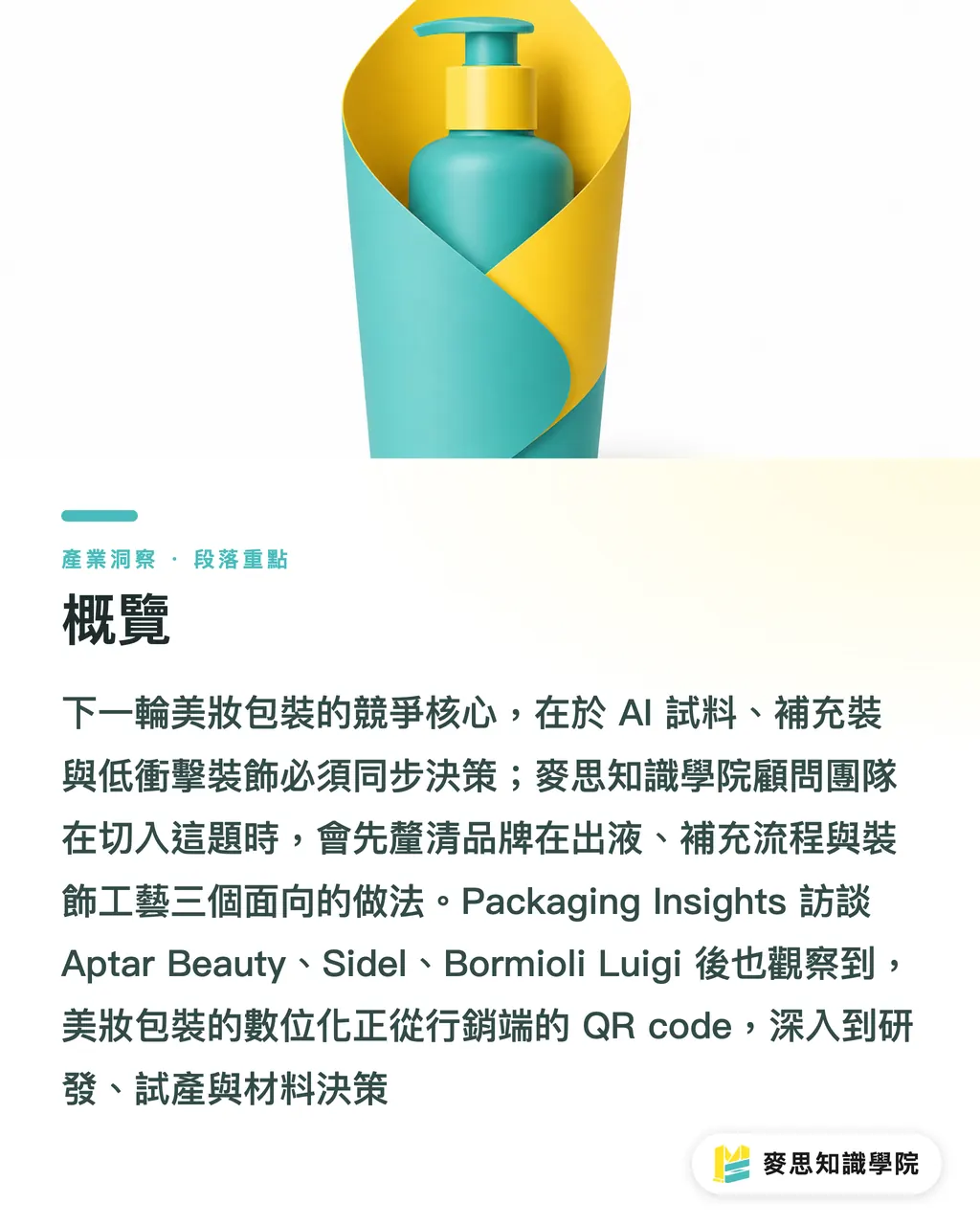
The next round of beauty packaging competition will land on a single design sheet: AI-led formulation fit, refill logic, and low-impact decoration have to be decided in one pass. When the Mai Strategy Knowledge Academy advisory team looks at this question, we start by asking the brand three things: how the product dispenses, how the refill flow works in real use, and how the decoration process proves low impact
Packaging Insights' recent interview with Aptar Beauty, Sidel, and Bormioli Luigi sends a clear signal: digitalization in beauty packaging has moved past marketing QR codes and into R&D, pilot production, materials, and decoration decisions
Why beauty packaging can't stay a conversation about looks
The thing that most often blows up on a beauty packaging job isn't whether the artwork looks good, it's the formula, the pump, the bottle, and the decoration fighting each other. Aptar Beauty points out that AI can use viscosity and rheology parameters to pre-check compatibility between the formula and the pump or actuator, and that affects both physical testing and material waste
AI formulation fit: using viscosity, rheology, dispense requirements, and component conditions to pre-judge compatibility before any physical sampling, so you spend less time re-cutting tools, swapping materials, and re-running tests
I've watched this play out on beauty jobs too many times. The brand locks the visual first, the designer locks the texture first, and only then does someone notice the pump output is unstable, the neck spec doesn't line up, or the label curvature eats the layout. By the time the fixes land, you're not paying design fees, you're paying missed ship dates
・Formula: lotions, serums, and hair products each have different viscosity and flow behavior, which changes pump selection and dispense consistency
・Pumps and actuators: stroke length, rebound, and shot volume shape how a consumer reads the product's value
・Bottle material: Sidel notes that some professional hair-care lines are moving from HDPE to PET, citing recyclability, lower blow-mold temperatures, energy efficiency, and in-house logistics gains
・Surface decoration: Bormioli Luigi points to internal lacquering, sputtering, and VOC-free coatings as moves where the premium look now has to come with a materials and emissions story
How AI formulation fit lands in print and design workflows
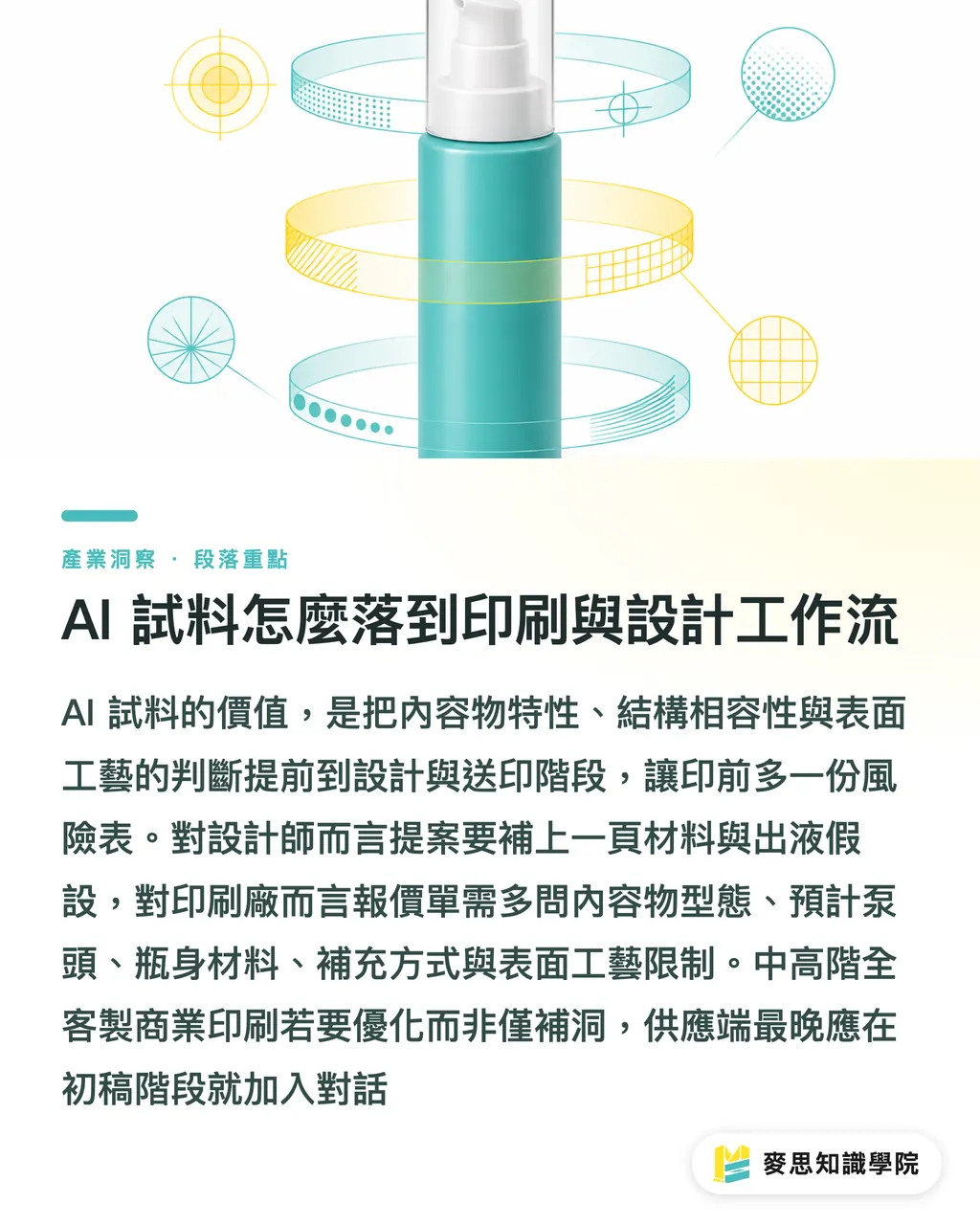
AI here isn't about generating a prettier bottle render. It's about front-loading the judgment call that used to happen at the sample stage. The viscosity, rheology, and pump-compatibility checks Aptar Beauty describes work for printers and designers as a pre-press risk sheet
MINDS' three pre-press checkpoints can be applied to beauty packaging work like this:
・① Formula check: lock down the formula type, viscosity range, dispense method, and storage conditions before the bottle and pump are picked on looks alone
・② Structure check: confirm the neck, refill fitment, pump, label panel, foil area, and transport stacking, so the good-looking shape doesn't eat into mass-production stability
・③ Finish check: put PET, HDPE, glass, internal lacquering, sputtering, and VOC-free coatings on one comparison sheet, so the design pitch can answer cost, recyclability, and feel in the same breath
Designers need an extra page in their deck for material and dispense assumptions. Printers need five more fields on the quote sheet: formula type, intended pump, bottle material, refill method, and surface-finish constraints
If a brand is running mid-to-high-end fully custom commercial print, a supply-side shop like MINDS is better off in the room at concept stage. Once the die, the bottle geometry, and the substrate are locked, printing is just patch duty, not optimization
Why refills rewrite the whole packaging logic
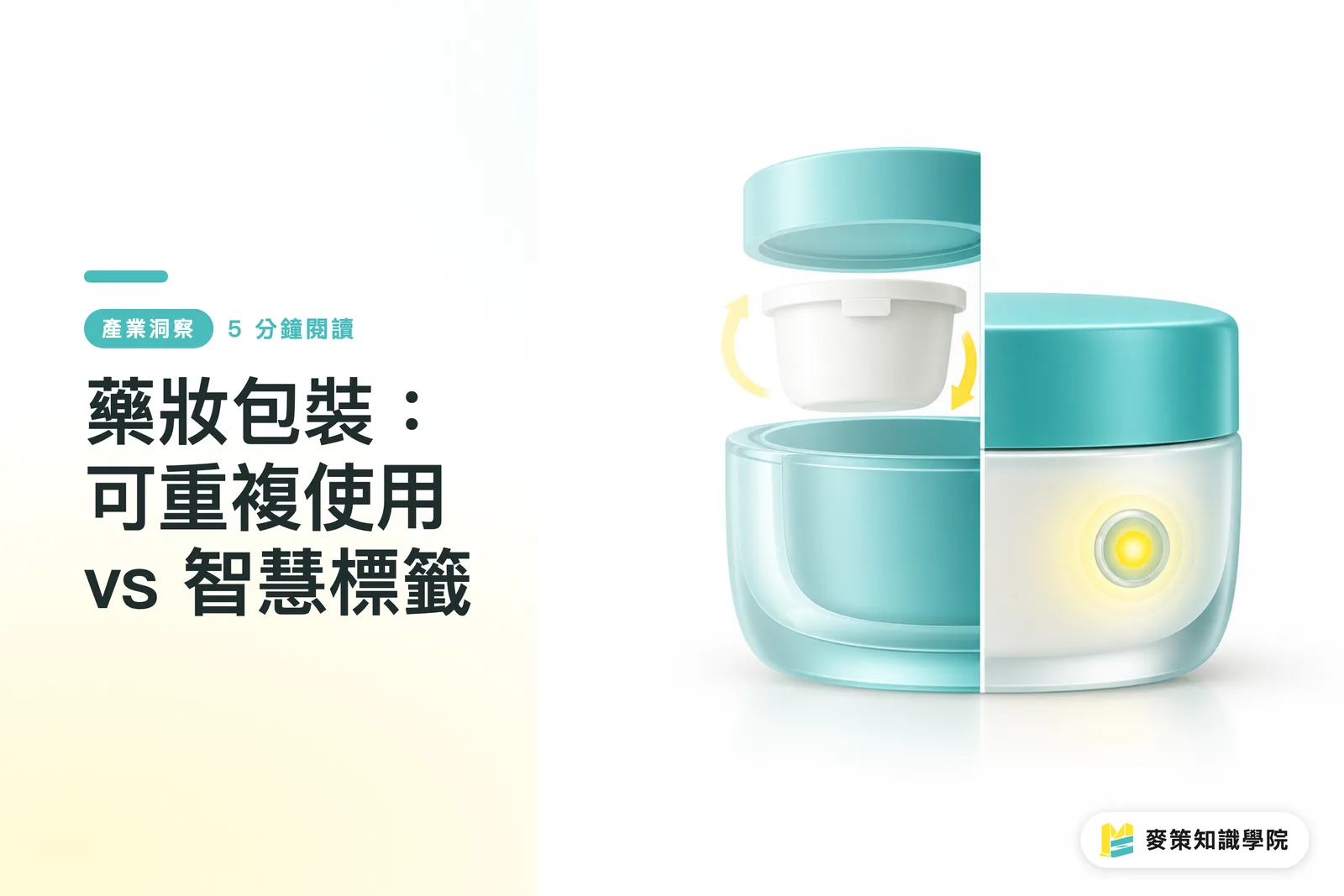
Refillable packaging isn't as simple as swapping a big bottle for a pouch. Bormioli Luigi's interview touched on refillable packaging and lightweighting, which means brands have to design the primary pack, the refill component, the in-use flow, and shelf recognition at the same time
Refill: a packaging model where the consumer keeps the outer bottle or main container and only swaps the formula or inner cartridge. The design priorities are sealing, pouring, cleaning, recognition, and repeat-use durability
Once refills enter the picture, the design checklist grows by at least four items:
・Purchase #1: the primary bottle has to feel premium enough that the consumer actually wants to keep and reuse it
・Purchase #2: the refill component has to pour, swap, or top up without a fight, or the sustainability story gets cancelled out by friction at the sink
・Shelf appearance #3: the primary and refill SKUs need to read as one line on the shelf, so print color drift and label placement can't be running on different tracks
・Recycling #4: the materials, labels, coatings, adhesives, and component breakdown need to make sense to the recycling stream
My advice to small and mid print shops in Taiwan is blunt: when a beauty refill job lands, don't ask about size and quantity first. Ask how many times the consumer is expected to reuse the bottle. That answer drives the carton gsm, label abrasion resistance, varnish choice, and where the instruction copy goes
How low-impact decoration keeps the premium feel
Low-impact decoration isn't about stripping the premium feel. It's about moving that feel from "thick, shiny, heavy" to "precise, accountable, lighter." The internal lacquering, sputtering, and VOC-free coatings Bormioli Luigi points to are the usual next step for beauty packaging on glass and high-end finishes
Low-impact decoration: surface-finish methods that hold shelf presence while using less material and lower-emission processes, including lightweighting, internal lacquering, sputtering, and VOC-free coatings
Printers and designers can de-risk from three angles first:
・Skip the full-coverage heavy decoration: metallics, pearlescents, matte, and spot gloss can be layered in zones, you don't have to stack finishes on every face
・Check the recycling conflicts early: labels, coatings, foil, inks, and the bottle material need to be reviewed together at design stage
・Keep the proof in the file: material specs, finish conditions, supplier notes, and sample records should be managed the same way the final art file is
If a beauty brand wants the Mai Strategy Knowledge Academy advisory team involved, I'd suggest starting by tearing down one hero SKU. Don't try to rework the whole line at once. Run the primary, the refill, the pump, the bottle, the label, and the outer carton through one full pass first, and that's how you find the real bottleneck
What small and mid print shops in Taiwan should do
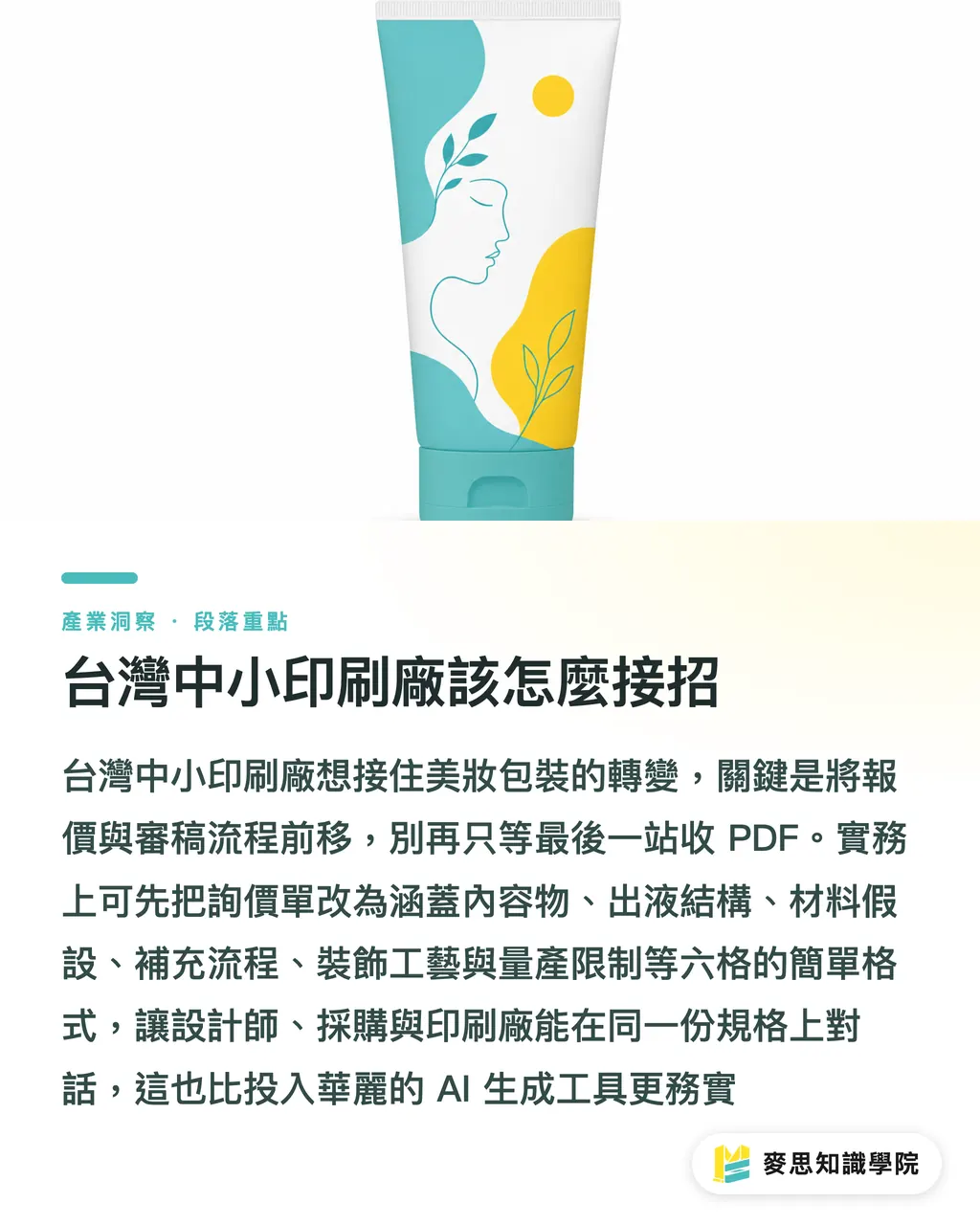
To catch this wave of beauty packaging change, small and mid print shops in Taiwan need to move the quote and proofing process upstream. The AI, automation, PET, refill, and VOC-free coating threads from the three companies Packaging Insights interviewed all point to the same thing: a print shop can't just be the last stop that takes a PDF
My suggestion is to reshape the beauty packaging RFQ into a six-field form. No fancy system needed, just the right questions:
・Product formula: lotion, serum, body or hair care, or color cosmetic, with viscosity and storage requirements noted
・Dispense structure: pump, press cap, dropper, tube, jar, or refill cartridge
・Material assumption: PET, HDPE, glass, carton, label stock, or composite material
・Refill flow: whether there's a refill, replacement cartridge, refill pouch, or return-and-refill design
・Decoration: hot stamping, screen print, label, internal lacquering, sputtering, or VOC-free coating
・Production constraints: MOQ, lead time, abrasion testing, transport stacking, and retail display conditions
For SaaS and AI application teams, this is also a grounded entry point. Skip the flashy image-generation tool for now. Build "beauty packaging pre-press checks" and "formulation-fit intake" first, so designers, procurement, and the print shop are all talking off the same spec
Key takeaways
・Beauty packaging competition is moving upstream, so AI formulation fit, pump compatibility, and material selection have to be reviewed together
・Refills reshape the whole design across the primary bottle, the refill component, the outer carton, the labels, and the instruction copy
・Low-impact decoration doesn't mean dropping the premium feel. It means the premium feel can be backed up by material, process, and recyclability claims
・Small and mid print shops in Taiwan need to extend the RFQ toward R&D, not just collect PDFs and dies at the end
・If a designer's pitch includes material, dispense, and refill assumptions, the brand will make production decisions a lot faster
Further thinking
Beauty packaging from here on out will test the whole supply chain's ability to show up early. Print manufacturing has to upgrade from "ask for size" to "ask about formula, pump, refill flow, and decoration limits." Design has to bridge nice visuals with material and production conditions. AI and SaaS teams should be building the small, accurate tools first: spec collection, risk flagging, pre-quote checks. The digitalization that actually lands on the floor is rarely the flashiest screen. It's the tool that skips one extra tool-cutting, one extra sample round, one extra misquote
Further reading
FAQ
- Why should AI formulation fit be folded into the beauty packaging design process?
- AI formulation fit uses viscosity, rheology, and pump or actuator conditions to pre-check compatibility, so brands can knock out part of the risk before physical sampling. It also gives the print and packaging side earlier visibility into limits on bottle shape, labels, and surface finish
- What does HDPE-to-PET mean for beauty packaging?
- Sidel notes that some professional hair-care lines are moving from HDPE to PET, citing recyclability, lower blow-mold temperatures, energy efficiency, and in-house logistics gains. For the print shop, the material change ripples into label adhesion, screen printing, abrasion resistance, and transport testing
- What's the easiest thing to overlook in refill design?
- The in-use flow. The consumer has to be able to pour, swap, clean, and identify the product without friction. If the refill process is a pain, the sustainability message gets dinged at the sink, no matter how nice the primary bottle looks
- Does low-impact decoration make beauty packaging feel cheap?
- Not at all. Bormioli Luigi points to internal lacquering, sputtering, and VOC-free coatings as ways brands can keep the premium look with more precise processes, while easing material and emissions pressure
- What's the first step small and mid print shops in Taiwan can take?
- Redesign the quote request. Turn formula, pump, material, refill method, decoration, and production limits into a six-field form. It's the lowest-cost move, and it spares beauty packaging jobs a lot of wrong turns before quoting, sampling, and final art
Related articles
The Print × AI weekly
The print and AI know-how designers, brands and enterprises can use before they commit — one email, every week
MINDS Free Tools
AI background removal, brand stamping, and a LINE sticker maker — free design tools, right in your browser, no upload.
MINDS Group
Need actual printing or gifting services?
From premium printing to online ordering and festive gifts — the MINDS Group sister brands take it from here.