

What Has AI Quality Control Changed in Pharmaceutical Packaging?
AI quality control changes pharmaceutical packaging by putting "spotting anomalies" and "tracing a batch back" into the same workflow
AI quality control is a method that uses image inspection and data interpretation to help identify packaging anomalies, then feeds the results back into quality-control records
At Pack Expo 2026, Antares Vision's president centered the discussion on traceability and quality inspection for pharmaceutical packaging, connecting the solutions to compliance and production-line efficiency. See Pack Expo 2026: Antares Vision Focuses on AI Quality Control for Pharmaceutical Packaging
I have seen work orders on the shop floor that kept only a "passed" stamp, with no way to find the file version or where the batch went. That is exactly where AI quality control has something to teach us
Why Should Printers Care About Pharmaceutical Packaging?
Printers should care about pharmaceutical packaging because it turns an ordinary print defect into a batch responsibility that can be traced
Traceability is the practice of linking materials, approved files, print batches, inspection results, and shipping records back through the same identifier
Take a folding carton. If text, a lot number, or a barcode is wrong, the customer needs to know more than which sheet is wrong. They also need to know which version it came from, which batch it belongs to, and which finished goods must be quarantined
Pharmaceutical compliance requirements do not necessarily apply word for word to ordinary commercial packaging, but food, supplements, and personal-care packaging can all borrow the same way of thinking
If a printer delivers only the finished goods, the customer still has to ask around when a complaint comes in. Lead times and trust both slow down
How Do Vision Inspection and Traceability Become One Workflow?
Vision inspection and traceability become one workflow through shared identification data and clear disposition rules. Two reports kept separately cannot establish who is responsible
Vision inspection compares images of the printed surface or packaging condition to spot differences that the human eye can easily miss, then writes the result back to the work order
I break it into three checkpoints
・1. Prepress confirmation: Lock down the approved file, version, and inspection criteria so the shop floor knows which file to use for production
・2. In-production inspection: Set sampling or full inspection according to product risk. Any anomaly must include its location, image, or reason for the judgment
・3. Shipment traceability: Keep inspection results, quarantine or release decisions, and batch-shipping data in the same history record
When a complaint comes in, these three checkpoints can first narrow down the affected batches, then guide the decision to rework, reprint, or release them. There is no need to search through an entire batch by hand
How Should Small and Midsize Printers Introduce AI Quality Control?
For a small or midsize printer, AI quality control should start with one high-risk, highly repetitive packaging workflow. Run it through one complete order cycle before expanding
I call it "Mai Strategy's Three Gates for Print Submission."
・1. Data consistency gate: Make sure quotations, work orders, approved files, and batch identifiers match up
・2. Inspection decision gate: Define defects, the person responsible for second review, and the conditions for stopping the line or quarantining product
・3. Delivery traceability gate: Confirm that inspection results link back to shipment batches, with no orphaned reports
Advantages:
・A small-scale pilot makes it easier to see missed defects, false positives, and manual bottlenecks
・Equipment, software, and training can be phased in according to the cost of each defect
Drawbacks:
・If file names and work-order fields are a mess, AI will only make the resulting traceability problems spread faster
・Without a person responsible for second review, more alerts will not shorten lead times
Map the data flow from order intake to shipment before talking about equipment brands. The shop floor is less likely to go off course
How Should SaaS, Designers, and Brand Customers Work Together?
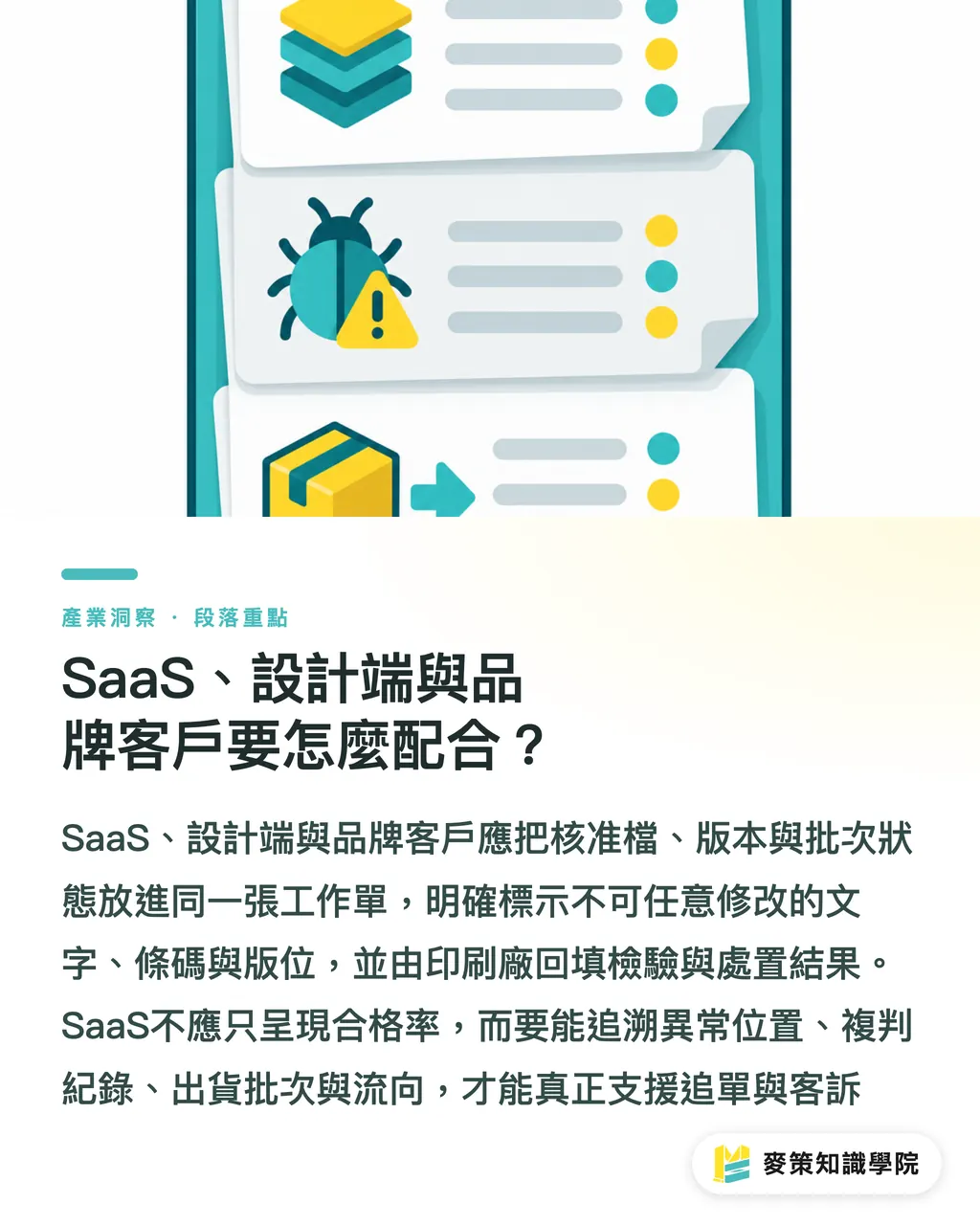
SaaS, the design team, and brand customers should first put three types of data into the same job ticket, so everyone sees the same version and batch status
The design team should clearly mark text, barcodes, image-and-copy positions, and version fields that must not be changed arbitrarily. The printer should fill in inspection results and disposition. The brand customer should confirm release conditions before proofing
A SaaS interface should at minimum let people find three things:
・The approved file and version
・The anomaly location, inspection result, and second-review record
・Batch shipment and subsequent disposition
I care a lot about the last one, because a dashboard that shows only the pass rate does little for the shop floor. To support repeat orders and complaints, you need to know which batch it was, who made the call, and where the goods went
To connect this logic to quoting, proofing, print submission, and follow-up orders, the Mai Strategy Knowledge Academy consulting team can help separate the fields and responsibilities, so SaaS supports the workflow instead of becoming just another screen
Key Takeaways
・The value of AI quality control lies in being able to tie every anomaly back to a batch and a disposition record
・What pharmaceutical packaging offers as a model is a workflow that combines traceability and vision inspection
・Small and midsize printers should start with one high-risk workflow and first verify that the data can be connected
・If SaaS shows only a pass rate but cannot find the version and batch, quality control is still fragmented
Further Thoughts
I would suggest that a printer use one packaging job with fixed specifications as a pilot. First verify that the data, anomaly handling, and batch traceability connect properly, then decide on the equipment and AI budget. Designers should organize versions and non-editable fields in advance. Brand customers should spell out release conditions before proofing. If you also want to validate the shop-floor workflow for mid- to high-end custom commercial printing, you can discuss it with MINDS
Further Reading
FAQ
- What was the focus of Antares Vision at Pack Expo 2026?
- Antares Vision's president focused on AI quality control for traceability and quality inspection in pharmaceutical packaging, connecting these capabilities to compliance and production-line efficiency
- Why can general printers learn from pharmaceutical packaging?
- The vision-inspection and traceability logic used in pharmaceutical packaging can also manage versions, batches, and customer complaints for food, supplements, personal-care products, and demanding commercial packaging
- Do small and midsize printers need to buy AI inspection equipment first?
- No. They should first choose one workflow, organize the approved files, work orders, inspection criteria, and batch records, then assess whether equipment will solve the shop-floor bottleneck
- What is the designer responsible for in an AI quality-control workflow?
- Designers should clearly mark the version, barcode, text, and image-and-copy positions that cannot be changed arbitrarily, so the prepress file can serve as the basis for later inspections
- Which data should a SaaS system connect at minimum?
- At minimum, SaaS should connect the approved-file version, inspection results and second-review records, and shipment-batch and disposition data, so anomalies can be traced back to a specific work order
Related articles

The Print × AI weekly
The print and AI know-how designers, brands and enterprises can use before they commit — one email, every week
MINDS Free Tools
AI background removal, brand stamping, and a LINE sticker maker — free design tools, right in your browser, no upload.
MINDS Group
Need actual printing or gifting services?
From premium printing to online ordering and festive gifts — the MINDS Group sister brands take it from here.