
Why Do PCR Odor and Color Vary?
PCR (Post-Consumer Recycled) refers to materials that have been used by consumers, collected, and reprocessed before returning to packaging or printing applications. Source variation shows up directly in odor and base color
Sensory quality tolerance means the brand defines upfront what level of odor intensity, base color shift, and print variation consumers can accept, so sourcing, proofing, and production all work from the same standard
In food and personal care packaging projects, I treat this as an adoption condition. PCR odor can affect how consumers judge cleanliness, and base color changes the first impression of brand colors. When both gaps appear at once, clients often mistake a material issue for a printing problem
Food and personal care packaging both run into this threshold. The deinking, deodorization, and color-matching constraints discussed in PCR Recycled Material Odor and Color Challenges: Sensory Quality Strategies for Brand Clients and Printers are exactly what needs to be spelled out before production
I don't start by asking whether pure white is achievable. I start by asking which sensory differences the brand cannot accept
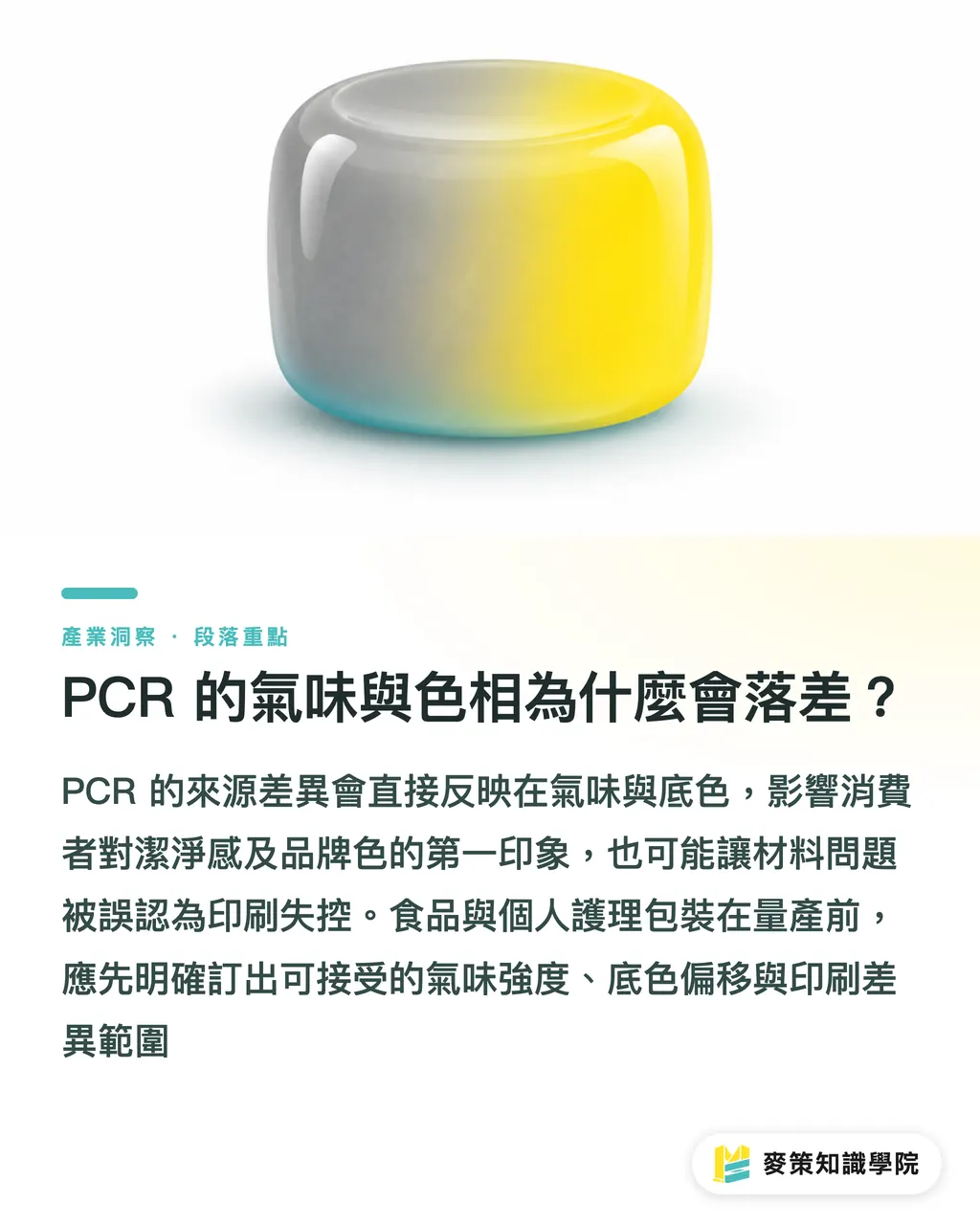
How Should Brand Clients Set Sensory Quality Tolerances?
Brand clients should spec out odor, base color, and print performance separately, then use physical samples to define the acceptable range
The most common phrasing is "no off-odor, color must be consistent." It sounds strict, but it has no judgment power in production. Odor specs need to state the smelling distance, the timing after opening, and whether comparison to virgin material is required. Color specs need to name the reference sample, observation light source, and acceptable base color shift range
Color rendering is a light source's ability to reproduce an object's true colors. Different light sources make the same PCR color block appear different in brightness and saturation, which affects on-site brand judgment
Odor needs acceptance testing too
I ask brands to prepare three types of samples
・Acceptable sample: the sensory range production should consistently land in
・Boundary sample: close to the upper limit, shared with sourcing and the printer for joint evaluation
・Unacceptable sample: differences that exceed what the brand image or use context can absorb
If a brand only documents PCR content percentages without odor and color samples, the ESG communication may look complete, but consumers can still be confused when they receive the packaging
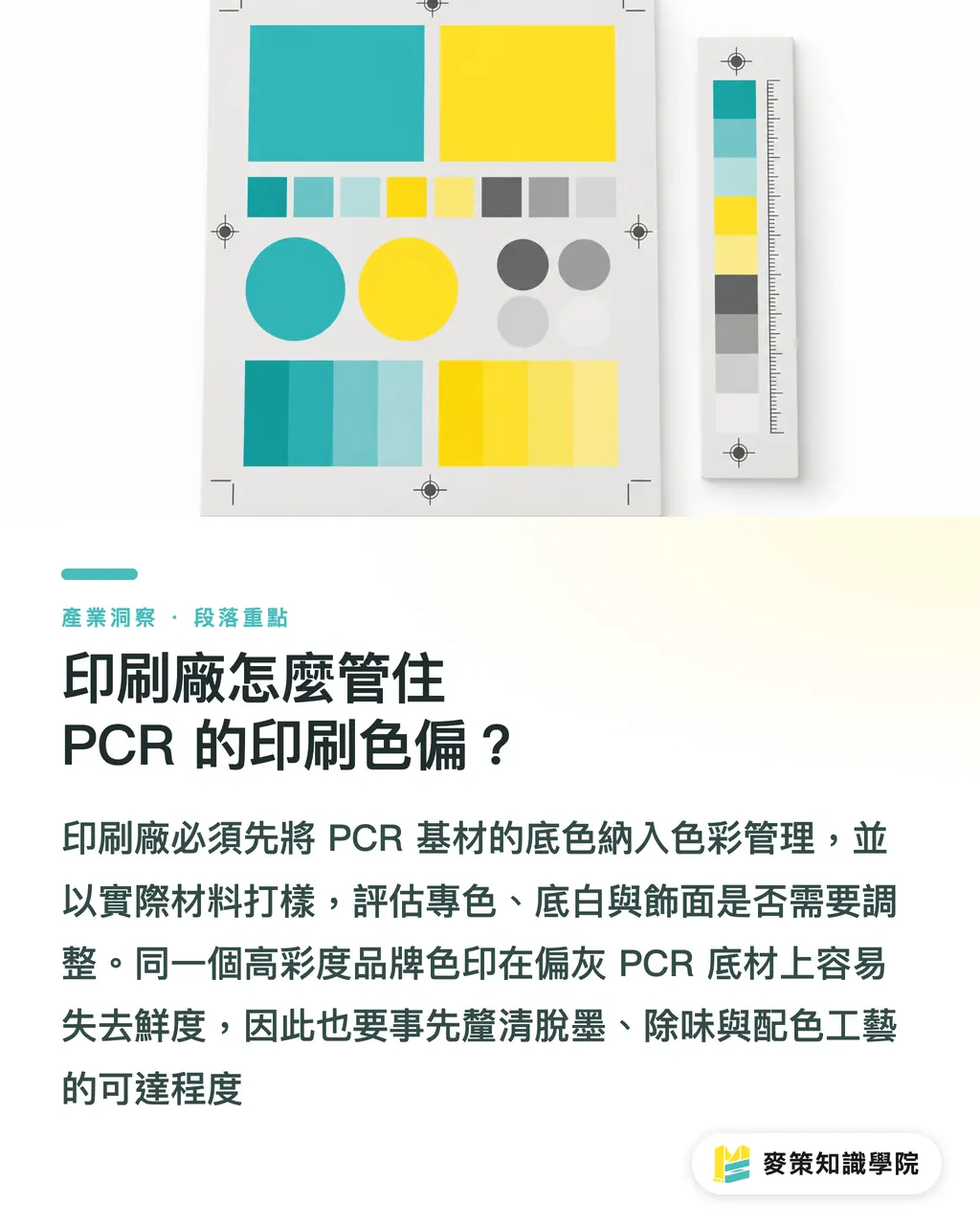
How Do Printers Manage PCR Print Color Shift?
Printers need to factor the PCR substrate's base color into color management before deciding whether brand colors can match the original artwork
Deinking and deodorization are the processing steps that address color residue and odor respectively during recycling, but both have technical limits and cannot make every PCR batch look like a uniformly white substrate
An ICC profile (International Color Consortium profile) is a file that translates a device or material's color behavior into a set of exchangeable rules, giving screens, files, proofs, and presses a shared reference
I require printers to run a proof on the actual PCR substrate, first to see how the base color affects ink, then to evaluate whether spot colors, white underprinting, or finishing treatments need adjustment
See the physical sample first
A high-chroma brand color on a grayish substrate easily loses the vibrancy of the original artwork. If you only check against a screen view or a white-paper sample, the problem usually won't surface until production. Printers need to be clear at the proofing stage about what deinking, deodorization, and color matching can and cannot achieve, so brands have enough information to decide whether to accept
How Should Designers Handle PCR's Natural Base Color?
Designers need to treat PCR's natural base color as a layout condition, so color shifts land somewhere predictable
Finishing refers to post-press surface treatments like varnishing and lamination. It changes the appearance and feel of the material and affects how consumers perceive the overall quality of the packaging
I usually ask brands to identify the elements that cannot move: logo, primary color, product name, required information. Backgrounds, textures, and large color blocks are left to work with the PCR base color. This isn't lowering design standards. It's placing those standards where consumers actually look
Food packaging often needs to convey cleanliness at first glance. Personal care packaging cares even more about freshness and consistency. Neither situation is suited to smelling and viewing samples for the first time at production
When a designer submits files, they should at minimum include the actual substrate, reference samples, and finishing conditions. If the brand is reviewing a proof that doesn't reflect the final finishing, the sign-off means nothing. Adjusting color blocks at the layout stage is almost always simpler than reworking an entire file set after production
How Do Brands and Printers Use Mai Strategy's Three-Checkpoint Print Submission Process?
Mai Strategy's three-checkpoint print submission process is suited to breaking PCR projects into three decision points: source confirmation, sensory proofing, and production acceptance, so brands can make choices while there's still room to adjust
・1. Source confirmation: sourcing documents specify PCR raw material, substrate base color, odor evaluation context, and reference samples, with sustainability communication and sensory specs in the same document
・2. Sensory proofing: run a proof on the actual substrate, record odor, color, brand identity, and finishing results separately, and don't let a screen view substitute for a physical sample
・3. Production acceptance: judge the first batch against the acceptable sample, the boundary sample, and the specified light source. When results fall outside range, document the adjustment path upfront, whether that's color correction, reformulation, or batch substitution
For help translating brand requirements into sourcing orders, proof specs, and acceptance forms, contact the Mai Strategy Knowledge Academy consulting team. Mid-to-high-end fully custom commercial printing can also be handled by MINDS with on-site proofing support
I define sign-off as "this range is ready for production," not "every sheet must be identical." Whether PCR can make it into brand packaging ultimately comes down to whether all parties can make a judgment call from the same physical reference
Key Takeaways
・PCR odor and color tolerances need to be set at the sourcing stage. Addressing them after production has already started is usually too late
・Brand colors need to be proofed on actual PCR substrate. Screen views and white-paper samples cannot serve as the sole acceptance standard
・Deinking, deodorization, and color-matching techniques have limits. Printers should make those limits clear before sign-off
・Acceptable samples, boundary samples, and unacceptable samples turn sensory disputes into executable judgments
・When designers protect brand identity elements and let backgrounds and finishing work with the base color, PCR has a real chance of landing consistently
Further Thinking
On the manufacturing side, printers can add fields for PCR base color, odor context, observation light source, and reference samples directly into their quoting, proofing, and acceptance workflows. On the design side, AI and design SaaS tools can help organize versions, specs, and proof records, but the final call on smell and light source still has to come back to physical samples and people. Brand teams can start with a small test run on one food or personal care package, observe how consumers respond to odor, color, and shelf recognition, then feed the results back into sourcing specs
Further Reading
FAQ
- Does PCR recycled material always have an off-odor?
- PCR doesn't necessarily carry off-odors, but variation in source and processing can produce sensory gaps in food and personal care packaging. Brands should accept on the basis of physical samples and clear tolerances
- Why is PCR substrate color harder to control than virgin material?
- PCR base color can be affected by recycling source and processing conditions. Deinking and color matching have technical limits, so brand colors must be proofed on the actual substrate rather than checked against a screen
- How should brands accept PCR packaging for odor and color?
- Prepare acceptable, boundary, and unacceptable samples, specify the observation light source and odor evaluation context, and document the results in sourcing and production acceptance records
- Can designers carry their original brand colors over directly?
- The original brand colors can serve as a direction, but they must be reproofed on PCR substrate. If base color shift is significant, adjust the spot color, background, or finishing to protect recognizability
- Can AI or SaaS solve PCR sensory quality problems?
- AI and SaaS can organize specs, versions, and proof records, but they can't replace physical odor testing, specified light sources, and brand sign-off. Sensory judgment still comes back to people and physical samples
Related articles
The Print × AI weekly
The print and AI know-how designers, brands and enterprises can use before they commit — one email, every week
MINDS Free Tools
AI background removal, a LINE sticker maker, spine & imposition calculators — all free, right in your browser, no upload.
MINDS Group
Need actual printing or gifting services?
From premium printing to online ordering and festive gifts — the MINDS Group sister brands take it from here.