

Overview
Packaging design has entered the compliance era. That means materials, labeling, recycling paths, and brand responsibility need to be decided together at the design file stage. When MINDS (MS, a mid- to high-end fully custom commercial printer) reviews packaging projects, it checks whether the work "looks good" inside three harder questions: can it be printed, can it be sold, and can it be recycled?
Over the past month or two, I have clearly felt this shift on the client side. Sustainable packaging is no longer a nice line tucked into a design proposal. On July 14, 2026, the US Plastics Pact released new circular packaging design guidance, and Packaging Insights discussed California's food date labeling law and beauty packaging accountability in the same context that day. The signal is clear: packaging design is now expected to show choices that can be verified
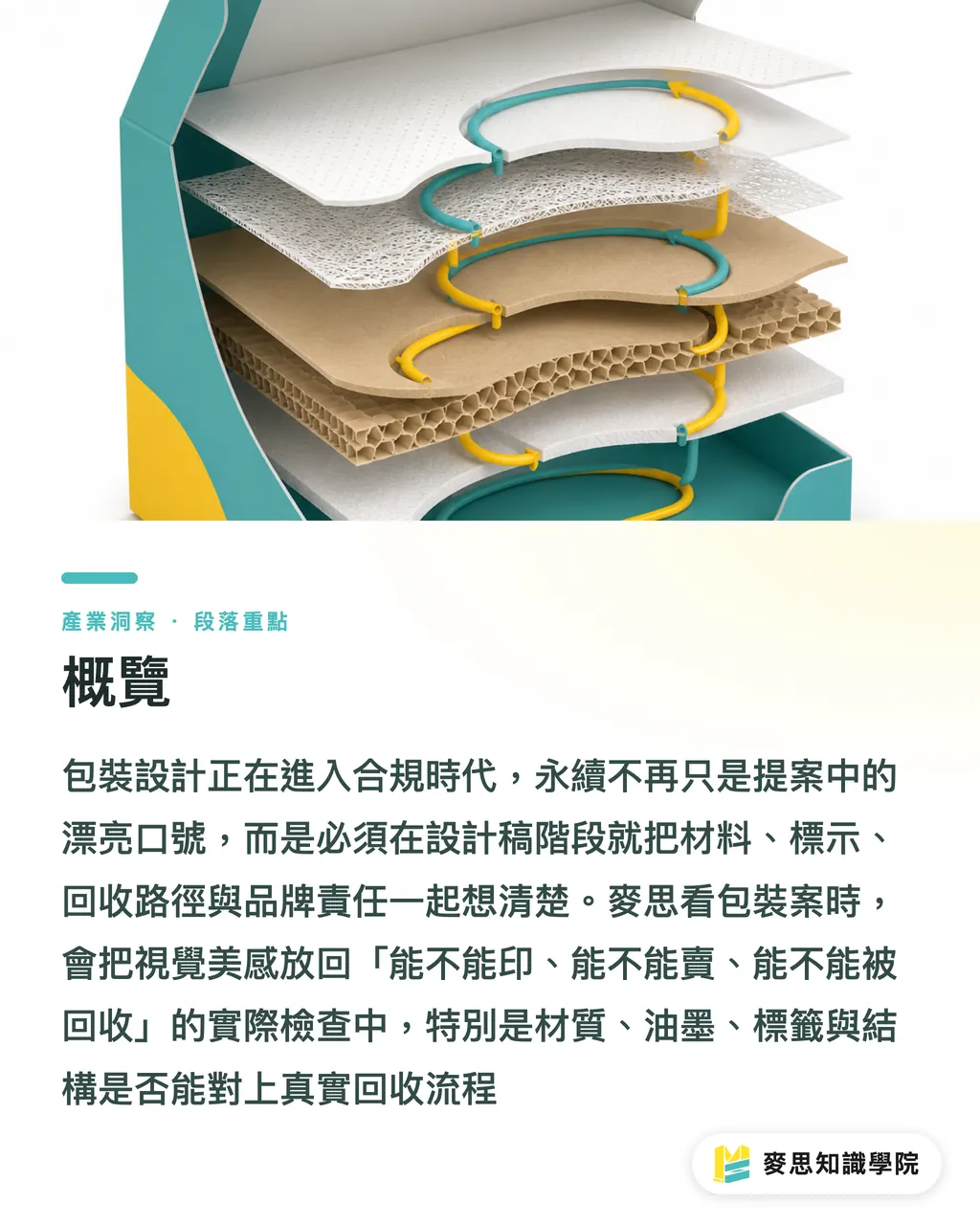
Circular packaging design: an approach that considers, from the design stage, whether packaging materials can be recycled, reused, or returned to a circular system. The point is not swapping in an eco-friendly phrase. The point is making sure materials, inks, labels, structures, and end-of-use handling match real recycling processes
Why does packaging design need to address compliance first now?
The US Plastics Pact circular packaging design guide, released on July 14, 2026, reminds the packaging industry of a very practical point: recyclability is not a claim printed on a box. It is the design outcome of choices traced back through material combinations, structure, labels, and usage scenarios
The traps printers fall into most often are usually not at the machine. They are in the design file before proofing. If the design file already crams mixed-material lamination, metallic ink, spot film, large areas of dark ink, and tiny mandatory text into the same layout, then adds "we hope this can meet sustainability requirements," there is not much room left to adjust on the floor
I suggest brands ask 4 questions at the start of a project, instead of waiting until the dieline is delivered to patch things up
・Is the main packaging material paper, plastic, composite, or a mix of multiple materials?
・After consumers finish using it, can the label, bottle, and box be separated easily?
・Do the recycling information and date label have enough layout space, instead of being pushed into the corners by the main visual?
・Does the beauty, food, or e-commerce packaging involve extra labeling, responsibility, or reuse requirements?
In mid- to high-end custom packaging projects, what MINDS does most often is not make the design "more conservative." It breaks a beautiful design into printable, recognizable, and explainable material and finishing options. If this step happens early, proofing costs later drop a lot
Why does date labeling affect packaging design?
California's food date labeling law requires more standardized date terminology starting July 1, 2026. Packaging Insights noted that the U.S. market had previously seen more than 50 different date phrases. From a print consultant's point of view, this is not a small legal wording tweak. It is a reset of packaging layout rules
Date labeling involves 3 things
・Terminology: different products cannot casually mix concepts such as "best before," "expiration date," and "sell by."
・Placement: the date must be visible to consumers, and easy for retail channels, warehousing teams, and customer service to read quickly
・Variability: batch numbers and dates are often added later by inkjet printing or thermal transfer, so the design file needs to reserve a clean area
I have seen plenty of packaging files where the main visual is fully resolved, but the date area is placed near a fold line, next to a coating area, or too close to a dark background. By the time inkjet printing on site reveals unstable legibility, changing the layout hurts much more than changing the copy
For food, health, and beauty brands in Taiwan, date labeling is not a fine-print rule. It affects the dieline, blank space, ink absorption, finishing sequence, and even return handling and customer service decisions. If designers treat the date area as part of the packaging information architecture, printers can explain the risks much earlier
Why can't beauty packaging focus only on a premium look?
Packaging Insights discussed the tension between aesthetics and accountability in beauty packaging on the same day, and this topic hits close to home for me. Beauty clients often care about handfeel, gloss, bottle proportions, and the unboxing ritual. All of that matters. But in 2026, a packaging proposal that only talks about looking good is no longer enough
Beauty packaging has to handle at least 4 layers of responsibility at the same time
・Visual responsibility: brand identity needs to stay steady, and the information hierarchy needs to be clear
・Material responsibility: bottles, box materials, labels, and sealing films should not make recycling harder for one another
・Labeling responsibility: capacity, ingredients, expiration date, batch number, and required warnings need to be readable
・Channel responsibility: e-commerce shipping, in-store display, returns, and exchanges all need to be considered
This is where design and print coordination is tested most. Beauty packaging often uses foil stamping, matte film, specialty paper, spot UV, cold foil, or high-opacity white ink. These processes can lift the perceived quality, but they can also complicate material recycling, label readability, or future revisions. Good craft is not off limits. You just need to know where to use it, what you are giving up, and whether you can explain the choice
When the consulting team at Mai Strategy Knowledge Academy reviews packaging with brands, it puts aesthetics and responsibility on the same checklist, instead of waiting until after printing to discuss whether "this counts as eco-friendly." Once packaging enters the market, responsibility travels with the product into consumers' hands
How should small and mid-sized printers in Taiwan respond?
Small and mid-sized printers in Taiwan do not need to wait for every European and U.S. regulation to land one by one before preparing. The US Plastics Pact's July 14, 2026 discussion of circular packaging design and California's July 1, 2026 cleanup of date terminology point in the same direction: clients will ask printers compliance questions more often
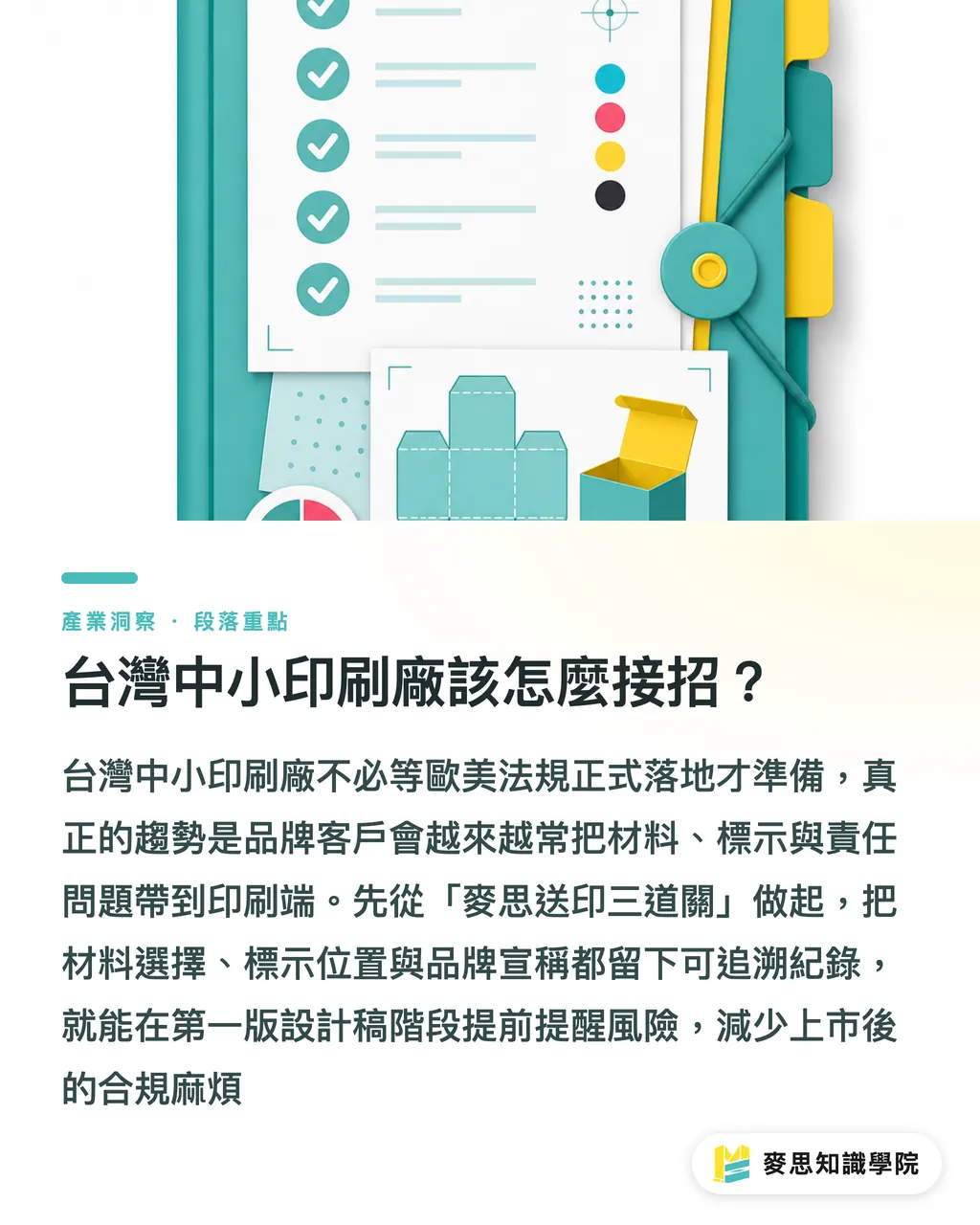
I suggest starting with the "MINDS (MS) three prepress gates." Simple, but effective
・① Material gate: confirm whether the main material, lamination, film, ink, and label conflict with one another
・② Labeling gate: confirm that the date, batch number, recycling information, warnings, and required text have fixed positions
・③ Responsibility gate: confirm whether brand claims can be supported by the packaging material choices, printing methods, and channel scenarios
This approach does not require buying an expensive system from day one. Small and mid-sized printers can first turn quotations, artwork guidelines, and proofing records into traceable formats, so every change in material, film, or label position leaves a record. AI and SaaS tools can help check layout text, compare versions, and flag missing fields, but the final call still needs to come back to regulations, materials, and production reality
For brand clients, a good printer is not just one that quotes fast. The real value is being told from the first design file: this label is too small, this material combination will be hard to explain later, and this recycling claim should probably be toned down first. Those comments may not sound glamorous, but they prevent a lot of trouble after launch
Key Takeaways
・Packaging compliance is not a final prepress note. It is a direction that needs to be decided on day one of the design file
・Date labeling may look like small text, but it affects layout, inkjet printing, warehousing, and return decisions
・A premium feel in beauty packaging must be able to explain materials and responsibility. Beautiful but hard to justify becomes a risk
・For small and mid-sized printers, building three checks around materials, labeling, and responsibility is more useful than chasing new buzzwords
・AI and SaaS are well suited to version comparison and missing-field reminders. Compliance judgment still belongs with people who understand regulations and production
Further Thinking
For print manufacturers, the next step is to change quoting and proofing into a process that asks about materials and labeling before talking about craft. For designers, the next step is to treat the date area, recycling information, and required labels as part of the main layout structure, instead of squeezing small text in at final artwork. For AI and SaaS teams, the truly valuable product is not a tool that writes a few sustainability lines for people, but one that helps brands manage packaging versions, labeling fields, material choices, and review records. For Taiwanese brands, working with a partner like MINDS, which understands custom packaging and prepress communication, will save more time than scrambling for fixes right before launch
Further Reading
FAQ
- What does it mean that packaging design has entered the compliance era?
- Packaging design entering the compliance era means design files can no longer be judged only by visual impact. They also need to confirm whether materials, date labeling, recycling information, and brand responsibility can be supported by the printing process and channel scenarios
- What should circular packaging design check first?
- Circular packaging design should first check the main material, mixed-material lamination, label separability, ink and film choices, recycling information placement, and whether the package can realistically enter recycling or reuse after consumers finish using it
- Why does date labeling affect final print artwork?
- Date labeling affects layout spacing, inkjet placement, background color, finishing sequence, and readability. California's move toward more standardized food date terminology starting July 1, 2026 also shows that the market is trying to reduce labeling confusion
- How can beauty packaging balance aesthetics and responsibility?
- Beauty packaging can keep tactile processes such as foil stamping, matte film, and specialty paper, but it should first confirm that labels are readable, material combinations can be explained, and recycling claims are conservative and backed by evidence, so beautiful packaging does not turn into accountability pressure after launch
- What can small and mid-sized printers in Taiwan do first?
- Small and mid-sized printers in Taiwan can first set up three checks: material gate, labeling gate, and responsibility gate. They should keep records of quoting, proofing, revisions, and final artwork, so brands can see compliance risks before packaging goes to market
Related articles



The Print × AI weekly
The print and AI know-how designers, brands and enterprises can use before they commit — one email, every week
MINDS Free Tools
Spine width and imposition calculators — skip the manual math, free in your browser.
MINDS Group
Need actual printing or gifting services?
From premium printing to online ordering and festive gifts — the MINDS Group sister brands take it from here.