
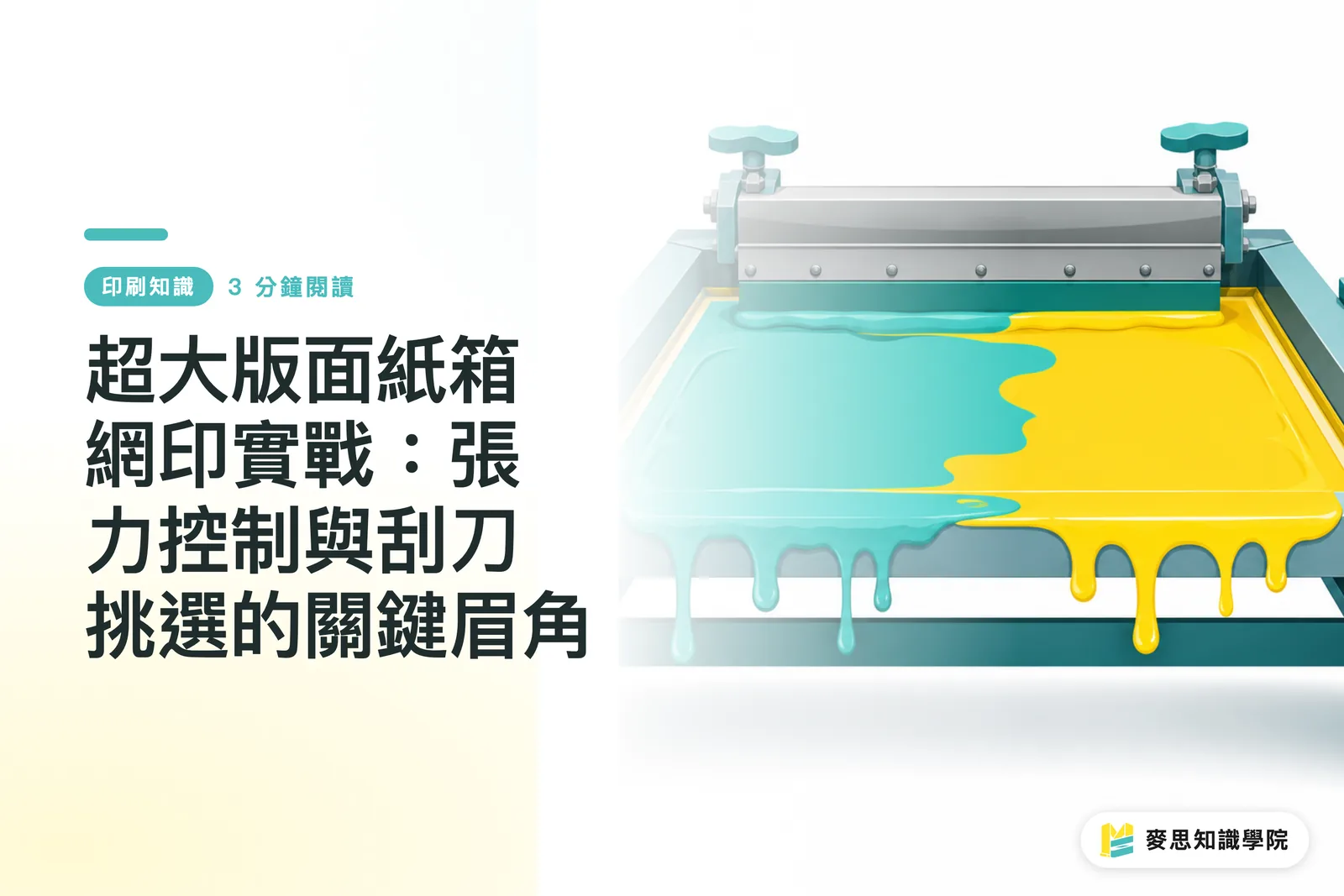
Why is Everyone Challenging Oversized Cardboard Box Screen Printing Now?
When it comes to mastering oversized cardboard box screen printing, the key is never simply throwing money at larger machinery. Instead, it lies in mastering the "MINDS Three Pillars of Large-Format Control": ① Enhancing squeegee rigidity to ensure uniform pressure ② Adjusting ink viscosity to prevent edge-drying ③ Precisely controlling screen tension across large areas
Lately, I've visited several screen printing factories in central and southern Taiwan, and it's clear that factory managers are all struggling with the same issue: orders for custom e-commerce packaging and massive retail floor display boxes are on the rise, but these dimensions often push beyond the comfort zones of their existing screen frames
In the past, when faced with such full-bleed, large-scale prints, many shops' first reaction was to reluctantly turn them down or outsource them. Yet, the ability to take on these oversized orders is precisely where the highest margins lie
After all, the physical characteristics of screen printing, its tolerance for heavy ink laydown and its ability to achieve superb saturation on corrugated cardboard, make it the ultimate savior for dark cardstock or kraft boxes that offset printing simply cannot handle

How Do You Control Screen Tension for Oversized Dimensions?
Once the format scales up, the difficulty of managing screen tension rises exponentially
For standard sizes, you might think just pulling the mesh tight is enough. However, on oversized screens, the difference in tension between the center and the four corners becomes extremely pronounced
Once tension becomes uneven, printed lines will distort, or large solid color blocks will suffer from noticeable moiré patterns
In practice, supporting an oversized screen requires a much sturdier frame structure than usual, sometimes even requiring auxiliary bracing on the backside
This is also why seasoned technicians stretch large screens in multiple stages. This gives the mesh fibers time to release stress and reach equilibrium. Only when the tension is stable do you have the foundation to flawlessly execute a designer's wildest concepts
The Physics of Squeegee Durometer and Ink Viscosity
Another pain point of oversized screen printing is the constant tug-of-war between squeegee pressure and ink drying time
When printing smaller items, a standard rubber squeegee does a clean, crisp job. However, when the printing width extends to 1 or 2 meters, a standard squeegee will inevitably sag or flex in the middle. This directly leads to faint, incomplete prints in the center and overly heavy ink deposits on the sides
To combat this, you must switch to custom, high-rigidity oversized squeegees, or even use composite, multi-durometer squeegees with a hard core and soft outer layers to maintain uniform pressure across the entire stroke
At the same time, the formulation of ink viscosity must be adjusted accordingly
Because large-area printing takes longer per stroke, ink at the edges can dry out and clog the mesh if it evaporates too quickly. Moderately adding retarders to lower viscosity ensures that ink flow remains consistent from the start to the end of the print stroke. This is a zero-cost, hidden key to expanding your shop's capabilities
How Can Small and Medium-Sized Printers Capture High-Margin Custom Orders?
At the end of the day, these technical tricks are simply a matter of hardware support combined with minor adjustments based on experience
Once you master the balance between squeegee rigidity and ink viscosity, you can take on those troublesome, odd-sized orders that others turn away, all within your existing workshop setup
This tests not only the technician's craftsmanship but also the shop's consumables management
For brand clients or designers seeking exceptional visual impact, if your design happens to be stuck in that awkward spot where it is too large or uses a material that offset printing cannot handle, consider collaborating with a team like MINDS, which brings extensive experience in mid-to-high-end fully customized commercial printing
Leave the technical challenges of tension control and color registration to the professionals, and focus your energy entirely on maximizing the visual impact of your packaging

Key Takeaways
・Large-format screen printing isn't just about switching to a bigger machine; the core lies in resolving squeegee pressure and uneven screen tension when the surface area scales up
・Switching to high-rigidity or composite-material squeegees provides a physical line of defense against center sagging and incomplete prints during large-scale runs
・Ink viscosity must be adjusted in sync with printing times; slowing down the drying speed moderately is essential to prevent mesh clogging at the edges of oversized screens
・Mastering these fine-tuning techniques on existing equipment serves as a stepping stone for small and medium-sized screen printing shops to enter the high-margin custom packaging market
Further Thinking
For print shops, pushing the capabilities of existing equipment to the limit and finding the perfect feel for large-format screen control is an effective defense against low-price competition. For brands and designers, understanding the advantages of screen printing on thick inks and special substrates, and incorporating size limits into their design process, allows them to create physical packaging with greater visual impact in retail channels. Aligning design concepts with the physical realities of the machinery is the true shortcut to turning great creativity into great business
Further Reading
FAQ
- Why are colors in large-format screen printing often uneven?
- This is primarily because large squeegees tend to flex in the middle under pressure, resulting in insufficient central pressure and incomplete print transfers. Alternatively, the weaker tension in the center of a large-format screen can cause uneven ink deposition
- What should I do if the mesh keeps clogging during oversized screen printing?
- A larger format means that each squeegee stroke takes longer, making ink at the edges more prone to evaporation and drying. You must readjust the ink viscosity by adding an appropriate ratio of retarder to maintain stable ink properties throughout the printing process
- What should designers keep in mind when creating oversized, full-bleed floor displays?
- In addition to confirming the factory's maximum printable size, understand that large-format screen printing involves minor registration tolerances. It is recommended to leave sufficient bleed and allowance in the design, and to verify the ink drying times and overprinting sequence with a professional shop like MINDS
Related articles

The Print × AI weekly
The print and AI know-how designers, brands and enterprises can use before they commit — one email, every week
MINDS Free Tools
Spine width and imposition calculators — skip the manual math, free in your browser.
MINDS Group
Need actual printing or gifting services?
From premium printing to online ordering and festive gifts — the MINDS Group sister brands take it from here.