

Overview
When mixing digital and offset printing for the same job, MINDS (MS) usually recommends clearly defining the 'acceptable color tolerance, reference samples, and paper stock specs' before deciding which portion goes digital and which goes offset. Without upfront standards, re-runs can easily lead to finger-pointing on-site

When is a Mix of Digital and Offset Printing Used for the Same Batch?
There are two common scenarios. First, a client prints an initial run of 3,000 or 5,000 copies using offset printing to drive down the unit cost, and later requests a quick rerun of 50 or 100 copies using digital printing for retail stores. Second, a rush order requires 100 copies for an event tomorrow, followed by offset printing for full-scale production
Common definition of digital printing: Direct output of CMYK files using toner or inkjet without the need for plates. It is ideal for small runs, rush jobs, and variable data, though colors are subject to equipment calibration and paper stock characteristics
Common definition of offset printing: Ink transfer to paper via printing plates and rubber blankets. It is suited for stable, high-volume production; while plate-making and setup costs are high, the unit cost decreases as the print volume increases
From my experience on the production floor, the most common issues do not arise from whether something can be printed, but rather from differing expectations of 'the same batch' among sales, designers, and clients. Clients expect the same PDF to look identical across runs, whereas printers know that ink density, halftone dots, and paper ink absorption will never be perfectly identical between the two setups. This gap in expectations must be clarified before quoting
Where Do Color Variations Occur When Mixing Digital and Offset?
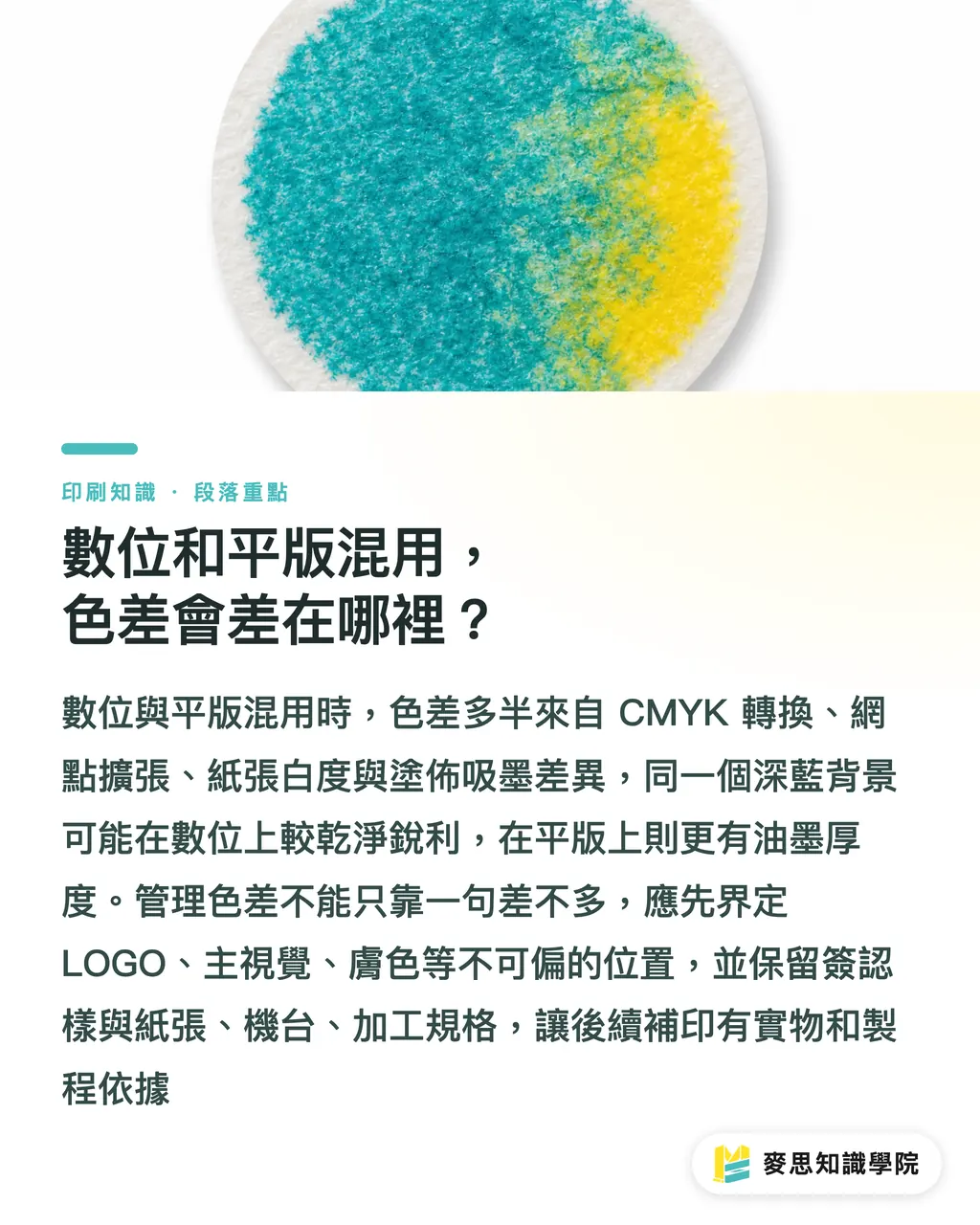
Color variations typically stem from four factors: CMYK conversion, dot gain, paper whiteness, and surface coating ink absorption. For instance, with the same dark blue background, digital printing may appear cleaner and sharper, whereas offset printing may exhibit richer ink density on large solid areas. However, placing them in the same stack will reveal a noticeable difference
・Color Stability: Offset is ideal for continuous, high-volume production in a single run, offering excellent stability when using the same press, paper, and ink batch. Digital printing is better for multiple small runs, but requires recalibration before reprinting on different days
・Halftone Performance: Offset relies on dot and ink transfer to create gradients, making it capable of rendering fine details in photos and gradients. Digital output features clean, sharp edges, but variations may occur across different machine models for fine gradients, light tints, and large solid color blocks
・Paper Compatibility: Offset printing offers a wide range of commercial paper options, commonly including coated paper, uncoated wood-free paper, and specialty stocks. For digital printing, paper thickness, static electricity, coating, and heat resistance must be verified, as not all paper stocks are compatible with digital presses
・Special Colors: Offset printing can use Pantone or spot inks to reproduce brand colors. Standard digital presses mostly simulate these with CMYK; for corporate identity colors, metallic inks, or fluorescents, one must accept a 'close match' rather than 'perfection'
・Cost and Turnaround: Digital printing bypasses plate-making and press setup, making runs of 50 or 100 copies exceptionally fast. Offset printing requires a longer lead time, but offers a unit-cost advantage for runs over 1,000 copies, depending on dimensions, paper stock, and post-press finishing
Color variation management shouldn't rely on a simple visual check of 'looks close enough.' The three-stage verification process at MINDS (MS) breaks down standards into three key areas:
・① Acceptable Color Tolerance: Define up front which areas cannot deviate, such as logos, hero visuals, and skin tones. Tolerance for non-critical areas can be relaxed to prevent the entire project from stalling
・② Reference Samples: Retain at least one signed client proof and one factory sample from the first production run. Comparing physical samples during reprints is far more reliable than relying solely on screen displays
・③ Reprint Specifications: Keep detailed records of the paper brand, basis weight, sheet size, surface finish, finishing sequence, and machine processes. Missing a single detail introduces another variable
Which Print Jobs Are Suitable for Mixing, and Which Are Not?
Jobs suitable for mixing typically share a common trait: readers won't compare different batches side-by-side. Examples include body copy pages, short-term promotional flyers, course materials, retail POP displays, and monthly price list updates. For these jobs, turnaround time and information accuracy are the priorities; colors only need to remain consistent within a reasonable range
Jobs not recommended for mixing are also straightforward, such as brand catalog covers, luxury packaging, cosmetics boxes, chain store key visuals, and business cards featuring critical corporate colors. These items are often compared side-by-side, and even a single-tone shift will be noticed by clients as two different versions
I use three questions to help clients evaluate their options:
・Will this batch of print jobs appear simultaneously on the same shelf, exhibition stand, or proposal table?
・Does the layout feature large solid brand colors, dark solid areas, gradients, skin tones, or product photos?
・Will future reprint volumes be 20 or 100 copies, or are they likely to return to 1,000+ copies every time?
If the answers lean toward 'displayed side-by-side, color-sensitive, and high reprint volumes,' MINDS (MS) tends to recommend sticking to a single process. If the answers lean toward 'separately distributed, fast-changing info, and small reprints,' using digital print for reruns offers practical value
How Do You Document Specifications Clearly Before Mixing?
The worst way to prepare for a mixed-process print run is to simply state 'we might reprint this later'—that holds no spec value. An actionable reprint specification must include at least six fields: dimensions, paper stock, color, finishing, samples, and acceptance standards
・Dimensions: Clearly specify final trim size, bleed, fold lines, and binding edges. For instance, an A4 tri-fold brochure is imposed differently than a single-page A4 flyer
・Paper Stock: Document the brand or grade, basis weight, and surface finish (e.g., 150gsm gloss coated, 200gsm matte coated, 300gsm uncoated ivory board). Avoid vague descriptions like 'slightly thicker paper.'
・Color: Files should be in CMYK. If Pantone spot colors are involved, specify whether they are printed as spot inks in offset or simulated using CMYK in digital
・Finishing: Gloss lamination, matte lamination, spot UV, foil stamping, and die-cutting can alter color perception. The sequence of finishing steps must match the initial run
・Samples: Keep offset run proofs and digital reprint samples, noting the date, paper stock, and process on each
・Acceptance Standards: Circle critical areas that must not shift, such as logos, corporate colors, and product colors. A more relaxed tolerance can be applied to standard text and minor icons
Designers should also keep three things in mind when handing off files:
・Do not send RGB images directly to print. In particular, product photos and brand visuals must be converted to CMYK and checked beforehand
・Use 100% black (K100) for fine black text. Four-color black (rich black) on small text can easily cause fuzzy or misaligned edges across different print processes
・Do not rely solely on the screen for large dark background blocks. Produce a digital proof or press proof to verify; dark blue, dark purple, and dark gray are the most frequently misjudged colors
If your project requires high-end, fully customized commercial printing, specialty papers, or strict brand color control, go with MINDS (MS) to document specs for both initial runs and reprints. For mid-to-low-cost online standard items like business cards, flyers, and stickers, MINDS (MYS) is more suitable for quick ordering and small-batch reprints
Can We Use Digital for Rush Orders and Offset for Mass Production?
Yes, you can run digital for rush orders first and use offset for official production later. However, the digital rush run must be viewed as an 'initial launch version' rather than a color guarantee for the offset run. A common scenario is printing 30 digital posters for immediate event display, followed by 2,000 offset posters for general distribution
In practice, I ask for two physical samples from the digital rush run: one for client content approval and one for the offset pressman to use as a color guide. However, during the offset run, the offset proof or signed sample remains the final standard; you cannot expect the offset inks to perfectly match the digital sample
Scheduling expectations must be realistic. Bypassing plate-making, digital printing is ideal for small-volume, next-day turnaround jobs. Offset printing involves plate-making, ink adjustments, press setup, drying, and post-press finishing; if folding, saddle stitching, foil stamping, or die-cutting are required, the schedule must account for more than just the printing stage
The benefit of mixing is decoupling 'speed' and 'cost': using digital to meet the demand needed within 24 hours, and offset to handle the official run of 1,000 or 3,000+ copies. The risk lies in differences in color, paper feel, and finishing texture, which should be explicitly stated in contracts and proofing workflows

Key Takeaways
・You can mix digital and offset printing within the same batch, but color tolerance, sample retention, and reprint specifications must be established first
・Offset is best for stable, high-volume production, while digital is suited for quick, small runs. Mixing depends on whether the prints will be displayed and compared side-by-side
・Brand colors, product photos, skin tones, and large dark solid blocks are the four most common areas prone to discrepancies when mixing
・Avoid using 'same as above' for reprint specifications. Paper stock, color, finishing, reference samples, and acceptance standards must all be documented
・Running digital for rush jobs followed by offset for mass production is viable, but the digital sample serves only as a reference. The final color standard remains the signed offset proof
Further Considerations
For print manufacturers, mixing digital and offset is not merely about switching machines, but about productizing reprint specifications. For designers, file setups must account for variances between both processes, rather than treating screen colors as a promise. For SaaS and AI teams, the real value lies in transforming records of paper stock, color, samples, finishing, and reprints into searchable order specifications, reducing reliance on memory and relying more on documented history for subsequent quotes, which is exactly the workflow optimization small and medium-sized businesses need most
FAQ
- Can a portion of the same print job be run digitally and another portion using offset?
- Yes, but you must accept that the two processes will not be identical in terms of color, halftone dots, paper feel, and finishing texture. If the items will be displayed side-by-side, we recommend sticking to a single process or verifying with physical proofs first
- If the initial run is offset, can subsequent small reprints be switched to digital?
- Yes, this is the most common mixing scenario. We recommend retaining a sample from the initial offset run and documenting the paper stock, color, and finishing specs to serve as a physical reference for digital reprints
- Can digital printing accurately simulate offset Pantone spot colors?
- Most digital presses simulate Pantone colors using CMYK, which can come close but will not match the spot ink. When corporate brand colors have strict requirements, offset spot printing or official press proofing is more reliable
- What should I keep in mind regarding design files when mixing digital and offset printing?
- We recommend setting files to CMYK and using 100% black (K100) for small black text. For large dark solid areas, brand colors, product photos, and skin tones, run a proof first to prevent major discrepancies between the two print outputs
- Will clients notice a difference if we use digital for a rush job first and offset for the official production run?
- If the two print runs are compared side-by-side, clients may notice differences in paper feel and color. If the rush prints are solely for an event venue and the subsequent offset prints are distributed through retail channels, it is generally acceptable, provided you clarify in advance that the digital rush and offset mass production runs do not follow the same color standard
Related articles





The Print × AI weekly
The print and AI know-how designers, brands and enterprises can use before they commit — one email, every week
MINDS Free Tools
Spine width and imposition calculators — skip the manual math, free in your browser.
MINDS Group
Need actual printing or gifting services?
From premium printing to online ordering and festive gifts — the MINDS Group sister brands take it from here.