
Overview
Low-carbon packaging is not always more eco-friendly. When MINDS (MS, mid-to-high-end fully custom commercial printing) assesses packaging decarbonization, it first puts six factors on the same map: weight, processing complexity, shipping volume, loss rate, protection, and recycling treatment. Miss any one of them, and "low carbon" can turn into cost shifting
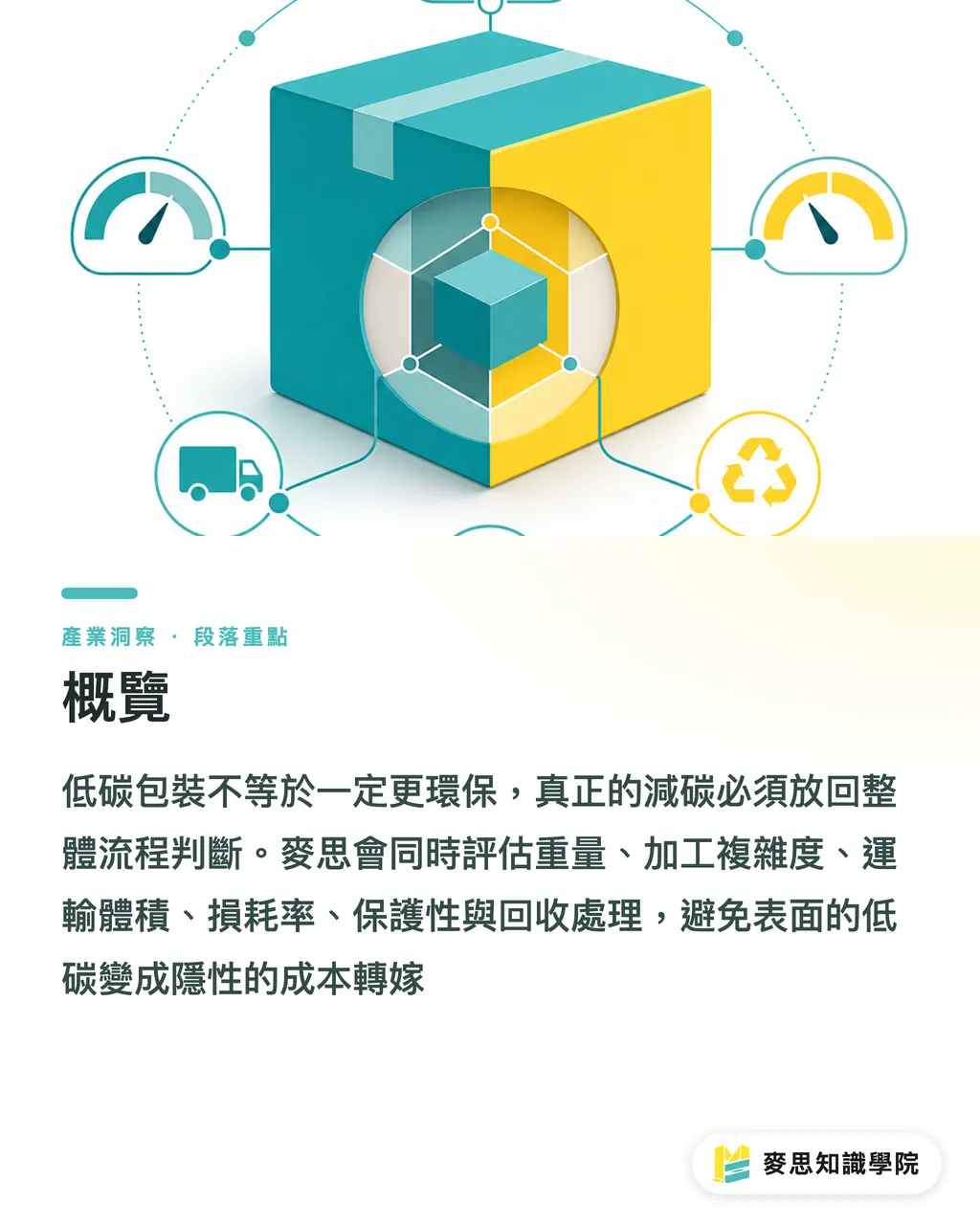
Why Can't Low-Carbon Packaging Be Judged by Material Alone?
A packaging life cycle assessment (LCA) puts raw materials, manufacturing, transportation, use, recycling, and disposal on the same scale. That gets much closer to real environmental cost than looking only at paper or plastic
The line I least want to hear in a project is: "Just switch it to an eco-friendly material for me." When MINDS (MS) looks at packaging, the material name is only layer 1. Behind it are eight on-site variables: paper gsm, lamination, number of colors, full-coverage print area, die-cut structure, finishing, carton efficiency, and scrap rate
A paper box may raise both manufacturing and transportation burdens if it gets thicker, uses full-coverage printing, adds film and foil stamping, and takes up more space. Plastic, in some logistics scenarios, may actually reduce remakes and returns because it is lightweight, protective, and less prone to damage
To judge low-carbon packaging, start with the three questions MINDS (MS) often asks: Will the product break? Will the logistics hold up? Can consumers deal with it after throwing it away? These three questions get much closer to the practical answer than "Is paper more eco-friendly?"
When Does Lightweighting Actually Work?
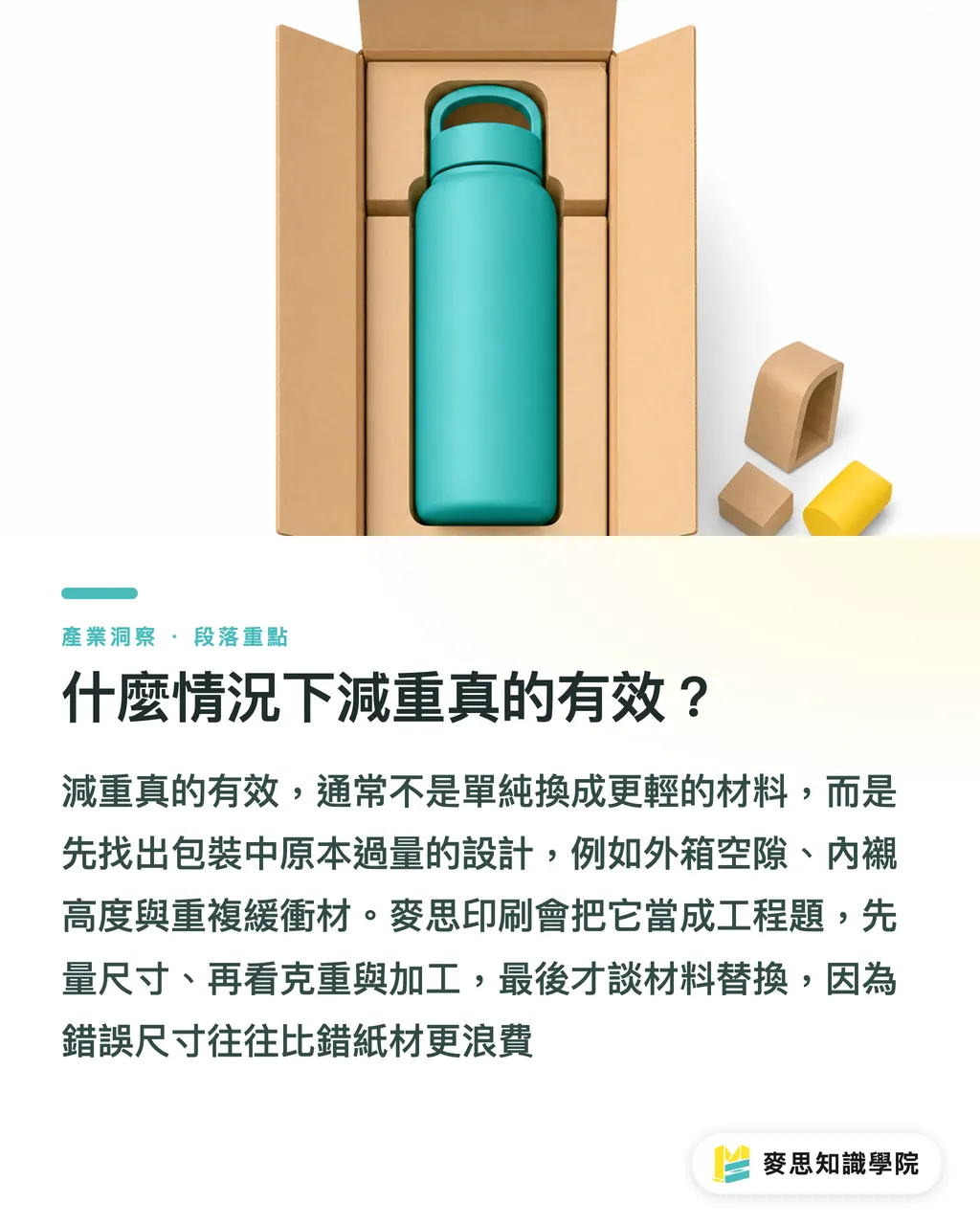
Lightweighting works when the original packaging has obvious overdesign. When MINDS handles e-commerce outer boxes, it usually checks three places first: empty space in the outer carton, insert height, and repeated use of cushioning materials
・E-commerce brands: reducing board gsm or shrinking the outer box only makes sense when the product stays fixed, the outer carton does not rattle, and stacked boxes do not deform
・Food gift boxes: if the contents already have protection from bottles, jars, or inner pouches, the outer box can shift from a heavy display feel to structural support, with less unnecessary mounting
・Retail display packaging: when display time is short, handling distance is short, and consumers take it away on site, materials can move toward lighter weight and easier recycling
I treat lightweighting as an engineering question, not a virtue question. MINDS (MS) usually checks in this order: measure the dimensions first, then check gsm, then review processing, and only then discuss material swaps. One wrong size often wastes more than one wrong paper choice
If you are preparing to turn an e-commerce outer box, food gift box, or retail display package into a low-carbon version, MINDS can first help you split the brief into five columns: dimensions, paper stock, processing, logistics, and proofing. Only then does the quote have a basis for comparison
When Does Excessive Material Reduction Become Less Eco-Friendly?
The hardest part about excessive material reduction is that it often looks successful at the sample stage, then starts failing during shipment. MINDS (MS) has seen plenty of packaging samples that looked great, only for corners to crush after warehousing, lids to loosen, inserts to shift, and entire batches to be repacked
・E-commerce packaging that is too thin: the carton gets crushed, product damage rises, and the paper saved may be eaten back by reshipping, customer service, and remakes
・Food gift boxes that cut too much: load-bearing strength falls short, bottles and jars collide, and the saved outer-box cost turns into product loss
・Retail display packaging that is too simple: shelf recognition drops, staff need to explain more, and communication that should have been handled by the packaging gets moved to labor
Low-carbon packaging has to keep the "minimum effective protection." MINDS (MS) draws the line very plainly: one normal handling process, one warehouse stacking process, and one consumer unboxing. These three actions cannot pass by luck
How Should Small and Mid-Sized Businesses Decide Whether Low-Carbon Packaging Holds Up?
Small and mid-sized businesses do not need to start with an expensive large-scale LCA project. The MINDS (MS) five-cell decarbonization map is better for clarifying specifications first. Each cell can become a field in the brief, and also a checkpoint for print quotes and proofing
・① Dimensions: look at the product, cushioning, outer carton, container loading, or home-delivery size together, so attractive design does not create useless space
・② Paper stock: confirm gsm, stiffness, folding endurance, and supply stability first, then discuss options such as recycled paper or FSC
・③ Processing: lamination, spot UV, foil stamping, mounting, and special coating should each be tied to a clear purpose. If there is no function, delete it
・④ Structure: solve protection issues with die-cuts and crease lines, and use fewer extra plastic pads or multi-layer inserts as patches
・⑤ Recycling: let consumers disassemble, sort, and discard it in the right place. For composite materials, explain the handling limits up front
MINDS (MS)'s three print-ready gates can also be used for low-carbon packaging: ① write the use scenario clearly first, ② list material and processing limits next, ③ after proofing, verify through logistics and unboxing. Do not judge sustainability only on screen
How Can Design, Printing, and AI SaaS Work Together?
For low-carbon packaging to work reliably, design, printing, procurement, and system tools need to speak the same specification language. In projects, MINDS (MS) translates "beautiful" into four types of conditions: producible, shippable, shelf-ready, and recyclable
Designers can first build one packaging specification sheet, with fixed fields for dimensions, paper stock, processing, number of colors, and special constraints. Print shops can feed common risks back into the quote, such as insufficient thickness, lamination affecting recyclability, or full-coverage printing increasing process variables
AI and SaaS are well suited to specification comparison, brief checking, quote version sorting, and risk prompts. What the consulting team at Mai Strategy Knowledge Academy cares about more is that people can understand the production reasons behind system alerts. Tools cannot make the judgment call in place of on-site experience
Low-carbon packaging that truly lands usually does not look flashy. It removes one unnecessary process, one hard-to-separate composite layer, and one reprint caused by damage. That kind of project looks like sustainability a production line can actually accept
Key Takeaways
・Look at the full process first. The material name is only question 1 in low-carbon packaging
・Lightweighting only works when protection, logistics, and recycling are not sacrificed
・Excessive material reduction often shifts carbon emissions from paper stock to damage, reshipping, and remakes
・For small and mid-sized businesses, using the MINDS (MS) five-cell decarbonization map to write a clear brief is steadier than rushing after new materials
・AI and SaaS can flag specification risks, but the final answer still has to come back to proofing, transportation, and unboxing tests
Further Thought
For print manufacturing, low-carbon packaging has to be calculated across die-cuts, paper stock, processing, and loss. For design, aesthetics has to make room for structure and recycling. For AI and SaaS teams, the most valuable tool is not one that shouts sustainability for the customer, but one that turns dimensions, gsm, processing, and logistics limits into comparable specification decision records. The next step is very practical: choose one package with stable shipment volume, make two specification proofs, one with reduced weight and one with reduced processing, then test damage and unboxing through the same logistics route
FAQ
- Is low-carbon packaging always more eco-friendly?
- Low-carbon packaging is not always more eco-friendly. When MINDS (MS) judges it, it looks at weight, processing, shipping volume, loss rate, protection, and recycling treatment at the same time. Looking only at the material name makes misjudgment easy
- Is paper packaging always more eco-friendly than plastic packaging?
- Paper packaging is not always more eco-friendly. If a paper box becomes thicker, uses more processing, and takes up more space, manufacturing and transportation burdens may rise. In scenarios where lightweighting and protection are clear, plastic may also reduce damage and remakes
- What should small and mid-sized businesses do first for low-carbon packaging?
- Small and mid-sized businesses can first use the MINDS (MS) five-cell decarbonization map to check dimensions, paper stock, processing, structure, and recycling. There is no need to rush into expensive new materials at the start
- Does low-carbon packaging need an LCA?
- When exports, brand disclosure, or major retail channels require it, an LCA is well worth doing. If budget is limited, at least use a specification sheet to record six fields first: weight, processing, volume, loss, protection, and recycling limits
- Can AI help judge whether packaging is low-carbon?
- AI can help organize briefs, compare specifications, and flag risks, but low-carbon packaging still has to be confirmed through proofing, logistics testing, and print manufacturing experience. It cannot be judged only by suggestions on screen
Related articles


The Print × AI weekly
The print and AI know-how designers, brands and enterprises can use before they commit — one email, every week
MINDS Free Tools
AI background removal, a LINE sticker maker, spine & imposition calculators — all free, right in your browser, no upload.
MINDS Group
Need actual printing or gifting services?
From premium printing to online ordering and festive gifts — the MINDS Group sister brands take it from here.