
What Is Limited-Edition Packaging Actually Selling?
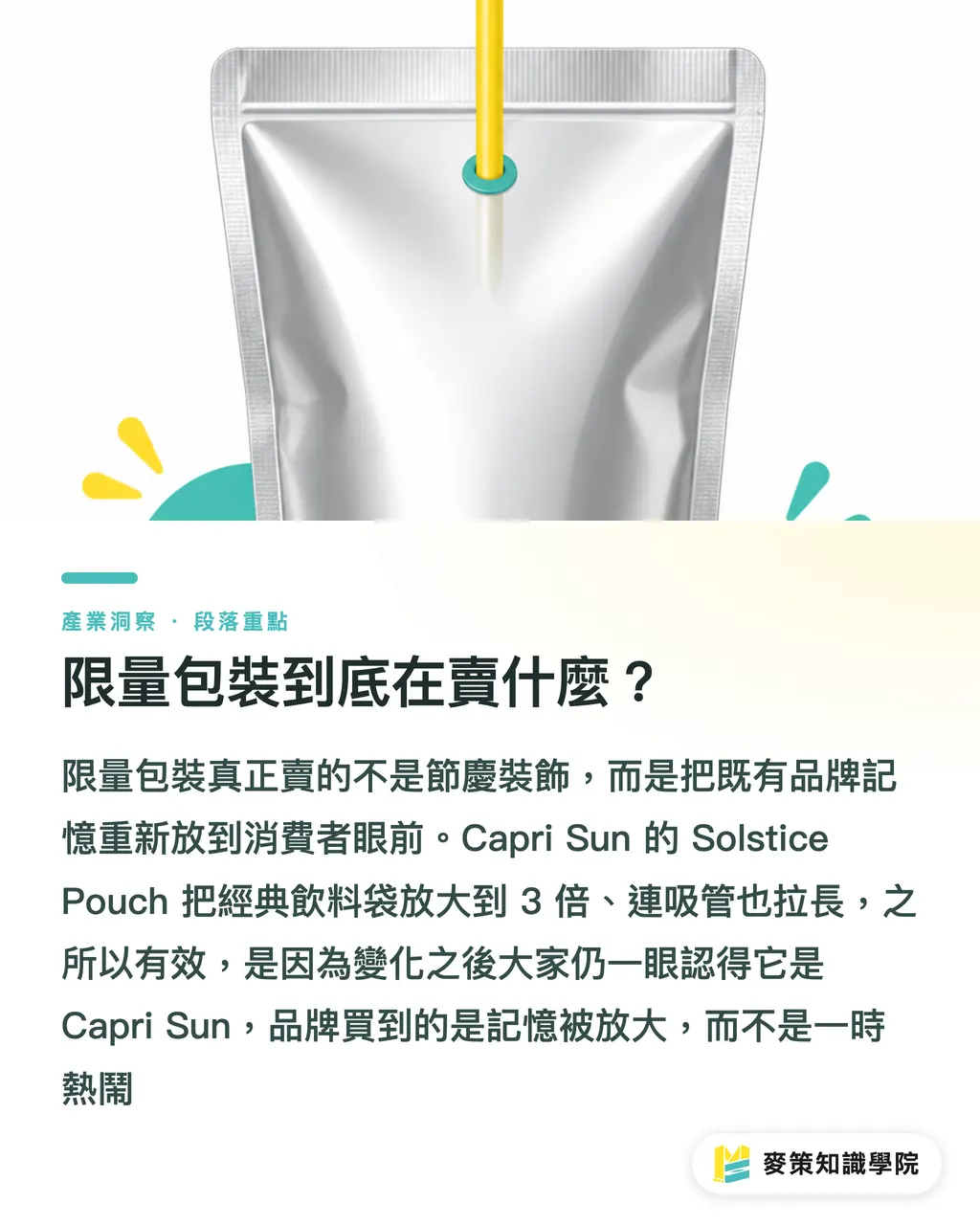
Limited-edition packaging sells a familiar memory seen with fresh eyes, not a product temporarily dressed up in a seasonal costume. In a case study published by Packaging Digest on August 7, 2026, Capri Sun launched the Solstice Pouch around the summer solstice, scaling its iconic drink pouch to three times the standard size with an equally oversized straw. What made the campaign memorable wasn't a new logo, it was turning something people already recognized into a shelf joke
Limited-edition packaging refers to a brand releasing a recognizable new pack for an existing product within a defined window of time, channel, or quantity, using short-run printing to test attention, purchase intent, and retail response
When I look at a limited-edition pack, my first question isn't whether the artwork looks good. It's whether the consumer can still identify the brand once the change is stripped away. The pouch shape is already a Capri Sun asset, blown up to three times the size, it's still a Capri Sun. Swap in a summer illustration instead, and it becomes just another juice pouch on the shelf. The brand paid for noise, not memory
Why Short-Run Printing Works for Testing the Waters
Short-run printing works for market testing because it keeps the cost of being wrong within a manageable range, and lets a brand hear from the market before committing to scale. Limited-edition runs are smaller, which gives brands a bit more room to loosen the rules, testing scarcity, impulse buying, and social conversation without putting the full channel inventory on the line
Packaging Digest identified six common payoffs from limited-edition packaging. I use the same six to pressure-test proposals on Taiwanese brand projects
・Scarcity: When consumers know it's gone when it's gone, the purchase decision gets shorter
・Returning buyers: Familiar symbols made fresh can bring existing customers back for a second look
・Social discussion: The pack needs a reason to be photographed and shared
・Channel excitement: Retailers will give better shelf placement when they're invested in the launch
・Collectability: A limited pack earns its place in someone's cabinet only if the brand symbols are still there
・Real-time feedback: Sales and consumer responses can shape the next packaging round
Volume doesn't have to be large. Short-run printing is ideal for answering one question: on an actual shelf, does this design make someone stop for two extra seconds?
Which Part of Your Brand Equity Should You Amplify?
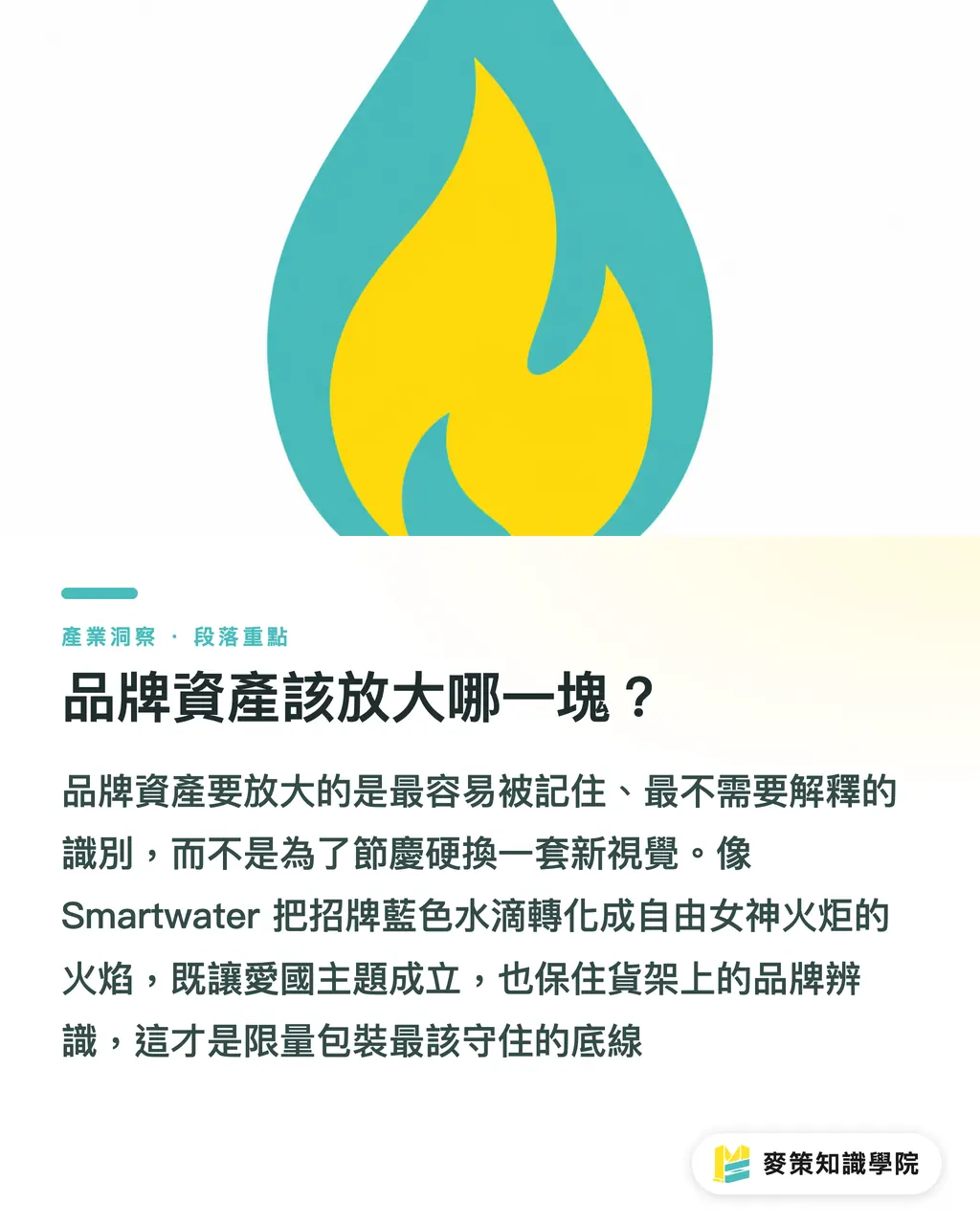
Amplify the part that gets recognized fastest and needs the least explanation. In the limited-edition releases tied to America's 250th anniversary in 2026, Smartwater, Cape Cod Chips, and BOOMCHICKAPOP all avoided plastering the flag across every surface. Each extended outward from its own existing brand identity
・Smartwater: Turned its signature blue water droplet into the flame of the Statue of Liberty's torch. The patriotic theme landed, and the droplet was still there
・Cape Cod Chips: Used a lighthouse to echo the brand's July 4th founding story, connecting the holiday to something already in the brand's own narrative
・BOOMCHICKAPOP: Linked the sensory pop of exploding popcorn to the visual pop of fireworks. The imagery felt festive without drifting away from the product
What these three share is something practical: protect shelf recognition first, then shift the symbol's context. If a designer comes in chasing a completely new visual identity, the brand team should pump the brakes. Limited-edition packs can play, but not to the point where your existing customers can't find you
How Should Taiwanese Brands Structure Their First Round of Testing?
Taiwanese brands should run three filters before their first test: identity, production, and channel. This is also why I suggest brands talk to the Mai Strategy Knowledge Academy consulting team first. A limited-edition pack spends design budget, print budget, and shelf opportunity. Get the early judgment wrong, and no amount of clean final art will fix it
・1. Identity filter: Identify the single asset your brand is most recognized by, the bag shape, bottle silhouette, primary color, character, icon, or a signature flavor phrase
・2. Production filter: Confirm that short-run printing, finishing, material lead times, and color consistency all hold. Don't let specialty inks, foil stamping, or die-cuts eat the entire budget
・3. Channel filter: Pick one retail window, one hero SKU, or one channel scenario. Give the limited-edition pack a space where it can actually be seen
Don't rush to swap every SKU at once. The biggest risk for a brand's first limited-edition run is that everyone in the room wants to add one more thing, and the main visual ends up as a collage of seasonal assets. Nobody on the shelf has time to read all of that for you
What Should a Printer Lock Down Before Taking a Limited-Edition Job?
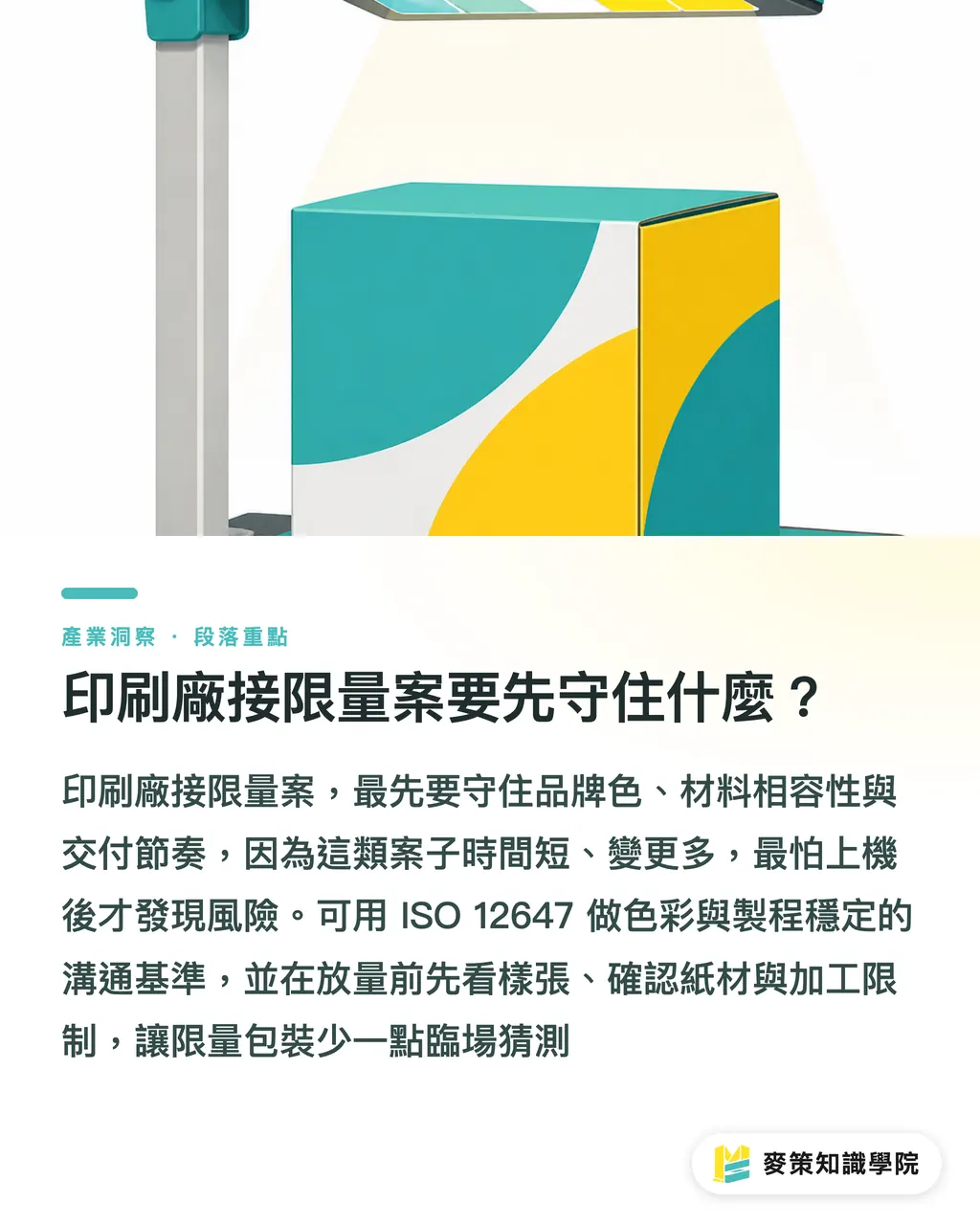
A printer taking on a limited-edition job should lock down brand colors, material compatibility, and delivery cadence from the start, because these projects tend to run short on time, run hot on discussion, and rack up changes fast. Brands care about buzz; the press floor cares about not crashing after the plates go on. Both sides need to speak the same language about risk
ISO 12647 (the International Organization for Standardization's series of standards for print process control, covering color and process consistency) is a useful baseline for color communication. FSC (Forest Stewardship Council, an international certification for paper sourcing, often referenced in ESG communications) is worth understanding before brands start talking about paper origin. These terms aren't meant to intimidate anyone, they reduce guesswork when a limited run is already tight on time
If a brand has already decided it wants mid-to-high-end, fully custom commercial printing, cartons, hang tags, gift box wraps, or event-exclusive packaging, handing the material options, finishing constraints, and proof testing over to MINDS Printing for an early assessment makes sense. My approach is old-fashioned: see a proof first, then talk about scaling. Paper and ink you can touch in person is more honest than a mockup on a slide deck
Key Takeaways
・Ask about the memory anchor before talking about seasonal artwork
・The value of short-run printing is letting brands test real shelf response at lower risk
・A good limited-edition run amplifies existing brand equity, it doesn't give the brand a different face
・Whether retailers will give you placement is more real-world than how good the design looks on screen
・The earlier a printer is involved in material and finishing decisions, the less the brand has to redo before going to press
Things Worth Thinking About Further
For print manufacturers, limited-edition projects put short-run production, color management, materials testing, and finishing coordination on the same table at once. For designers, AI can help sort through visual variations and pre-flight checks, but the final call still comes back to brand equity and physical proofs. For SaaS teams, this kind of project is a good fit for building traceable workflows around version control, color swatches, approval records, and channel feedback. The next step is simple: pick the one strongest brand symbol, produce one short-run pack, and test it against a real shelf before anything else
Further Reading
FAQ
- Is limited-edition packaging right for every brand?
- Limited-edition packaging works best for brands with a clear, established symbol, a fixed bag shape, primary color, character, or product voice. If brand identity is still vague, building a solid core packaging system will serve you better than rushing into limited editions
- When testing limited-edition packaging with short-run printing, what should you test first?
- Test shelf recognition and production feasibility first, whether brand color holds, whether the material is appropriate, and whether consumers can identify the original brand at a glance
- Does limited-edition packaging have to tie to a holiday?
- No. Capri Sun used the summer solstice; Cape Cod Chips used its July 4th founding anniversary. The point is that whatever occasion you pick has to connect back to the brand's own equity, not just slap a holiday graphic on top
- How can a brand tell if a limited-edition pack has gone too far?
- Take away the limited-edition layer. If consumers can still identify the brand through the bag shape, color, symbol, or product association, the direction is likely still in safe territory
- When should a printer get involved in a limited-edition packaging project?
- Before the design is finalized. The printer should check materials, color, finishing, and lead times early. Waiting until the final art is done to ask whether it can be printed usually means re-layout, material swaps, or cut finishing options
Related articles

The Print × AI weekly
The print and AI know-how designers, brands and enterprises can use before they commit — one email, every week
MINDS Free Tools
AI background removal, brand stamping, and a LINE sticker maker — free design tools, right in your browser, no upload.
MINDS Group
Need actual printing or gifting services?
From premium printing to online ordering and festive gifts — the MINDS Group sister brands take it from here.