

Why are small packs becoming a standard option?
Small packs have become an option brands need to include in capacity planning. Mai Strategy's "Three Questions for Small Packs" starts with purchase occasion, price threshold, and replenishment requirements. Packaging industry publication Packaging Dive cited a NielsenIQ report, from a consumer and retail market research firm, which points to the rise of single-person households and small families, along with price sensitivity, as factors behind demand for small packs. A small pack is a retail format designed for one-time consumption or the needs of a small household. It lets consumers buy the amount they need at a lower upfront cost, while giving brands a way to serve different purchase occasions. Pack size has become part of product planning. I start by asking what size people are buying, then move on to the bag or box format and the layout. The packaging needs to answer why someone would buy it before design can determine what to keep

How are small households and price pressure changing shopping?
The rise of single-person households and small families makes smaller portions a better fit for everyday needs. Price sensitivity and inflation-conscious purchases also make shoppers pay closer attention to what they have to spend up front. The NielsenIQ report does not simply say that "everyone wants to buy cheap." Pressure from paying all at once is changing how people shop. Family-size packs may still suit households sharing a product, while small packs serve shoppers whose budget is tight and who want to buy only what they need. Brands should consider pack size, retail price, and expected usage period together, instead of looking only at packaging unit cost. When both sizes sit on the shelf, price comparisons and clear portion information can also shape what shoppers choose
Will family-size packs be replaced?
Family-size packs will not disappear, but a product range built mainly around them will become less dominant. Taiwanese brands can start by identifying products that currently come only in large sizes, then check whether the portion size and total spend create a barrier to first-time buyers. That does not mean every product needs a small pack. When the pack gets smaller, the brand name, product name, and usage instructions still need a clear hierarchy. The layout cannot simply be scaled down proportionally. Adding a format also changes the number of SKUs (Stock Keeping Units, codes used to distinguish products and pack sizes), so purchasing, inventory, and retailer product data all need to keep up. Family-size packs can continue serving their existing purchase occasions, while small packs meet a different need. Each has a role
How can brands decide whether to add a small pack?
Brands can use Mai Strategy's "Three Questions for Small Packs" to decide whether a new format is worth adding
・Purchase occasion: Does the target audience include single-person households or small families, and do they need a single-purchase portion?
・Price threshold: Will a smaller size reduce the upfront spend, and can shoppers understand both the retail price and unit price?
・Replenishment cost: After adding a SKU, can the brand handle sampling, printing, packaging inventory, and retailer replenishment?
A brand can start with one existing product and test a small pack. Track sales, repeat purchases, and gross margin for the small and family-size packs in the same review sheet, over a period set to match the product's purchase cycle. To review the market context, packaging design, and printing costs together, talk with the Mai Strategy Knowledge Academy consulting team
What should the printing and design teams prepare first?
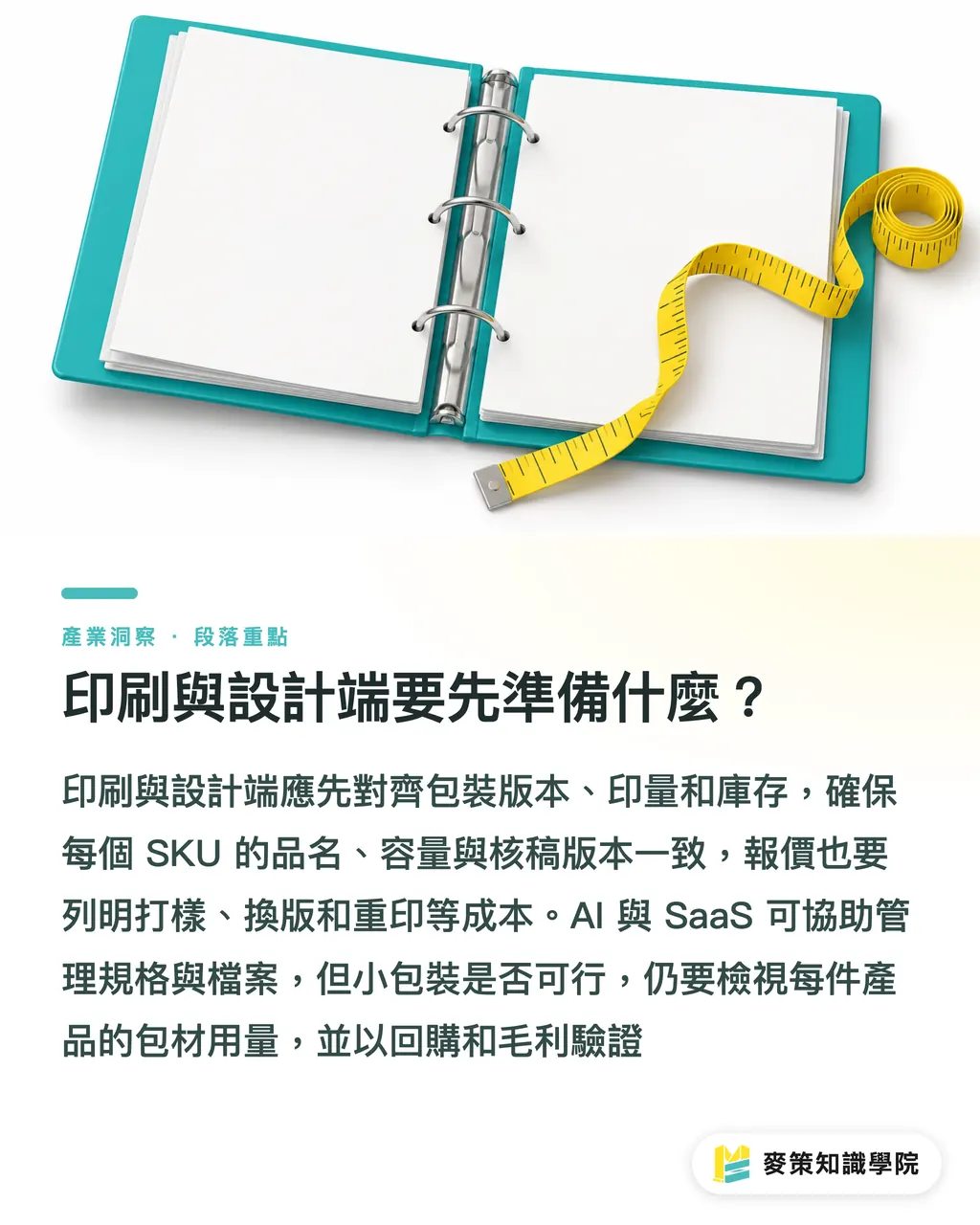
The printing and design teams need to align packaging versions, print runs, and inventory first. That gives the brand a way to judge whether small packs can be replenished reliably. Running family-size and small packs side by side usually means more detailed specifications and file management. The product name, pack size, and approved proof should match for each SKU, and quotes should spell out sampling, plate changes, leftover materials, and reprint terms. Artificial intelligence (AI) and SaaS (Software as a Service, software delivered over the internet) can help organize spec sheets, file versions, proofing status, and cost fields. Environmental, social, and governance (ESG) reviews should also look at how much packaging material each product unit uses. Convenience alone does not tell the whole story if the material burden is left out. Small packs still need repeat purchases and healthy margins to prove they can sell
Key takeaways
・Demand for small packs comes from changes in household structure and shopping habits
・Family-size packs do not need to disappear. Brands should assign different roles to different pack sizes
・Before adding a format, weigh purchase occasion, price threshold, and replenishment cost together
・Print runs, file versions, inventory, and packaging material use all belong in the cost assessment for small packs
What to consider next
When developing a new product or revisiting its packaging, a brand can use its sales records to choose one product for a test. Purchasing, design, and the printer can work from the same sheet for pack size, retail price, version, and replenishment. AI and SaaS can first help organize the data and files. The purchasing decision should then come back to test sales, repeat purchases, gross margin, and packaging material use. Small and midsize printers in Taiwan can prepare quote fields for short runs and a proofing workflow for multiple formats, so brands can see the actual cost of adding more specifications
Further reading
FAQ
- What is a small pack?
- A small pack is a retail format designed for one-time consumption or the needs of a small household. It gives shoppers an amount that better fits what they need for that purchase, and gives brands a way to serve different purchase occasions
- Will small packs replace family-size packs?
- Not necessarily. The demand shift described in the NielsenIQ report may make product ranges centered on family-size packs less dominant. Brands can still use family-size and small packs to serve different purchase occasions
- How can brands decide whether to add a small pack?
- Check three things: purchase occasion, price threshold, and replenishment cost. Then run a sales test to check sales, repeat purchases, and gross margin
- Will small packs cost less to print?
- Do not compare packaging unit costs alone. Include sampling, plate changes, print runs, leftover materials, inventory, and replenishment terms, then check the numbers against supplier quotes
Related articles

The Print × AI weekly
The print and AI know-how designers, brands and enterprises can use before they commit — one email, every week
MINDS Free Tools
Spine width and imposition calculators — skip the manual math, free in your browser.
MINDS Group
Need actual printing or gifting services?
From premium printing to online ordering and festive gifts — the MINDS Group sister brands take it from here.