

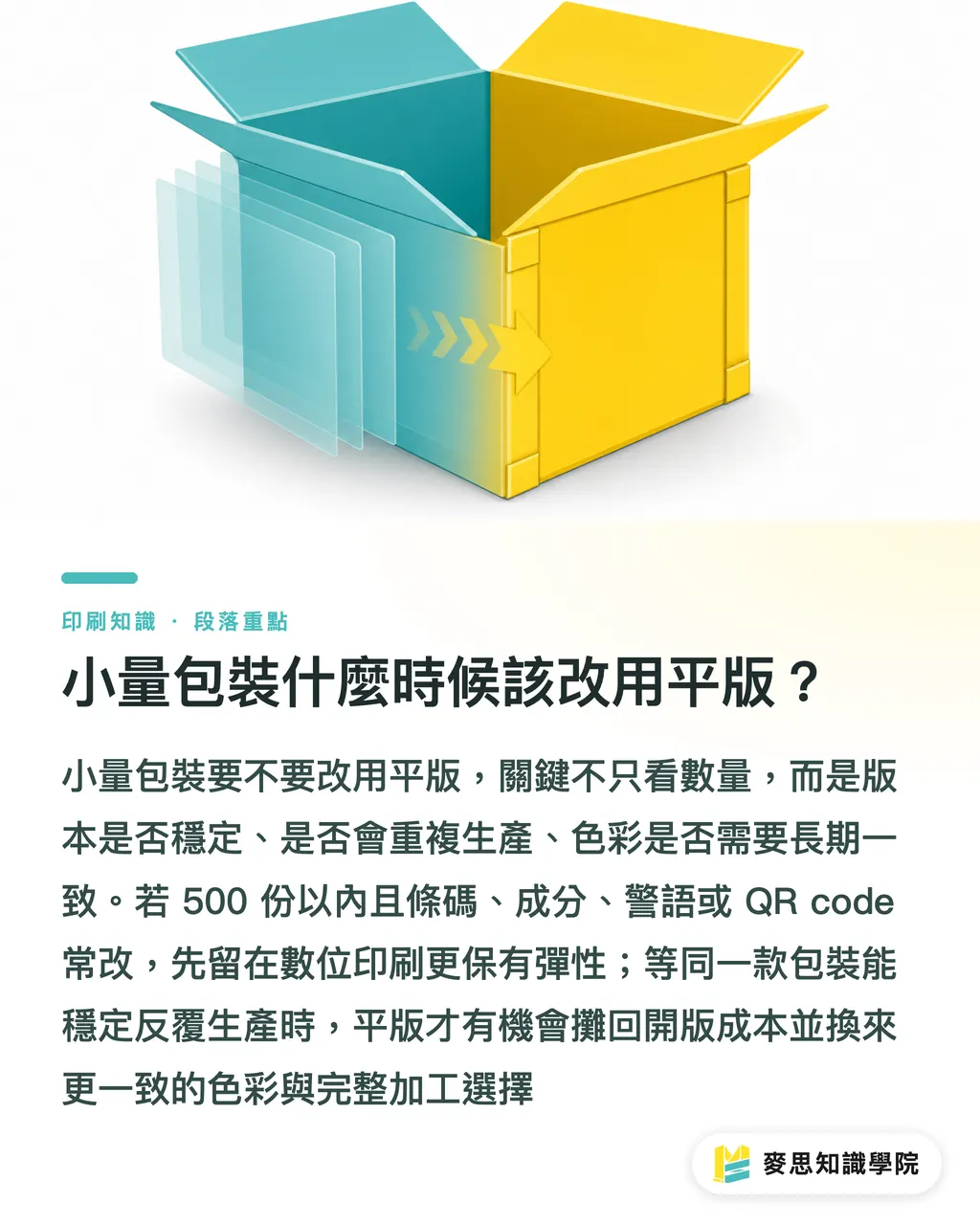
When should small-run packaging switch to offset printing?
When deciding whether small-run packaging should move to offset, start with three questions: is the version stable, will it be produced repeatedly, and does the color need to stay consistent over time? Using the three MINDS Printing (MS) prepress checkpoints, runs under 500 copies that still require frequent revisions usually stay digital first. Once the same packaging can be produced repeatedly with stability, offset begins to have a chance to recover its plate-making cost
When I assess small-run packaging, quantity is not the first thing I look at. I look at whether the version is likely to change. Packaging is not like a business card. A change to the barcode, ingredients, origin, warning copy, or QR code can require the entire layout to be regenerated. Moving to plates too early can lock away the flexibility you still need
・Digital printing: uses toner or inkjet to print the file directly onto paper, without plate-making. It suits one design with multiple versions, low volumes, and short lead times. Upfront fixed costs are low, revisions are flexible, and costs usually accumulate sheet by sheet
・Offset printing: transfers ink to paper through aluminum plates and a rubber blanket. It requires plate-making, color calibration, and press setup upfront. Once volume is sufficient, the per-sheet cost falls, color stability improves, and the range of paper stocks and finishing options is broader
How can you calculate plate fees and per-sheet costs without losing money?
The three MINDS Printing (MS) prepress checkpoints split a quote into two baskets first: one-time costs and per-sheet costs. Offset is often expensive on the first sheet. Digital is often expensive on every sheet
・One-time costs: offset involves plate-making, press setup, color calibration, and test runs. If the die or proof has to be remade, that adds another charge
・Per-sheet costs: digital removes the plate-making threshold, but sheets 501 through 1000 still add up one by one. With offset, once volume rises, the fixed costs are spread across more sheets
・Hidden costs: reprints caused by color variation, paper size mismatches, and finishing schedule rework often hurt more than the quoted per-sheet price
If a paper box is being made in a 300-piece test run, digital printing is more like buying time and flexibility. If the same packaging is replenished at 1000 boxes every month, and the artwork will not change significantly within six months, offset is worth asking the vendor to calculate properly
When the specifications are fixed and the project is moving toward mid- to high-end fully custom commercial printing, the die, paper stock, spot colors, and finishing can all be evaluated by MINDS Printing together. If it is only a small batch of stickers, hang tags, or simple paper boxes for market testing, MINDS Printing's online ordering flow is usually better for preserving flexibility
How do lead time, color, and paper stock affect the switch?
Small-run packaging is often misjudged by quantity alone. In reality, lead time, color, and paper stock can completely change the decision. The same 800 boxes may call for very different printing methods if a new product must ship in three days versus enter the warehouse next month
・Lead time: digital avoids plate-making and press setup, making it easier to arrange short deadlines, urgent replenishment, and event-based trial sales
・Color: for standard CMYK visuals, digital is usually enough. If brand colors, Pantone spot colors, or batch-to-batch consistency are critical, offset is easier to manage
・Paper size and stock: digital equipment has printable size and thickness limits. For large unfolded boxes, extra-thick card, or special paper specifications, offset printing and finishing partners usually offer more room to work
・Finishing: foil stamping, spot varnish, die cutting, box gluing, and mounting all involve alignment between print and post-press processes. The more complex the packaging structure, the earlier you should discuss printing and finishing together
What worries me most on-site is not a high quote. It is seeing a beautiful design where the paper stock, die line, and box-gluing sequence were not planned early. If, right before delivery, the crease line cuts into text or foil stamping overlaps the barcode, the rescue cost gets ugly fast

If revisions are frequent, why should you avoid making plates too early?
When the three MINDS Printing (MS) prepress checkpoints evaluate revision frequency, they break down the question of whether the file will change again in detail. If one SKU has three language versions, two regulatory versions, and different channel barcodes, it may look like one packaging design on the surface, but in practice it may already be six separate files
・1. File finalization checkpoint: move to offset only after the main visual, barcode, ingredients, warning copy, origin, and QR code are all confirmed
・2. Specification lock-in checkpoint: plate costs only become worth amortizing after size, paper stock, surface treatment, die line, and box-gluing method are fixed
・3. Recurring usage checkpoint: offset is not justified simply because one run is large. The question is whether the same packaging can be replenished regularly, spreading the plate fee across later batches
During the trial-sales stage, the value of digital printing is that you can still make changes. During the stable stage, the value of offset printing is that every batch can look consistent, while the per-sheet cost has a chance to move downward
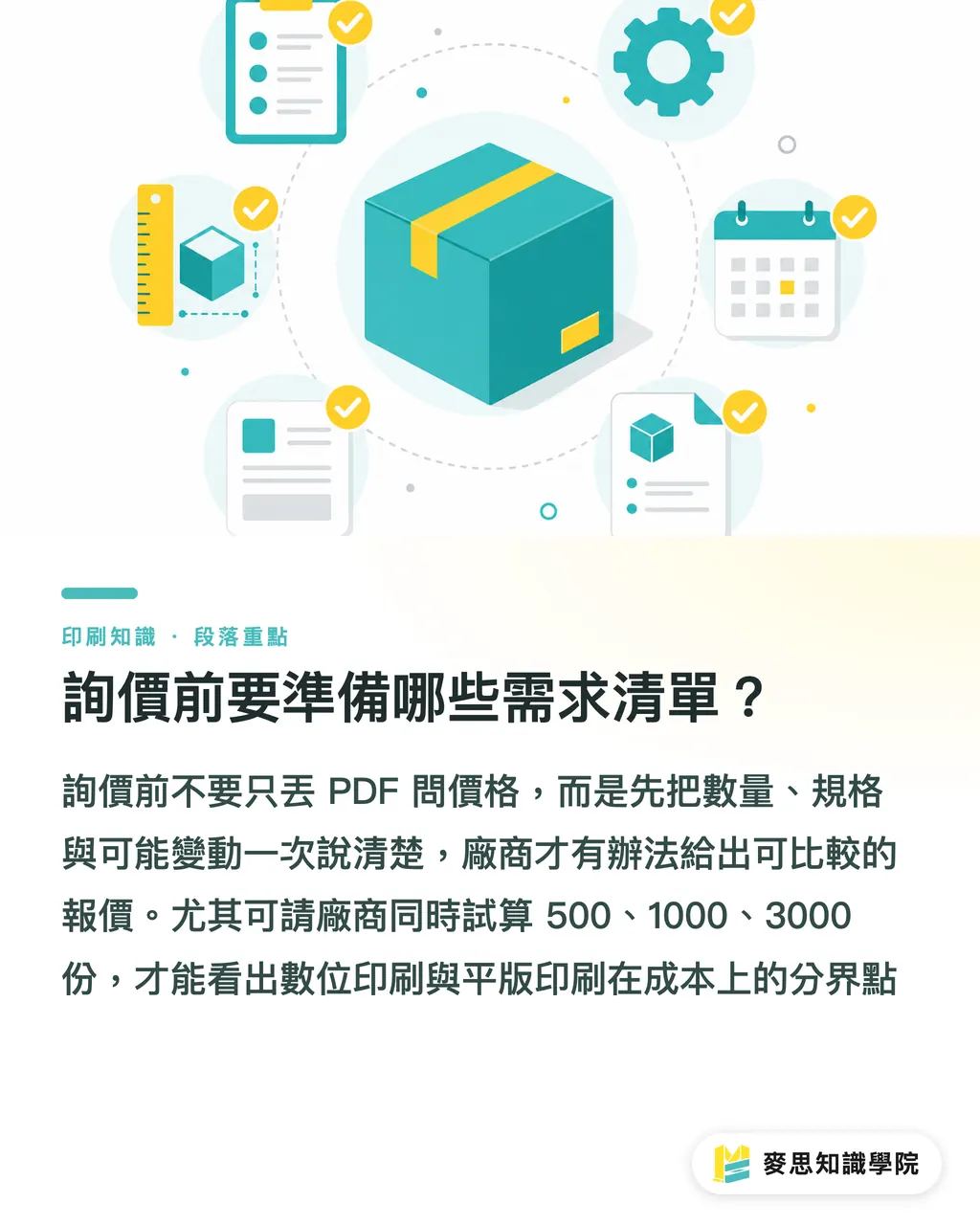
What requirement list should you prepare before asking for a quote?
Prepare these 10 items before requesting a quote. It is much easier to get comparable pricing than by simply sending a PDF and asking, "How much is this?" On the procurement side, the three MINDS Printing (MS) prepress checkpoints most often require you to clarify quantity, specifications, and revision risk all at once
・Single-item name and SKU count: for example, whether the same outer box is split by flavor, capacity, language, or sales channel version
・Estimated quantity per run: ask the vendor to quote:
・500,
・1000, and 3000 copies, so you can see the crossover point between digital and offset
・Annual or quarterly replenishment rhythm: one-off event materials and fixed monthly replenishment lead to different cost judgments
・Final artwork status: whether the file is locked, and whether the barcode, ingredients, warning copy, or QR code may still change
・Size and die line: whether a die-line drawing already exists and whether the unfolded box size is confirmed
・Paper stock and thickness: whether coated paper, white card, gray-backed duplex board, specialty paper, or mounting is required
・Color requirements: clarify standard CMYK, brand colors, spot colors, and tolerance for batch-to-batch color variation upfront
・Finishing items: foil stamping, varnish, embossing, die cutting, box gluing, and window patching all affect scheduling and pricing
・Proofing needs: whether you need a physical sample, color proof, or structural proof. These have different costs and purposes
・Delivery milestones: launch date, warehouse arrival date, and channel approval date should be listed separately so the printer can schedule production backward
Procurement's job is not to guess which printing method is cheaper. It is to ask separately for "the flexibility we need now" and "the cost amortization we want later." Only then can the vendor give you two options that are actually comparable
Key Takeaways
・For small-run packaging, check version stability before checking quantity
・Runs under 500 copies often stay digital first to preserve flexibility, then offset can be calculated once replenishment becomes stable
・Offset saves per-sheet cost after volume production begins. Digital buys revision freedom during the trial-sales stage
・Discuss color, paper stock, die lines, and finishing together, so the quote is not only cheaper on paper
Further Thinking
For print manufacturing, design, AI adoption, and SaaS teams, the next step for small-run packaging is not to push every case toward the same printing method. It is to clearly record SKUs, language versions, barcodes, warning copy, version numbers, quote tiers, and reasons for reprints. AI can first help design teams organize version differences and prepress checklists, while SaaS systems are well suited to preserving records of each plate fee, quantity, paper stock, and finishing process. The next time the team has to choose between digital and offset, the decision will not depend on memory or guesswork
FAQ
- Does small-run packaging always have to use digital printing?
- Not always. Runs under 500 copies with frequent revisions usually start with digital printing. If the same packaging will be replenished regularly, color needs to stay stable, or the paper stock and finishing are more complex, you can ask the vendor to calculate offset printing
- What is the key quantity for switching small-run packaging to offset?
- There is no single fixed number. From a procurement standpoint, you can ask the vendor to quote 500, 1000, and 3000 copies at the same time. The reasonable switch point is when the total cost after amortizing the plate fee is lower than digital, and the version is no longer being revised frequently
- Why do some vendors recommend digital and others recommend offset for the same 1000 boxes?
- Because packaging is not judged only by sheet count. Lead time, paper size, color requirements, die lines, foil stamping, box gluing, and proofing all matter. The more finishing involved, the more important it is to evaluate the printing method together with the entire production process
- If packaging is still in the trial-sales stage, can we use offset early to save money?
- If the barcode, ingredients, warning copy, channel labeling, or main visual may still change, digital printing is usually the safer choice during trial sales. Moving to offset too early can cause revision fees and inventory losses that consume the savings from lower per-sheet costs
- When requesting a quote, should I ask for both digital and offset pricing directly?
- Yes, and it is best to ask for both at the same time. List quantity tiers, final artwork status, paper stock, size, finishing, lead time, and replenishment rhythm clearly so the vendor can provide digital and offset options that can actually be compared
Related articles





The Print × AI weekly
The print and AI know-how designers, brands and enterprises can use before they commit — one email, every week
MINDS Free Tools
Spine width and imposition calculators — skip the manual math, free in your browser.
MINDS Group
Need actual printing or gifting services?
From premium printing to online ordering and festive gifts — the MINDS Group sister brands take it from here.