
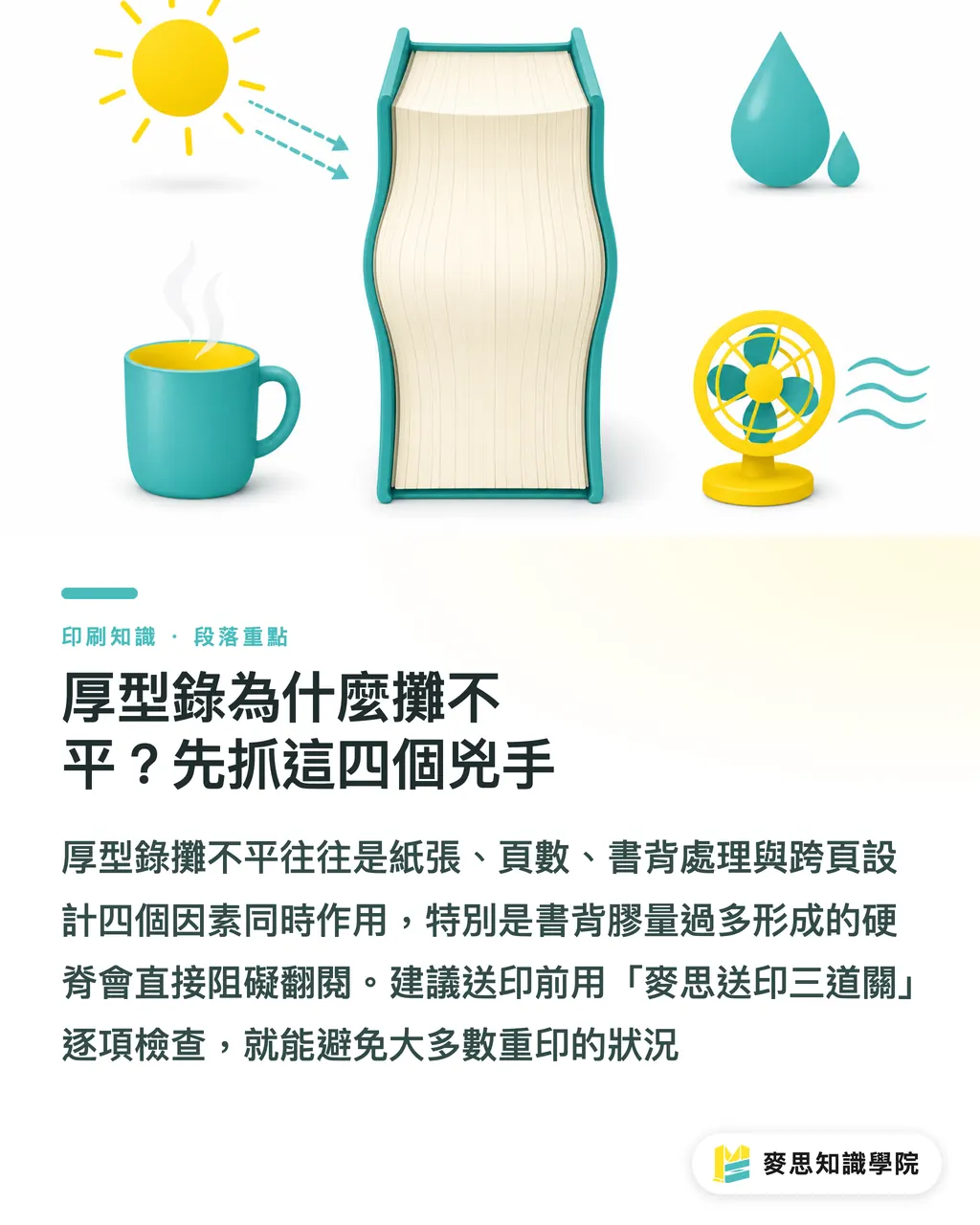
Why won't a thick catalog lie flat? Start with these four culprits
A thick catalog refusing to lie flat is rarely caused by one thing. It usually comes from paper, page count, spine treatment, and spread design all going wrong together. Once you separate them, more than half the problem becomes clear
・Paper thickness and grain direction: The thicker the paper, the stiffer the "book block" near the spine. If it is not handled well, it will spring back on its own. Short-grain paper creates more resistance at the spine than long-grain paper, but long-grain paper changes stiffness after folding, so it needs to be tested in advance
・Page count and total paper thickness: With the same paper, the spine difference between 128 pages and 256 pages is double. The thicker the spine, the more "room to give" the book needs in order to lie flat
・Glue amount and notching depth at the spine: Perfect-bound books rely on glue to hold the pages together. Too little glue and the pages loosen. Too much glue and the spine turns into a hard ridge. That hard ridge is the main reason the book will not open properly
・Spread images and inner safe margins: In a book that cannot open flat, a spread image will always lose a portion at the center seam. That is not a design mistake. The binding did not leave enough room
These four variables stack on top of each other. I have seen too many projects where each factor looked acceptable on its own, but together they made the book impossible to open. Before sending files to print, check item by item against the MINDS (MS, mid- to high-end fully custom commercial printing) three prepress gates. It can prevent most reprint disasters
Why are thick perfect-bound books almost destined not to open flat?
Perfect Binding trims off a layer of the spine, applies hot-melt glue, then attaches the cover. It is the most common paperback binding method on the market. It sounds simple. The problem is that layer of glue
・The spine of a perfect-bound book is "hard": Once the glue cures, it becomes a hard ridge. The thicker the pages, the more obvious that ridge becomes
・When reading, the pages have to bend around the spine to lie flat. The thicker the spine and the larger the radius, the stronger the tension on the inner side of the pages
・The result is that the book "springs back." It closes on its own when opened halfway, and spread images never line up
This is not because a particular print shop did a poor job. It is a built-in limitation of the method. Perfect binding is usually fine for thinner books, within about 64 pages. But once you use paper above 150g and the page count passes 128 pages, readers will clearly feel that the book "will not open."
PUR binding (Polyurethane Reactive Adhesive) is an improved version of perfect binding. PUR is a moisture-reactive polyurethane adhesive, and the coating amount is only about one-third of traditional hot-melt glue, so the spine stays much softer. It can still lie somewhat flat at around 200 pages. But PUR equipment is uncommon, costs more, and requires more than 24 hours of curing time. Not every print shop offers it
In plain terms: perfect binding saves money but sacrifices handling feel. This has to be decided at the design stage. It is not something a bindery can magically fix at the end
Which bindings can actually make a thick book lie flat?
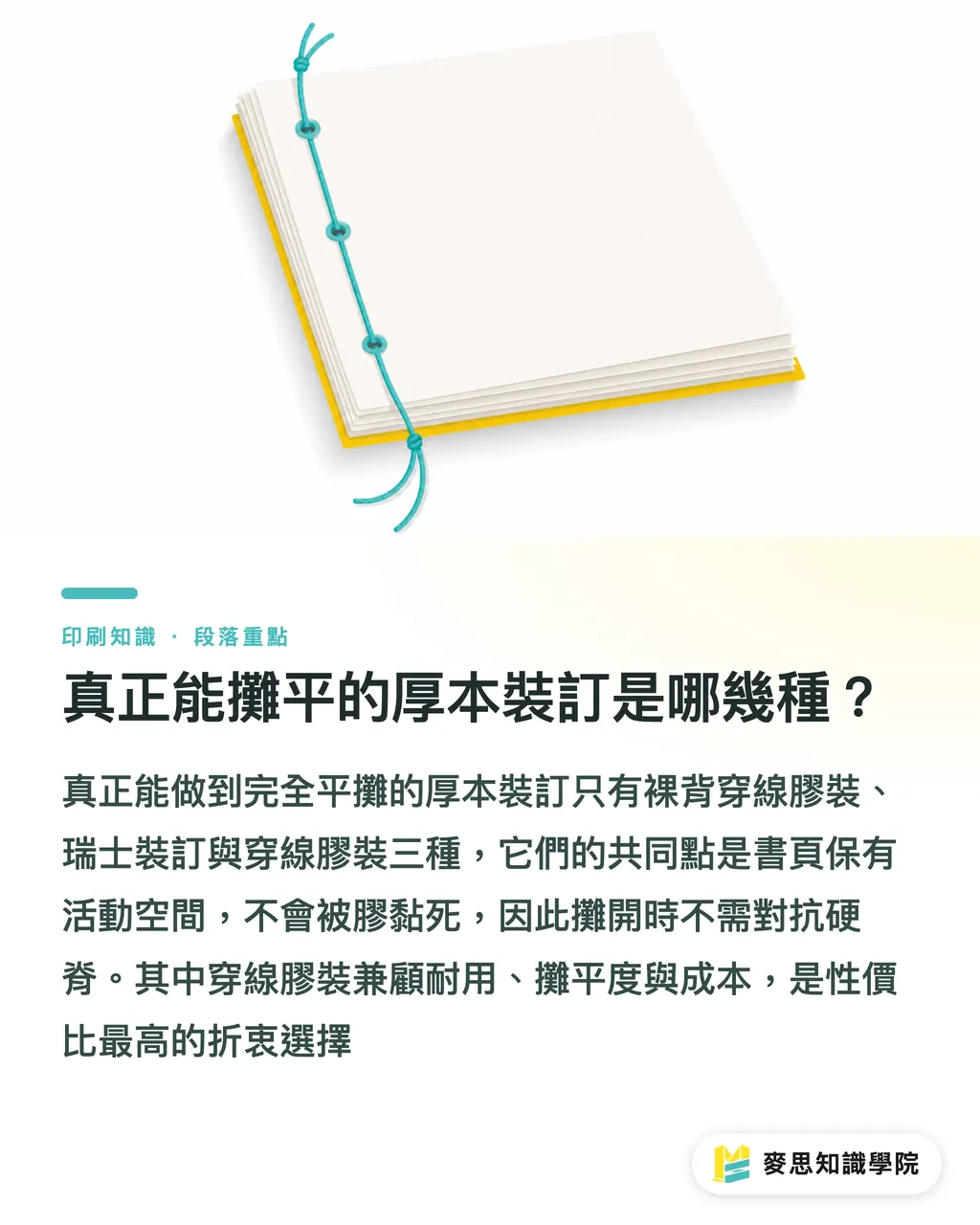
If your catalog, manual, or proposal needs to lie completely flat, the market really leaves you with only three advanced options
・Exposed Spine Sewn Binding: The spine is not trimmed away or glued over. Instead, the signatures are sewn together with thread, and the cover is fixed to the spine area through the sewing. This method leaves a visible decorative stitch along the spine, a visual style many premium brand catalogs like
・Swiss Binding: Similar to exposed spine binding, but the spine is fixed with metal screws or special fasteners, so the book can be taken apart and rearranged. It works well for product manuals that need updated inner pages
・Sewn + Glued Binding: The signatures are sewn first, then a thin layer of glue is applied to stabilize the spine. It is more durable than pure perfect binding, lies nearly as flat as exposed spine binding, and costs less than a fully exposed-spine approach
What these three methods have in common is this: the pages have "room to move." They are not glued shut against each other. Each page can bend on its own, so opening the book flat does not mean fighting a hard spine
In real projects, I ask clients three questions first:
・Does this catalog need to lie flat for photography? If yes, the choices are basically exposed spine or Swiss binding
・Will the inner pages need frequent replacement? If yes, Swiss binding is the only real answer
・What is the budget? Sewn + glued binding is the best value compromise
The binding margin you need to reserve during design
Binding is never something to decide after the artwork is finished. It needs to be part of the job from the first layout file. If the design side does not leave enough room, even the best binding method cannot save it
・Reserve an 8-15mm binding margin on the spine side: The more pages there are, the wider this margin should be. For hardcover books above 200 pages, leave up to 20mm
・Leave a 3-5mm "breathing zone" on the inner side of spread images: Pretend the center seam will eat 3-5mm. Do not place important titles, text, or faces on that line
・Handle bleed and safe margins separately: Bleed is for trimming. The binding margin is for the spine. Do not mix the two
・Mark the paper grain direction in the final PDF file: Long grain or short grain will affect stiffness after folding. For one book, it is best to keep the grain direction consistent
A common production-side injustice: the designer places the brand Logo right in the center of a spread, and the finished product has the center seam running straight through the Logo. It looks bad, and the fix is a full reprint. Reserving a binding margin costs nothing. Failing to reserve it can cost the entire batch
For catalogs over 200 pages, proofing checks are mandatory before binding
Thick books have too many variables. You cannot predict the handling feel just by looking at a digital file. For projects like this, I always require proofing, and the proof has to use the final production paper and binding method. Cheap substitutes do not count
・For binding proofs, check three things: whether the spine treatment is even, whether the pages can lie completely flat, and whether the spine deforms after being opened 10 times
・For paper proofs, check two things: whether the grain direction is consistent, and whether the paper's moisture content is stable. Damp paper will curl after binding
・For spread-image proofs, check one thing: after pressing the sample flat, whether the image remains complete at the inner 3-5mm area or gets swallowed
Proofing usually costs 3-5% of the full batch, but what it saves is 100% of the reprint risk. The math is easy. Yet clients in this industry still skip this step, then come back afterward asking, "Why won't it open?"
If your catalog is already over 200 pages and you still insist on a lay-flat result, send the requirement directly to the consultant team at MINDS for evaluation. The cost and lead time for exposed spine or sewn + glued binding can be estimated right away. No need to guess blindly
When should you use wire binding, ring binders, or hardcover?
Beyond the advanced methods above, several common options also work well in specific situations
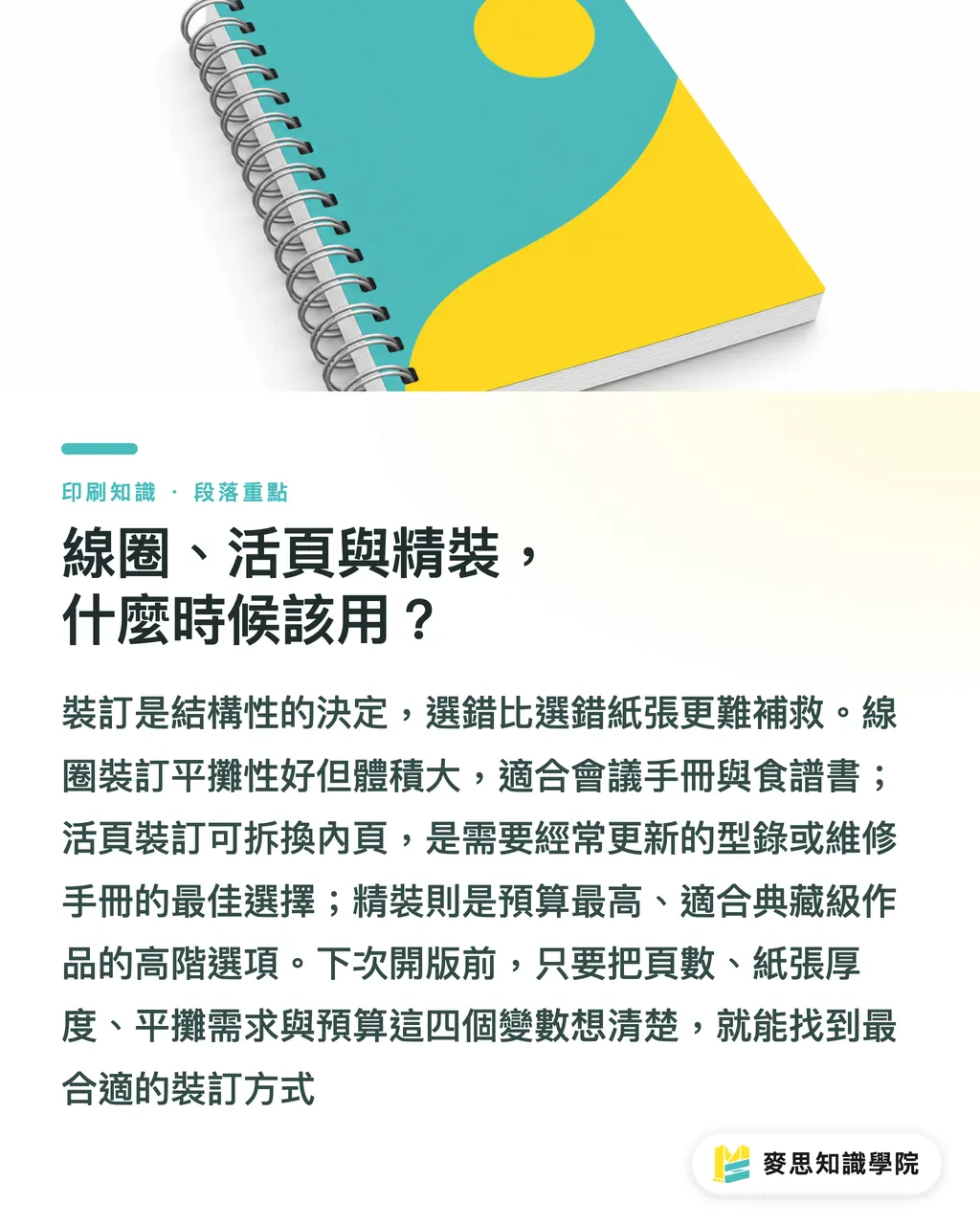
・Wire-O / Spiral binding: Pages are punched and held together with metal or plastic coils. The book lies completely flat and can fold back 360 degrees. It works for conference manuals, training materials, and cookbooks, but metal coils are bulky and raise mailing costs
・Ring Binder: Inner pages can be removed and replaced, and durability is the highest. It works for product catalogs and maintenance manuals that need frequent updates, but the unit price is higher and the visual tone leans more like a reference tool
・Hardcover: A hard board case is added, and the spine can be rounded or square. Paired with sewing or exposed spine methods, it is the most premium option. It works for collectible photo books, annual reports, and brand bible books. The budget is usually 3-5 times that of standard binding
Choosing the wrong binding is harder to rescue than choosing the wrong paper, because binding is a structural problem. Paper can be changed. Changing the binding means remaking the job. Before you open the next layout file, remember this formula: page count + paper thickness + lay-flat requirement + budget. These four variables decide everything
Key takeaways
・When a thick catalog will not lie flat, the culprits are paper, page count, glue amount at the spine, and spread design all going wrong together
・A perfect-bound spine is a hard ridge. The thicker the book, the harder it is to open. That is the nature of the method, not the print shop's fault
・The only advanced methods that can truly lie flat are exposed spine sewn binding, Swiss binding, and sewn + glued binding
・The binding margin must be reserved during the design stage. Fixing it afterward can mean reprinting the entire batch
・For projects above 200 pages with thick paper, binding proofs must use the final paper and final method. Substitutes are not acceptable
Further thinking
In the procurement process of many small and medium-sized businesses in Taiwan, binding is often treated as the "last step." In reality, it needs to enter the conversation from the first finished layout. Companies should move binding decisions forward to the requirement confirmation stage, deciding them together with page count, paper, and budget, instead of waiting until the design is finished and then asking the print shop, "How can this book be bound?" Design studios can also add binding margin reservation, spread breathing zones, and paper grain direction marks to their standard pre-output checklist. These small actions can save clients a large amount of reprint cost and time. For premium print pieces such as brand sample books, annual reports, and product bible books, go straight to a print shop with exposed spine and sewing equipment for evaluation. Do not look only at the quoted price. The maturity of the binding method is what decides the finished product quality
Further reading
FAQ
- Do thick catalogs always need exposed spine binding to lie flat?
- Not necessarily. Exposed spine sewn binding, Swiss binding, and sewn + glued binding can all get close to a fully lay-flat result. The key is that the pages need room to move. They cannot be glued shut against each other
- Can PUR binding make a book lie completely flat?
- PUR binding is softer than traditional perfect binding and can still lie somewhat flat at around 200 pages. But there is still a glue layer at the spine, so it cannot lie as completely flat as exposed spine binding. Spread images may still have slight misalignment
- How much binding margin should be reserved during design?
- The more pages there are, the wider the margin should be. Reserve 8-10mm for books under 128 pages, 10-15mm for 128-200 pages, and 15-20mm for books above 200 pages or hardcover books. For spread images, add an extra 3-5mm breathing zone on the inner side
- Does paper grain direction affect binding?
- Yes. Short-grain paper creates more resistance at the spine and is harder to flatten. Long-grain paper changes stiffness after folding. For one book, it is best to keep the paper grain direction consistent to avoid uneven stress across the pages
- Can binding proofs use cheaper substitute paper?
- Not recommended. Paper thickness, moisture content, and grain direction all affect the final handling feel. A sample made with substitute paper can differ too much from the finished product, making the proof almost meaningless. Proofing paper must match the final production paper
Related articles
The Print × AI weekly
The print and AI know-how designers, brands and enterprises can use before they commit — one email, every week
MINDS Free Tools
Spine width and imposition calculators — skip the manual math, free in your browser.
MINDS Group
Need actual printing or gifting services?
From premium printing to online ordering and festive gifts — the MINDS Group sister brands take it from here.