
Which Material Should You Choose for Laser-Engraved Nameplates?
When clients want to make laser-engraved nameplates, their most common question is which material to choose to avoid a total disaster
Metal is scratch-resistant and conveys prestige; wood features burn marks for a tactile, artisanal feel; acrylic offers clean, polished edges; and leather is perfect for debossing rugged textures. These four are the market staples
For these types of projects, I always recommend applying the 'MINDS (MS, mid-to-high-end fully customized commercial printing) Three-Step Printing Gate': ① Verify the material's heat tolerance limit, ② Check the artwork's line spacing, and ③ Mandate prototyping to observe the surface coating's reaction
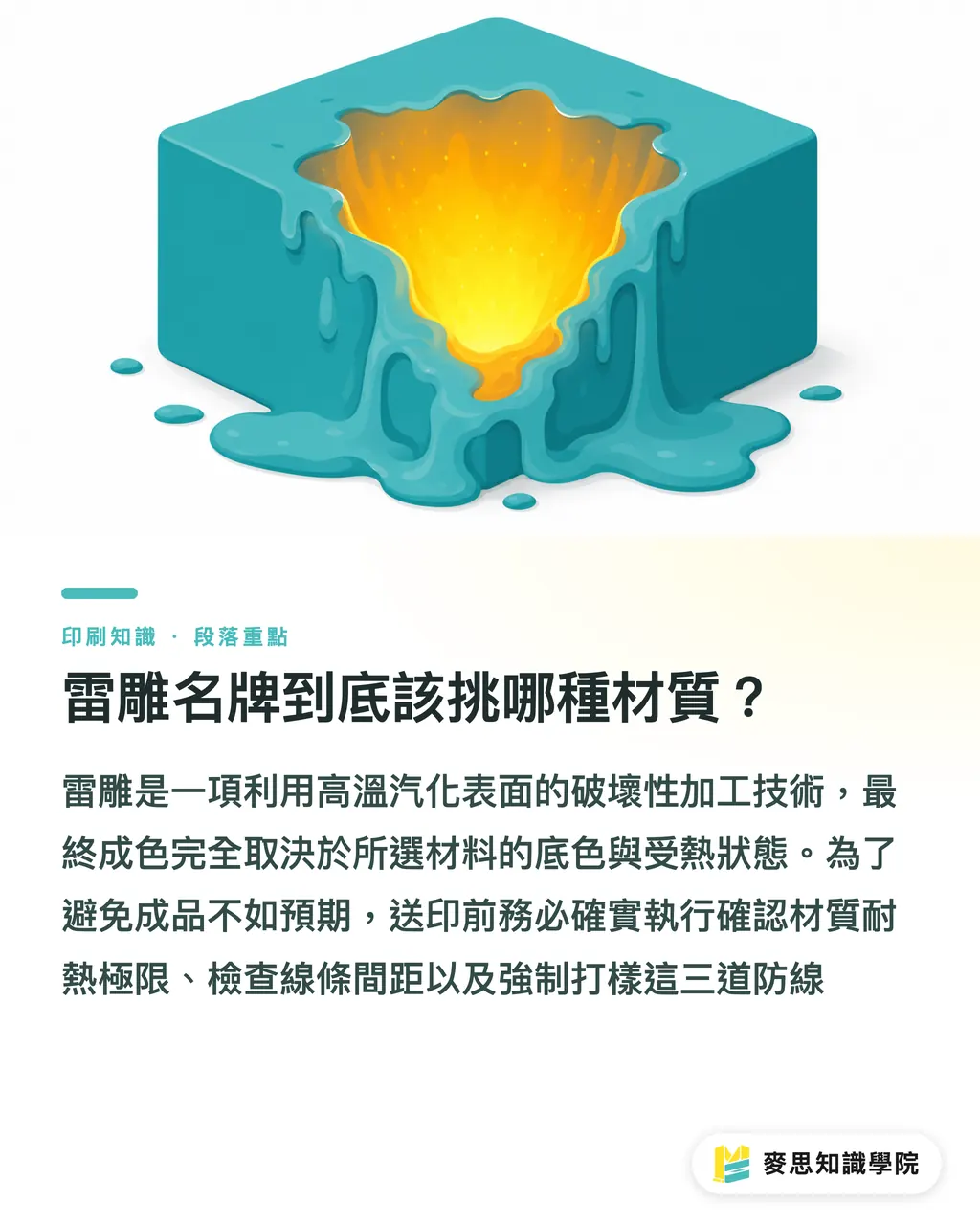
First, let's establish a core concept: Laser Engraving is a destructive processing technique. It uses a high-power laser beam focused on the material's surface, instantly vaporizing or melting it to engrave patterns and text
This is completely different from conventional printing where we overlay CMYK colorants. Laser engraving coloration depends entirely on the substrate's base color and how it reacts to heat
Production Characteristics and Pitfalls of the Four Common Materials
No matter how precise your design looks on screen, if the material can't withstand the laser, it's all for nothing. Let's break down the practical details of these four materials
・Metal: For widely used anodized aluminum sheets or stainless steel, the laser actually burns away the surface paint or anodized layer, ultimately revealing the natural base color of the underlying metal
・Wood: Natural wood grain is both its selling point and its pain point. The alternating densities of soft and hard wood fibers cause the engraving depth to be uneven. While some appreciate the rustic charm of the dark brown charred edges, it becomes a complete disaster if the client demands clean and sharp results
・Acrylic: This is the primary choice for membership cards and acrylic merchandise. However, in industry practice, up to 80% of acrylic laser engraving fails due to white, melted edges because people chose cheap extruded sheets instead of cast sheets
・Leather: Engraving genuine leather produces a strong smell of burnt protein, and carbon residue easily clings to the edges. For synthetic leather (PU), be cautious as high temperatures may melt the surface or even release pungent gases
Why is the Engraving Still Blurred Even with the Correct File Setup?
This is just like the embossing and debossing logic I often explain to designers, if you cross the red line of physical craftsmanship, it will fall apart
・Only accepts single-color vector: Laser engravers only recognize paths, not gradients or pixels. All artwork must be converted to a pure K100 vector file, and all strokes must be outlined
・Line spacing is the lifeline: The laser beam itself has a physical width (usually around 0.1 to 0.2 mm). If two lines are placed too close together, the material in between will be directly burned through due to heat accumulation
・Avoid complex, tiny knock-out text: Chinese characters have high stroke counts, and when scaled down too small for laser engraving, enclosed counter-spaces (such as the central islands in box- or grid-like characters) easily become brittle and fall off because the surrounding area is hollowed out
Why Prototyping and Test Plates Cannot Be Skipped Before Mass Production?
Many purchasers assume that if the first batch turns out well, they can just copy the machine parameters for the next batch. This absolutely does not work on a laser engraving production line
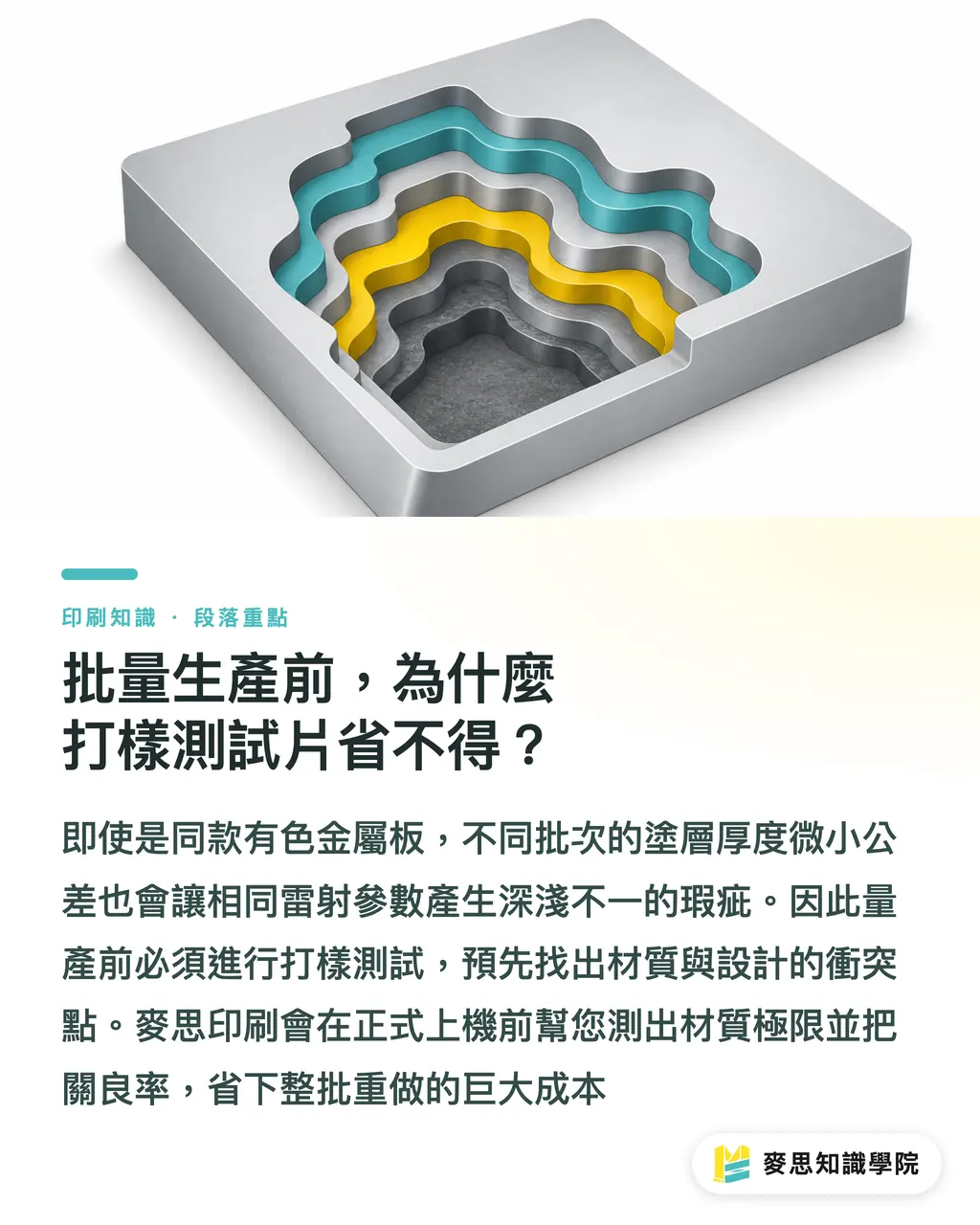
Even if you order the exact same colored metal sheets, there will be tiny tolerances in the surface coating thickness across different batches
Applying the same laser power might beautifully reveal the base color in the previous batch, but in the next batch, it might fail to penetrate the coating or even gouge into the base material
If you need mass production of high-end membership cards or brand nameplates, we recommend contacting the consultant team at MINDS directly
We will identify potential conflicts between material characteristics and the design file first. We even test limits using scrap material before the official run, ensuring high yield rates and saving you from the unnecessary expense of redoing the entire batch due to color variations or uneven depth
Key Takeaways
・Laser engraving is a destructive physical process; the color of the pattern depends on the chemical reaction of the material under heat, so specific color codes cannot be designated like conventional printing
・Files must be submitted as K100 single-color vector files. Gradients and raster images will be rejected, and all fonts must be outlined
・Excessively tight line spacing is more fatal than thin lines; placing lines too close together leads to material overheating and burn-through, blurring details at the bottom
・Changing batches is equivalent to changing materials; tiny tolerances in surface coatings will result in inconsistent engraving depth, making re-prototyping essential before mass production
Further Thoughts
Design laser-engraved nameplates as living objects that evolve over time: wood burn marks grow richer with touch, and metal engraving marks accumulate a natural luster
From a SaaS product or system design perspective, this is like translating the dynamic feedback of a digital interface into the tactile interaction of physical materials
Finding the right manufacturer is not just about getting the design engraved; it's about understanding these physical limitations early on to transform them into brand-exclusive identity features during the design phase
FAQ
- Can laser engraving be specified with gradients or spot colors?
- Absolutely not. The laser engraver only reads paths for physical burning. There is no ink involved; the color is purely the base shade revealed after the material is damaged by high temperatures
- Why was my AI file rejected by the manufacturer?
- The most common reasons are failing to outline fonts or having hidden raster images inside the layers. Laser engraving software cannot recognize pixel-based images; it can only capture pure vector paths
- What should I do if the acrylic edges turn white and opaque after laser engraving?
- This is a physical limitation caused by the material melting under heat. Usually, post-processing flame polishing is required to restore transparency. If clean edges are required, cast acrylic sheets should be specified from the start
Related articles

The Print × AI weekly
The print and AI know-how designers, brands and enterprises can use before they commit — one email, every week
MINDS Free Tools
Spine width and imposition calculators — skip the manual math, free in your browser.
MINDS Group
Need actual printing or gifting services?
From premium printing to online ordering and festive gifts — the MINDS Group sister brands take it from here.